B2B ecommerce involves businesses selling products or services to other businesses online, typically featuring bulk orders, negotiated pricing, and specialized purchasing portals. The best examples—Grainger, Amazon Business, Steelcase—demonstrate what separates functional wholesale sites from ones that actually drive revenue.
This guide breaks down 12 B2B ecommerce examples worth studying, the features that make them work, and the lessons you can apply to your own store today.
What Is B2B Ecommerce
B2B ecommerce involves businesses selling products or services to other businesses online, featuring large bulk orders, negotiated pricing, and specialized purchasing portals. Top examples include Grainger, Amazon Business, and Steelcase, which use features like customer-specific pricing, punch-out catalogs, and high-volume order management to streamline procurement for corporate buyers.
The difference from B2C is significant. When a consumer buys a single item at a fixed price, that’s B2C. When a distributor orders 500 units at a negotiated rate, pays on Net 30 terms, and routes the order through an internal approval workflow, that’s B2B.
- Bulk purchasing: Orders placed in large quantities rather than single units
- Negotiated pricing: Contract-based or customer-specific rates rather than fixed retail prices
- Purchasing portals: Dedicated storefronts or account areas for business buyers
Types of B2B Ecommerce Business Models
Before diving into specific examples, it helps to understand the types of B2B ecommerce and how each operates in practice. The model a company uses shapes everything from pricing structure to buyer experience.
Wholesale and Distribution
Wholesalers and distributors sell products in bulk to retailers, resellers, or other businesses. Minimum order quantities and tiered pricing based on volume are standard here, along with established relationships with repeat buyers.
Manufacturer to Business
Some manufacturers bypass distributors entirely and sell directly to other businesses. This approach gives them more control over margins and customer relationships, though it requires building out sales and fulfillment infrastructure.
B2B Marketplaces
Platforms like Amazon Business and Alibaba host multiple sellers, letting business buyers compare vendors and consolidate purchasing. The marketplace handles transaction infrastructure while giving sellers access to a large buyer base.
Hybrid B2B and B2C
Many brands now operate both wholesale and retail channels from a single storefront. The complexity lies in managing a dual pricing setup—showing different products and payment options depending on whether the visitor is a retail customer or a verified wholesale buyer.
Subscription and Recurring B2B
For consumables and supplies, some businesses offer ongoing contracts or subscription-based purchasing. Office supplies, industrial materials, and any product a buyer replenishes on a regular schedule fit this model.
Benefits of B2B Ecommerce for Wholesale Brands
Why are so many manufacturers and distributors moving B2B operations online? The short answer: efficiency gains that compound over time.
When you give buyers a self-service portal, they place orders without waiting for a sales rep to respond. Order history and saved carts speed up repeat purchasing. Automated pricing rules eliminate the manual quoting mistakes that eat into margins.
- Self-service ordering: Buyers place orders without sales rep involvement
- Faster reorders: Saved carts and order history speed up repeat purchasing
- Reduced operational errors: Automated pricing rules eliminate manual quoting mistakes
- Expanded reach: Serve buyers across regions without physical sales presence
- Lower cost to serve: Digital workflows replace phone, fax, and email orders
What Makes a Great B2B Ecommerce Example
What separates a good B2B ecommerce site from a great one? It’s rarely just the product catalog.
The best B2B sites share a few common traits. They show logged-in buyers their negotiated rates immediately—no hunting through emails or calling a rep. They offer efficient bulk ordering tools like quick order forms or CSV uploads. And they build flexibility into B2B payment options, whether that’s net terms, purchase orders, or quote-to-order workflows.
- Transparent pricing for logged-in buyers: Business customers see their negotiated rates immediately
- Efficient bulk ordering tools: Quick order forms, CSV uploads, or SKU-based entry
- Flexible payment options: Net terms, purchase orders, and quote-to-order workflows
- Seamless procurement integration: Punch-out catalogs or ERP connectivity
- Fast, intuitive UX: B2C-like experience adapted for high-volume purchasing
Key Features of Top B2B Ecommerce Sites
The examples below all share certain B2B capabilities that make them effective for business buyers. Understanding each feature helps you recognize what’s working and what you might apply to your own store.
Customer Group and Contract Pricing
Customer groups let you segment buyers—retailers, distributors, VIP accounts—and assign different price lists to each. Contract pricing takes this further, giving individual accounts their own negotiated rates. Every buyer sees the right price without manual intervention.
Quote to Order and RFQ Workflows
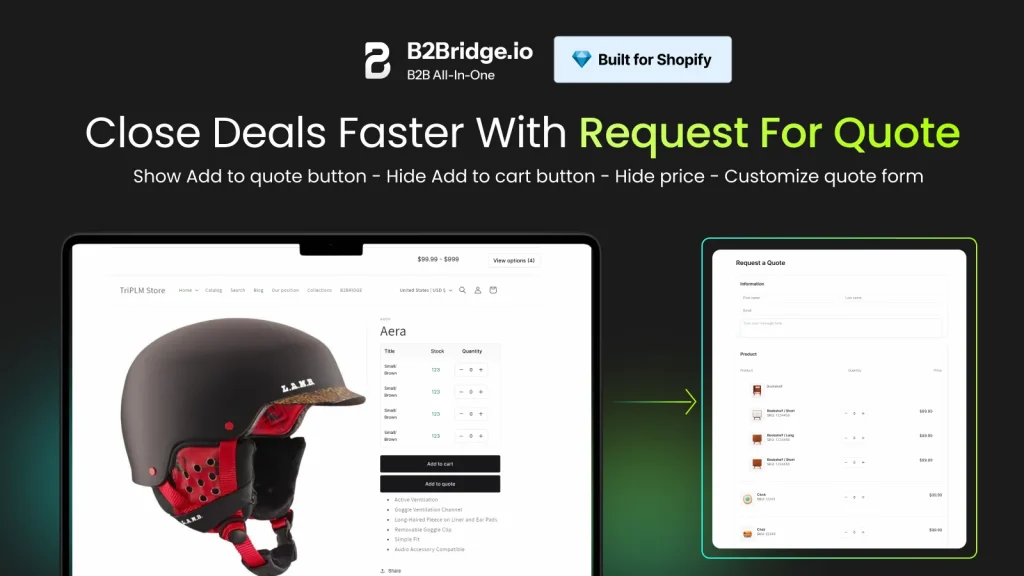
For complex or high-value purchases, buyers often want to negotiate before committing. RFQ (Request for Quote) workflows let them submit quote requests directly from the site. You review, adjust pricing if appropriate, and convert the quote into an order—all without email back-and-forth.
Net Payment Terms and Flexible Checkout
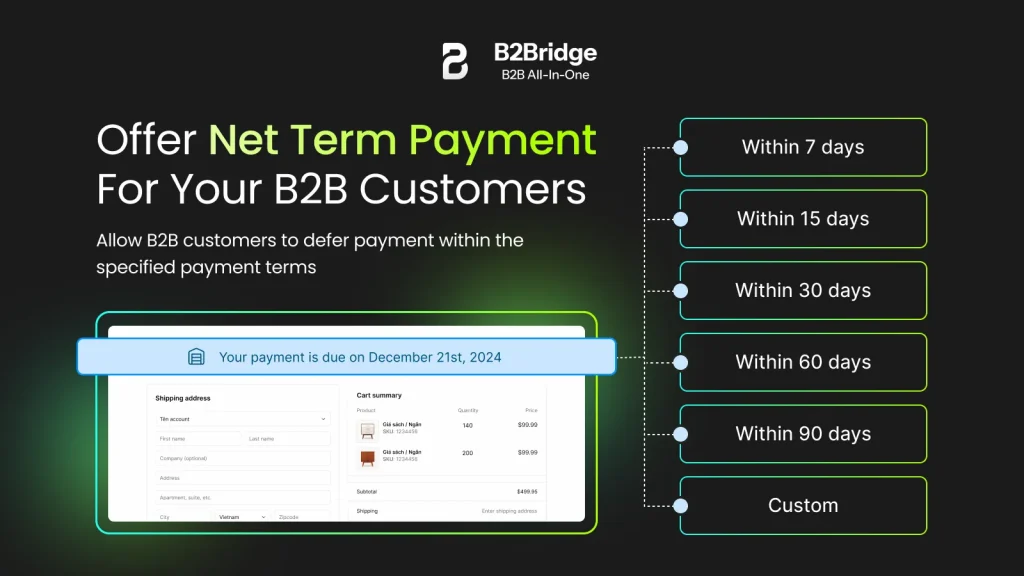
Business buyers expect to pay on terms, not at the moment of checkout. Net 15, Net 30, and Net 60 payment terms let approved customers receive goods now and pay later. Assigning different terms by customer group gives you control over credit risk while meeting buyer expectations.
Gated Catalogs and Wholesale Registration
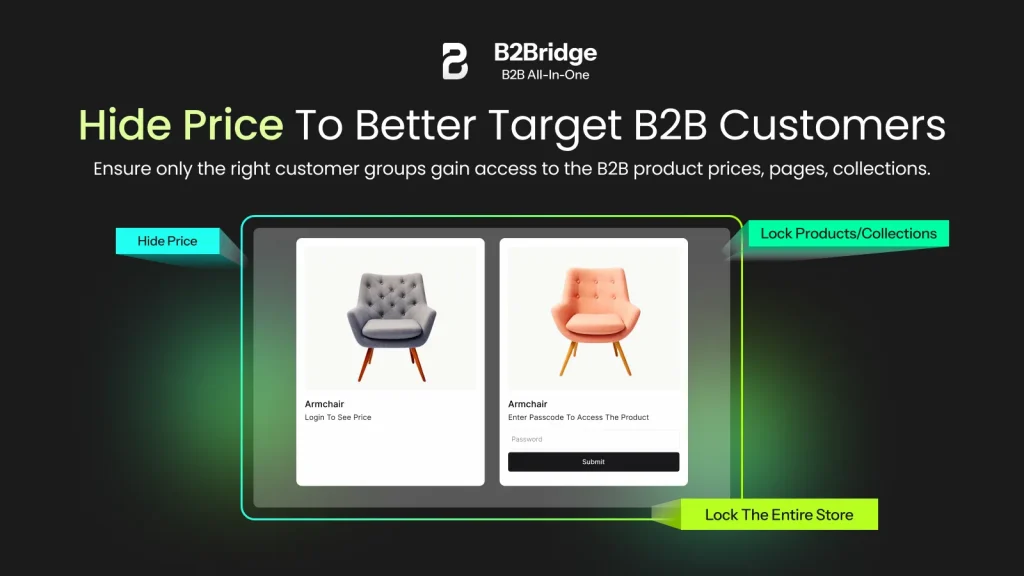
Most B2B sites hide wholesale pricing from retail shoppers and competitors. Registration forms capture business credentials—tax ID, resale certificate, company details—and an approval workflow verifies buyers before granting access to wholesale rates.
Quick Order and Bulk Reorder Tools
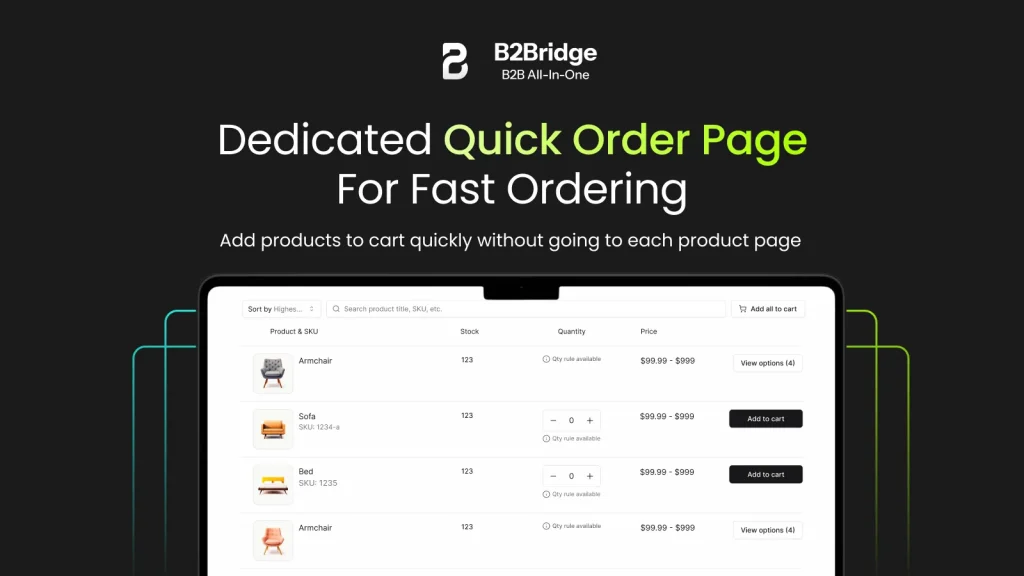
Wholesale buyers often know exactly what they want. Quick order forms let them enter SKUs or product names directly without browsing. Saved carts and one-click reorder from order history reduce friction for repeat purchases.
ERP and CRM Integration
ERP (Enterprise Resource Planning) and CRM (Customer Relationship Management) systems hold your pricing, inventory, and customer data. Syncing with your storefront keeps everything aligned—no manual updates, no conflicting information across systems.
Self Serve Buyer Account Portals
Account dashboards let buyers view order history, download invoices, check payment status, and manage saved addresses. The more buyers can do themselves, the less your team handles routine requests.
12 B2B Ecommerce Examples Worth Studying
Each brand below represents a different industry and approach, but all demonstrate what effective B2B ecommerce looks like in practice.
Grainger
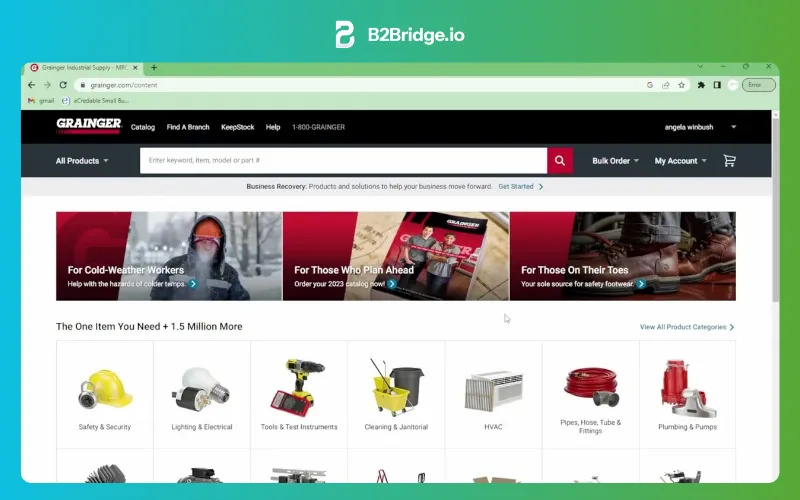
Grainger is the benchmark for industrial B2B ecommerce. With millions of SKUs and real-time inventory visibility, the site handles everything from MRO supplies to safety equipment at massive scale. The search functionality is legendary—buyers find exact specs in seconds.
Standout features: Real-time stock visibility, account-specific pricing, fast reorder from order history, robust filtering by spec
Amazon Business
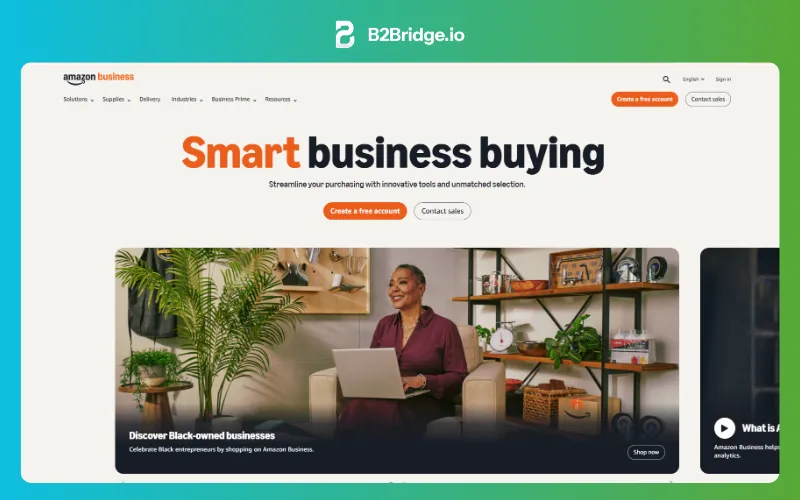
Amazon Business took the familiar consumer experience and layered enterprise-grade tools on top. Net payment terms, multi-user accounts, spend analytics, and tax-exempt purchasing have made it a go-to for procurement teams of every size.
Standout features: Net 30 terms, quantity discounts, approval workflows, business Prime pricing, consolidated invoicing
Uline
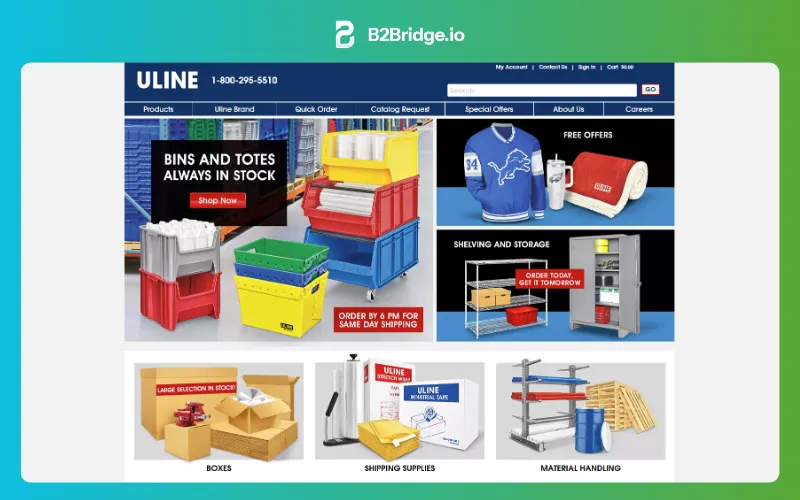
Uline’s site excels at speed. Tiered pricing visuals make quantity breaks immediately obvious, nudging buyers toward larger orders without sales pressure. The mobile reorder experience is particularly strong—repeat customers can restock in under a minute.
Standout features: Visual tiered pricing tables, one-click reorder, same-day shipping options, mobile-optimized catalog
McMaster-Carr
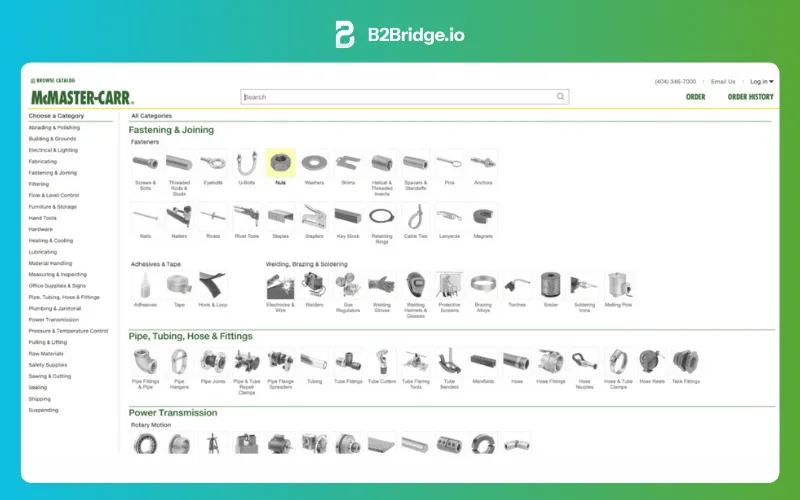
McMaster-Carr is a masterclass in specification-driven search. Engineers and procurement specialists love it because they can search by technical dimension, material grade, or tolerance spec and get exact results instantly. The catalog has over 600,000 products, all with detailed technical documentation.
Standout features: Engineering-grade product specs, technical drawing downloads, CAD file availability, near-perfect search relevance
Fastenal
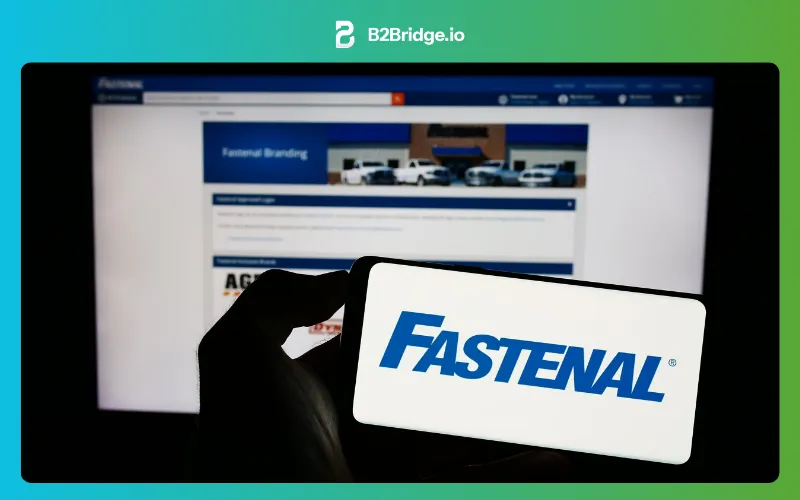
What makes Fastenal unique is the hybrid model—online ordering synced with local branch inventory. This works particularly well for SMBs that want items quickly and can’t wait for shipping. Role-based visibility means different customer types see pricing and products relevant to them.
Standout features: Local inventory sync, click-and-collect, role-based catalog access, dedicated account rep tools
Berlin Packaging
Berlin Packaging serves both B2B and B2C customers from a single storefront. Custom quoting capabilities and customer-specific pricing demonstrate how a hybrid approach can work without fragmenting operations.
Standout features: Custom quoting, customer-specific pricing, unified B2B/B2C storefront

Steelcase
Steelcase implemented punch-out catalog integration for its largest B2B clients. Corporate buyers initiate purchases within their own internal procurement systems while pulling product and pricing data directly from Steelcase.
Standout features: Punch-out catalog integration, corporate procurement compatibility, enterprise account management

Sunbelt Rentals
Sunbelt Rentals built a self-service portal for managing equipment rentals, quotes, and account information. Buyers handle routine tasks without phone calls, freeing up reps for higher-value conversations.
Standout features: Self-service rental management, online quoting, account dashboard

ASUS
ASUS runs a unified B2B reseller channel with role-based pricing and streamlined distributor ordering. The approach shows how electronics manufacturers can serve different buyer tiers from one platform.
Standout features: Role-based pricing, distributor ordering workflows, reseller portal

HP
HP’s partner portal offers tiered pricing, marketing resources, and integration with reseller systems. It’s a strong example of how technology companies support channel partners through digital tools.
Standout features: Tiered partner pricing, marketing resource library, reseller system integration

Clarion Safety Systems
Clarion Safety Systems built their B2B storefront around custom orders and quote workflows. Customer group pricing ensures different buyer segments see appropriate rates.
Standout features: Custom order capabilities, quote workflows, customer group pricing

FoodServiceDirect
FoodServiceDirect manages a large catalog with headless commerce architecture and B2B-optimized ordering. The approach demonstrates how foodservice distributors can handle complex inventory at scale.
Standout features: Headless commerce architecture, large catalog management, B2B ordering optimization

Common Patterns Across the Best B2B Ecommerce Sites
Looking across the examples above, certain patterns emerge. The recurring features reflect what business buyers actually expect.
- Personalized pricing visible on login: Every top site shows customer-specific rates immediately after authentication
- Streamlined reordering: Saved carts, order history, and one-click reorder reduce friction for repeat buyers
- Self-service over sales-assisted: Best sites minimize reliance on sales reps for routine orders
- Procurement system compatibility: Enterprise buyers expect punch-out or ERP integration
- B2C-quality UX for B2B workflows: Clean design, fast search, and mobile responsiveness
Business buyers want the convenience of consumer ecommerce with the flexibility their purchasing requirements demand.
Top B2B Ecommerce Platforms Powering These Brands
The platform you choose shapes what’s possible. Here’s how the major options compare:
| Platform | Best For | Key B2B Capabilities |
|---|---|---|
| Shopify | Growing brands, hybrid B2B/B2C | Customer groups, price lists, wholesale channels, extensible via apps |
| BigCommerce | Mid-market B2B | Customer group pricing, quote management, corporate account hierarchies |
| Adobe Commerce | High-volume catalogs | Shared catalogs, company accounts, requisition lists |
| Salesforce Commerce Cloud | Enterprise with CRM integration | AI personalization, CRM-native profiles, complex approval workflows |
| OroCommerce | Purpose-built B2B | Native RFQ, corporate hierarchies, flexible pricing rules |
| SAP Commerce Cloud | SAP ERP users | Deep ERP integration, contract management, global compliance |
Shopify
Shopify’s native B2B capabilities include company account, price lists (via catalogs), and wholesale channels. Apps like B2Bridge extend functionality—adding net payment terms, price hiding, and customer-specific catalogs—without requiring Shopify Plus or a separate B2B store.

BigCommerce
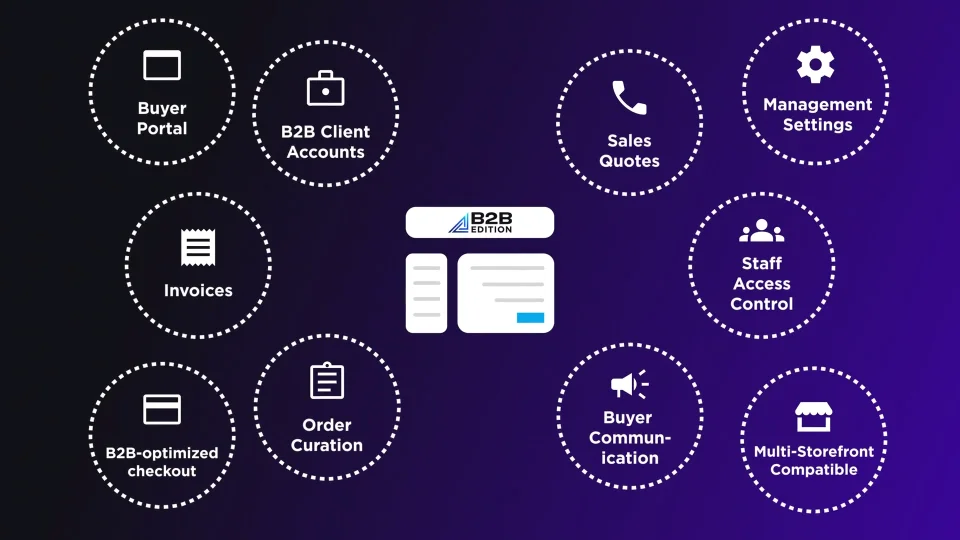
BigCommerce B2B Edition offers customer group pricing, quote management, and corporate account hierarchies out of the box. The composable architecture allows customization without massive development overhead.
Adobe Commerce
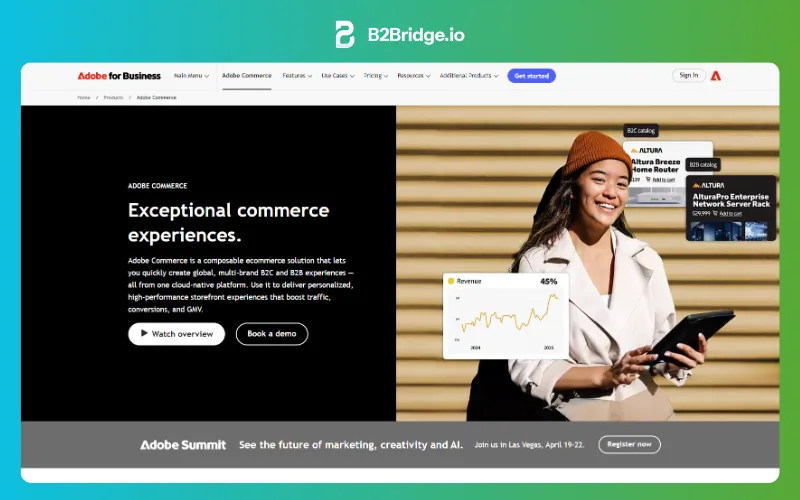
Adobe Commerce (formerly Magento) pairs powerful product information management with B2B-specific features. For brands with thousands of complex SKUs and sophisticated pricing rules, it remains one of the most flexible options.
Salesforce Commerce Cloud
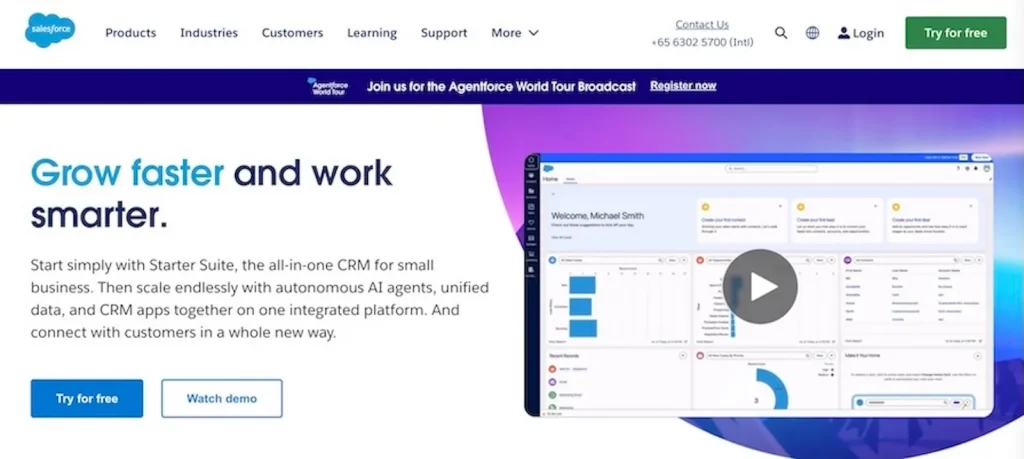
Salesforce Commerce Cloud brings AI-powered personalization to enterprise B2B portals. Deep CRM integration is the biggest differentiator—buyer profiles and purchase history inform every interaction.
OroCommerce
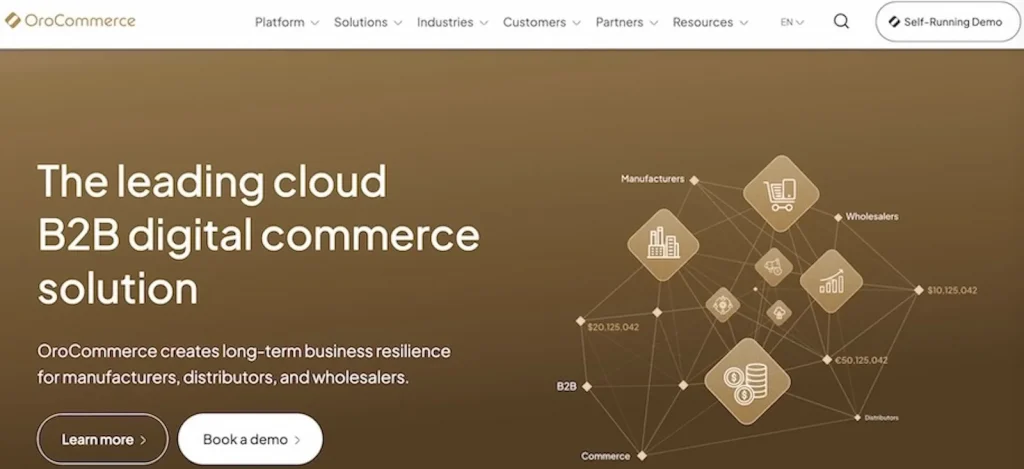
OroCommerce was purpose-built for B2B, which shows in native quoting and negotiation workflows. Buyers request quotes, reps respond with custom pricing, and the whole process lives within the platform.
SAP Commerce Cloud
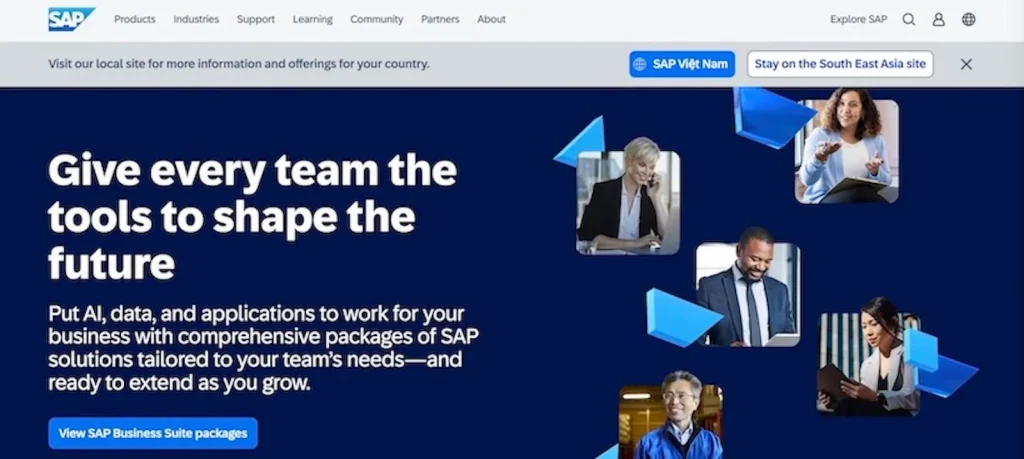
For enterprises already running SAP ERP, SAP Commerce Cloud is the natural choice. Pricing, inventory, contracts, and customer data stay in sync with backend systems.
Lessons You Can Apply to Your Own B2B Store
The patterns from the examples above translate into a concrete B2B ecommerce strategy. Here’s how to apply what the best B2B sites are doing.
Step 1. Define Customer Groups and Contract Pricing
Segment your buyers—retailers, distributors, VIP accounts—and create price lists for each. Map your existing pricing tiers to your ecommerce platform so every buyer sees the right rate automatically.
Step 2. Gate Wholesale Pricing With Registration and Approval
Create a registration form that captures business credentials like tax ID and resale certificate. Set up an approval workflow before granting wholesale access—this protects your margins and creates an incentive to register.
Step 3. Build Quote to Order and Net Terms Into Checkout
Enable RFQ for large or custom orders. Assign net payment terms by customer group so approved buyers can pay on terms while new accounts pay upfront.
Step 4. Connect Your ERP and CRM to Your Storefront
Sync pricing, inventory, customers, and orders between systems. Prioritize integrations that eliminate manual data entry—the sites that struggle most are those that bolt on integrations later.
Step 5. Optimize for Reorders With Quick Order Tools
Add quick order forms, saved cart functionality, and one-click reorder from order history. For repeat buyers, speed matters more than discovery.
Step 6. Unify B2B and B2C in One Store
Run both channels from a single storefront by showing different prices and experiences based on customer login status. This reduces operational complexity while serving both audiences.
How B2Bridge Powers Modern B2B Ecommerce on Shopify
Every feature highlighted in the examples above—customer-specific pricing, net terms, gated access, quick ordering—is available to Shopify merchants through B2Bridge. You don’t require Shopify Plus or a separate B2B store to compete with enterprise-grade sites.
B2Bridge embeds wholesale operations directly into your existing Shopify setup:
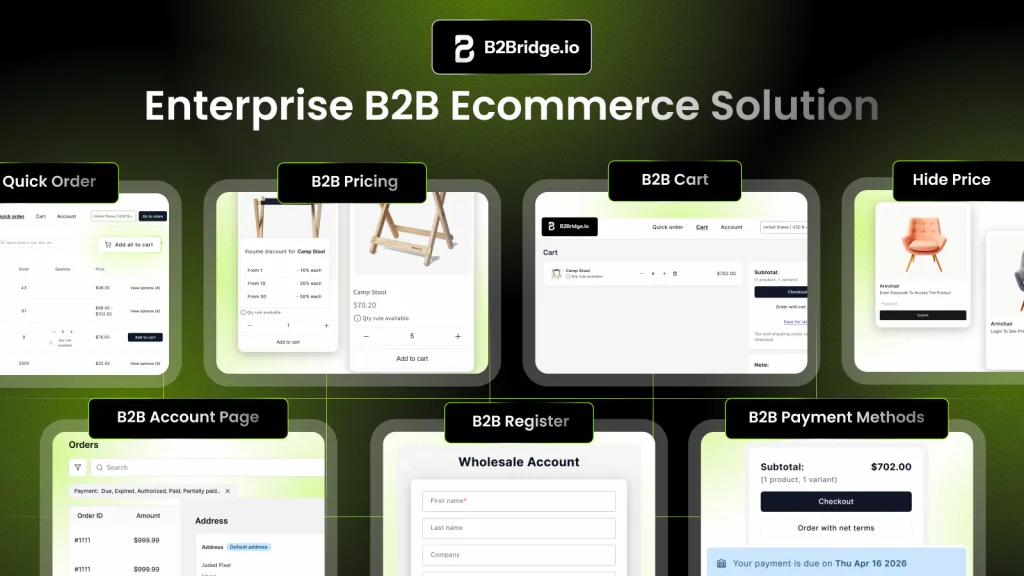
- B2B Pricing Engine: Customer group pricing, contract price lists, volume tiers, and hidden wholesale rates
- ERP and CRM Integration: Sync with NetSuite, Zoho, Odoo, and custom systems via enterprise API
- B2B Lock: Gate products, collections, and prices by customer group or login status
- B2B Payment: Net terms (Net 15/30/60) and RFQ workflows built into Shopify checkout
- B2B Registration: Custom wholesale signup forms with approval workflows and automatic customer tagging
- Unified B2B and B2C: Run both channels from one Shopify store
If you want to run B2B like the brands on this list—without the enterprise budget—B2Bridge is where to start.
Frequently Asked Questions About B2B Ecommerce Examples
What is the difference between B2B and B2C ecommerce?
B2B ecommerce involves businesses selling to other businesses with features like bulk pricing, net payment terms, and customer-specific rates. B2C ecommerce involves businesses selling directly to individual consumers at fixed retail prices. The buying process, order sizes, and payment expectations differ significantly between the two.
Is Amazon a B2B or B2C company?
Amazon operates both models. Amazon.com serves consumers (B2C) while Amazon Business is a dedicated B2B marketplace offering bulk pricing, purchasing approvals, and tax-exempt purchasing for business accounts.
Can you run B2B ecommerce on Shopify without Shopify Plus?
Yes. Apps like B2Bridge enable full B2B functionality—including customer group pricing, net terms, wholesale registration, and gated catalogs—on standard Shopify plans without requiring an upgrade to Shopify Plus.
How do you start a B2B ecommerce business?
Start by identifying your target business buyers and understanding their purchasing requirements. Set up customer groups with appropriate pricing tiers, create a registration and approval workflow for wholesale access, and choose a B2B ecommerce platform that supports features like net terms and bulk ordering.

Hi, I’m Ha My Phan – an ever-curious digital marketer crafting growth strategies for Shopify apps since 2018. I blend language, logic, and user insight to make things convert. Strategy is my second nature. Learning is my habit. And building things that actually work for people? That’s my favorite kind of win.