Choosing between Shopify and BigCommerce for B2B comes down to a fundamental tradeoff. Shopify offers a larger app ecosystem and easier hybrid B2B+B2C operations. BigCommerce packs more native wholesale features into the box. Both platforms can power serious wholesale operations, but they take different paths to get there.
This guide breaks down the core differences across pricing logic, payment terms, buyer experience, ERP integration, and total cost of ownership. Use it to match the right platform to your wholesale business.
>> You may also like: 20 Shopify B2B Examples: Real Wholesale Stores and What They Get Right
Shopify vs BigCommerce B2B: Feature Comparison at a Glance
Shopify works best for businesses that want ease of use, a massive app ecosystem, and the ability to run wholesale and retail from one store. BigCommerce delivers more built-in B2B features without relying on apps, though it typically requires separate storefronts for B2B and B2C operations.
The short version: Shopify offers better UI and faster time-to-market. BigCommerce provides more native functionality out of the box.
| Criteria | Shopify B2B | BigCommerce B2B |
|---|---|---|
| Plan requirement | Plus for native B2B, or apps like B2Bridge on any plan | Enterprise for B2B Edition |
| Native B2B features | Company accounts, price lists, payment terms | Invoice portal, quote management, buyer roles |
| Hybrid B2C + B2B | Unified storefront | Separate storefronts typical |
| App ecosystem | Largest marketplace | Smaller but capable |
| ERP/CRM integration | Via apps and APIs | Native and API-based |
A quick definition: a B2B ecommerce platform is software that lets businesses sell to other businesses online. It includes features like account-based pricing, net payment terms, and bulk ordering that consumer stores don’t offer.
What Is Shopify B2B
Shopify B2B is built natively into the platform — available across Basic, Grow, Advanced, and Plus plans. The features you get depend on your plan.
- All plans (Basic, Grow, Advanced): Company profiles, locations, up to 3 B2B market catalogs, quantity rules & price breaks, net terms, vaulted credit cards, ACH (US only), draft orders, PO numbers, easy reorders, Trade theme, quick order lists, and Shopify Flow automations.
- Shopify Plus adds: Unlimited catalogs, direct catalog assignment to individual companies/locations (customer-specific pricing), deposit requirements, partial payments, payment requests per fulfillment, and contextual storefront & checkout via Markets.
Apps like B2Bridge complement native B2B — particularly for workflows not yet covered natively on non-Plus plans — but are not required to access B2B functionality on Shopify

What Is BigCommerce B2B
BigCommerce positions its B2B Edition as a dedicated wholesale layer available on Enterprise plans. The platform emphasizes having more built-in B2B features without requiring apps, though implementation timelines tend to run longer.
- B2B Edition: Invoice portal, corporate account management, shared shopping lists, and buyer roles
- Buyer portal: A dedicated interface for wholesale customers, often separate from the retail storefront
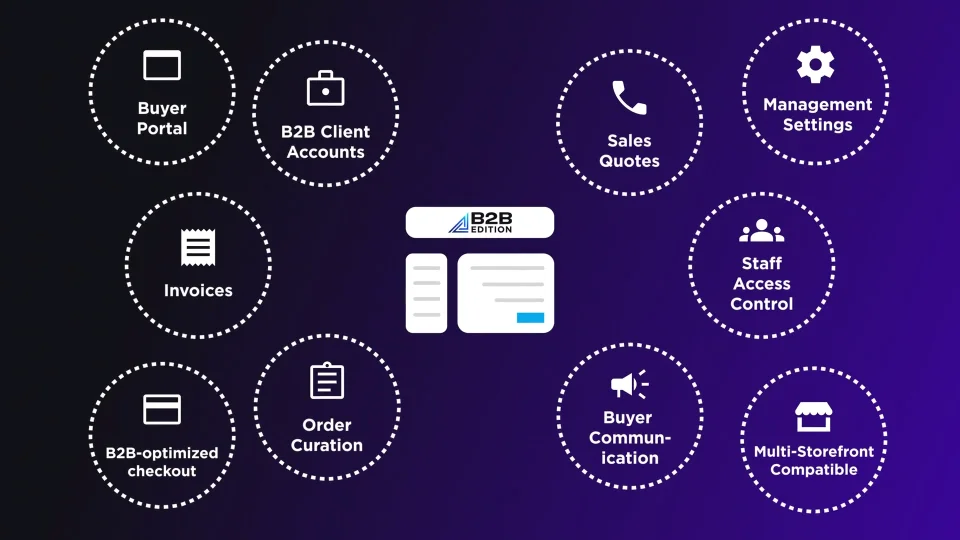
Native B2B Features Compared
Both platforms offer B2B-specific capabilities, but they approach the problem differently. BigCommerce builds more features natively. Shopify’s app ecosystem, including B2Bridge, can match or exceed those capabilities with greater flexibility.
Customer Accounts and Company Hierarchies
Shopify Plus offers company profiles where multiple buyers operate under a single parent account with different permissions. BigCommerce provides corporate accounts with role-based access controls.
A company hierarchy means a parent company with multiple buyers who have varying levels of purchasing authority. Think of a distributor where the purchasing manager can approve orders up to $10,000, but anything larger requires the CFO’s sign-off.
For merchants not on Plus, B2Bridge enables similar customer group structures with tag-based segmentation and approval workflows.
Price Lists and Customer Group Pricing
Price lists are custom catalogs with specific pricing assigned to particular customer groups. You might have Gold, Silver, and Bronze tiers, or separate rates for distributors versus retailers.
Shopify Plus includes native price lists (called catalogs). Non-Plus merchants can achieve the same result with B2Bridge. It supports customer-specific pricing, volume discounts, contract rates, and fixed or percentage discounts at the variant level.
BigCommerce offers custom price lists per account as part of its B2B Edition.
Quotes, Net Terms, and RFQ Workflows
Net terms are payment arrangements like Net 30 or Net 60. The buyer pays within 30 or 60 days of invoicing rather than at checkout. RFQ stands for Request for Quote, a workflow where buyers submit pricing inquiries for large or custom orders.
BigCommerce has native invoice management and payment-on-account features. Shopify relies on Plus features or apps for net terms. B2Bridge offers both net terms (Net 15/30/60) and RFQ workflows on any Shopify plan, converting quote requests directly into draft orders.
Wholesale Registration and Gated Access
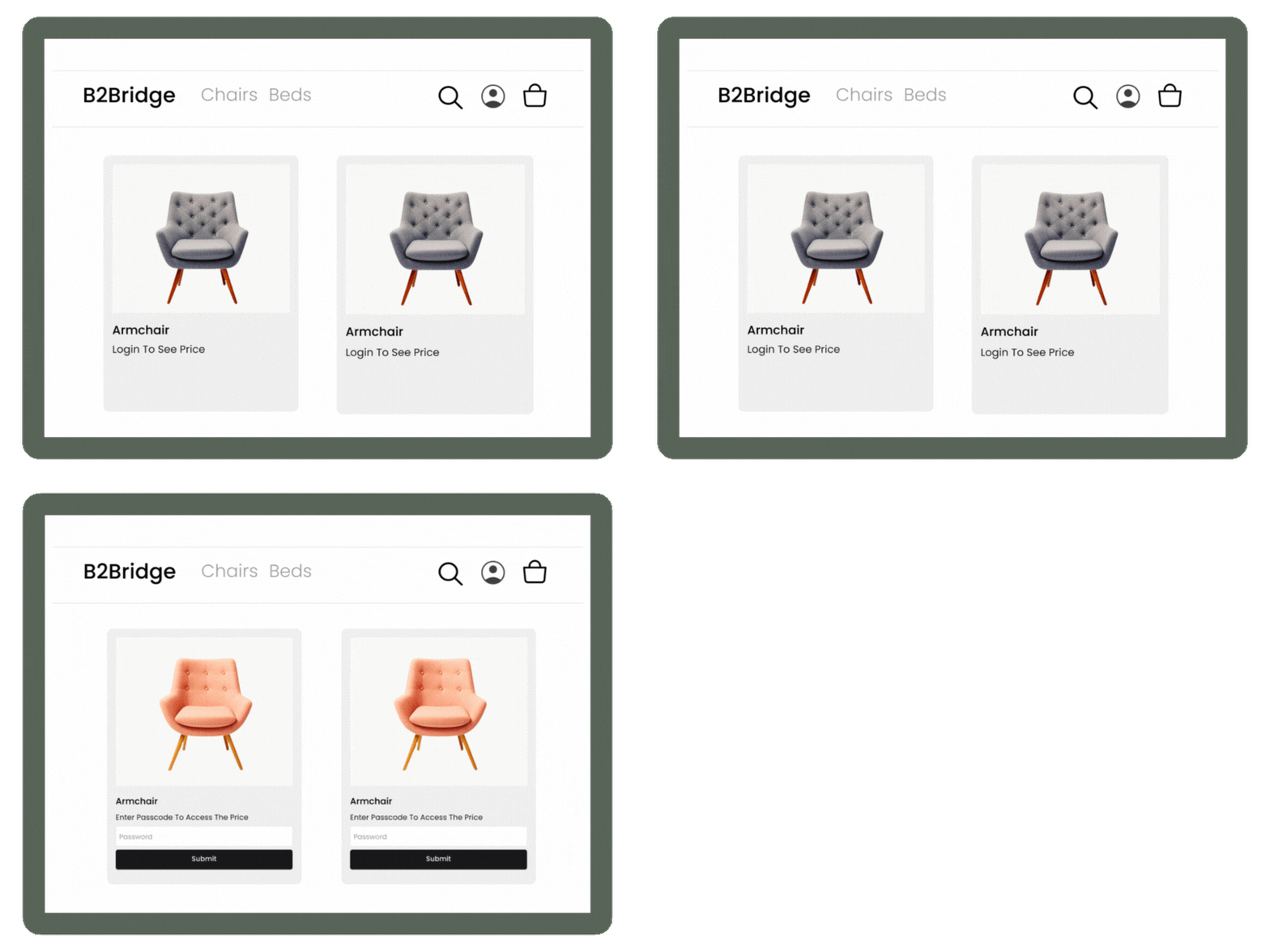
Gated access means hiding wholesale prices or products from retail visitors until they’re verified as B2B buyers. Both platforms support gating, though implementation differs.
BigCommerce handles gating through its B2B Edition. On Shopify, B2Bridge’s B2B Lock and Registration features let you password-protect products and hide prices. Custom registration forms capture business credentials before granting wholesale access.
B2B Pricing Engine and Catalog Logic
Complex pricing is where B2B operations succeed or fail. According to McKinsey’s B2B Pulse Survey, 73% of B2B buyers are now comfortable spending $50,000+ in a single online transaction, so your wholesale buyers expect pricing that reflects their relationship with you, not a one-size-fits-all number.
The main types of B2B pricing logic include:
- Volume/tiered pricing: Price decreases as quantity increases
- Customer-specific pricing: Unique prices per buyer or account
- Contract pricing: Negotiated rates for specific customers
- Quantity rules: Minimum order quantities, case packs, and increments
BigCommerce handles pricing complexity through its B2B Edition with custom price lists. Shopify Plus offers native price lists, though complex rules often require apps. B2Bridge’s pricing engine supports all of the scenarios listed above, including variant-level pricing and automatic discount application, on any Shopify plan.

B2B Payment Options, Net Terms, and RFQ
B2B buyers rarely pay at checkout the way consumers do. Bank transfers command ~41% of B2B payments, with procurement teams expecting to pay on terms, and large orders often requiring negotiation before purchase.
- Shopify: Net terms available via Plus or apps; RFQ requires apps like B2Bridge
- BigCommerce: Native invoice portal and payment-on-account features
B2Bridge lets you assign different payment methods and net terms to specific customer groups. Your VIP distributors might get Net 60, while new wholesale accounts pay on Net 15. RFQ can be enabled only for approved groups, and quote requests convert directly into Shopify draft orders.

B2B Buyer Experience and Storefront UX
The way wholesale buyers purchase differs fundamentally from retail. B2B customers are reordering known products in bulk, not browsing for inspiration.
Quick Order and Bulk Ordering
Quick order is a streamlined interface that lets buyers add multiple SKUs rapidly without browsing through product pages. When your customer is ordering 50 different variants in a single session, quick order becomes essential.
BigCommerce offers quick order functionality in its B2B Edition. On Shopify, B2Bridge provides a quick order portal optimized for variant-heavy purchases and CSV bulk uploads.
Reorders and Saved Carts
B2B buyers frequently reorder the same products week after week. Both platforms support order history access, though the depth of reorder functionality varies.
B2Bridge adds saved carts and one-click reorder capabilities, reducing the friction that causes wholesale customers to pick up the phone instead of completing orders online.

B2B Cart and Checkout
The cart experience for B2B differs from retail. Buyers expect to see their negotiated pricing, net terms, and quantity validation before checkout.
B2Bridge replaces the default Shopify cart for logged-in B2B buyers. The dedicated interface surfaces B2B prices, displays net terms, and enforces quantity rules automatically.
Hybrid B2B and B2C on One Store
Running wholesale and retail from a single storefront means one inventory, one admin, and lower operational cost. Shopify pulls ahead significantly here.
BigCommerce typically requires separate storefronts for B2B and B2C operations. Shopify, especially with apps like B2Bridge, excels at unified stores. Retail visitors see standard pricing while logged-in wholesale buyers see negotiated rates, gated products, and B2B checkout options.
- Single storefront benefits: One inventory, one admin, lower operational cost, unified analytics
- Separate storefront drawbacks: Duplicate product management, split reporting, higher maintenance
ERP and CRM Integration Capabilities
ERP (Enterprise Resource Planning) and CRM (Customer Relationship Management) systems are the backbone of wholesale operations. Integration keeps pricing, customers, and orders synced across your entire tech stack.
Both platforms offer APIs for integration. Shopify’s ecosystem has more pre-built connectors, while BigCommerce emphasizes native integration capabilities.
B2Bridge provides deep integrations with NetSuite, Zoho, Odoo, and custom ERPs. You can manage price lists and customer groups directly in your ERP while keeping Shopify in sync automatically.
Pricing and Total Cost of Ownership
Total cost of ownership includes base platform fees plus apps, development, and ongoing maintenance. The sticker price rarely tells the full story.
| Cost Factor | Shopify | BigCommerce |
|---|---|---|
| B2B-ready plan | Plus for native B2B | Enterprise for B2B Edition |
| Transaction fees | Waived on Shopify Payments | No transaction fees |
| App costs | Additional for B2B apps | Fewer apps typically needed |
| Development | Lower for basic setups | Moderate with more native features |
BigCommerce avoids transaction fees but enforces annual revenue caps on lower plans. Shopify Plus starts higher but often delivers lower total cost through faster implementation and higher conversion rates.
Ease of Use and Time to Launch
Shopify is widely considered more user-friendly, with a superior drag-and-drop editor and intuitive admin interface. With millennials comprising 73% of B2B buyers, consumer-grade UX is a baseline expectation. BigCommerce offers deeper built-in customization but requires more technical comfort.
Time to launch depends on complexity. Shopify B2B stores can go live in days to weeks with turnkey apps like B2Bridge. BigCommerce implementations typically take longer due to more configuration requirements.
Scalability for Enterprise Wholesale
Both platforms serve enterprise merchants, though they scale differently. Analysts have examined which platform fits mid-market and enterprise retailers better. BigCommerce handles large catalogs and complex product configurations well out of the box.
Shopify scales through its infrastructure and app ecosystem.
For manufacturers and distributors with complex pricing logic and ERP dependencies, the choice is clear. Prefer native features? Choose BigCommerce.
Prefer ecosystem flexibility? Choose Shopify with apps like B2Bridge.
International and Multi-Currency Selling
Wholesale businesses often sell across borders, which means multi-currency pricing and localized experiences matter.
Shopify Markets provides robust international selling capabilities. BigCommerce offers multi-storefront options for different regions. B2Bridge supports multi-currency pricing and tax-exempt logic for global wholesale operations within Shopify.
App Ecosystem and Extensibility
Shopify’s app marketplace is significantly larger than BigCommerce’s, and the difference matters for B2B. Learn more about how each ecosystem compares for extensibility. When you encounter a feature gap, you’re more likely to find a solution on Shopify.
BigCommerce’s approach of building more features natively means fewer apps are needed, but it also means less flexibility when your requirements don’t match their assumptions.
Migrating Between Shopify and BigCommerce
If you’re considering a platform switch, migration involves data export/import for products, customers, and orders, plus theme rebuilding and app replacement. A detailed migration and comparison guide can help you plan the process. Both platforms offer migration tools, though the process typically takes weeks to months depending on catalog size and customization depth.
Shopify vs BigCommerce B2B: Pros and Cons
Shopify B2B Strengths and Limitations
- Strengths: Largest app ecosystem, unified B2B+B2C capability, easier to use, faster time to launch, strong mobile experience
- Limitations: Native B2B requires Plus; complex pricing and workflows depend on apps like B2Bridge
BigCommerce B2B Strengths and Limitations
- Strengths: Native B2B Edition features, no transaction fees, built-in invoice portal, strong for complex catalogs
- Limitations: Smaller app marketplace, typically requires separate B2B storefront, steeper learning curve
How to Choose: Shopify vs BigCommerce B2B
1. Map Your Pricing and Catalog Complexity
Assess how complex your wholesale pricing actually is. If you’re managing customer-specific pricing, volume tiers, contract rates, and quantity rules, confirm that your chosen platform or app stack supports that complexity without workarounds.
2. Audit Your ERP and CRM Stack
Identify which systems require integration. Confirm that connectors or API support exist for your existing tools before committing to a platform.
3. Define Your B2B Buyer Workflows
Map how your buyers actually purchase. Consider RFQ requirements, payment terms expectations, reorder frequency, and self-service needs. The platform that matches your buyers’ expectations will drive higher conversion.
4. Project Your Total Cost at Scale
Calculate the full cost including platform fees, apps, development, and ongoing maintenance as your business grows. A lower starting price can become expensive at scale if you’re paying per-transaction fees or hitting revenue caps.
Why Shopify B2B Wins for Most Wholesale Operations
For most manufacturers, distributors, and wholesalers, Shopify’s combination of ease of use, ecosystem depth, and hybrid B2B+B2C capability makes it the stronger choice. The app ecosystem fills any native feature gaps, and solutions like B2Bridge bring enterprise B2B capabilities to any Shopify plan without requiring Plus.
B2Bridge enables customer-specific pricing, net terms, RFQ workflows, gated access, and wholesale registration on standard Shopify plans. Deep ERP/CRM integrations keep your systems aligned, and the unified storefront approach means you’re not doubling operational work across separate platforms.
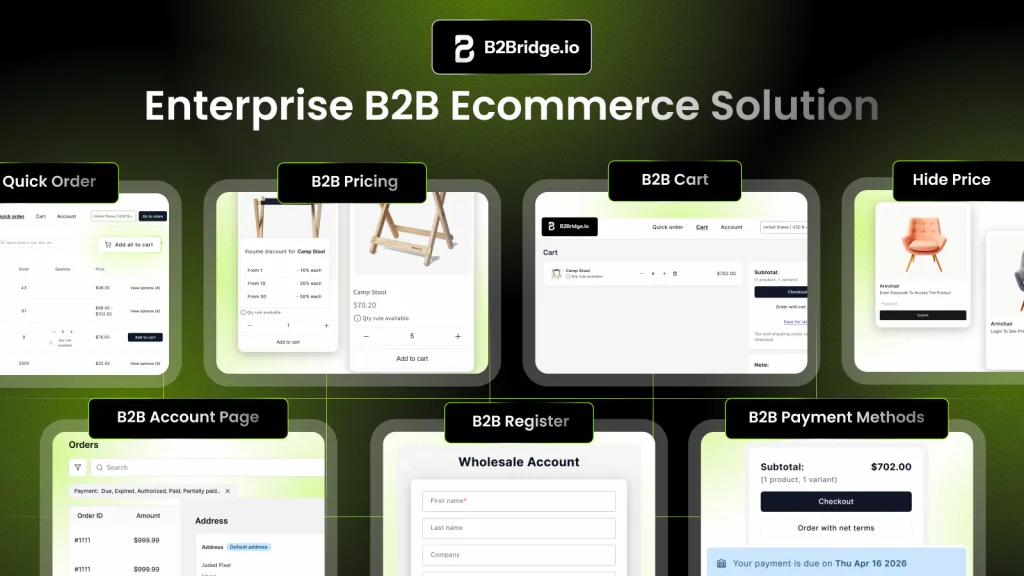
Book A Demo to see how B2Bridge brings enterprise B2B capabilities to your Shopify store.
Frequently Asked Questions about Shopify B2B vs BigCommerce B2B
Do you need Shopify Plus to run B2B on Shopify?
No. You can run full B2B operations on any Shopify plan using apps like B2Bridge. It provides enterprise-grade pricing, net terms, gated access, and wholesale registration without requiring Plus.
Can BigCommerce B2B Edition replace a custom wholesale portal?
BigCommerce B2B Edition offers robust native features like invoice management and buyer roles. However, complex pricing logic or deep ERP integrations may still require customization or third-party solutions.
Which platform is better for manufacturers and distributors?
Shopify typically works better for manufacturers and distributors who want a unified B2B+B2C store and access to the largest app ecosystem. BigCommerce may suit those who prefer more native B2B features without relying on apps.
Shopify vs BigCommerce B2B: Launch Timeline
Shopify B2B stores can launch in days to weeks depending on complexity, especially with turnkey apps like B2Bridge. BigCommerce implementations typically take longer due to more configuration requirements.
Can you run wholesale and retail on the same Shopify store?
Yes. Shopify excels at hybrid B2B+B2C operations on a single storefront. Apps like B2Bridge enable separate pricing, gated access, and wholesale-only features for logged-in B2B buyers while retail customers see standard pricing.

As a Product Marketing Executive at B2Bridge, I focus on the Enterprise B2B Ecommerce domain. I leverage my understanding of product and user psychology to deliver customer-centric content that addresses business challenges and fuels growth.