Choosing between Shopify and SAP Commerce Cloud often comes down to a single question: do you need deep SAP ecosystem integration, or do you need to launch fast with predictable costs? Both platforms power serious B2B operations, but they’re built for fundamentally different business contexts.
This guide breaks down the seven key differences that actually matter—from pricing and deployment models to native B2B functionality—so you can make the right call for your wholesale operation.
Shopify vs SAP Commerce Cloud at a Glance
SAP Commerce Cloud is built for large enterprises with complex, high-volume operations requiring deep ERP integration. Shopify excels in ease of use, speed to market, and lower total cost of ownership. The right choice depends on your operational complexity, existing tech stack, and how quickly you want to launch.
If you’re already running SAP S/4HANA and have dedicated development resources, SAP Commerce Cloud offers unmatched connectivity to your backend systems. If you prioritize launching in weeks rather than months with predictable costs, Shopify paired with specialized B2B apps delivers enterprise functionality without enterprise complexity.
| Criteria | SAP Commerce Cloud | Shopify / Shopify Plus |
|---|---|---|
| Best for | Large enterprises, SAP-native organizations | SMBs to enterprise, hybrid B2B/B2C brands |
| Deployment model | PaaS (Azure/Kubernetes) | SaaS (fully managed) |
| Typical implementation | 6–18 months | Days to weeks |
| B2B capabilities | Comprehensive native features | Basic native, extended via apps |
| ERP integration | Native SAP suite connectivity | Middleware or app-based |
What Is SAP Commerce Cloud
SAP Commerce Cloud (formerly SAP Hybris) is an enterprise-grade Platform-as-a-Service e-commerce solution. It’s designed for large organizations managing complex product catalogs, global operations, and deep SAP ecosystem requirements.
The platform sits within the broader SAP suite, connecting natively to S/4HANA, SAP CRM, and other backend systems. Typical use cases include manufacturers managing thousands of SKUs across multiple regions, distributors with intricate contract pricing structures, and global enterprises requiring multi-language, multi-currency storefronts.

Pros of SAP Commerce Cloud
- Deep SAP ecosystem integration: Native connectivity with S/4HANA, SAP CRM, and SAP ERP keeps pricing, inventory, and customer data synchronized without middleware.
- Enterprise-grade customization: Full code-level control via SAP Commerce SDKs and the Angular-based Spartacus storefront lets you build exactly what your operation requires.
- Complex B2B workflows: Built-in support for contract pricing, approval hierarchies, multi-organization structures, and punch-out procurement.
- Global scalability: Multi-region, multi-currency, and multi-language capabilities come out of the box.
Cons of SAP Commerce Cloud
- High total cost of ownership: Significant licensing fees, infrastructure costs, and implementation investments of $250,000–$1,000,000+ add up quickly.
- Long implementation cycles: Typical deployments require 6–18 months with specialized SAP partners.
- Steep learning curve: You’ll likely require dedicated SAP-certified development resources to build and maintain the platform.
- Slower time to market: Complex configuration and customization often delay launch compared to SaaS alternatives.
What Is Shopify and Shopify Plus
Shopify is a SaaS e-commerce platform known for speed and simplicity. You can launch a store in days rather than months. Shopify Plus — now powering over 47,000 live websites — is the enterprise tier, adding dedicated support, higher API limits, and native B2B features like company accounts and wholesale price lists.
While standard Shopify handles most DTC operations well, Shopify Plus unlocks B2B-specific functionality and checkout customization. That said, many growing wholesalers extend Shopify’s capabilities with specialized apps rather than upgrading to Plus immediately.

Pros of Shopify
- Rapid deployment: Launch stores in days or weeks rather than months of implementation.
- Low technical barrier: Intuitive admin, no-code storefront customization, and fully managed hosting mean less reliance on developers.
- Extensive app ecosystem: Thousands of apps add B2B functionality, payment options, and integrations without custom development.
- Predictable costs: Subscription-based pricing with transparent monthly fees makes budgeting straightforward.
- Built-in reliability: Automatic updates, security patches, and infrastructure scaling happen without your intervention.
Cons of Shopify
- Native B2B gaps: Out-of-the-box B2B features may require third-party apps for complex wholesale operations like customer-specific pricing or RFQ workflows.
- Limited code-level customization: The SaaS model restricts deep backend modifications compared to open platforms.
- ERP integration complexity: Connecting to enterprise systems like NetSuite or SAP requires middleware or specialized apps.
- Checkout constraints: Checkout customization is more limited than fully open platforms, though Shopify Functions has expanded options.
7 Key Differences Between Shopify and SAP Commerce Cloud
The following seven differences capture what actually matters when choosing between platforms. Each comparison highlights where one platform excels and where tradeoffs exist.
1. Target Audience and Business Fit
SAP Commerce Cloud is ideal for large manufacturers, global distributors, and organizations already invested in SAP infrastructure with dedicated IT teams. Shopify and Shopify Plus work well for DTC brands, growing wholesalers, and businesses prioritizing speed over deep customization.
The question isn’t which platform is “better.” It’s which fits your operational complexity and existing tech stack. A manufacturer running S/4HANA with complex approval hierarchies has different requirements than a growing brand launching its first wholesale channel.
Outcome: Choose based on where you are today and where you’re headed, not just feature lists.
2. Pricing and Total Cost of Ownership
SAP Commerce Cloud uses enterprise licensing plus infrastructure costs. Shopify uses predictable subscription pricing. The difference in total cost of ownership can be substantial.
For SAP, license fees, cloud infrastructure, implementation partners, ongoing maintenance, and SAP-certified developers drive costs well into six figures annually. For Shopify, monthly subscription, transaction fees, and app costs for extended functionality typically run a fraction of SAP’s investment.
B2B apps like B2Bridge can add enterprise B2B capabilities to Shopify, including customer-specific pricing, net terms, and ERP integration, at a fraction of SAP’s total cost.
3. Deployment Model and Platform Architecture
SAP Commerce Cloud runs as a PaaS (Platform-as-a-Service) on Azure with Kubernetes-based infrastructure. You manage deployments, scaling configurations, and infrastructure decisions. Shopify operates as fully managed SaaS on AWS, where the platform handles hosting, security, updates, and scaling automatically.
- SAP (PaaS): More control, but requires DevOps expertise and ongoing infrastructure management.
- Shopify (SaaS): Less control, but dramatically reduced operational burden for your IT team.
4. Customization and Developer Flexibility
SAP offers full code-level access via the Spartacus frontend and Commerce SDKs. You can modify virtually anything, though that flexibility comes with maintenance responsibility.
Shopify offers app-based extensibility via Shopify Functions, APIs, and Liquid/Hydrogen for headless builds. The tradeoff is clear: less raw control, but faster implementation and lower maintenance burden.
- SAP approach: Angular-based Spartacus storefront, custom extensions, full backend access.
- Shopify approach: Theme customization, app integrations, GraphQL/REST APIs, Shopify Functions for checkout logic.
5. Scalability and Performance
Both platforms handle enterprise traffic, but differently. SAP requires manual scaling configuration, meaning you decide how resources are allocated. Shopify auto-scales based on demand, handling flash sales and traffic spikes without intervention.
For B2B operations with predictable order volumes, SAP’s fine-tuned control may appeal. For brands with variable traffic or rapid growth, Shopify’s hands-off scalability reduces operational risk.
Outcome: Shopify offers hands-off scalability. SAP offers fine-tuned control for complex performance requirements.
6. ERP, CRM, and Enterprise Integration Capabilities
SAP has native integration with the SAP ecosystem. S/4HANA, SAP CRM, and related systems connect seamlessly. For non-SAP systems, custom integration work is required.
Shopify requires middleware or apps for ERP connections. Solutions like B2Bridge provide enterprise API connectivity to NetSuite, Zoho, Odoo, and custom ERPs directly within Shopify, keeping pricing, customers, and orders synchronized across systems.
- SAP: Pre-built connectors to SAP suite; custom integration for non-SAP systems.
- Shopify: App-based integrations; enterprise APIs available through specialized B2B solutions.
7. Native B2B Functionality and Time to Launch
SAP includes contract pricing, approval workflows, and multi-org support natively. Shopify Plus has basic B2B features but relies on apps for advanced wholesale logic.
Here’s where the gap closes: B2Bridge adds customer-specific pricing, net terms (Net 15/30/60), RFQ workflows, and B2B registration directly into Shopify. You get SAP-level B2B depth with Shopify’s implementation speed.
Outcome: SAP delivers B2B out of the box. Shopify with B2Bridge achieves comparable B2B depth with faster implementation.
Shopify vs SAP Commerce Cloud Side by Side Comparison Table
| Feature | SAP Commerce Cloud | Shopify / Shopify Plus |
|---|---|---|
| Best for | Large enterprises, regulated industries | SMBs to enterprise, hybrid B2B/B2C |
| Deployment model | PaaS (Azure/Kubernetes) | SaaS (fully managed) |
| Pricing structure | Enterprise licensing + infrastructure | Monthly subscription + apps |
| Implementation timeline | 6–18 months | Days to weeks |
| Customization depth | Full code-level access | App-based, theme, and API extensibility |
| Native B2B features | Comprehensive | Basic (enhanced via apps like B2Bridge) |
| ERP integration | Native SAP suite; custom for others | Middleware or app-based |
| Scalability | Manual configuration | Automatic |
| Developer requirements | SAP-certified specialists | General web developers |
How to Choose Between Shopify and SAP Commerce Cloud
The right platform depends on your business context, not just feature comparisons. Here’s how to think through the decision.
When SAP Commerce Cloud Is the Right Choice
SAP Commerce Cloud fits well when you’re already deeply invested in the SAP ecosystem, including S/4HANA and SAP CRM. It also makes sense if you operate in heavily regulated industries requiring specific compliance configurations.
Organizations with dedicated SAP development resources and acceptable long implementation timelines often find SAP Commerce Cloud aligns with their operational model. The same applies if your B2B workflows require native multi-organization hierarchies and complex approval chains.
When Shopify Is the Right Choice for Enterprise B2B
Shopify fits well when you prioritize speed to market and want to launch in weeks, not months. It also works if you want predictable costs without large upfront licensing investments.
Running hybrid B2B and B2C operations from a single storefront is another common reason to choose Shopify. You can extend Shopify’s B2B capabilities with specialized apps like B2Bridge for customer-specific pricing, net terms, and ERP integration.
Outcome: Most growing B2B brands find Shopify plus a dedicated B2B layer delivers enterprise functionality without enterprise complexity.
Closing the Enterprise B2B Gap on Shopify With B2Bridge
If you want Shopify’s simplicity with SAP-level B2B functionality, B2Bridge bridges that gap. Here’s what it adds to your Shopify store:
- B2B Pricing Engine: Customer-specific pricing, volume discounts, contract price lists, and tiered pricing logic, all managed from your existing systems.
- Net Terms and RFQ: Offer Net 15/30/60 payment terms and quote-to-order workflows for large buyers without manual invoice management.
- ERP and CRM Integration: Sync pricing, customers, and orders with NetSuite, Zoho, Odoo, and custom ERPs via enterprise APIs.
- Unified B2B + B2C Store: Run wholesale and retail from a single blended store without requiring Shopify Plus.
- B2B Registration and Access Control: Gate wholesale pricing and catalogs for verified business buyers only.
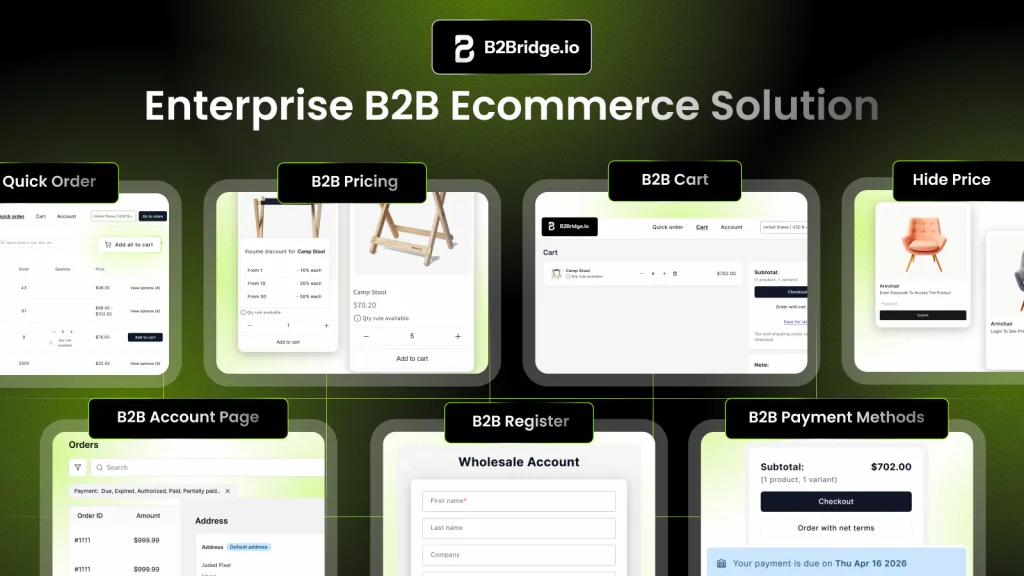
Ready to bring enterprise B2B to Shopify? Book a Demo to see how B2Bridge can replace SAP-level complexity with Shopify simplicity.
Frequently Asked Questions About Shopify vs SAP Commerce Cloud
Can Shopify replace SAP Commerce Cloud for enterprise B2B?
Yes. With Shopify’s B2B GMV up 96% year-over-year in 2025, Shopify combined with a dedicated B2B solution like B2Bridge can deliver enterprise B2B capabilities including customer-specific pricing, net terms, and ERP integration. For many businesses currently on or considering SAP Commerce Cloud, this combination offers a viable alternative.
Is Shopify Plus enough for B2B without third-party apps?
Shopify Plus includes basic B2B features like company accounts and price lists. However, most enterprise B2B operations require additional apps for advanced pricing logic, RFQ workflows, net payment terms, and deep ERP integration.
How long does it take to migrate from SAP Commerce Cloud to Shopify?
Migration timelines vary based on catalog complexity and integration requirements. Most businesses can launch a fully functional Shopify B2B store in weeks rather than the months typically required for SAP implementations.
Does Shopify integrate with SAP S/4HANA and other ERPs?
Shopify can integrate with SAP S/4HANA and other enterprise ERPs through middleware solutions or specialized B2B apps like B2Bridge, which provides enterprise API connectivity for syncing pricing, customers, and orders across systems.
Which platform has the lower total cost of ownership for B2B ecommerce?
Shopify typically offers a significantly lower total cost of ownership due to its subscription-based pricing, managed infrastructure, and shorter implementation cycles compared to SAP Commerce Cloud’s enterprise licensing and ongoing maintenance requirements.
Which platform is better for hybrid B2B and B2C operations?
Shopify excels at hybrid B2B/B2C operations, allowing you to run both channels from a single storefront. Solutions like B2Bridge differentiate the buying experience by customer type. SAP Commerce Cloud often requires more complex configuration for unified storefronts.

As a Product Marketing Executive at B2Bridge, I focus on the Enterprise B2B Ecommerce domain. I leverage my understanding of product and user psychology to deliver customer-centric content that addresses business challenges and fuels growth.