Minimum Order Quantity (MOQ) is the smallest number of units a supplier will sell in a single transaction—a threshold designed to ensure every order covers production costs and stays profitable.
For buyers, MOQs determine how much capital gets tied up in inventory. For sellers, they protect margins and keep operations efficient. This guide covers how MOQs work, the formula for calculating them, and how to enforce or negotiate them in B2B ecommerce.
>> Download Minimum Order Quantity Excel Template for free!
What Is Minimum Order Quantity (MOQ)
Minimum Order Quantity (MOQ) is the lowest number of units a supplier will sell in a single transaction. Suppliers use MOQs to ensure profitability and production efficiency by covering fixed costs like labor, materials, and shipping. Without a minimum threshold, small orders can quickly become unprofitable once overhead gets factored in.
Think of MOQ as the supplier’s break-even floor. Every order below that number costs more to fulfill than it brings in—so suppliers draw a line.
- Profitability: Each order covers production and handling costs
- Production efficiency: Suppliers can plan manufacturing runs with predictable volume
- Shipping optimization: Fulfillment becomes economically viable when orders are consolidated
Why Suppliers and Wholesalers Set MOQs
The reasoning is straightforward: small orders eat into margins. When a supplier processes an order, fixed costs kick in regardless of order size—warehouse labor, packaging, shipping coordination, and administrative overhead. A 10-unit order often costs nearly as much to fulfill as a 500-unit order.
MOQs protect against that imbalance. By setting a minimum threshold, suppliers ensure every transaction contributes meaningfully to the bottom line rather than draining resources.
- Cover fixed costs: Raw materials, labor, packaging, and logistics all carry baseline expenses
- Maintain profit margins: Small orders can be unprofitable after overhead
- Stabilize production: Predictable order sizes help with planning and inventory management
Types of Minimum Order Quantity
MOQs aren’t one-size-fits-all. Depending on your product mix, customer base, and operational setup, you might structure minimums in different ways.
Per-Product MOQ
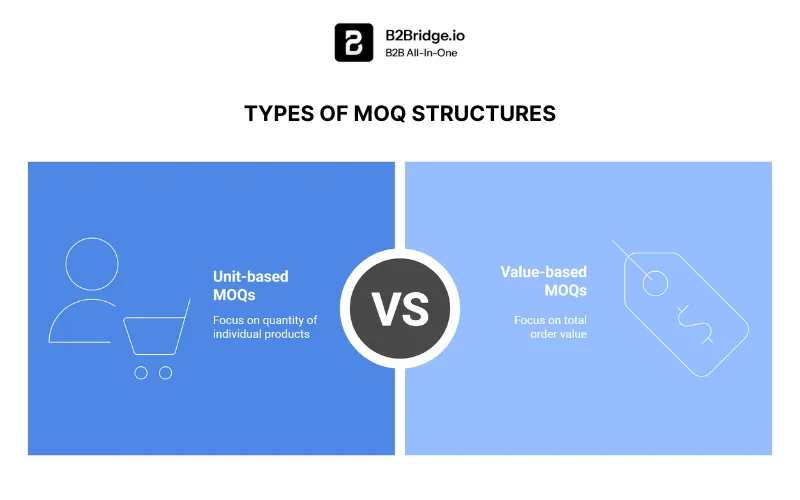
This is the most common type. Each individual SKU or product line carries its own minimum quantity. If you sell widgets and gadgets, buyers might face a 50-unit minimum on widgets and a 100-unit minimum on gadgets—each tracked separately.
Per-Order MOQ
Here, the minimum applies to the entire order rather than individual products. A buyer can mix and match across your catalog as long as the total quantity—say, 200 units—meets the threshold.
Dollar-Based MOQ
Instead of counting units, some suppliers set a minimum order value. A $500 minimum, for example, gives buyers flexibility in what they purchase while ensuring the order is worth processing.
Variant or SKU-Level MOQ
Different variants of the same product—colors, sizes, configurations—can carry different minimums. This is common in apparel, where a supplier might require 12 units per color rather than 12 units total across all colors.
Customer-Group MOQ
Not all buyers are equal. New accounts might face higher minimums to offset onboarding risk, while established wholesale partners enjoy lower thresholds as a reward for loyalty and consistent ordering.
| MOQ Type | Based On | Example |
|---|---|---|
| Per-Product | Units per SKU | Minimum 50 units of Product A |
| Per-Order | Total units in cart | Minimum 100 units across all products |
| Dollar-Based | Order value | Minimum $500 order |
| Variant-Level | Units per variant | Minimum 12 per color |
| Customer-Group | Buyer tier | New accounts: 200 units; VIP accounts: 50 units |
How MOQ Impacts Inventory and Cash Flow
MOQs create trade-offs for buyers. The threshold you face determines how much capital gets tied up in inventory—and how much risk you carry if demand shifts.
High MOQ
Larger minimums typically unlock lower per-unit pricing as part of a broader wholesale pricing strategy. However, they also mean more cash tied up in stock and greater exposure to obsolescence if products don’t sell as expected. Overstocking becomes a real risk when you’re forced to buy more than you can move in a reasonable timeframe.
Low MOQ
Smaller minimums reduce upfront capital requirements and inventory burden. The trade-off is higher per-unit costs and more frequent reordering, which can increase shipping expenses and administrative overhead over time.
How to Calculate Minimum Order Quantity
If you’re a supplier or wholesaler setting your own MOQ, the calculation comes down to understanding your costs and finding the break-even point.
Step 1. Determine Demand
Start with historical sales data. How many units of each product do customers typically order? What’s the average order size? Forecasting expected volume helps you set a minimum that’s realistic for your buyers while still protecting your margins.
Step 2. Calculate Holding Costs
Factor in what it costs to store inventory: warehouse space, insurance, depreciation, and the opportunity cost of capital tied up in stock. Holding costs influence how much inventory you want to carry—and how quickly you want it moving out the door.
Step 3. Find the Break-Even Point
Identify the minimum number of units required to cover production and fulfillment costs for a single order. This includes your cost of goods sold—materials, labor, packaging—plus shipping. Below this number, you lose money on the transaction.
Step 4. Set the MOQ Threshold
Your MOQ lands at or above the break-even point. Some suppliers add a buffer to ensure profitability even when costs fluctuate. Others set tiered MOQs that decrease as order volume increases, rewarding larger buyers.

MOQ vs EOQ
MOQ and EOQ get confused often, but they serve different purposes and come from different sides of the transaction.
MOQ (Minimum Order Quantity) is supplier-driven. It’s the smallest order a supplier will accept.
EOQ (Economic Order Quantity) is buyer-driven. It’s the optimal order size that minimizes total inventory costs—balancing ordering costs against holding costs.
| Factor | MOQ | EOQ |
|---|---|---|
| Set by | Supplier | Buyer (calculated internally) |
| Purpose | Ensure supplier profitability | Minimize buyer’s total inventory costs |
| Focus | Minimum threshold | Optimal order size |
| Negotiable | Often yes | N/A (formula-based) |
A buyer’s EOQ might be 300 units, but if the supplier’s MOQ is 500, the buyer either orders more than optimal or finds a different supplier willing to accommodate smaller quantities.
Benefits of Minimum Order Quantity
Well-managed MOQs create advantages on both sides of the transaction.
Benefits for Suppliers
- Cost efficiency: Balances manufacturing costs with fulfillment overhead
- Production stability: Enables predictable demand and inventory planning
- Reduced operational waste: Avoids processing unprofitable small orders
Benefits for Buyers
- Lower per-unit pricing: Higher quantities often unlock volume discounts
- Stronger supplier relationships: Consistent ordering builds trust and negotiating leverage
- Simplified ordering: Fewer, larger orders reduce administrative overhead
Disadvantages of Minimum Order Quantity
MOQs aren’t without drawbacks—especially for buyers navigating high thresholds.
- Overstocking: Buying more than needed to meet a high MOQ can lead to excess inventory, storage costs, or obsolete stock
- Cash flow strain: Large upfront purchases tie up working capital that could be deployed elsewhere
- Stockouts (if MOQ too low): On the supplier side, setting minimums too low may increase shipping costs and create inventory gaps
How to Negotiate a Lower MOQ With Suppliers
If a supplier’s MOQ feels out of reach, negotiation is often possible. Suppliers want your business—they just want it to be profitable.
Offer a Higher Per-Unit Price
Suppliers may accept smaller orders if the margin per unit increases. You’re essentially paying a premium for flexibility, which can make sense when testing new products or entering new markets.
Propose a Long-Term Contract
Committing to future volume—say, a 12-month purchasing agreement with net payment terms—can justify a lower MOQ on initial orders. The supplier gains predictability, and you gain flexibility on order sizes.
Request Staggered Deliveries
Agree to the full MOQ but receive inventory in smaller shipments over time. This reduces your storage burden while still meeting the supplier’s volume requirements.
Ask for Alternative Materials or Components
Lower-cost inputs may reduce the supplier’s break-even threshold, making smaller orders viable without sacrificing quality.
Use Competing Suppliers as Leverage
If you have alternatives, say so. Demonstrating that you’re evaluating options can encourage flexibility on terms.
How to Set and Enforce MOQ in a B2B Store
For suppliers selling through ecommerce, enforcing MOQs requires the right B2B ecommerce features. Manual enforcement—checking orders after submission—creates friction and errors.
Step 1. Define MOQ Rules per Product and Customer Group
Decide which products require minimums and whether different buyer tiers get different thresholds. A tiered approach rewards loyal customers while protecting margins on new accounts.
Step 2. Configure MOQ in Your Ecommerce Platform
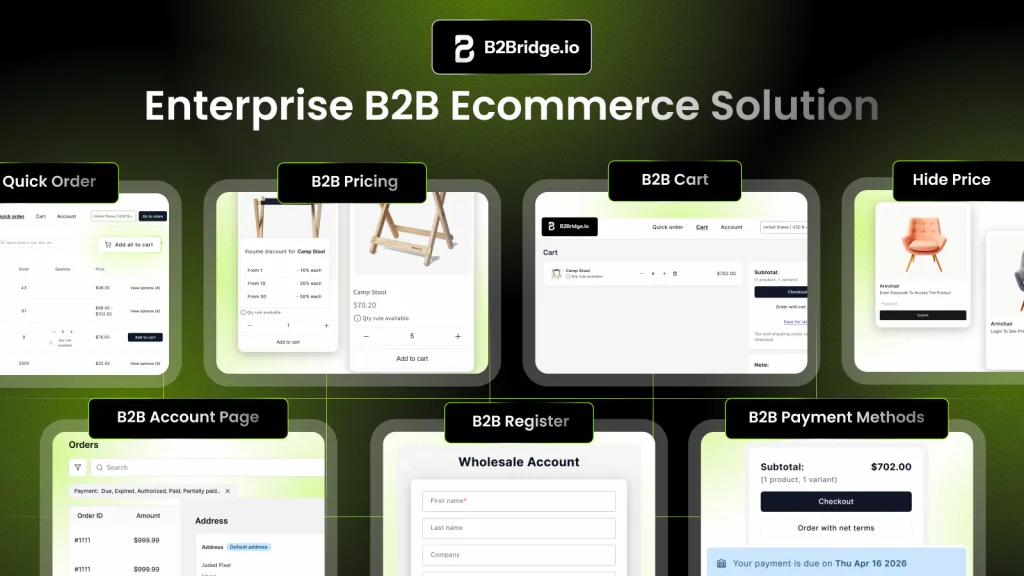
Use a B2B app or platform feature to set min/max quantity rules at the product, variant, or cart level. Tools like B2Bridge allow this configuration directly in Shopify without custom development.

Step 3. Communicate MOQ on Product and Cart Pages
Display minimum quantity requirements clearly so buyers understand before checkout. Surprises at checkout lead to abandoned carts and frustrated customers.
Step 4. Block Checkout Below the MOQ Threshold
Prevent orders that don’t meet the MOQ from completing. This protects margins and eliminates the need for manual order review or awkward follow-up conversations.
Common Mistakes When Setting Minimum Order Quantity
- Setting MOQ too high: Deters smaller buyers and limits customer acquisition
- Setting MOQ too low: Results in unprofitable orders and operational strain
- Inconsistent enforcement: Allowing exceptions erodes pricing discipline over time
- Poor communication: Buyers surprised at checkout may abandon orders entirely
- Ignoring customer segments: A single MOQ may not fit all buyer types—tiered thresholds often work better
Optimize Wholesale MOQ With B2Bridge
If you’re running B2B operations on Shopify, enforcing MOQs manually—or relying on basic apps—creates unnecessary friction.
B2Bridge brings enterprise-grade MOQ enforcement to Shopify without the enterprise budget:
- Min/max order quantity: Set minimums at the product, variant, or cart level
- Case packs and quantity increments: Require orders in multiples (e.g., dozens or cases)
- Customer-group pricing: Different MOQ thresholds for different buyer tiers
- Hidden B2B pricing: Keep wholesale minimums invisible to retail shoppers
The result is fewer abandoned carts, cleaner order flow, and margins that stay protected.
Frequently Asked Questions About Minimum Order Quantity
What is a normal MOQ?
MOQs vary widely by industry and supplier. Handmade goods might carry minimums of 5–10 units, while manufactured products often start at hundreds or thousands. There’s no universal standard—it depends entirely on the supplier’s cost structure and production setup.
Is MOQ the same as a case pack?
No. A case pack is a specific packaging unit—say, 12 units per case. MOQ is the minimum total quantity a buyer can order, which may or may not align with case pack sizes. You might face a 48-unit MOQ that requires ordering four cases.
Can MOQ be set per customer group or variant in Shopify?
Shopify’s native B2B features offer limited quantity rules. Most merchants use third-party apps like B2Bridge to configure MOQ rules by customer group, product, or variant.
Is MOQ the minimum or maximum order quantity?
MOQ refers to the minimum—the smallest quantity a supplier will sell. Maximum order quantity is a separate limit sometimes used to manage inventory allocation or prevent stockouts during high-demand periods.

Hi, I’m Ha My Phan – an ever-curious digital marketer crafting growth strategies for Shopify apps since 2018. I blend language, logic, and user insight to make things convert. Strategy is my second nature. Learning is my habit. And building things that actually work for people? That’s my favorite kind of win.