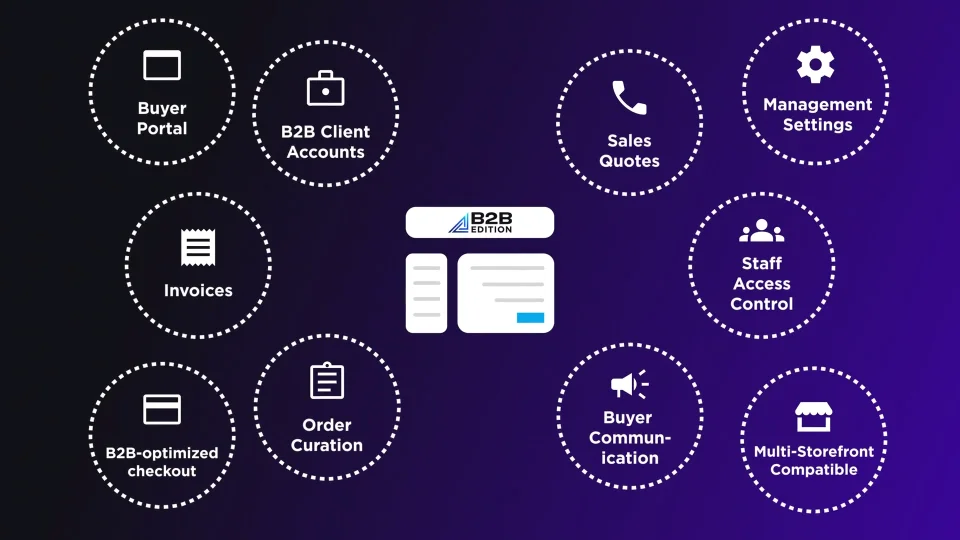
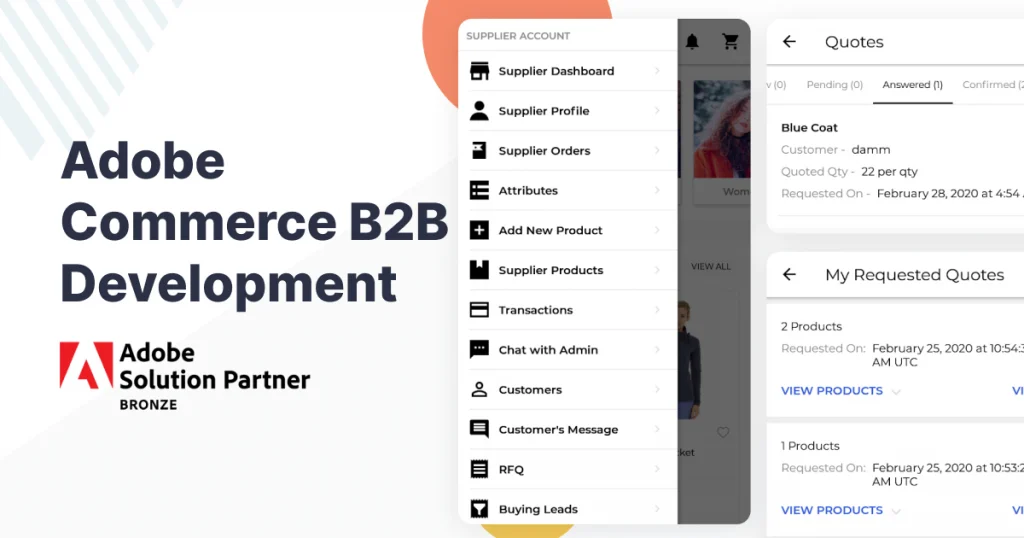
Top B2B Ecommerce platforms include Shopify for unified B2B/B2C selling, BigCommerce for headless flexibility, Adobe Commerce for enterprise needs, commerce tools for composable architecture, and OroCommerce for B2B-first capabilities. Large enterprises may prefer Salesforce, SAP, or NetSuite for deep CRM/ERP integration.
This list of the best B2B Ecommerce platforms is curated to help you match the right solution to your scale and strategy. The right choice depends on your requirements – such as advanced integrations, headless setups, or a B2B-focused feature set – with solutions ranging from SMB-friendly options like WooCommerce and Wix to highly scalable enterprise platforms.

What Is a B2B Ecommerce Platform
A B2B ecommerce platform is software that lets businesses sell products or services to other businesses online. Unlike retail ecommerce tools built for individual shoppers, B2B platforms handle the complexity that comes with wholesale transactions: negotiated pricing, bulk orders, net payment terms, and integration with back-office systems.
The leading platforms in 2026 include Shopify Plus, BigCommerce, Adobe Commerce (Magento), and OroCommerce. Each offers features like custom pricing engines, bulk ordering tools, and ERP connectivity, though they differ in implementation speed, customization depth, and ideal use cases.
Think of a B2B ecommerce platform as a self-serve procurement portal rather than a storefront. Business buyers log in, see pricing specific to their account, place large orders across multiple SKUs, and pay on terms like Net 30 rather than swiping a credit card at checkout.
>> Read more: 12 Best B2B Ecommerce Apps for Growing Businesses
How B2B Ecommerce Differs From B2C Ecommerce
If you’re coming from retail ecommerce, B2B operates on a completely different logic. The differences show up in how buyers behave, how pricing works, and how payments flow.
Buyer Behavior and Order Complexity
B2B buyers purchase on behalf of organizations. A single order might include hundreds of line items, require approval from a finance director before submission, and repeat on a predictable schedule every month. Retail shoppers, by contrast, typically buy one or two items on impulse.
Pricing and Contract Logic
Retail pricing is fixed and visible to everyone. B2B pricing is negotiated, customer-specific, and often tied to volume. A distributor ordering 10,000 units sees different numbers than a retailer ordering 500. Price lists, tiered discounts, and contract rates are standard.
Payment Terms and Checkout Flow
Retail buyers pay immediately at checkout. B2B buyers expect to pay later by invoice, often on Net 30 or Net 60 terms. Request for Quote (RFQ) workflows let buyers submit inquiries for large or custom orders, which sellers review and convert into formal quotes.
Catalog Access and Account Hierarchy
Wholesale catalogs are typically gated behind login walls. Different buyer types see different products and prices based on their account permissions. Multi-user accounts with role-based access let purchasing managers, approvers, and finance teams each handle their part of the buying process.
| Factor | B2C Ecommerce | B2B Ecommerce |
|---|---|---|
| Pricing | Fixed, public | Negotiated, customer-specific |
| Payment | Immediate checkout | Net terms, invoicing |
| Order size | Small, single items | Large, bulk quantities |
| Catalog access | Open to all | Gated, login-required |
| Decision-making | Individual | Committee/approval chains |
Must-Have Features of a B2B Ecommerce Platform
The B2B ecommerce features that separate adequate platforms from excellent ones directly address how business buyers actually purchase. Here’s what to evaluate.
B2B Pricing Engine and Customer-Specific Price Lists
A price list is a set of prices assigned to a specific customer group or individual account. Strong platforms support role-based pricing (Gold, Silver, Bronze tiers), contract pricing for key accounts, and volume discounts displayed directly on product pages.
ERP and CRM Integration
ERP (Enterprise Resource Planning) systems manage back-office operations like inventory, accounting, and fulfillment. CRM (Customer Relationship Management) tracks customer relationships and sales data. Platforms that sync with systems like NetSuite, SAP, Zoho, or Odoo keep pricing, inventory, and customer data aligned across your entire operation.
Net Payment Terms and RFQ Workflows
Net terms (Net 15/30/60) let approved buyers purchase now and pay later by invoice. RFQ functionality allows buyers to request custom quotes for large or complex orders, which you can review, adjust, and convert into orders without email back-and-forth.
Gated Catalogs and B2B Registration
Password protection, login-only access, and wholesale registration forms verify business buyers before granting access to wholesale pricing. Gating protects margins and creates an incentive for legitimate buyers to register.
Quick Order, Bulk Reorder, and B2B Cart
Quick order forms let buyers enter SKUs and quantities directly without browsing product pages. Saved carts, reorder functionality, and dedicated B2B cart experiences optimize for high-SKU orders that would be tedious in a standard retail checkout.
How to Choose the Right B2B Ecommerce Platform
Selecting a platform involves more than comparing feature lists. The right choice depends on your business model, existing tech stack, and growth trajectory.
Step 1. Map Your B2B Business Model and Buyer Segments
Start by identifying whether you sell to distributors, retailers, or direct to businesses—each represents a distinct B2B ecommerce model with unique pricing, payment, and catalog requirements that your platform will need to support.
Step 2. Audit Your ERP, CRM, and Existing Tech Stack
List your current systems and determine what data needs to sync: pricing, inventory, customers, orders. Integration requirements often drive platform selection more than features do.
Step 3. Define Your Pricing and Order Rules
Document your pricing models (volume, tiered, contract), minimum order quantities, quantity increments, and any approval workflows. The platform you choose has to support your specific rules without heavy customization.
Step 4. Evaluate Total Cost of Ownership and ROI
Consider implementation costs, ongoing fees, customization work, and expected efficiency gains. License cost alone rarely tells the full story. Factor in development time, training, and maintenance.
Step 5. Test Customization, Scalability, and Time to Launch
SaaS platforms typically launch faster while open-source solutions offer more control but require more setup. Match platform capabilities to where your B2B operations are headed, not just where they are today.
Best B2B Ecommerce Platforms to Consider
In 2026, selecting the right B2B Ecommerce platform is more crucial than ever. As industries develop quickly and digital transformation occurs faster, businesses require platforms that match their individual ways of working, how they integrate systems and how they grow. The best B2B Ecommerce platforms empower you to streamline sales, automate processes, and deliver personalized buying experiences.
“In B2B, pick the wrong platform and customers face a host of issues (pricing, catalog, workflows, fulfillment) that render the tool unusable.” – Jay Schneider (B2B Platform Guide)
Before going into detail about each of Ecommerce platforms, let’s explore an overview comparison table below:
| Platform | Best For | Key Strengths | Notable Drawbacks |
| Shopify Plus | High-growth businesses | – Handles high sales volumes – Easy to customize – Strong app ecosystem – 24/7 support | – Limited advanced B2B customization – Transaction fees if not using Shopify Payments |
| WooCommerce | Small to mid-sized businesses | – Highly flexible – Large plugin ecosystem – Cost-effective – Wholesale-friendly layouts | – Requires plugins for full B2B features – Scaling needs hosting tweaks |
| BigCommerce B2B | Growing wholesalers & manufacturers | – Native B2B features (custom pricing, quotes) – No transaction fees – Strong multi-region support | – Steeper learning curve – Theme customization requires coding |
| OroCommerce | Mid-market & enterprise B2B | – B2B-focused out-of-the-box features – Flexible workflows – Multi-channel sales | – Complex setup – Limited third-party extensions |
| BetterCommerce | Mid to large enterprises | – API-first – Omnichannel – AI capabilities – Multi-store management – Highly customizable | – Custom pricing – Steep learning curve – Requires technical expertise |
| Sana Commerce | ERP-integrated manufacturers | – Deep ERP integration (SAP, MS Dynamics) – Real-time data sync – Seamless B2B experience | – Limited standalone Ecommerce features – Pricing can be high |
| SAP Commerce Cloud | Large enterprises with SAP ERP | – Enterprise-grade – Omnichannel – AI personalization – Real-time order management | – Very high cost – Long deployment – Less agile for midsize |
| Salesforce B2B | CRM-integrated enterprises | – Seamless Salesforce CRM integration – AI-powered insights – Mobile optimized | – Premium pricing – Complex customization needs |
| Wix Ecommerce | Small businesses and startups | – Easy to use – Good design templates – Basic Ecommerce features | – Limited B2B-specific features – Less scalable for large catalogs |
| Squarespace | Small businesses, creatives | – Beautiful design – Easy setup Integrated marketing tools | – Limited B2B functionality – Fewer integrations |
| Alibaba | Global wholesale marketplace | – Massive global reach – Strong supplier network – Bulk order capabilities | – Marketplace model – Less control over branding and customer data |
| Znode | Enterprises needing headless | – API-rich – Headless commerce – Supports complex B2B scenarios | – Requires technical resources – Smaller ecosystem |
| Adobe Commerce | Complex B2B and B2C enterprises | – Former Magento Commerce – Highly customizable – Strong Adobe ecosystem integration | – High cost and complexity – Requires developer expertise |
| Oracle Commerce | Large enterprises | – Robust enterprise features – Strong personalization and AI | – High cost – Complex implementation |
| PrestaShop | Small to mid-sized businesses | – Open-source, flexible – Large community – Cost-effective | – Requires technical skills – Limited out-of-the-box B2B features |
| Pulse Commerce | Mid-sized businesses | – Focus on B2B with flexible workflows – Quote management – Integrations | – Less known – Smaller ecosystem |
| NuORDER | Wholesale and brand manufacturers | – Visual product catalogs – Order management – Digital showroom | – Higher cost – Niche focus |
| NetSuite Commerce | ERP-integrated mid to large firms | – Strong ERP integration – Unified commerce platform | – Expensive – Complex setup |
| WizCommerce | B2B companies wanting Amazon-like experience | – AI-driven recommendations – User-friendly – ERP integrations | – Smaller platform – Less widespread |
| Cloudfy | Manufacturers and wholesalers | – SaaS-based – Integrates with ERP and CRM | – Limited brand recognition – Smaller ecosystem |
Top B2B Ecommerce Platforms You Shouldn’t Miss
Shopify Plus

Shopify Plus is on the top list of 20 best B2B Ecommerce platforms. Users can benefit from B2B features, headless commerce setup and personalized checkout, as well as services unique to Shopify and a large network of partners.
Key Features:
- Custom pricing per company or location
- B2B storefronts can be gated for approved buyers using customer accounts with company-specific logins
- Customizable checkout
- Shopify calculates the pricing for delivery on the spot and prepares shipping labels
Pricing
- $2,300/month on a 3-year term
- $2,500/month on a 1-year term
- Option for variable platform fee for complex business structures
Pros
- B2B built-in tools
- Scales well as businesses grow without limits
- Easy to use
- Greater customization and extensibility
Cons
- Lack of multi-store support
- Added transaction fees without Shopify Payments
>> Read more: B2B Ecommerce Detailed Guide: What It Is and How to Start
Transform your B2B store with B2Bridge.
Discover how B2Bridge can transform your wholesale business.
Schedule a demo today to see our payment management tools in action.
WooCommerce

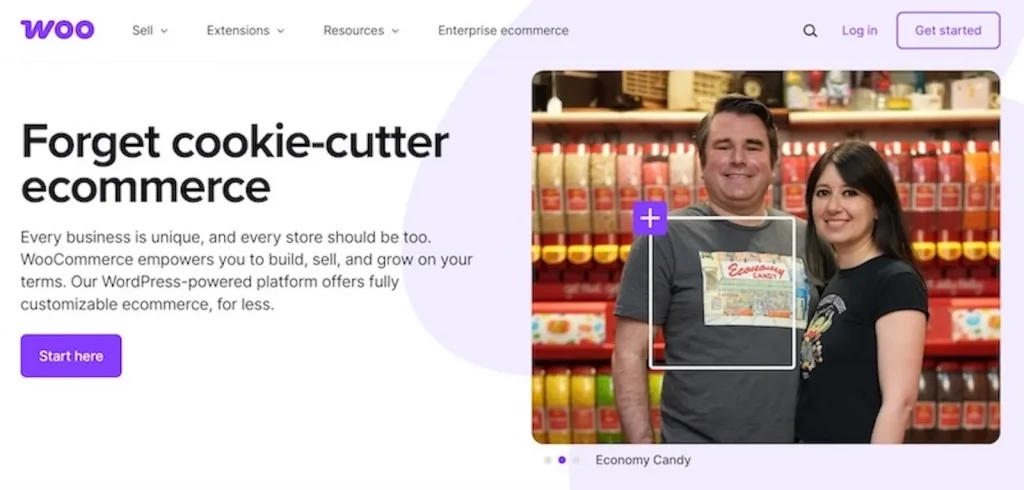
WooCommerce is an open-source Ecommerce platform that runs on WordPress, appreciated for being flexible and allowing many different customizations.
Key features
- Wholesale pricing based on quantity and customer-group specific pricing
- B2B registration, custom user roles, and company accounts
- Bulk order processing, re-ordering, B2B sales reports, and ERP/CRM integration
- Private catalogs, hidden prices, product variations, and quick order forms
Pricing: WooCommerce is a free, open-source plugin. However, overall costs depend on scale.
Pros:
- Core plugin is no cost, offering full control
- Extensive design and feature flexibility
- Leverages WordPress’s strong SEO capabilities
- Thousands of plugins for added functionality
Cons:
- Needs a WordPress site to run
- No Built-in Support: Relies on community or third-party help
>> You may concern: 12 Best Wholesale Apps for Shopify You Shouldn’t Miss
BigCommerce

BigCommerce is a well-known Ecommerce platform used by companies to create B2B and B2C stores that can grow with their business.
Key Features:
- User-friendly storefronts with fast-loading websites
- Numerous integrations from the platform’s library
- Advanced customer segmentation & custom price lists
- Credit & invoice management
- Easy account management & user permissions
- Self-service buyer portal
- Seamless ERP & CRM integrations
- Shared shopping lists & easy reorders
- Great SEO features
Pricing:
- Standard Plan: $39/month
- Plus Plan: $105/month
- Pro Plan: $399/month
- Enterprise Plan: Custom priced based on sales volume
Pros:
- Advanced customization options
- Robust SEO and social selling capabilities
- No transaction fees
Cons:
- Expensive premium themes
- Plans have sales volume limits
For businesses scaling in 2026, you should compare the best B2B commerce platforms with punchout integration US market 2025 for seamless ERP and supplier connectivity.
Magento Commerce (now Abode Commerce)

Magento Commerce (now Abode Commerce) is an important Ecommerce platform for wholesale businesses, providing them with a complete B2B platform. It helps businesses manage sophisticated B2B operations with features for customer accounts, custom pricing, bulk orders and additional features.
Key Features:
- Ability for buyers to create company accounts, manage multiple users, assign roles/permissions, and define purchasing limits
- Built-in functionality for buyers to request quotes and sellers to manage and convert them into orders
- Allows buyers to create and manage lists of frequently purchased items for easy reordering
- Enables businesses to create custom product catalogs and pricing specific to different customer groups
- Expedited ordering process for B2B customers who know specific product SKUs or need to upload large order lists
- Configurable workflows for internal purchase order approvals within a B2B company
Pricing:
- Magento Open Source is free
- Adobe Commerce pricing is customized based on GMV, AOV, and feature needs, typically costing tens to hundreds of thousands per year, plus implementation and maintenance
Pros:
- Strong tools for managing admins and customizing the system
- A large social group and an active extension support system
- Built for managing complex and large B2B operations
Cons:
- Upfront costs are higher here than they are on other platforms
- Calls for greater technical knowledge to put in place and manage
>> Explore: Shopify vs Adobe Commerce: Which Platform Should You Actually Use
OroCommerce

OroCommerce is designed for businesses that sell wholesale and gives them the tools they need to manage their online activities more effectively. Many general Ecommerce platforms lack the features OroCommerce offers which are tailored to B2B businesses.
Key Features:
- A platform that supports B2B companies by providing CRM and Ecommerce functions
- Handling both account management and access control for websites
- Catalogs that can be personalized and numerous price lists
- Easy ways to order and reorder
- A variety of payment options
Pricing:
- OROCommerce Community Edition is free to use
- OROCommerce Enterprise Edition pricing is not publicly disclosed
Pros:
- Designed exclusively for B2B businesses
- Out-of-the-box integrations with CRM and marketing tools
Cons:
- Limited extension ecosystem compared to other platforms
- Relatively low development availability and support
BetterCommerce

Why is BetterCommerce on the list of 20 best B2B Ecommerce platforms? Because it addresses the needs of businesses no matter how big or small. The platform provides a range of tools that allow companies to improve their website, manage their work more efficiently.
Key Features:
- Manage company accounts, user access, and permissions
- Segment pricing and catalogs by customer groups
- Built-in RFQ workflows
- Credit terms and payment on account supported
- Easily tailor the platform to your business and grow with it
- API-first for ERP, CRM, PIM, and more
- An integrated CMS
- Run B2B, B2C, and regional stores from one platform
Pricing: Starts from £800.00
Pros:
- Highly flexible and customizable platform
- Comprehensive set of features for enterprises
- Robust integration capabilities
Cons:
- Custom pricing may be more expensive for smaller businesses
- Steep learning curve for non-technical users
Sana Commerce

Sana Commerce is an ERP-integrated B2C and B2B Ecommerce platform. This platform helps businesses streamline their online sales processes.
Key Features:
- Customers manage accounts, orders, invoices, and payments synced with ERP
- Supports complex B2B workflows like credit limits and approvals
- Multi-language and multi-currency, powered by ERP integration
- Integrated ERP at the core to ensure every customer enjoys the same experience
- Tailored content based on customer profiles
- Functionality for quick mass orders, easy re-ordering and handling of quotations
- Optimized mobile shopping experience with PWA storefront
Pricing: Sana Commerce has 3 plans: Essential, Pro, and Advanced. It does not make its pricing public. Customers have to get in touch with the company to request a quote.
Pros:
- Fast and effortless setup of ERP systems
- B2B tools with many capabilities
- Large community and ecosystem of third-party solutions
Cons:
- Steep learning curve and implementation complexity
- Lack of transparent pricing information
SAP Commerce Cloud

SAP Commerce Cloud gives businesses plenty of options to make their Ecommerce activities better. This application is part of SAP’s enterprise suite and is famous for powerful ERP integration.
Key Features:
- Offering different prices and catalogs for individual customers
- Access rights and responsibility areas
- Supports bulk, recurring orders, and approvals
- A smoother style of omnichannel fulfillment
- Plenty of links to SAP’s collection of business apps such as CRM, ERP and marketing automation
- Advanced product content tools
- Having full and detailed analysis and reporting tools
Pricing: Starts from $100k/year, with a $50k/license. Pricing for Standard Edition and Professional Edition is available upon request.
Pros:
- Powerful omnichannel capabilities
- Deep integration with SAP’s enterprise ecosystem
- Robust data collection and analysis tools
Cons:
- Requires reliance on certified SAP partners and professional support rather than a broad open-source community
- High complexity and cost of customization, requiring specialized developers and significant investment
Salesforce B2B Commerce

Salesforce Commerce Cloud is a cloud solution that lets businesses manage and improve their B2B and B2C online stores. There are Starter, Pro, Growth and Advanced pricing plans, all with different features and prices.
Key Features:
- Account-based commerce to manage company accounts, hierarchies, and multiple buyers
- B2B quote creation, negotiation, and conversion to orders
- Seamless Salesforce integration for a 360° customer view
- Platform built on SaaS that allows for growth and easy access
- Easy-to-use merchandising tools along with good catalog management
- Features that use personalization and machine learning
Pricing:
- Pricing for the B2B-focused editions is available upon request
Pros:
- Robust CRM integration and data-driven insights
- Scalable and secure SaaS platform
Cons:
- Implementation and customization can be complex and require specialized Salesforce development expertise
- Higher pricing compared to other B2B Ecommerce platforms
Wix Ecommerce

Wix offers an easy-to-use, all-in-one platform for small businesses to create and manage their online presence but lacks advanced B2B functionality.
Key Features:
- Wholesale pricing, customer group segmentation, and basic quote functionality
- Easy design with AI-powered assistance with drag-and-drop website builder
- Built-in tools for managing stock, handling payments and promoting the business online
- A lot of mobile-friendly templates and customization choices
- SEO and marketing tools to help your site get noticed online
Pricing:
- Light Plan: $17/month
- Core Plan: $29/month
- Business Plan: $36/month
- Business Elite Plan: $159/month
Pros:
- Extremely user-friendly for non-technical users
- Comprehensive set of tools for managing an online business
- No coding skills required
Cons:
- Limited features required for complicated B2B operations
- Transaction fees on lower-tier plans
- Potential limitations on storage and scale as the B2B business grows
Squarespace

New users of Squarespace can create an attractive online store with the help of its simple website builder and stylish templates. Squarespace allows small businesses and entrepreneurs to build and manage their online presence.
Key Features:
- Easily build a website by drag-and-drop elements and customizable templates
- Chance to offer physical products, digital downloads, services and subscriptions
- Inventory, promotions and SEO are all parts of the same integrated system
- Easy integration with different social media sites
Pricing:
- Personal Plan: $14/month (Includes website functionality only, without e-commerce capabilities)
- Business Plan: $20/month
- Basic Commerce Plan: $24/month
- Advanced Commerce Plan: $44/month
Note: These prices are generally correct for annual billing (monthly billing is typically higher).
Pros:
- Visually appealing and mobile-responsive designs
- Easy to set up and manage
Cons:
- Higher transaction fees on lower-tier plans
- Limited features required for robust B2B operations
Alibaba

Alibaba is a global B2B Ecommerce platform that provides businesses with a lot of tools and services to help them expand their sales internationally. Being a paid seller on Alibaba, companies benefit from a range of features that make it easy to reach buyers all over the world.
Key Features:
- Customize your storefront and use it in different languages
- Over 40 million B2B buyers worldwide are able to use the platform
- Responding to buyer questions and RFQs is a requirement
- Tools for marketing and analytics to get the best results
Pricing:
- Quarterly plans starting at $199/month
- Annual plans with 15% savings starting at $166/month
Pros:
- Vast global buyer network
- Comprehensive suite of business tools
- Dedicated customer support
Cons:
- Steep learning curve for new users
- Business verification requirements
Znode

Znode is one of the best B2B Ecommerce platforms which was designed for mid-market and enterprise businesses to manage multiple online stores from a single platform.
Key Features:
- Multi-store management
- Product information management
- Built-in content management system
- Enterprise site search capabilities
- Advanced order management system
- Complex pricing and inventory controls
Pricing:
- Annual licensing fees start around $5,000
- Custom pricing based on business needs
- No public standardized pricing structure
Pros:
- Flexible, customizable framework
- Supports extensive product catalogs
- API-driven architecture with 1,200+ endpoints
Cons:
- Requires developer expertise
- Complex upgrade process
- Potential performance issues with highly customized user interfaces
- Limited reporting capabilities
Oracle Commerce

Oracle Commerce makes it easy for businesses to bring together data from customers, sales, administration and operations with financial information.
Key features:
- A single platform for placing orders in B2B commerce
- Supports diverse B2B purchasing processes
- Automation of sales tasks and the creation of insights with AI
- Integration with Oracle’s range of tools for generating, managing and transforming revenue, including CPQ and Subscription Management
- Options for deploying your site with cloud-native, headless or hybrid techniques
Pricing: Based on a subscription model, but details are not publicly available.
Pros: Intuitive user interfaces for business users and developers
Cons:
- Complex and costly for small or even many mid-sized businesses
- Implementation requires significant investment in resources and expertise
PrestaShop

PrestaShop is an open-source platform that allows businesses of any size to deploy and customize the software as needed. While flexible, it lacks many native B2B features such as advanced quoting, multi-user accounts, and ERP integration. These capabilities require additional modules or custom development.
Key features:
- Two main types: Self-hosted and customized
- Features for payments, marketing, shipping and data analysis
- PrestaShop Marketplace has a broad collection of add-ons and themes
Pricing: PrestaShop Open Source is free to download and use
Pros:
- Open-source flexibility
- Wide range of features and integrations
- Large community
Cons:
- Some technical knowledge required for full customization
- Users typically rely on community forums, paid modules, or third-party developers for enterprise-level support
Pulse Commerce

Businesses use Pulse Commerce to easily manage their inventory and improve their online storefront.
Key features:
- B2B pricing models, inventory control supporting customer-specific pricing
- ERP/CRM integration for seamless data flow between systems and storefronts
- B2B order workflows to manage complex orders like blanket orders and scheduled deliveries
- Blending reporting and analysis for decisions based on data
Pricing: Not publicly available, but likely scales based on business size and needs
Pros:
- Robust inventory control
- Multichannel integration
- Automated workflows
Cons:
- Limited information on pricing and deployment options
- Quite complex for non-technical users
NuORDER

NuOrder makes it easier for brands to do wholesale selling and for retailers to discover and purchase items.
Key features:
- Wholesale sales are enabled by online brand catalogs, special pricing for accounts and easy order tracking
- Tools to help with assortment planning for smarter data-based shopping and fewer stock surpluses
- The platform allows you to explore and purchase from exciting new brands.
- A smooth connection between ERP and POS
Pricing: Custom-tailored based on business needs, not publicly available
Pros:
- Streamlined B2B sales and buying
- Data-driven decision making
- Global scalability
Cons: limited public information on pricing and deployment options
NetSuite Commerce

With NetSuite Commerce, businesses can control their online, in-store and office processes from just one system.
Key features:
- Company accounts with multi-user access and role-based permissions for B2B buyers
- Functions for managing quotes that cover the needs of businesses selling to other businesses
- Self-service tools for checking orders, handling invoices and setting flexible payment options
- Support for businesses selling their products to individuals and to other companies
- Order management from a single point across multiple sales channels
- Combining customer relationship management (CRM)
Pricing: Custom-tailored based on business needs, not publicly available
Pros:
- End-to-end commerce capabilities
- Improved operational efficiency
- Enhanced customer experience
Cons:
- Limited public information on pricing
- Complexity for some businesses
WizCommerce

WizCommerce is an AI-powered B2B Ecommerce platform designed to help wholesale businesses streamline their online sales and operations.
Key features:
- A flexible store design, providing easy product finding, custom tips and simple repeat ordering
- Easily integrate the platform with ERPs and other important systems to create one data source
- The ability for customers to choose their own prices, payment plans and how they want their goods delivered
- Using automation and helpful customer account tools to both serve buyers and reduce the workload
Pricing: Not publicly available
Pros:
- Industry-specific B2B capabilities
- AI-driven features
Cons: More suited for larger wholesale enterprises
Cloudfy

The last platform in this list of the best B2B Ecommerce platforms is Cloudfy. It is built to ease the tasks of manufacturers, distributors and wholesalers in their online businesses and encourage their growth.
Key features:
- Customizable storefront with advanced product discovery, personalized customer experiences, and easy repeat ordering
- Seamless integration with leading ERP, CRM, and other business systems
- Punchout and EDI ordering capabilities for B2B procurement
- Mobile apps for sales representatives and customers to place orders on-the-go
Pricing: Subscription-based, with custom quotes based on business needs
Pros:
- Industry-specific B2B functionality
- Cloud-based scalability
Cons: Limited public information on exact pricing
Running B2B Ecommerce on Shopify Without a Second Storefront
Many Shopify merchants assume they need Shopify Plus or a separate B2B store to sell wholesale. That’s not the case.
Wholesale apps like B2Bridge embed enterprise B2B functionality directly into existing Shopify stores. You serve retail and wholesale buyers from one storefront, with logged-in B2B customers seeing their specific pricing, catalogs, and payment options.
The setup eliminates duplicate operational work. Instead of managing two platforms, two inventories, and two sets of customer data, everything runs from one Shopify admin. Wholesale operations run as smoothly as DTC, without the overhead of a second system.

FAQs
Top B2B ecommerce platforms in 2026 include Shopify Plus, Adobe Commerce (Magento), BigCommerce, WizCommerce, among others. Each offers features catering to scalability, customization, and integration with enterprise systems
Important features include multi-user account management, customized pricing and catalogs, seamless ERP and CRM integration, bulk ordering, AI-driven personalization, self-service portals, robust security, and mobile responsiveness
Shopify Plus is widely regarded as the best for fast-growing B2B brands, offering scalable infrastructure, automation tools, and flexible storefront customization.
Leading platforms like Shopify Plus, Alibaba, and BigCommerce support multi-currency, multiple languages, and localized payment options essential for global B2B operations.
Assess your business size, growth plans, integration needs, customization requirements, and budget. Evaluate platforms based on scalability, ease of use, feature set, and vendor support to find your ideal match.
Shopify offers B2B features through Shopify Plus and third-party apps like B2Bridge. Apps add enterprise B2B capabilities such as custom pricing, net terms, and ERP integration to any Shopify store.
No. Apps like B2Bridge enable full B2B functionality including customer-specific pricing, gated catalogs, and net payment terms on standard Shopify plans without requiring a Shopify Plus upgrade.
Implementation time varies by platform. SaaS solutions like Shopify with B2Bridge or BigCommerce can launch in weeks, while custom implementations on Adobe Commerce or OroCommerce may take several months.
Conclusion
In a rapidly evolving digital commerce landscape, choosing from the best B2B Ecommerce platforms can make or break your success. Each platform also offers special advantages for businesses of any size and model. The right platform will handle tasks automatically, improve how you communicate with buyers and help the business grow.

Hi, I’m Hanh – a product marketing professional passionate about driving growth, simplifying complex solutions, and creating impactful strategies for Shopify that connect products with customers.