A B2B ecommerce model is the framework a business uses to sell products or services to other businesses online—typically involving bulk orders, negotiated pricing, and account-based purchasing rather than one-off consumer transactions.
By 2026, over 80% of B2B sales interactions are projected to happen on digital channels. This guide breaks down the main B2B ecommerce model types, how they work, and how to choose the right one for your wholesale operation.

What Is a B2B Ecommerce Model
A B2B ecommerce model is the online sale of goods, services, or information between companies rather than to individual consumers. The model centers on high-volume, repeat purchases with personalized pricing, bulk ordering, and secure procurement portals.
Think of the “model” as the blueprint for how your transactions, pricing structures, and buyer relationships are organized. In retail ecommerce, a single customer buys one item at a fixed price. In B2B ecommerce, transactions typically involve negotiated pricing, tiered discounts, and longer sales cycles.
The core components break down like this:
- Buyer type: Other businesses, such as retailers, distributors, or procurement teams
- Transaction structure: Bulk orders, contract pricing, and account-based purchasing
- Sales channel: Online storefronts, gated wholesale portals, or B2B marketplaces
>> Read more: B2B Ecommerce Case Studies: 13 Real Examples Driving Serious Growth
How B2B Ecommerce Models Work
The mechanics of B2B ecommerce look quite different from consumer checkout flows. Here’s how a typical B2B transaction unfolds:
- A buyer registers or logs into a gated wholesale portal
- The buyer views customer-specific pricing and catalogs tailored to their account
- The buyer places a bulk order or submits a request for quote (RFQ)
- The seller reviews and approves the order, often adjusting pricing or terms
- Payment is processed via net terms or invoice
A few terms worth knowing: Net terms refer to payment deadlines after invoicing. Net 30, for example, means payment is due 30 days after the invoice date. RFQ stands for request for quote, a formal process where buyers ask for custom pricing on large or complex orders. Customer-specific pricing means different buyers see different prices based on their account, volume, or contract.
B2B vs B2C Ecommerce Models
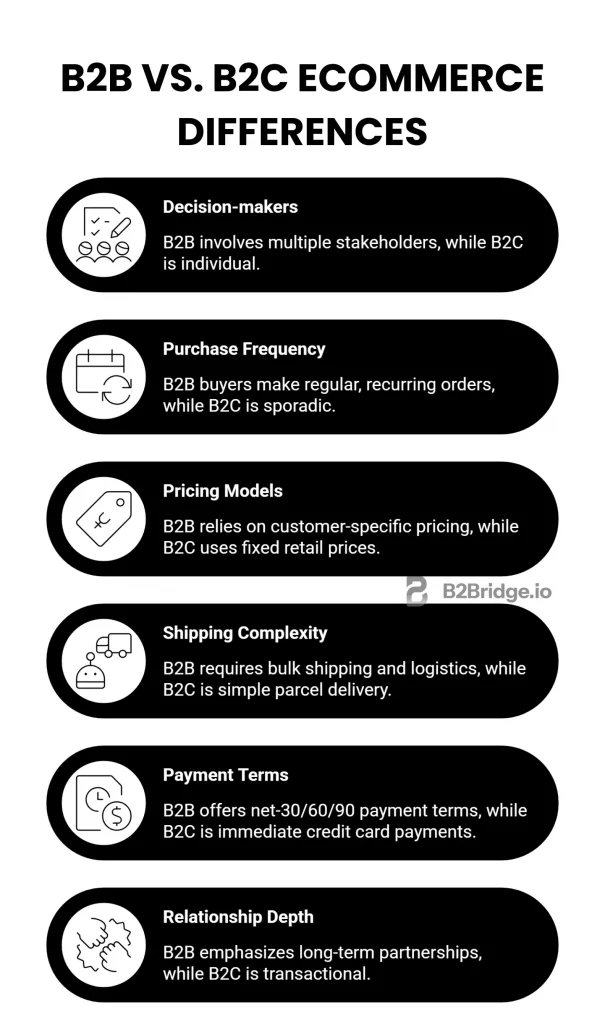
If you’re coming from a retail background, the differences between B2B and B2C ecommerce can feel substantial. Here’s a side-by-side comparison:
| Factor | B2B Ecommerce Model | B2C Ecommerce Model |
|---|---|---|
| Buyer | Businesses, wholesalers, distributors | Individual consumers |
| Order size | High-volume, bulk quantities | Single-unit purchases |
| Pricing | Negotiated, tiered, customer-specific | Fixed, public pricing |
| Payment | Net terms, invoices, credit accounts | Instant card payment |
| Sales cycle | Longer, relationship-driven | Short, transactional |
| Checkout | Quote requests, approval workflows | One-click checkout |
The tools and platform features you’ll want for B2B are fundamentally different from B2C. A B2C store optimizes for impulse purchases. A B2B store optimizes for efficiency, accuracy, and repeat ordering.
Main Types of B2B Ecommerce Models
Businesses typically fall into one or more model types based on their role in the supply chain. Let’s walk through the primary categories.
Manufacturer-Direct Model
In this model, manufacturers sell directly to retailers or business buyers online, bypassing intermediaries entirely. You’ll often see this with custom orders or OEM (original equipment manufacturer) relationships where buyers want products built to specification.
Wholesaler Model
Wholesalers purchase in bulk from manufacturers and resell to retailers or smaller businesses. Volume-based pricing and minimum order quantities (MOQs) are standard here. The more you buy, the better your per-unit cost.
Distributor Model
Distributors act as logistics and sales partners, often holding regional inventory and providing fulfillment services. Distributors bridge the gap between manufacturers and end buyers, handling everything from warehousing to customer support.
Hybrid B2B and B2C Model
A single storefront serves both wholesale buyers and retail consumers. This approach requires customer-group-based pricing visibility and access control. Wholesale prices stay hidden from retail shoppers, while logged-in B2B buyers see their negotiated rates.
B2B2C Model
Here, a business sells through another business to reach end consumers. Think of a brand selling via a retailer’s ecommerce site. Data and branding flow through the chain, and the original seller often maintains some control over the customer experience.
B2B Marketplace Model
Multiple sellers list on a shared platform where buyers can compare and purchase from various vendors. Alibaba, Amazon Business, and Faire are well-known examples. Marketplaces aggregate supply and demand, making them powerful for discovery.
SaaS and Subscription Model
Software or services sold on recurring contracts to business customers fall into this category. Subscription billing, seat-based pricing, and contract renewals define the transaction structure.
>> Read more: B2B Ecommerce for Retailers: Best Platforms Compared
Marketplace-Based B2B Ecommerce Models
Marketplaces deserve a closer look because they come in three distinct orientations. Knowing which one fits your business can shape your entire go-to-market approach.
Supplier-Oriented Marketplace
Also called eDistribution, this model puts the supplier in control. The supplier operates the platform and attracts multiple buyers. A manufacturer’s branded wholesale portal is a classic example.
Buyer-Oriented Marketplace
Sometimes called eProcurement, this model flips the dynamic. A large buyer aggregates suppliers to streamline purchasing. Corporate procurement portals often work this way, consolidating vendor relationships into a single interface.
Intermediary-Oriented Marketplace
Also known as eExchange, this model involves a neutral third party connecting many buyers and many sellers. Alibaba and ThomasNet operate in this space, facilitating transactions without favoring either side.
B2B Ecommerce Model Examples
Real-world examples make B2B ecommerce models concrete:
- Alibaba: An intermediary marketplace connecting global manufacturers with wholesale buyers across industries
- Amazon Business: A hybrid marketplace offering business-only pricing, bulk discounts, and procurement tools alongside consumer products
- McKesson: A distributor model for pharmaceutical and medical supply distribution to healthcare providers
- Grainger: An industrial distributor selling MRO (maintenance, repair, operations) supplies to businesses of all sizes
- Faire: A B2B marketplace connecting independent retailers with wholesale brands, particularly in the home and lifestyle space
Each of these B2B ecommerce website examples has built its model around how its buyers actually purchase.
Benefits of a B2B Ecommerce Model
Why do businesses invest in B2B ecommerce? The B2B ecommerce benefits tend to cluster around a few key areas:
- Higher wholesale revenue: Self-serve ordering increases order frequency and average order value
- Lower operational cost: Automated pricing, ordering, and invoicing reduce manual admin work
- Faster order processing: Digital workflows eliminate email chains and phone orders
- Better buyer retention: Personalized pricing and saved carts encourage repeat purchases
- Stronger data and forecasting: Centralized order data improves inventory planning and demand forecasting
Common Challenges of B2B Ecommerce Models
B2B ecommerce comes with its own set of pain points. You might recognize a few of these:
- Disconnected ERP and CRM systems: Without proper B2B ecommerce integration, orders, pricing, and customer data live in separate systems, causing sync errors and manual reconciliation
- Complex customer-specific pricing: Managing unique price lists for each buyer segment is manual and error-prone without the right tools
- Gated pricing and catalog access: Protecting wholesale prices from retail visitors requires access control features many platforms lack
- Quote-to-order and net terms friction: Without digital RFQ and payment terms, large buyers often abandon checkout
- Running B2B and B2C on separate stores: Maintaining two storefronts doubles operational work and increases the risk of errors
If any of these sound familiar, you’re not alone. And they’re solvable with the right platform approach.
How to Choose the Right B2B Ecommerce Model
Selecting the right model starts with understanding your own operations and defining a clear B2B ecommerce strategy. Here’s a framework to guide your decision:

Step 1: Map your buyer segments and sales channels
Identify who you sell to, whether retailers, distributors, or direct businesses, and how they currently purchase. Are they calling sales reps? Emailing orders? Using a competitor’s portal?
Step 2: Audit your pricing and order rules
Document your wholesale pricing structures: volume discounts, tiered pricing, contract pricing, MOQs. The more complex your pricing, the more you need a robust B2B ecommerce platform.
Step 3: Review your ERP, CRM, and inventory stack
List your existing systems (NetSuite, Zoho, Odoo, etc.) and integration requirements. Seamless data sync is often the difference between a smooth operation and constant firefighting.
Step 4: Define payment, credit, and RFQ requirements
Determine if you want net terms (Net 30/60), invoice billing, or quote-to-order workflows. Enterprise buyers often expect these as standard.
Step 5: Decide between a standalone or hybrid storefront
Choose whether to run a dedicated B2B store, a unified B2B+B2C store, or both. Hybrid models reduce operational overhead but require more sophisticated access controls.
B2B Ecommerce Trends Shaping Modern Models
The landscape is shifting fast. Here’s what’s defining B2B ecommerce heading into 2026:
- AI-powered personalization: Dynamic pricing recommendations and personalized product suggestions based on buyer behavior
- Headless and composable commerce: Decoupled frontend and backend architectures for flexible, customized buyer experiences
- Embedded net terms and B2B payments: Native support for invoice billing, credit lines, and payment terms within checkout
- Self-serve wholesale portals: Buyers increasingly expect to browse, order, and manage accounts without sales rep involvement
- Unified B2B and B2C storefronts: Single stores serving both audiences with role-based pricing and access, eliminating duplicate operations
The leaders in this space aren’t just following trends. They’re building for where buyer expectations are headed.
Operationalizing Your B2B Ecommerce Model with B2Bridge
If you’re running on Shopify and want to add B2B capabilities without a platform migration, B2Bridge embeds enterprise-grade B2B operations directly into your existing store.
Here’s what that looks like in practice:
- B2B Pricing Engine: Customer-specific pricing, volume tiers, contract price lists, and hidden wholesale pricing
- B2B UX: Wholesale Bulk Order, reorder, custom B2B cart, saved cart for later
- ERP and CRM Integration: Sync with NetSuite, Zoho, Odoo, and custom systems via API
- B2B Lock: Gated access to protect wholesale pricing from retail visitors
- B2B Payment: Net terms (Net 15/30/60) and RFQ workflows built into checkout
- Unified B2B+B2C Store: Run both channels on one Shopify store without Shopify Plus

Book a Demo to see how B2Bridge fits your B2B ecommerce model.
Frequently Asked Questions about B2B Ecommerce Models
What is the B2B ecommerce business model?
A B2B ecommerce business model is the framework a company uses to sell products or services to other businesses through online channels, typically involving bulk orders, negotiated pricing, and account-based purchasing.
What is the 95/5 rule for B2B?
The 95/5 rule suggests that only about 5% of your target market is actively buying at any given time. B2B marketing, therefore, focuses heavily on building brand awareness with the 95% who will buy later.
What are the four models of ecommerce?
The four primary ecommerce models are B2B (business-to-business), B2C (business-to-consumer), C2C (consumer-to-consumer), and D2C (direct-to-consumer), each defined by who is selling and who is buying.
What is the difference between B2B, B2C, C2C, and D2C?
B2B involves businesses selling to businesses. B2C involves businesses selling to individual consumers. C2C involves consumers selling to other consumers (like eBay). D2C involves brands selling directly to consumers without intermediaries.
Is wholesale the same as B2B ecommerce?
Wholesale is one type of B2B ecommerce where goods are sold in bulk at discounted prices to retailers or resellers. However, B2B ecommerce also includes other models like distributor sales, manufacturer-direct sales, and SaaS subscriptions.

Hi, I’m Hanh – a product marketing professional passionate about driving growth, simplifying complex solutions, and creating impactful strategies for Shopify that connect products with customers.