B2B ecommerce marketplaces now drive over $6 trillion in global transactions annually, and that number keeps climbing. For manufacturers and distributors, these platforms offer a fast path to wholesale buyers without building an audience from scratch.
But not all marketplaces serve the same purpose, and the wrong choice can mean margin compression, limited brand control, or buyers who never remember your name. This guide breaks down 13 of the best B2B ecommerce marketplaces for manufacturers and distributors, what makes each one work, and how to decide whether a marketplace, your own B2B store, or both fits your operation.
What Is a B2B Ecommerce Marketplace
A B2B ecommerce marketplace is an online platform that connects multiple business buyers and sellers in one place, offering streamlined procurement, bulk pricing, and specialized logistics for wholesale transactions. Platforms like Alibaba, Amazon Business, and Faire bring together manufacturers, distributors, and retailers so businesses can source products, negotiate pricing, and place bulk orders without juggling dozens of supplier relationships.
What sets B2B marketplaces apart from a standard online store is the multi-vendor model. Instead of buying from one brand, you browse catalogs from dozens or hundreds of suppliers on a single platform.
- Request for quote (RFQ): Buyers submit custom pricing requests for large or complex orders
- Bulk ordering: Transactions are built for high-volume purchases, not single units
- Net payment terms: Many platforms offer Net 30, Net 60, or longer invoicing cycles
- ERP integrations: Orders, inventory, and customer data sync with backend systems
How B2B Ecommerce Marketplaces Differ From B2C Marketplaces
If you’ve sold on Amazon or eBay’s consumer side, the B2B world operates on a different rhythm. B2C transactions are typically one-time, fixed-price purchases with immediate payment. B2B, on the other hand, involves longer sales cycles, negotiated pricing, and repeat bulk orders from the same buyers.
| Factor | B2B Marketplace | B2C Marketplace |
|---|---|---|
| Buyer type | Businesses, retailers, distributors | Individual consumers |
| Order size | Bulk, wholesale quantities | Single units |
| Pricing | Negotiated, tiered, customer-specific | Fixed, public pricing |
| Payment | Net terms, invoicing, RFQ | Immediate payment |
| Sales cycle | Longer, relationship-based | Transactional, one-time |
The practical implication here is that your product listings, pricing strategy, and fulfillment workflows all look different when you’re selling to procurement teams rather than individual shoppers.
Types of B2B Ecommerce Marketplaces
Not all B2B marketplaces serve the same purpose. Understanding the categories helps you identify which platforms align with your products and target buyers.
Vertical B2B Marketplaces
Vertical marketplaces focus on a single industry, such as food service, industrial equipment, or fashion wholesale. Because vertical platforms attract buyers already searching for your specific product category, you often see higher purchase intent and less competition from unrelated sellers.
Horizontal B2B Marketplaces
Horizontal platforms like Amazon Business and Alibaba serve multiple industries with diverse product categories. You get broader reach, though you’re also competing with a wider range of sellers across different verticals.
Many-to-Many and One-to-Many Marketplaces
A many-to-many marketplace (like Alibaba) hosts multiple sellers and multiple buyers. A one-to-many model is essentially a branded wholesale portal where a single seller serves many buyers. The first is about discovery, while the second is about control.
Local and Global B2B Marketplaces
Some platforms focus on regional trade, while others facilitate cross-border transactions. Global marketplaces bring logistics, customs, and multi-currency considerations into play, which matters if you’re targeting international distributors.
13 Best B2B Ecommerce Marketplaces for Manufacturers and Distributors
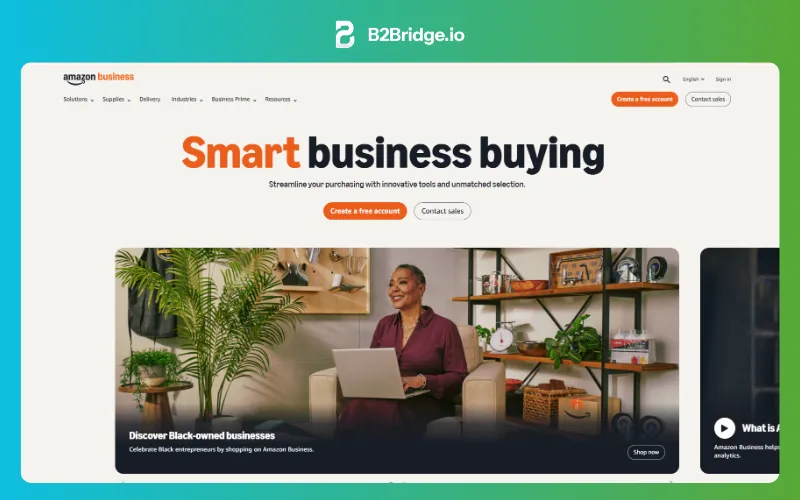
1. Amazon Business
Amazon Business is the largest horizontal B2B marketplace in North America, supporting business pricing, bulk discounts, and tax-exempt purchasing. The platform works particularly well for manufacturers selling commodity or industrial products at scale.
Standout features: Business-only pricing and quantity discounts, integration with procurement systems, Fulfillment by Amazon (FBA) for B2B orders.
2. Alibaba
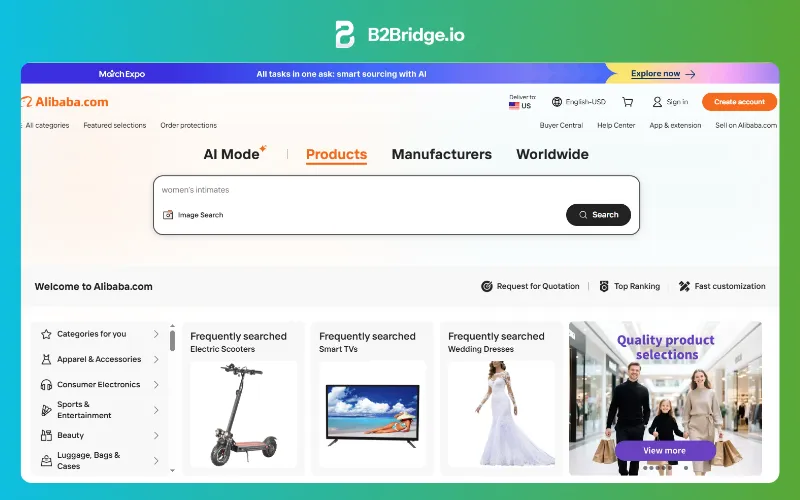
Alibaba connects international buyers with manufacturers worldwide, making it the go-to platform for sourcing and export. If you’re a manufacturer seeking overseas distributors or retailers, Alibaba is where global wholesale happens.
Standout features: Trade Assurance buyer protection, RFQ system for custom orders, global reach across virtually all product categories.
3. Faire
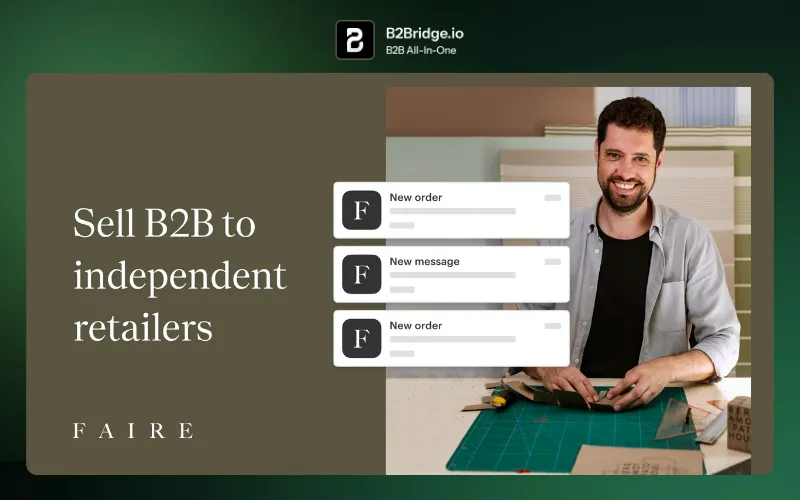
Faire is a curated wholesale marketplace connecting independent retailers with brands and artisans. Known for offering Net 60 terms and free returns to retailers, Faire is ideal for consumer goods manufacturers targeting boutique and indie retail.
Standout features: Net 60 payment terms for retailers, low risk for buyers with free returns, and a curated, brand-focused catalog.
4. Global Sources
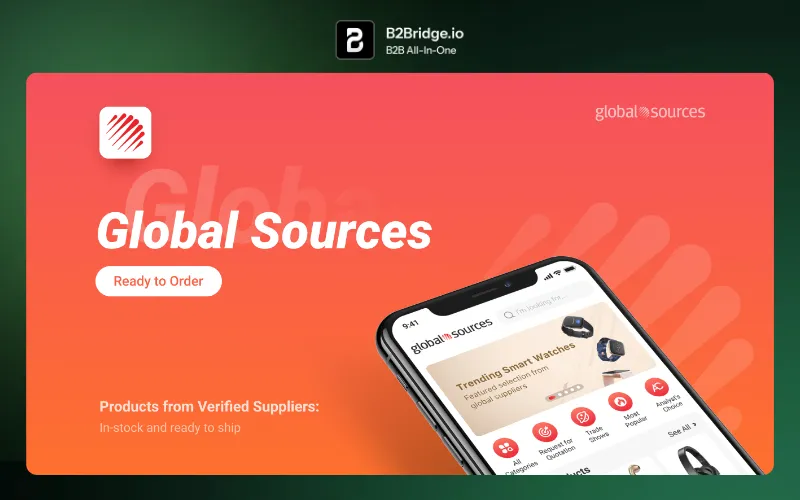
Global Sources is an Asia-based platform focused on verified manufacturers in electronics, fashion, and home products. Distributors seeking vetted Asian suppliers often start here.
Standout features: Supplier verification programs, trade show integration, focus on electronics and consumer goods.
5. ThomasNet
ThomasNet is a leading platform for sourcing industrial products and custom manufacturing in North America. The platform is particularly strong for manufacturers in the industrial and MRO space.
Standout features: Industrial product focus, supplier discovery tools, North American buyer network.

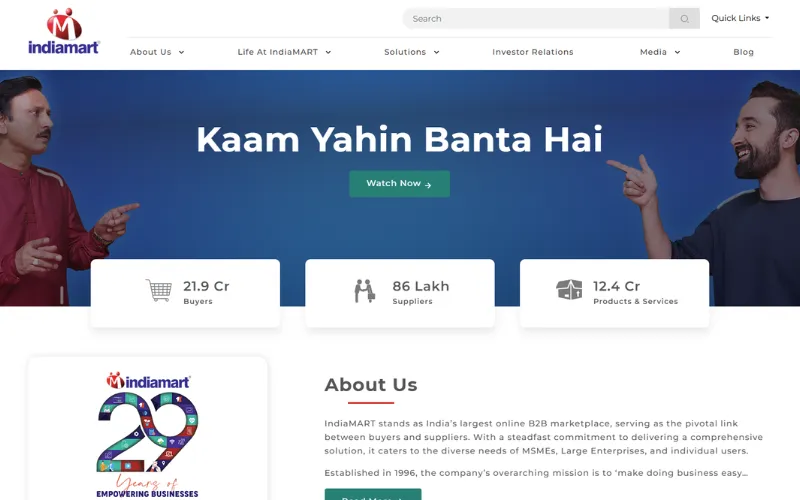
6. IndiaMART
IndiaMART is India’s largest B2B marketplace, connecting buyers with suppliers across manufacturing and industrial categories. The platform is the go-to choice for manufacturers sourcing from or selling into the Indian market.
Standout features: Lead generation model, strong in industrial and raw materials, regional logistics support.
7. DHgate
DHgate is a China-based marketplace for small and medium wholesale orders, with lower minimum order quantities than Alibaba. Distributors testing new suppliers or ordering smaller batches often find DHgate useful.
Standout features: Lower minimum order quantities, escrow payment protection, wide product range.
8. Ankorstore
Ankorstore is a European wholesale marketplace connecting brands with independent retailers across the continent. Consumer goods manufacturers expanding into European retail will find a strong retailer network here — Ankorstore is one of several leading B2B marketplaces in Europe worth evaluating.
Standout features: European retailer network, net payment terms for buyers, brand-first positioning.

9. Joor
Joor is a wholesale fashion marketplace connecting brands with global retailers through a digital showroom model. Apparel and accessories manufacturers selling to fashion retailers use Joor to manage orders and showcase collections.
Standout features: Virtual showroom functionality, order management for fashion wholesale, global retailer network.

10. Tundra
Tundra (Wholesale in box) is a commission-free wholesale marketplace for North American brands and retailers. Emerging brands seeking margin-friendly marketplace exposure appreciate the no-fee model.
Standout features: No commission fees for sellers, curated brand catalog, net terms for qualified retailers.

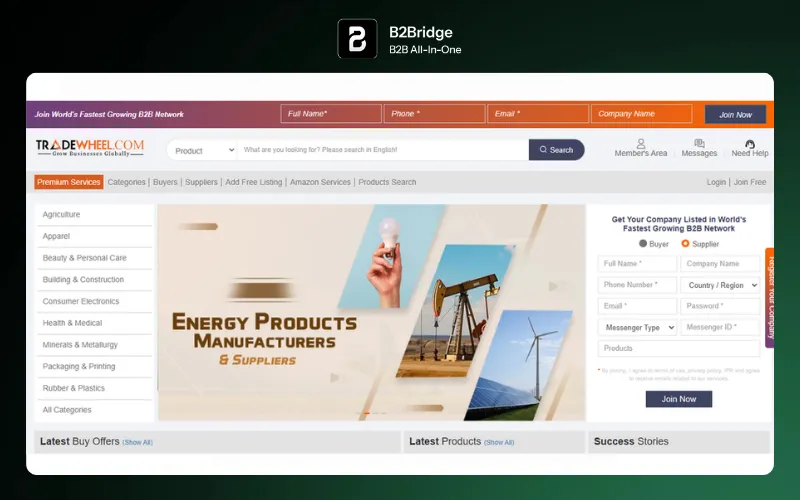
11. TradeWheel
TradeWheel connects manufacturers with international buyers, with a focus on verified suppliers and export opportunities.
Standout features: Supplier verification, RFQ functionality, multi-industry coverage.
12. EC21
EC21 is a Korea-based global marketplace connecting suppliers with international buyers, with particular strength in the Asia-Pacific region.
Standout features: Trade lead system, Asia-Pacific buyer network, product catalog listings.

13. Mirakl
Mirakl is a B2B marketplace platform, not a marketplace itself, that powers enterprise marketplaces for brands and retailers. Manufacturers wanting to launch their own branded marketplace use Mirakl’s white-label technology.
Standout features: White-label marketplace technology, enterprise-grade scalability, used by major B2B brands.

Best B2B Wholesale Marketplaces for Small Businesses
The best B2B wholesale marketplaces for small businesses are Faire, Tundra, Ankorstore, and DHgate — platforms built around low minimum order quantities, net payment terms, and curated catalogs, so you can start sourcing or selling without enterprise-level volume.
Small businesses buy and sell differently than large distributors. Tight cash flow, smaller order sizes, and limited upfront capital mean the right marketplace is one that lowers the barrier to the first order rather than rewarding bulk scale. Here’s where each fits:
- Faire — best for independent retailers and consumer-goods brands. Net 60 terms and free returns remove the risk of testing new products.
- Tundra — commission-free wholesale, so emerging brands keep full margin on every order.
- Ankorstore — strong European retailer network with net terms, ideal for small brands expanding into EU retail.
- DHgate — lower minimum order quantities than Alibaba, useful for small distributors testing suppliers in smaller batches.
As a small business grows, marketplace fees and limited brand control start to eat into margin. That’s usually the point where sellers add a direct B2B channel on their own Shopify store — keeping customer relationships and pricing under their control — and run it alongside the marketplace rather than depending on one platform.
Benefits of Selling on a B2B Ecommerce Marketplace
Why do manufacturers and distributors list on B2B marketplaces in the first place? The advantages are tangible:
- Instant buyer access: You tap into an existing pool of verified business buyers actively searching for products
- Reduced customer acquisition cost: The marketplace handles traffic and discovery, so you focus on fulfillment
- Built-in trust signals: Buyer reviews, platform verification, and escrow reduce friction for new relationships
- Operational support: Many platforms offer fulfillment, payment processing, and logistics integration
For manufacturers without an established online presence, marketplaces provide a fast path to wholesale revenue.
Challenges of Selling on B2B Ecommerce Marketplaces
Marketplaces come with trade-offs. Here’s what to weigh before committing:
- Margin compression: Commissions and fees reduce your wholesale profit margin
- Limited brand control: Your storefront follows the marketplace’s template, and buyers may not remember your brand
- Price competition: Competing sellers can undercut you, leading to price wars
- Dependency risk: Platform policy changes or account suspensions can disrupt your revenue overnight
- Customer data ownership: You often lack direct access to buyer contact information for remarketing
Because of limitations like margin compression and limited brand control, many manufacturers eventually add a direct B2B channel alongside their marketplace presence.
How to Choose the Right B2B Ecommerce Marketplace
Selecting a platform comes down to fit. Here’s what to evaluate:
Buyer Audience and Vertical Fit
Does the marketplace’s buyer base match your target customers? A niche vertical platform may outperform a general horizontal one for specialized products.
Commission, Fees, and Payment Models
Compare fee structures against your margin. Subscription models may be cheaper at high volume, while commission models may work for lower volume.
ERP and CRM Integration
Integration matters because syncing orders, inventory, and customer data reduces manual work and errors. Ask whether the marketplace supports API connections to your existing systems.
Net Terms, RFQ, and Wholesale Pricing Support
Check if the platform supports B2B-specific payment flows like Net 30/60 terms, request for quote, and tiered volume pricing. Payment flexibility is often essential for wholesale buyers.
B2B Ecommerce Marketplace vs Your Own B2B Store on Shopify
At some point, you’ll ask: when does it make sense to run your own B2B channel instead of, or alongside, marketplaces?
Brand Ownership and Buyer Relationships
On your own store, you own the customer relationship and data. On a marketplace, the platform sits between you and the buyer. The long-term value of direct relationships compounds over time.
Pricing, Net Terms, and RFQ Control
Your own store lets you set customer-specific pricing, offer net terms to select buyers, and run RFQ workflows tailored to your sales process. Marketplaces standardize payment and pricing flows.
| Factor | B2B Marketplace | Your Own B2B Store |
|---|---|---|
| Customer data | Platform owns | You own |
| Pricing control | Limited, competitive | Full, customer-specific |
| Brand experience | Templated | Fully customizable |
| Fees | Ongoing commissions | Platform/app subscription |
| Net terms/RFQ | Platform-dependent | You control |
For high-volume sellers, owned channels often yield better margins over time.
Run a Frictionless B2B Channel Alongside Marketplaces With B2Bridge
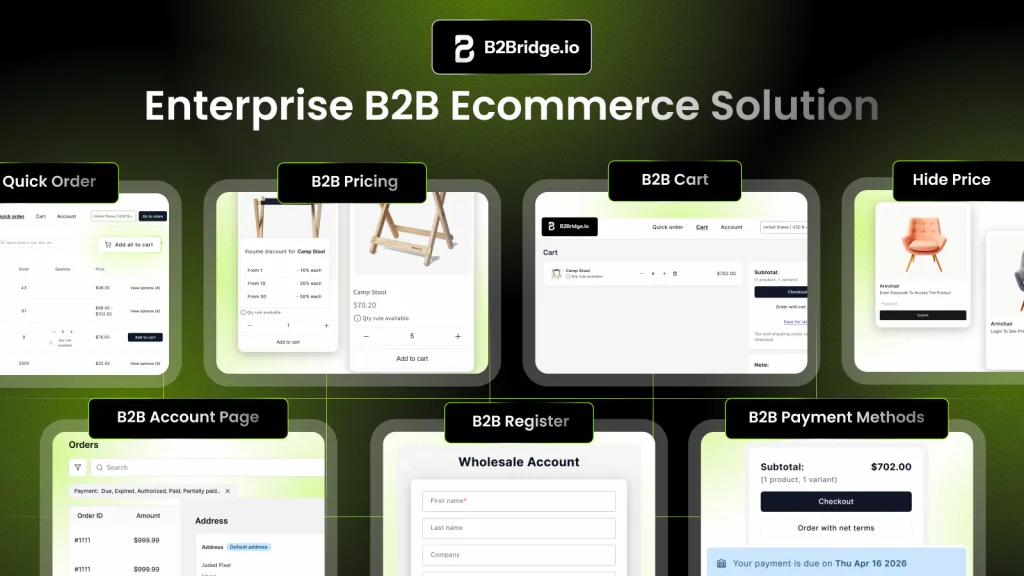
If you’re ready to build a direct B2B sales channel on Shopify that complements your marketplace presence, B2Bridge embeds enterprise-grade B2B operations directly into Shopify. You can run wholesale without splitting work across multiple systems.
- ERP and CRM integration: Sync pricing, customers, and orders with NetSuite, Zoho, Odoo, or custom systems
- Advanced B2B pricing engine: Set customer-specific, volume-based, and contract pricing without spreadsheets
- Net terms and RFQ workflows: Offer flexible payment options and quote-to-order flows for large buyers
- Unified B2B + B2C on Shopify: Run wholesale and retail from one store without Shopify Plus
Book a Demo to see how B2Bridge helps manufacturers and distributors launch a B2B channel on Shopify.
Frequently Asked Questions About B2B Ecommerce Marketplaces
What are the best B2B wholesale marketplaces?
The best B2B wholesale marketplaces are Alibaba (global sourcing), Amazon Business (North American reach), Faire (independent retailers), Global Sources and IndiaMART (verified manufacturers), and DHgate (lower minimum orders). The right choice depends on your industry, buyer location, and order size — vertical marketplaces often convert better than general ones for specialized products.
What is the best B2B marketplace for small businesses?
For most small businesses, Faire is the best starting point thanks to net 60 terms, free returns, and a curated catalog aimed at independent retailers. Brands wanting to keep full margin often prefer Tundra (commission-free), while small distributors sourcing in smaller batches favor DHgate for its low minimum order quantities.
What is the largest B2B ecommerce marketplace in the world?
Alibaba.com is widely recognized as the world’s largest B2B ecommerce marketplace, connecting millions of buyers and suppliers across virtually every product category globally.
Is Shopify a B2B marketplace?
Shopify is not a marketplace. Shopify is a B2B ecommerce platform that lets you build your own B2B or B2C online store. With apps like B2Bridge, you can add enterprise B2B features like customer-specific pricing, net terms, and RFQ to your Shopify store.
Can you sell on a B2B marketplace and run your own B2B store at the same time?
Yes. Many manufacturers and distributors use marketplaces for discovery and lead generation while operating their own B2B store for direct sales and better margins. A multi-channel approach reduces dependency on any single platform.
How do sellers get paid on a B2B ecommerce marketplace?
Payment terms vary by platform. Some marketplaces process payments immediately and remit funds after a holding period, while others support net terms where the marketplace or a financing partner extends credit to buyers. Always review the platform’s payment policies and fee structure before listing.

As a Product Marketing Executive at B2Bridge, I focus on the Enterprise B2B Ecommerce domain. I leverage my understanding of product and user psychology to deliver customer-centric content that addresses business challenges and fuels growth.