Shopify and OroCommerce sit at opposite ends of the B2B ecommerce spectrum. One prioritizes speed and simplicity with a hosted SaaS model, while the other offers open-source flexibility for teams willing to manage their own infrastructure.
The platform you choose shapes everything from implementation timeline to long-term operational costs. This guide breaks down the 10 differences that matter most for wholesale operations, including pricing logic, deployment models, and total cost of ownership.
What Is Shopify
Shopify is a hosted SaaS ecommerce platform powering over 4 million online stores. It handles hosting, security, and payment processing automatically, so you focus on selling rather than managing servers.
Originally built for direct-to-consumer brands, Shopify has expanded into B2B — with B2B sales surging 109% year-over-year in Q1 2025 — through Shopify Plus and a large ecosystem of third-party apps. For wholesale operations, Shopify Plus unlocks native B2B features like customer-specific catalogs and company accounts. Meanwhile, merchants on standard Shopify plans can achieve similar functionality through specialized apps, making enterprise-grade B2B accessible without the Plus price tag.

What Is OroCommerce
OroCommerce is an open-source B2B ecommerce platform designed specifically for complex wholesale operations. Built by the team behind OroCRM, it targets manufacturers, distributors, and multi-channel wholesalers who require deep customization and native B2B workflows.
Unlike platforms that added B2B as an afterthought, OroCommerce includes features like corporate account hierarchies, RFQ management, and workflow automation out of the box. The trade-off is that you’ll typically require technical resources to deploy and maintain it, since OroCommerce is self-hosted or requires managed cloud infrastructure.

Shopify vs OroCommerce at a Glance
Before diving into specifics, here’s a quick comparison across the dimensions that matter most for B2B operations:
| Feature | Shopify | OroCommerce |
|---|---|---|
| Deployment model | Hosted SaaS | Self-hosted or cloud |
| Target audience | B2C + hybrid B2B/B2C | B2B-only operations |
| Native B2B capabilities | Limited (Plus or apps required) | Comprehensive out of the box |
| Pricing model | Monthly subscription + transaction fees | Open-source (free) or Enterprise license |
| Customization level | App-based extensibility | Full source code access |
| Time to launch | Days to weeks | Months |
| Best for | Brands wanting speed and simplicity | Complex B2B with dedicated dev teams |
10 Key Differences Between Shopify and OroCommerce for B2B Wholesale
The comparison table gives you the overview. Now let’s break down each difference so you can evaluate which platform fits your wholesale operation.
1. Deployment Model and Hosting
Shopify operates as a fully hosted platform, meaning you never touch a server. Updates, security patches, and infrastructure scaling happen automatically.
OroCommerce follows an open-source model. The code is freely available, but you’re responsible for hosting, server maintenance, and security. “Open-source” means you can modify any part of the platform, though that flexibility comes with operational overhead. Some merchants opt for OroCommerce’s managed cloud offering, but even then, technical staff or an agency partner is typically involved.
Takeaway: If your team lacks dedicated developers, Shopify’s managed approach removes significant complexity.
2. B2B Pricing and Customer Group Logic
Pricing flexibility often makes or breaks a B2B platform decision — 33% of B2B buyers express frustration when platforms fail to display their negotiated contract pricing. OroCommerce includes native price lists, customer group pricing, and contract-specific rates without additional configuration. You can set different prices for distributors versus retailers versus VIP accounts directly in the admin.
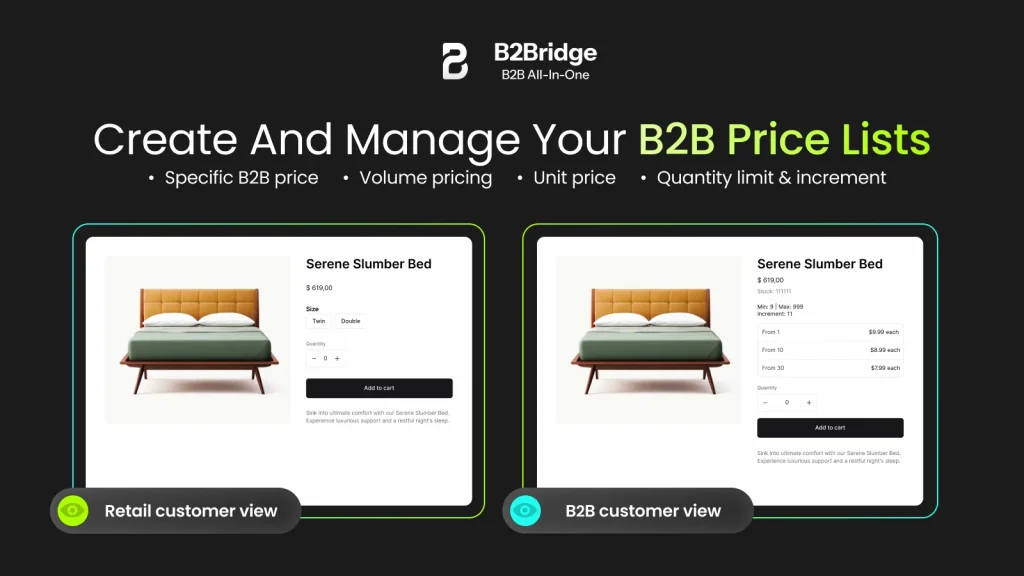
Shopify’s native B2B pricing requires a Plus subscription. Standard Shopify merchants can achieve the same functionality through apps like B2Bridge that layer enterprise pricing logic onto any Shopify plan:
- Customer-specific pricing: Set unique prices per account or customer group
- Volume tiers: Automatically apply discounts based on quantity thresholds
- Hidden wholesale rates: Keep B2B pricing invisible to retail visitors
3. Catalog and Product Management
OroCommerce handles complex product hierarchies, configurable products, and detailed attribute management natively. For manufacturers with thousands of SKUs and intricate product relationships, this depth matters.

Shopify’s catalog system is simpler by design, with variants limited to three options per product. That said, most wholesale operations find Shopify’s structure sufficient, especially when combined with metafields and apps that extend product data capabilities.

4. RFQ and Quote-to-Order Workflows
Request for Quote (RFQ) workflows let buyers submit pricing requests for large or custom orders, which your team then reviews and converts into orders. OroCommerce includes RFQ natively. Buyers request quotes, sales reps respond with custom pricing, and the entire negotiation lives within the platform.
Shopify doesn’t offer native RFQ functionality. However, apps can add complete quote-to-order workflows, including draft order conversion and approval processes, without requiring Shopify Plus.

5. Net Payment Terms and B2B Checkout
Business buyers expect to pay on terms — 78% cite payment terms as a key consideration. Net 30, Net 60, sometimes Net 90. This means buyers receive goods now and pay by invoice later, which is standard practice in wholesale but foreign to typical retail checkout.
OroCommerce supports payment terms natively within its checkout flow. Shopify also supports net payment terms natively on all plans via Shopify B2B without a third-party app. Deposit requirements, partial payments, and payment requests per fulfillment are Plus-only. Apps like B2Bridge can extend these workflows for non-Company-based segments or custom invoice flows.
6. ERP and CRM Integration
OroCommerce comes bundled with OroCRM, giving you native customer relationship management. For ERP connections, you’ll typically require custom development or middleware, though the platform’s API is robust.
Shopify takes an ecosystem approach. There’s no native CRM, but a massive app marketplace and well-documented APIs exist for connecting to NetSuite, Zoho, Odoo, QuickBooks, and custom ERPs. For many merchants, this flexibility actually simplifies integration since you choose the tools that match your existing stack.
7. Hybrid B2B and B2C Storefronts
Here’s where Shopify genuinely shines. Running both wholesale and direct-to-consumer from a single storefront is straightforward. You can show different prices, products, and checkout options based on whether a visitor is a logged-in B2B buyer or a retail customer.
OroCommerce was built exclusively for B2B. If you also sell direct to consumers, you’d require a separate platform for that channel, which means managing two storefronts, two inventories, and two sets of operational workflows.
8. Customization and Developer Effort
OroCommerce offers unlimited customization since you have full access to the source code. Want to modify checkout logic, build custom workflows, or restructure the entire buyer portal? You can. The catch: you’ll require PHP developers familiar with the Symfony framework.
Shopify’s customization happens through apps, theme modifications, and Shopify Functions. You won’t rewrite core platform logic, but for most B2B use cases, the combination of apps and Liquid templating provides sufficient flexibility without requiring a development team on staff.
9. Time to Launch and Implementation Cost
Shopify implementations typically measure in days or weeks. You can have a functional B2B store live within a week if you’re working with the right apps and have your product data ready.
OroCommerce implementations commonly take three to six months, sometimes longer for complex deployments. The platform’s power comes with setup complexity, and you’ll likely require an implementation partner to configure workflows, integrations, and customizations properly.
10. Scalability and Total Cost of Ownership
Long-term costs diverge significantly between platforms. Shopify charges monthly subscriptions plus transaction fees (unless you use Shopify Payments), with app costs adding to the total. The model is predictable and scales with your revenue.
OroCommerce’s open-source edition has no licensing fees, but you’ll pay for hosting, security, maintenance, and developer time. Enterprise Edition requires licensing. For many mid-market businesses, OroCommerce’s total cost of ownership actually exceeds Shopify’s when you factor in infrastructure and development resources.
Shopify vs OroCommerce Pricing and Total Cost of Ownership
Understanding the full cost picture helps you budget accurately.
Shopify costs include:
- Monthly subscription ($29–$299 for standard plans; $2,300+/month for Plus)
- Transaction fees (0.5%–2% unless using Shopify Payments)
- App subscriptions for B2B functionality
- Theme customization (one-time or ongoing)
OroCommerce costs include:
- Hosting infrastructure (varies based on traffic and requirements)
- Development and maintenance (ongoing)
- Implementation partner fees for initial setup
- Enterprise Edition licensing (if applicable)
Takeaway: Shopify’s costs are more predictable and front-loaded into subscriptions. OroCommerce can appear cheaper initially but often costs more when you account for technical resources.
Pros and Cons of Shopify and OroCommerce for B2B
Shopify
| Pros | Cons |
|---|---|
| Fast setup and time to market | Limited native B2B without Plus or apps |
| Large app ecosystem for extending functionality | Less customizable than open-source |
| Strong foundation for hybrid B2B/B2C | Transaction fees apply |
| No technical maintenance required | Variant limitations for complex products |
OroCommerce
| Pros | Cons |
|---|---|
| Purpose-built for complex B2B operations | Longer implementation timeline |
| Deep customization with full source access | Requires dedicated technical resources |
| No transaction fees | Higher total cost of ownership for most |
| Native RFQ and workflow automation | B2B-only (no hybrid B2C support) |
When to Choose Shopify vs OroCommerce
Choose Shopify if You Run Hybrid B2B and B2C
Shopify makes sense when you’re selling to both wholesale buyers and retail consumers, when speed to market matters more than deep customization, when your team lacks dedicated developers, or when you want predictable monthly costs.
You might assume Shopify can’t handle enterprise B2B requirements, but that’s increasingly untrue. Apps like B2Bridge add customer-specific pricing, net payment terms, RFQ workflows, and gated wholesale access to any Shopify plan, not just Plus.
Choose OroCommerce if You Need Open Source Customization
OroCommerce fits when you operate B2B-only with no consumer sales, when you have dedicated PHP developers or an agency partner, when you require deep customization that apps can’t provide, or when on-premise hosting is a compliance requirement.
Shopify Plus vs OroCommerce for Enterprise B2B
At the enterprise tier, Shopify Plus unlocks native B2B features including company accounts, customer-specific catalogs, and quantity rules. It’s a significant upgrade from standard Shopify for wholesale operations.
OroCommerce Enterprise Edition adds advanced workflow automation, enhanced support, and additional security features beyond the open-source version.
The key difference remains: Shopify Plus gives you enterprise B2B within a managed ecosystem, while OroCommerce Enterprise gives you maximum control with maximum responsibility. For merchants who want enterprise capabilities without managing infrastructure, Shopify Plus combined with specialized B2B apps often delivers the best balance.
>> See more: 7 Shopify Plus B2B Alternatives for Wholesalers in 2026
Top Shopify and OroCommerce Alternatives for B2B Ecommerce
BigCommerce B2B Edition
BigCommerce offers native B2B functionality including customer group pricing, quote management, and company accounts. It sits between Shopify’s simplicity and OroCommerce’s complexity, appealing to mid-market brands wanting more built-in B2B features without self-hosting.
Adobe Commerce
Formerly Magento, Adobe Commerce provides extensive customization for enterprise B2B operations. Like OroCommerce, it requires significant technical resources but offers deep flexibility for complex catalog and pricing requirements.
Salesforce B2B Commerce
Salesforce’s B2B offering integrates tightly with Salesforce CRM, making it attractive for organizations already invested in the Salesforce ecosystem. It’s enterprise-priced and enterprise-complex, best suited for large organizations with existing Salesforce infrastructure.
Choosing the Right B2B Ecommerce Platform for Your Wholesale Business
The right platform depends on your specific operation, not on which platform has the longest feature list. Consider evaluating your B2B pricing complexity, assessing your technical resources, factoring in hybrid B2B/B2C requirements, reviewing time to launch priorities, and calculating total cost of ownership including hosting, development, apps, and ongoing maintenance.
For Shopify merchants who want enterprise B2B capabilities without platform migration, B2Bridge provides the pricing engine, net terms, RFQ workflows, and access controls that wholesale operations require, all within your existing Shopify store.

Book a Demo to see how B2Bridge can add enterprise B2B functionality to your Shopify store.
Frequently Asked Questions About Shopify vs OroCommerce
Is OroCommerce better than Shopify for B2B wholesale operations?
OroCommerce offers deeper native B2B features for complex wholesale operations, while Shopify provides faster implementation and stronger hybrid B2B/B2C capabilities. When paired with specialized B2B apps, Shopify can match most of OroCommerce’s functionality with significantly less technical overhead.
Can Shopify handle enterprise B2B without upgrading to Shopify Plus?
Yes. Shopify merchants can add enterprise-grade B2B features like customer-specific pricing, net terms, and RFQ workflows through third-party apps without requiring a Shopify Plus subscription.
How long does it typically take to migrate from OroCommerce to Shopify?
Migration timelines vary based on catalog size and customization complexity. Shopify implementations typically complete in weeks rather than months, though data migration and app configuration add time depending on your current setup’s complexity.
Does OroCommerce offer native integration with NetSuite and Zoho ERPs?
OroCommerce provides API capabilities for ERP integration, but connecting with systems like NetSuite or Zoho typically requires custom development or third-party middleware solutions.
Which platform offers better security for enterprise B2B transactions?
Both platforms provide enterprise-grade security. Shopify manages security automatically as a hosted platform with PCI compliance built in. OroCommerce requires your team to maintain security protocols, apply patches, and manage compliance for self-hosted deployments.

As a Product Marketing Executive at B2Bridge, I focus on the Enterprise B2B Ecommerce domain. I leverage my understanding of product and user psychology to deliver customer-centric content that addresses business challenges and fuels growth.