Volume pricing is a price reduction offered to buyers who purchase large quantities—the more units ordered, the lower the per-unit cost. It’s one of the most common pricing mechanisms in wholesale and B2B, used by manufacturers, distributors, and retailers to incentivize bigger orders.
This guide covers how volume discount pricing work in B2B sales, the main types and structures, how to calculate them without eroding margins, and how to implement them in Shopify for wholesale operations.

What is Volume Pricing
A volume discount is a price reduction offered to buyers who purchase large quantities of goods. The more units someone orders, the less they pay per item. Typical discounts range from 5% to 25% depending on the quantity tier and industry.
Manufacturers, distributors, and wholesalers use volume discounts to move inventory faster and reward buyers who commit to larger orders. For the buyer, it means lower per-unit costs. For the seller, it means bigger orders and stronger relationships with repeat customers.
In B2B, volume discounts are standard practice. Without them, there’s little reason for a retailer or distributor to place a large order instead of buying just what they need for the week. Here’s a simple example of a B2B volume discount table:
| Order Quantity | Discount | Price per Unit |
|---|---|---|
| 1–49 units | — | $100 |
| 50–99 units | 5% | $95 |
| 100–249 units | 10% | $90 |
| 250–499 units | 15% | $85 |
| 500+ units | 20% | $80 |
How Volume Pricing Work in B2B Sales
The seller sets quantity thresholds, and when a buyer’s order reaches one of those thresholds, a discount applies. This can happen automatically at checkout or through a negotiated price list.
B2C discounts tend to be flat promotions available to everyone. B2B volume discounts work differently—they’re often tied to customer groups, contracts, or account-specific pricing. Two buyers placing the same order might see different prices based on their relationship with the seller.
- Threshold-based: The discount triggers when the order meets a minimum quantity
- Customer-specific: Different buyers receive different volume tiers based on their contract or customer group
- Automated or manual: Discounts can apply at checkout or through quote workflows for larger deals
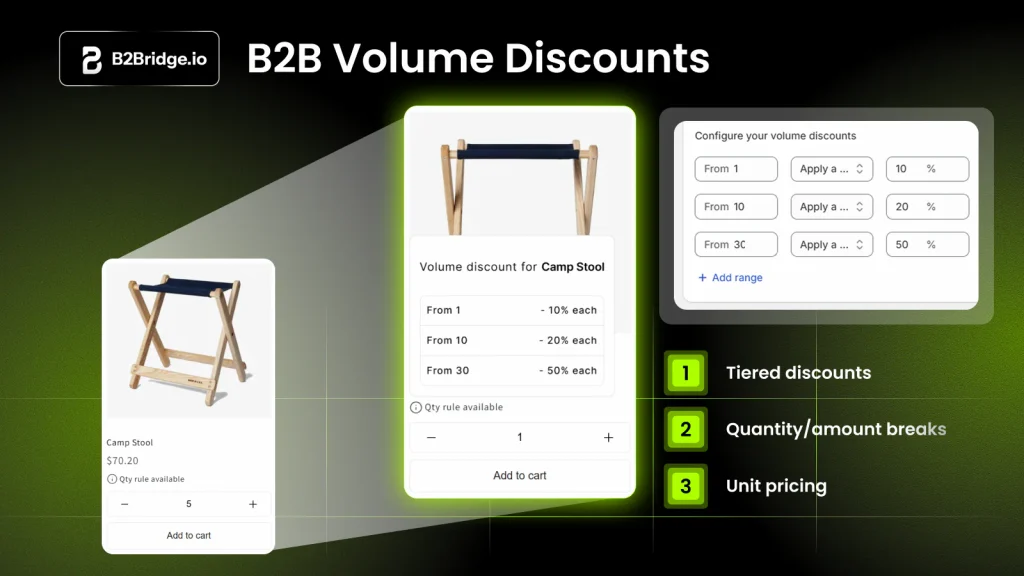
Model & Volume discount pricing formula
The right structure depends on your products, your buyers, and how you want to shape purchasing behavior.
Tiered Volume Pricing Formula
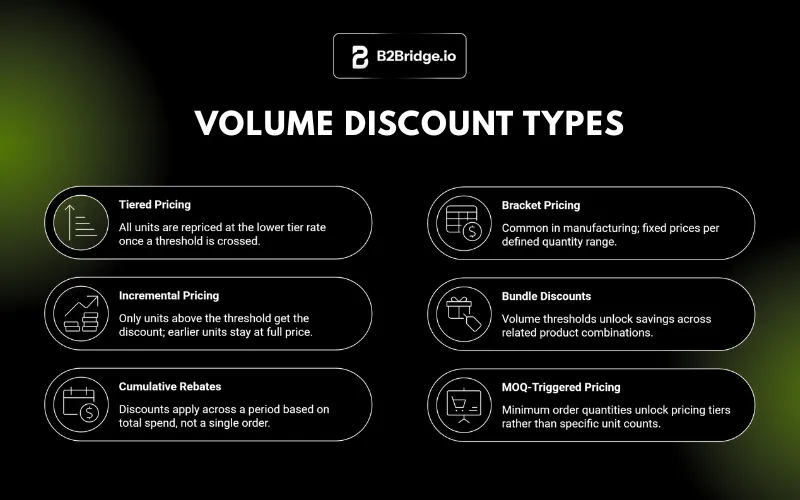
With tiered pricing, different discount rates apply to specific quantity ranges. Units 1–50 might be full price, units 51–100 get 10% off, and units 101+ get 15% off.
| Quantity Range | Price Per Unit |
|---|---|
| 1–50 | $10.00 |
| 51–100 | $9.00 |
| 101+ | $8.50 |
Each tier has its own per-unit price, so the buyer pays different rates for units in each range.

Threshold Volume Discounts
Unlike tiered pricing, threshold discounts apply a single lower rate to the entire order once the buyer crosses a quantity threshold. If the threshold is 100 units and the buyer orders 100, all 100 units get the discounted price—not just the units above 99.
Package and Bundle Volume Discounts
Package discounts apply to predefined packs or bundled items. Buying a case of 12 for a set price, or purchasing a kit with multiple SKUs at a reduced total, falls into this category. Case packs are common in food, beverage, and consumer goods distribution.
Cumulative Volume Discounts
Cumulative discounts reward total purchases over a period—a quarter or a year, for example. A buyer who purchases $50,000 over six months might qualify for a retroactive discount or credit toward future orders. ERP or CRM systems typically track cumulative volume and apply the discount accordingly.
How to Calculate a Volume Discount
Getting the math right protects your margins while still offering attractive pricing.
Step 1: Set your base price and margin floor
Start with your standard unit price. Then calculate your wholesale profit margin to determine the lowest price you can offer without losing money—your margin floor. This is the line you won’t cross regardless of order size.
Step 2: Define quantity tiers
Decide where your discount breakpoints will be. Align tiers with how your buyers actually order. If most customers buy in cases of 24, your tiers might be 24, 48, and 96 units rather than arbitrary round numbers.
Step 3: Apply the discount formula per tier
The basic formula: Discounted Price = Base Price × (1 − Discount Percentage)
If your base price is $20 and you’re offering 15% off at a certain tier, the discounted price is $20 × 0.85 = $17.
Step 4: Model total revenue and margin impact
Before publishing your tiers, calculate expected revenue at each level. A 20% discount sounds generous, but if it drops you below your margin floor on high-volume orders, you’re losing money at scale.
Volume Pricing Examples for Wholesale and B2B
Concrete examples make volume discount structures easier to apply.
Tiered Pricing Example
A lighting distributor sells LED bulbs with the following tier structure:
| Quantity | Price Per Unit | Discount |
|---|---|---|
| 1–49 | $8.00 | 0% |
| 50–99 | $7.20 | 10% |
| 100+ | $6.40 | 20% |
A buyer ordering 75 units pays $8.00 for the first 49 and $7.20 for units 50–75.
Threshold Pricing Example
The same distributor might offer threshold pricing instead: any order of 100+ units gets a flat $6.40 per unit across the entire order. All 100 units receive the same discount, not just the ones above 99.
Contract-Based Volume Pricing Example
A manufacturing customer with a long-term agreement might have a negotiated price list separate from standard tiers. Their contract specifies $5.80 per unit regardless of quantity—a rate unavailable to other buyers.
Benefits of Offering Volume Discounts Pricing
- Larger average order value: Buyers add more units to qualify for better pricing, increasing order size without additional acquisition cost
- Stronger customer retention: Cumulative discounts and negotiated pricing encourage repeat orders
- Faster inventory turnover: Bulk orders move inventory quickly, reducing holding costs that typically run 20%–30% of inventory value annually
- Competitive positioning: Structured volume pricing signals professionalism and differentiates you from competitors with flat pricing
Disadvantages and Risks of Volume Discounts
- Margin erosion: Aggressive discounts without margin modeling can reduce profitability on high-volume orders
- Brand devaluation: Over-reliance on discounts can train buyers to wait for deals or perceive products as lower value
- Channel conflict: If wholesale prices leak to retail customers, it undermines B2C pricing
- Operational complexity: Managing multiple price lists and customer-specific contracts adds administrative burden
Volume Discount vs Bulk Discount vs Tiered Pricing
| Term | Definition | Best For |
|---|---|---|
| Volume Discount | Price reduction based on quantity purchased | General B2B and wholesale |
| Bulk Discount | Often synonymous with volume discount; emphasizes large single orders | One-time large purchases |
| Tiered Pricing | Different rates for different quantity ranges | Complex pricing with multiple breakpoints |
In practice, “bulk discount” and “volume discount” usually mean the same thing. Tiered pricing is a specific structure within volume discounting where each quantity range has its own rate.
Volume Discount vs Volume Rebate
A volume discount reduces the price at the point of sale—the buyer sees the lower price on their invoice. A rebate is paid after purchase, often retroactively based on total volume over a quarter or year.
Rebates require tracking and reconciliation, which adds administrative overhead. Volume discounts are simpler to implement but less flexible for rewarding cumulative purchasing behavior over time.
Are Volume Discounts Legal
Volume discounts are legal when applied consistently and not used to unfairly exclude competitors or harm specific buyers.
In the United States, the Robinson-Patman Act requires that discounts be available on equal terms to competing buyers—as reinforced by the FTC’s first enforcement action in decades targeting volume discount structures that favored large buyers. You can offer different pricing to different customer groups, but the criteria for qualification need to be consistent and defensible. This is not legal advice—consult with counsel if you’re structuring complex discount programs, particularly as senators have urged renewed enforcement in 2026.
How to Set Up a Volume Pricing Strategy
Step 1: Segment customers into groups
Create customer groups based on buyer type—distributor, retailer, VIP, or new account. Each group can have different volume tiers and qualification thresholds.
Step 2: Build price lists for each segment
Develop separate price lists with volume-based pricing for each customer group. This keeps pricing organized and easy to update.
Step 3: Configure quantity tiers and MOQs
Define minimum order quantities (MOQs) and case pack rules. If you sell in cases of 12, your tiers might require orders in multiples of 12 to qualify for discounts.
Step 4: Document eligibility and approval rules
Establish clear criteria for which customers qualify for volume discounts. Document this for your sales team and for compliance purposes.
Step 5: Automate pricing in your storefront and ERP
Manual pricing is error-prone at scale. B2B ecommerce tools can apply volume discounts automatically at checkout and sync with your ERP for accurate invoicing.
Common Mistakes With Volume Discount Pricing
- Discounting without margin modeling: Offering discounts without calculating the impact on profitability leads to margin erosion
- Exposing wholesale prices to retail customers: Failing to hide B2B pricing from B2C shoppers creates channel conflict
- Ignoring MOQs and case pack rules: Volume discounts without minimum order enforcement can result in unprofitable small orders
- Skipping ERP and CRM sync: Manual price management leads to errors and inconsistent pricing across channels
Managing Volume Discounts in Shopify B2B
Shopify can handle volume discounts, but B2B operations typically require capabilities beyond what’s available out of the box. All-in-one apps like Vitals offer volume discount features alongside 40+ other conversion apps, such as reviews, bundles, upsells, popups, and discount offers in one single subscription.
- Customer group-based pricing: Buyers can be assigned to groups with unique price lists, so each group sees its contracted volume tiers at checkout
- Quantity rules and case packs: Minimum and maximum order quantities, increments, and case pack sizes can be enforced
- Hiding B2B prices from B2C shoppers: Wholesale pricing remains invisible to retail visitors—only logged-in, approved B2B buyers see volume discounts
- Syncing volume tiers with your ERP: Integrating Shopify with your ERP keeps price lists, customer groups, and order data aligned
With B2Bridge, you can create flexible volume discounts based on order quantity or cart value, helping you encourage larger wholesale orders while keeping pricing consistent across customer groups. Set tiered pricing rules, apply discounts per product or across the entire order, and automate bulk pricing directly inside Shopify — no manual calculations or discount codes required.

Scale Wholesale Revenue With Smarter Volume Pricing
Volume discounts work best when they’re automated, protected from retail visibility, and aligned with your ERP data. Manual spreadsheets and disconnected systems create errors that erode margins and frustrate buyers.
- Automate volume pricing: Rule-based pricing engines apply the right discount at checkout
- Sync with your systems: Keeping ERP, CRM, and Shopify aligned ensures consistent pricing across channels
- Protect your margins: Modeling discounts before applying them, and enforcing MOQs, keeps bulk orders profitable
Contact us to get expert guidance on setting up volume discounts that scale with your wholesale operation.
Frequently Asked Questions About Volume Discounts
When are B2B quantity discounts legal?
B2B quantity discounts are generally legal if they reflect legitimate cost savings, like lower shipping or operational costs for bulk orders. Problems arise when discounts unfairly disadvantage competing buyers or harm competition. In the U.S., the Robinson-Patman Act regulates discriminatory pricing practices, especially when similar customers receive unequal pricing without justification.
When should a business avoid offering volume discounts?
Avoid volume discounts when margins are already thin or when inventory is limited and demand is high. Discounting in those scenarios reduces profitability without meaningful benefit.
Can volume discounts be combined with other B2B promotions?
Yes, but stacking discounts requires careful margin modeling. Most B2B pricing tools allow rules that prevent excessive discount combinations, like capping total discount percentage.
Do volume discounts apply to services or only physical products?
Volume discounts work for both products and services, including SaaS subscriptions, consulting hours, and licensing. The structure is the same: price decreases as quantity or usage increases.
What is the difference between a volume discount and a quantity discount?
The terms are often used interchangeably in B2B contexts. Both refer to price reductions based on the number of units purchased.
How do you keep volume discounts hidden from retail customers on Shopify?
A B2B app can restrict pricing visibility to logged-in, approved wholesale buyers. This prevents retail customers from seeing or accessing volume-discounted pricing.

Hi, I’m Hanh – a product marketing professional passionate about driving growth, simplifying complex solutions, and creating impactful strategies for Shopify that connect products with customers.