Wholesale pricing on Shopify is the practice of showing approved business buyers lower, tiered prices while retail shoppers keep seeing standard prices on the same store. You create customer groups, assign each group a price list or volume discount, and hide those prices behind a login. Most brands run both audiences from one Shopify store rather than building a second one.
This guide covers the ways to offer wholesale pricing, a step-by-step setup, the pricing strategies that protect your margins, and what each approach costs. It also flags where native B2B hits a wall as you scale.
What Wholesale Pricing on Shopify Means
Wholesale pricing on Shopify means selling to business buyers at bulk or discounted rates, hidden from regular retail shoppers. A distributor logs in and sees $6 a unit. A retail customer sees $10. Same store, same product, two different prices.
The trick is control. You decide who qualifies, what they pay, and which products they can even see. That’s why most merchants tie wholesale prices to a customer account and gate them behind approval.
For Shopify brands, this matters because you’re usually adding B2B to a store that already sells to consumers. You don’t want to rebuild anything. You want the wholesale layer to sit quietly on top of your existing catalog. Get that right, and one store serves both audiences without conflict.
Ways to Offer Wholesale Pricing on Shopify
There are three main ways to offer wholesale pricing on Shopify: native Shopify B2B, a dedicated wholesale app, or a separate password-protected store. Most hybrid brands pick an app for flexibility. Which one fits? It depends on your plan, your scale, and how many pricing tiers you need.
Native Shopify B2B Catalogs
Native B2B is built into Shopify and works across Basic, Grow, Advanced, and Plus plans as of 2026. It handles company accounts, quantity rules, price breaks, net terms, and purchase orders. The catch: non-Plus plans cap you at three active B2B catalogs. Good for simple setups, tight once you add tiers.
Dedicated Wholesale Pricing Apps
Wholesale apps add customer-tag pricing, gated access, registration forms, and bulk order forms on any Shopify plan. This is where hybrid brands get the most room to move. Options include B2Bridge, Wholesale Gorilla, and Wholesale Pricing Discount B2B — each strong at customer-group pricing without a replatform.
Password-Protected or Separate Wholesale Store
The oldest method gates a page or spins up a second Shopify store for wholesale only. It’s cheap to start and simple to grasp. But it’s the hardest to maintain, because you end up managing duplicate catalogs and inventory. Treat it as a fallback, not the plan.
How to Set Up Wholesale Pricing on Shopify Step by Step
You set up wholesale pricing on Shopify in six moves: create customer groups, build price lists, add volume discounts, gate access, set terms, then test. Each step stacks on the last. Where do you begin? Here’s the practical order most merchants follow.
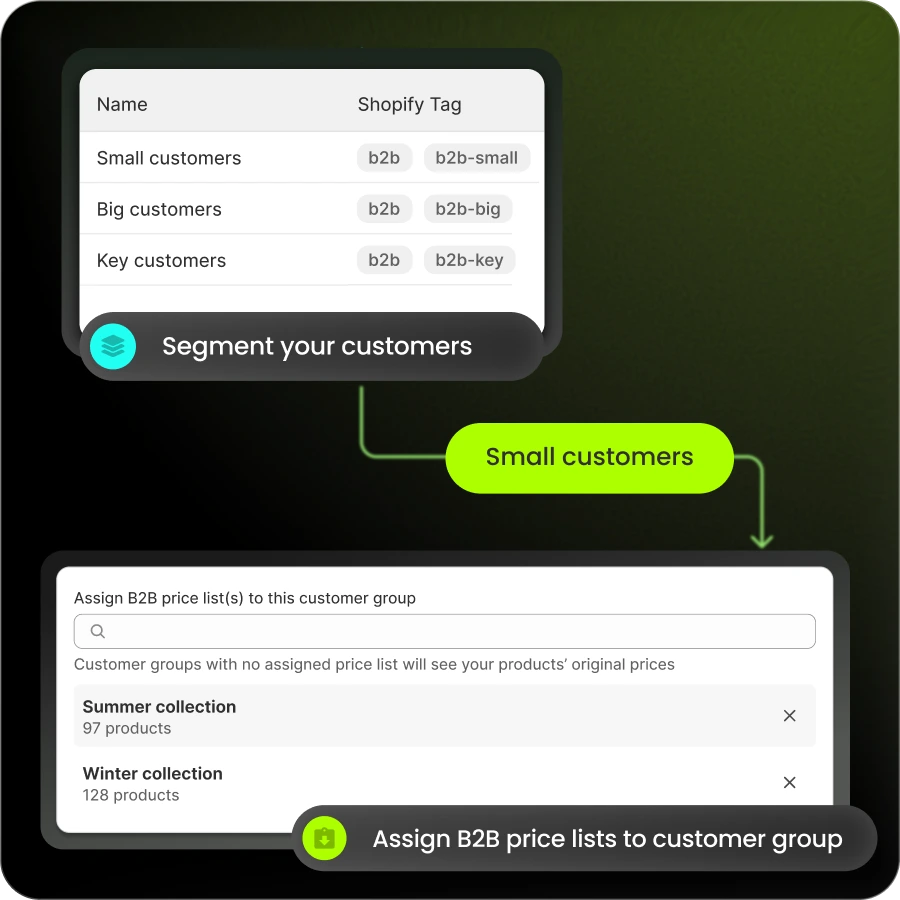
1. Create Your Wholesale Customer Groups
Segment your buyers into customer groups using tags — distributor, retailer, VIP, or new account. Each group becomes a container for its own rules.
Outcome: every buyer type can carry its own prices.
2. Build Customer-Specific Price Lists
Assign each group a price list with fixed prices or a percentage off, storewide or per product. A gold-tier reseller might get 40% off; a silver tier gets 25%.
Outcome: the right buyer sees the right price the moment they log in.
3. Add Volume and Tiered Discounts
Layer in volume discounts so larger orders unlock lower unit prices — say 10% off at 50 units, 20% off at 250. This rewards bulk buying automatically.
Outcome: bigger orders without a single manual quote.
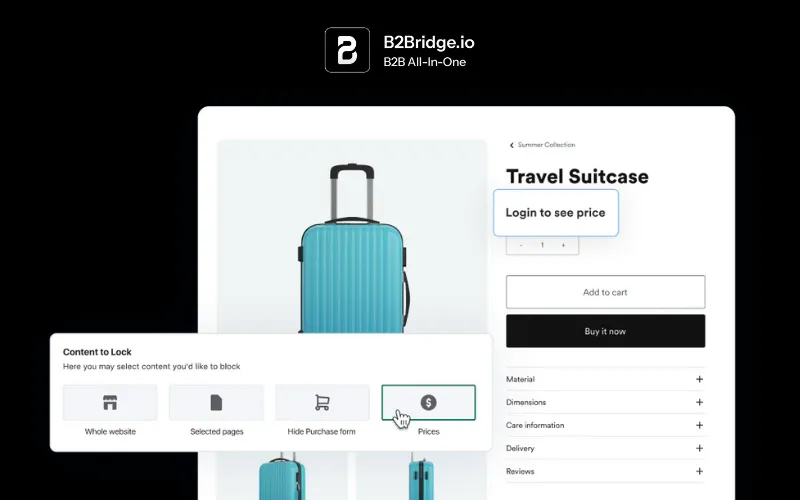
4. Gate Wholesale Prices Behind a Login
Require approval and hide wholesale prices from the public with a registration form and auto-tagging. Only vetted buyers get in.
Outcome: retail shoppers never see your B2B rates.
5. Set Minimum Orders and Payment Terms
Add minimum order quantities and net payment terms like Net 30 for trusted accounts. This keeps small orders profitable and matches how B2B buyers pay.
Outcome: every wholesale order clears your floor.
6. Test With a Sample Wholesale Account
Create a test customer, tag it, and log in as that buyer. Check pricing, product access, and checkout before you launch. Outcome: buyers hit a clean flow, not your bugs.
Wholesale Pricing Strategies That Protect Your Margins
Your wholesale pricing strategy decides whether volume actually pays. The four common models are cost-plus, tiered, role-based, and value-based. So which one should you use? They all start from a clear number: wholesale price = cost + (cost × markup %). Aim to keep margins healthy even after the discount.
Cost-Plus Pricing
Add a fixed markup to your unit cost. If a product costs $20 and you want 30%, you charge $26. It’s simple and guarantees margin. The downside? It ignores what the market will actually bear.
Tiered and Volume-Based Pricing
Lower the unit price as quantity climbs. This is the strongest lever for larger orders, because buyers stretch to reach the next break. Keep it to three or four tiers so the structure stays readable.

Role-Based Pricing
Give each customer group its own prices. A distributor and a small retailer buy the same item at different rates, based on their tag. This is the model that makes running retail and wholesale together possible.
Value-Based Pricing
Price to the value a buyer gets, not just your cost. It works best for unique or premium products where the markup is defensible. It takes more research, but the margins reward it.
Running Retail and Wholesale From One Store
Yes, you can run retail and wholesale from one Shopify store — no second site required. Customer groups and gated price lists keep the two audiences apart. Retail shoppers browse and pay full price. Approved B2B buyers log in and see wholesale rates on the same products.
So why do so many brands still bolt on a separate store? Usually because their app can’t cleanly hide B2B pricing or manage enough tiers. That’s the real constraint, not Shopify itself.
This is where an all-in-one approach earns its keep. Tools like B2Bridge handle pricing, gated access, net terms, and quote requests in a single hybrid setup instead of stitching three apps together. One system, two audiences, no duplicate catalog to maintain.
Why the Native B2B Catalog Limit Matters as You Scale
Native Shopify B2B caps non-Plus plans at three active catalogs, which becomes a wall the moment you add a fourth pricing tier. At that point you’re forced to choose: upgrade to Shopify Plus at roughly $2,300 a month, or move your pricing to an app. Neither is obvious for a growing brand.
Every option penalizes scale differently. Native B2B limits catalogs. SparkLayer meters you by order count. Shopify Plus removes the caps but charges enterprise money for them. The more wholesale you sell, the more each one costs you.
That’s the gap B2Bridge is built to close. It offers unlimited price lists, customer groups, and orders at a flat monthly rate, so your pricing structure doesn’t break as your B2B grows. No catalog ceiling. No order meter. The bill stays the same whether you run three tiers or thirty.
Wholesale Pricing Options on Shopify Compared
Which option fits? It comes down to your scale and how many pricing tiers you’ll run. If you’ll pass three catalogs or a few hundred orders a month, weight unlimited all-in-one higher. Here’s the at-a-glance view.
| Option | Best for | Scaling limit | Pricing |
|---|---|---|---|
| Shopify native B2B | Simple B2B on your current plan | 3 active catalogs (non-Plus) | Free with plan |
| Shopify Plus B2B | Enterprise, unlimited catalogs | None | ~$2,300/mo |
| Wholesale Gorilla | SMB wholesale add-on | By plan tier | From ~$34.95/mo |
| Wholesale Pricing Discount B2B | Discount-focused setups | By plan tier | From ~$24.99/mo |
| B2Bridge | Hybrid brands scaling B2B | Unlimited lists, groups, orders | $0 / $99 / $199 / $299 |
Best Practices for Managing Wholesale Pricing
What keeps wholesale pricing profitable over time? A few habits, applied as costs and customers shift. Good pricing isn’t set-and-forget.
- Review pricing quarterly. Costs and competitors move. Recheck your tiers every quarter so margins don’t quietly erode.
- Segment by volume and loyalty. Reward your best accounts with better rates, and keep new buyers on entry pricing until they earn more.
- Hold your margin band. Wholesale should stay profitable, not just lower — keep discounts inside a range you’ve modeled.
- Graduate accounts onto net terms. Start new buyers on immediate payment, then extend Net 30 or Net 60 as their history proves out.
- Communicate tiers clearly. Publish a clean price list so buyers know what they get. Fewer pricing questions, faster orders.
How Much It Costs to Offer Wholesale Pricing on Shopify
Offering wholesale pricing on Shopify ranges from free to about $2,300 a month, depending on the route. Native B2B is free with your plan but caps non-Plus stores at three catalogs. Dedicated wholesale apps run roughly $25 to $150 a month. Shopify Plus sits at the top around $2,300.
So what should you actually budget? The middle path is usually the smart one. B2Bridge plans run flat at $0, $99, $199, and $299 a month, with unlimited price lists and orders unlocking at $99. You get room to scale without the enterprise bill — and without hitting a catalog cap at your fourth tier.
Setting Up Unlimited Wholesale Pricing With B2Bridge
If you’re scaling wholesale seriously, the ceiling matters more than the setup. B2Bridge is an all-in-one B2B app for Shopify built so your pricing doesn’t break as you grow. Unlimited price lists, customer groups, and orders start at $99 a month, with the whole B2B workflow in one place.
- Unlimited customer groups and custom price lists at a flat price
- Volume and tiered discounts applied automatically at checkout
- Net 15, 30, and 60 payment terms with credit limits
- Quote requests, quick order forms, and one-click reordering
- A sales rep portal plus ERP sync with NetSuite, Zoho, and Odoo
Merchants like Brooklyn Bicycle and Trailer Valet already run wholesale this way on their existing stores. Want to see it on yours? Book a Demo.

FAQs About Shopify Wholesale Pricing
Can you offer wholesale pricing on Shopify without Shopify Plus?
Yes. A wholesale app adds customer-group pricing, gated access, and volume discounts on any Shopify plan. You only need Plus for unlimited native catalogs, which apps like B2Bridge remove anyway.
How do you show different prices to wholesale and retail customers?
Assign wholesale buyers to a customer group with its own price list, gated behind a login. Retail shoppers keep seeing standard prices, while approved B2B buyers see wholesale rates on the same products.
How many wholesale price lists can you create on Shopify?
Native B2B caps non-Plus plans at three active catalogs. Dedicated apps like B2Bridge allow unlimited price lists, so you can add pricing tiers without upgrading to Shopify Plus.
Do you need a developer to set up wholesale pricing?
No. Most wholesale apps configure customer groups, price lists, and discounts from the Shopify admin without code. You can launch a working wholesale channel in a day or two.
Can you offer net payment terms on wholesale orders?
Yes. Both native B2B and apps like B2Bridge support net terms such as Net 15, Net 30, and Net 60. Approved buyers can pay after they receive goods.

Hi, I’m Tri, a tech enthusiast. With over 4 years of hands-on experience with Shopify and a total of eight years in technology and ecommerce, I currently serve as a Technical Leader on Shopify app development projects. My goal is to contribute solutions that are user-friendly, stable, and scalable within the Shopify App ecosystem.