Choosing between Shopify Plus and Magento comes down to a fundamental tradeoff: speed and simplicity versus unlimited customization and control. Both platforms power enterprise ecommerce, but they demand very different levels of technical investment and operational commitment.
This guide breaks down the core differences in cost, scalability, B2B capabilities, and implementation effort so you can determine which platform fits your business model and growth trajectory.
Shopify Plus vs Magento at a Glance Comparison Table
Shopify Plus is a hosted SaaS platform built for fast deployment and lower maintenance overhead. Adobe Commerce (Magento) is an open-source platform designed for complex enterprise operations that require deep customization. The comparison below captures the core differences.
| Feature | Shopify Plus | Magento (Adobe Commerce) |
|---|---|---|
| Hosting | Fully managed SaaS | Self-hosted or Adobe Cloud |
| Pricing Model | Monthly subscription | License + hosting + dev costs |
| B2B Native Features | Yes (expanding) | Yes (robust in Adobe Commerce) |
| Customization | Moderate via apps/APIs | Extensive (open source) |
| Technical Requirement | Low to moderate | High (requires developers) |
| Time to Launch | Weeks to months | Months to a year |
| Best For | Fast-scaling DTC and hybrid B2B/B2C | Complex, highly custom enterprise |
What Is Shopify Plus
Shopify Plus is Shopify’s enterprise tier, built for high-growth brands that want managed infrastructure without heavy technical overhead. It operates as a SaaS (Software as a Service) model, which means Shopify handles servers, security patches, and uptime. You focus on selling.
- Fully managed hosting: Shopify owns the infrastructure and guarantees uptime
- Checkout Extensibility: Customize checkout flows without modifying core platform code
- Shopify Flow: Automate workflows like customer tagging, inventory alerts, and fraud flagging
- Expansion stores: Launch multiple storefronts under one account for international markets or dedicated B2B channels
What Is Magento and Adobe Commerce
Magento is an open-source ecommerce platform now owned by Adobe. Two versions exist: Magento Open Source (free to download, self-hosted) and Adobe Commerce (the paid enterprise version with cloud hosting and B2B modules).
Both versions require developer resources to build, host, and maintain. The open-source flexibility is powerful, though it comes with operational responsibility.
- Magento Open Source: Free to download, but you pay for hosting, security, and development
- Adobe Commerce: Licensed enterprise version with cloud hosting, B2B modules, and Adobe ecosystem integrations
- Open-source flexibility: Full code access allows unlimited customization
- Developer dependency: Requires PHP developers for setup, maintenance, and upgrades
Core Differences Between Shopify Plus and Magento
Hosting and Deployment Model
Shopify Plus operates as a fully managed SaaS platform. Shopify owns the infrastructure, handles scaling, and pushes updates automatically. You don’t touch servers.
Magento is self-hosted (or managed via Adobe Cloud). You’re responsible for server configuration, CDN setup, and performance optimization. This gives you control, but also accountability for uptime and security.
Pricing Structure
Shopify Plus uses predictable monthly subscription pricing. You know what you’re paying each month, which simplifies budgeting.
Magento Open Source has no license fee, but the real costs come from hosting, development, and ongoing maintenance. Adobe Commerce adds license fees on top of infrastructure costs.
Engineering and Maintenance Effort
Day-to-day operations on Shopify Plus require minimal technical staff. Updates happen automatically, and most customizations happen through apps or APIs.
Magento demands ongoing developer involvement. Security patches, version upgrades, and performance tuning all require hands-on work from an in-house team or an agency.
Speed of Feature Releases
Shopify Plus pushes new features continuously. You get access to improvements without manual intervention.
Magento updates require manual implementation and testing. New features often sit unused because the upgrade effort is too high for many teams.
Total Cost of Ownership for Shopify Plus and Magento
Total Cost of Ownership (TCO) captures everything you spend to run a platform over time, not just the sticker price. This is where the comparison gets interesting.
Shopify Plus Licensing and Predictable SaaS Costs
Shopify Plus pricing includes hosting, security, and most maintenance. Additional costs come from apps, themes, and transaction fees (unless you use Shopify Payments). The predictability makes financial planning straightforward.
Magento Hosting, Development, and Maintenance Costs
Magento’s cost components stack up: hosting infrastructure, agency or in-house developer salaries, security tools, extension licenses, and upgrade projects. Costs scale with complexity and traffic — businesses on legacy ecommerce infrastructure can spend up to 40% more on maintenance than those on modern platforms.
Hidden Costs You Can Plan For
Both platforms have expenses that catch teams off guard:
- App and extension fees: Third-party functionality adds up on both platforms
- Custom development: Shopify Plus for checkout or B2B customization; Magento for nearly everything
- Migration costs: Data migration, replatforming agency fees, and potential downtime
- Opportunity cost: Slower launches on Magento can delay revenue by months
Scalability and Performance Compared
Scalability refers to how well a platform handles traffic spikes and growing order volumes. This matters most during flash sales, product launches, or viral moments.
Shopify Plus auto-scales by default. The cloud infrastructure handles traffic surges automatically without intervention. Magento performance depends entirely on your hosting tier, caching configuration, and code optimization. Poor configuration leads to slow load times and checkout failures during peak traffic.
Outcome: Shopify Plus checkout is battle-tested for high volume, processing 967,000 requests per second during BFCM with 99.99% uptime. Magento checkout can bottleneck under load without proper setup.
Security, Compliance, and Hosting Responsibility
Shopify Plus is PCI DSS Level 1 compliant out of the box. PCI DSS (Payment Card Industry Data Security Standard) is required for processing credit cards, and Shopify handles all of it for you.
With Magento, you’re responsible for PCI compliance, SSL certificates, security patches, and breach response. This isn’t impossible, but it requires dedicated resources and expertise.
- Shopify Plus: Handles all compliance, security patches, and vulnerability monitoring
- Magento: You implement and maintain security measures yourself or via your hosting provider
B2B and Wholesale Capabilities Compared
Both platforms now compete seriously in B2B ecommerce. The difference lies in implementation complexity and out-of-the-box depth.
Shopify Plus B2B Features
Shopify Plus has invested heavily in native B2B functionality: company accounts, customer-specific price lists, payment terms, quantity rules, and a dedicated B2B sales channel. Complex wholesale logic often requires apps to extend native capabilities.
Magento B2B Features
Adobe Commerce’s B2B module includes shared catalogs, company accounts with buyer hierarchies, requisition lists, quote workflows, and purchase order approvals. This functionality is robust but only available in the paid Adobe Commerce tier, not Magento Open Source.
Custom Pricing, Net Terms, and Quote Workflows
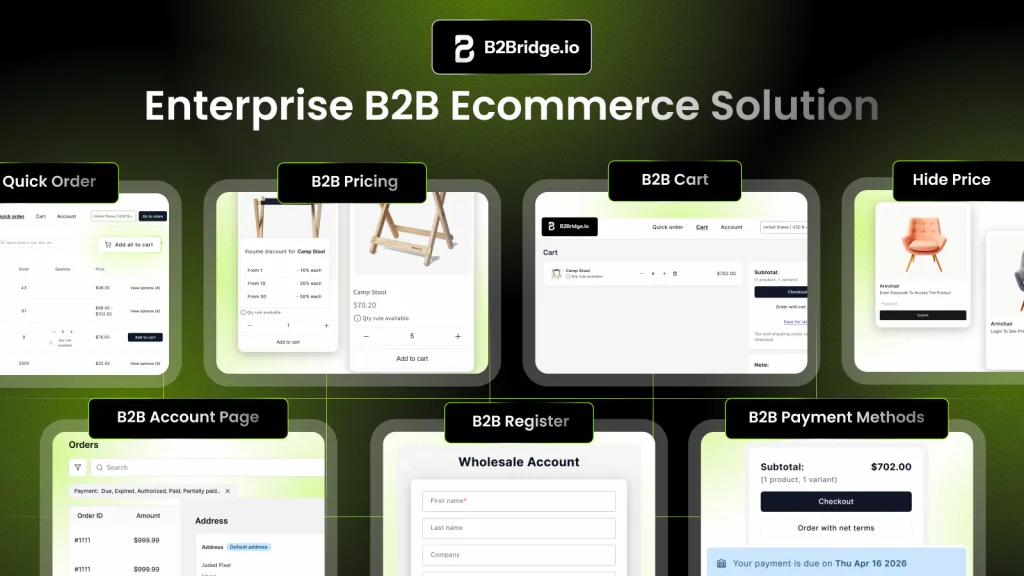
Both platforms support B2B pricing and payment terms, though depth varies. Shopify Plus handles basic price lists natively. Complex scenarios like volume tiers, minimum order quantities, customer-specific contracts, and RFQ automation often require apps like B2Bridge. Magento’s B2B module includes RFQ and negotiated pricing natively but requires development to customize.
Tip: You don’t always need Shopify Plus for enterprise B2B. Solutions like B2Bridge bring advanced pricing logic, net terms, and ERP integration to standard Shopify plans.
Customization and Developer Effort
Customization means modifying the platform beyond out-of-the-box settings. Here’s where the platforms diverge sharply.
Magento offers full code access and unlimited flexibility, but high developer dependency and upgrade risk come with it. Shopify Plus customization happens via APIs, apps, and Checkout Extensibility, which is faster to implement and easier to maintain.
- When Magento wins: Highly unique business logic that no app can replicate
- When Shopify Plus wins: Speed to market and lower ongoing maintenance burden
ERP and CRM Integration Options
Both platforms integrate with major ERPs (NetSuite, SAP, Microsoft Dynamics) and CRMs (Salesforce, HubSpot, Zoho). The difference is how.
Magento often requires custom middleware or developer-built connectors. Shopify Plus has a growing ecosystem of pre-built integrations and APIs that simplify the process.
For B2B merchants on Shopify, B2Bridge offers deep ERP/CRM integration, automatically syncing price lists and customer groups with systems like NetSuite, Zoho, and Odoo.
Implementation Time and Time to Launch
Time to launch measures the duration from project kickoff to live store. Faster launches mean faster revenue.
Shopify Plus implementations typically complete in weeks to a few months. Magento projects often take many months to over a year, depending on complexity and customization requirements.
Migrating From Magento to Shopify Plus
Replatforming, or moving your ecommerce operations from one platform to another, is a significant undertaking — though 90% of businesses that replatformed experienced sales and revenue improvements. Here’s a practical framework.
1. Audit Your Current Magento Setup
Document all products, customers, order history, custom functionality, and integrations. Identify what to migrate versus what to rebuild or replace.
2. Map Products, Customers, and Price Lists
Export and clean data for import into Shopify. Plan how B2B price lists and customer groups will translate to the new platform structure.
3. Rebuild B2B Workflows and Integrations
Evaluate which Magento customizations require equivalent solutions on Shopify, whether via native features, apps like B2Bridge, or custom development.
4. Test, Cut Over, and Launch
Run parallel testing, train your team, and plan a cutover strategy that minimizes downtime and customer disruption.
How to Choose the Right Platform for Your Business
When Shopify Plus Is the Better Fit
Shopify Plus works well when you want fast time to market with minimal technical overhead. It’s also a strong choice if you prioritize predictable costs and managed infrastructure, or if your B2B requirements can be met with native features plus apps. Teams without in-house development resources often find Shopify Plus easier to operate.
When Magento Is the Better Fit
Magento makes sense when you have unique business logic requiring deep code-level customization. It’s also appropriate if you have dedicated Magento developers on staff or budget for ongoing agency work. Teams that require Adobe ecosystem integrations (Analytics, Target, Experience Manager) or are already running a mature Magento store with heavy customization may find migration costs outweigh benefits.
When Shopify With a B2B Solution Wins
There’s a middle path: Shopify (not necessarily Plus) combined with a specialized B2B app. This approach works well for businesses that want Shopify’s ease of use plus enterprise B2B functionality without the Shopify Plus price tag or Magento complexity.
Running Enterprise B2B on Shopify With B2Bridge
B2Bridge enables complex B2B operations on Shopify without requiring Shopify Plus or a separate wholesale store. If you’re evaluating platforms specifically for B2B, this changes the calculus.
- B2B Pricing Engine: Role-based pricing, contract price lists, volume discounts, min/max order rules
- B2B UX: Wholesale Bulk Order, reorder, B2B cart, Company Account portal
- ERP and CRM Integration: Sync with NetSuite, Zoho, Odoo, and custom systems via enterprise API
- Flexible Payment Options: Net terms, RFQ-to-order workflows, customer group payment rules
- Unified B2B and B2C Store: Run wholesale and retail from one Shopify storefront
- B2B login & register form: Hide/Lock B2B price
Outcome: Wholesale businesses using B2Bridge report faster order processing, fewer pricing errors, and the ability to scale B2B without doubling operational work.

Frequently Asked Questions About Shopify Plus and Magento
Is Adobe Commerce the same as Magento?
Adobe Commerce is the rebranded, licensed enterprise version of Magento that includes cloud hosting and B2B modules. Magento Open Source remains available as a free, self-hosted option but lacks the B2B features included in Adobe Commerce.
Is Shopify Plus cheaper than Magento Open Source?
While Magento Open Source has no license fee, the total cost of ownership, including hosting, development, security, and maintenance, often exceeds Shopify Plus’s predictable subscription pricing for most businesses.
Can Magento handle high traffic flash sales as well as Shopify Plus?
Magento can handle high traffic if properly configured with robust hosting and caching, but this requires significant investment and expertise. Shopify Plus auto-scales by default, making flash sale performance reliable without additional setup.
Do you need Shopify Plus to sell B2B on Shopify?
No. Apps like B2Bridge bring enterprise B2B capabilities including custom pricing, net terms, and ERP integration to standard Shopify plans without requiring an upgrade to Shopify Plus.
How long does a Magento to Shopify Plus migration take?
Migration timelines vary based on catalog size, customizations, and integrations. Most Magento to Shopify Plus projects complete in a few months compared to the longer timelines typical of new Magento implementations.

As a Product Marketing Executive at B2Bridge, I focus on the Enterprise B2B Ecommerce domain. I leverage my understanding of product and user psychology to deliver customer-centric content that addresses business challenges and fuels growth.