Shopify B2B and B2Bridge both let you sell wholesale on Shopify, but they fit different stages. Shopify’s native B2B — free on all paid plans since April 2026 — covers company accounts, up to three catalogs, and net terms. B2Bridge adds unlimited price lists, RFQ, registration, storefront lock, a sales rep portal, and ERP sync on any plan.
The choice isn’t always either/or. B2Bridge runs on top of Shopify, so many merchants start with native B2B and add B2Bridge when they outgrow its ceilings. This guide compares the two side by side, shows exactly where native stops being enough, and helps you match the right setup to how you actually sell.
What Is the Difference Between Shopify B2B and B2Bridge
The difference is scope and scale: Shopify native B2B is the built-in wholesale layer Shopify ships with your plan, while B2Bridge is an app that extends Shopify with unlimited pricing and workflows the native stack doesn’t include. Native covers the fundamentals for free. B2Bridge covers what happens after you outgrow them.
Shopify native B2B is a suite of built-in features — company profiles, catalogs, volume pricing, and net terms — that turned on for every paid plan in April 2026. It lives inside your Shopify admin with no separate install. For a store with a few wholesale accounts and simple pricing, it’s often all you need.

B2Bridge is an enterprise B2B app that installs on top of your existing Shopify store, including on top of native B2B. It removes the caps native imposes — unlimited price lists, customer groups, and orders — and adds request-for-quote, self-serve registration, storefront locking, a sales rep portal, and ERP integration. Because it layers onto Shopify rather than replacing it, the real question isn’t “which one,” but “when do I need more than native gives me?”

Shopify B2B vs B2Bridge at a Glance
Here is how the two compare across the capabilities that most often decide a wholesale setup. Native wins on cost for simple stores; B2Bridge wins on scale and workflow depth.
| Capability | Shopify native B2B | B2Bridge |
| Cost to start | Free on Basic/Grow/Advanced | Free (Starter); paid from $99/mo |
| Price lists / catalogs | Up to 3 active catalogs (non-Plus) | Unlimited price lists on any plan |
| Customer groups | Company-based, catalog-capped | Unlimited customer groups |
| Net payment terms | Yes (all paid plans) | Yes (Net 15/30/60/90 + credit limits) |
| RFQ / quote to order | No (any plan) | Yes (Growth and above) |
| Self-serve registration | No (manual in admin) | Yes, with approval and auto-tagging |
| Storefront lock / hide price | Not below Plus | Yes (Professional and above) |
| Sales rep portal | No (reps use Draft Orders) | Yes (Growth and above) |
| ERP / CRM sync | Standard API, rate-limited non-Plus | Public API for NetSuite/Zoho/Odoo (Advanced and above) |
| Runs on | Your Shopify plan itself | On top of any Shopify plan |
What Shopify Native B2B Includes
Shopify native B2B gives every paid plan a genuine wholesale foundation at no extra cost. Since April 2, 2026, Basic, Grow, and Advanced merchants can run company accounts, custom catalogs, volume pricing, and net terms without upgrading to Plus — a change Shopify announced in its own changelog.
The native stack covers the core of a straightforward wholesale operation:
- Company profiles with multiple buyers and locations under one account
- Up to 3 active catalogs with B2B-specific pricing, assigned through Shopify Markets
- Volume pricing and quantity rules, including minimum order quantities enforced at checkout
- Net payment terms (Net 15/30/60/90) set per company or location
- B2B checkout with vaulted credit cards, plus ACH for US merchants
For fuller detail on the native feature set, see B2Bridge’s Shopify B2B features guide.
Two things are worth knowing up front. The 3-catalog limit is shared across all your B2B markets combined, not three per market. And several capabilities stay exclusive to Shopify Plus — unlimited catalogs, direct catalog assignment to specific companies, deposits and partial payments, and a dedicated wholesale storefront. Plus starts around $2,300/month, so verify current pricing before you plan around it.
What B2Bridge Adds on Top of Shopify
B2Bridge adds the scale and the workflows native B2B leaves out, all in a single app on any Shopify plan. Where native caps you at three catalogs and stops at the basics, B2Bridge removes the ceiling and fills the gaps that show up as your wholesale channel matures.
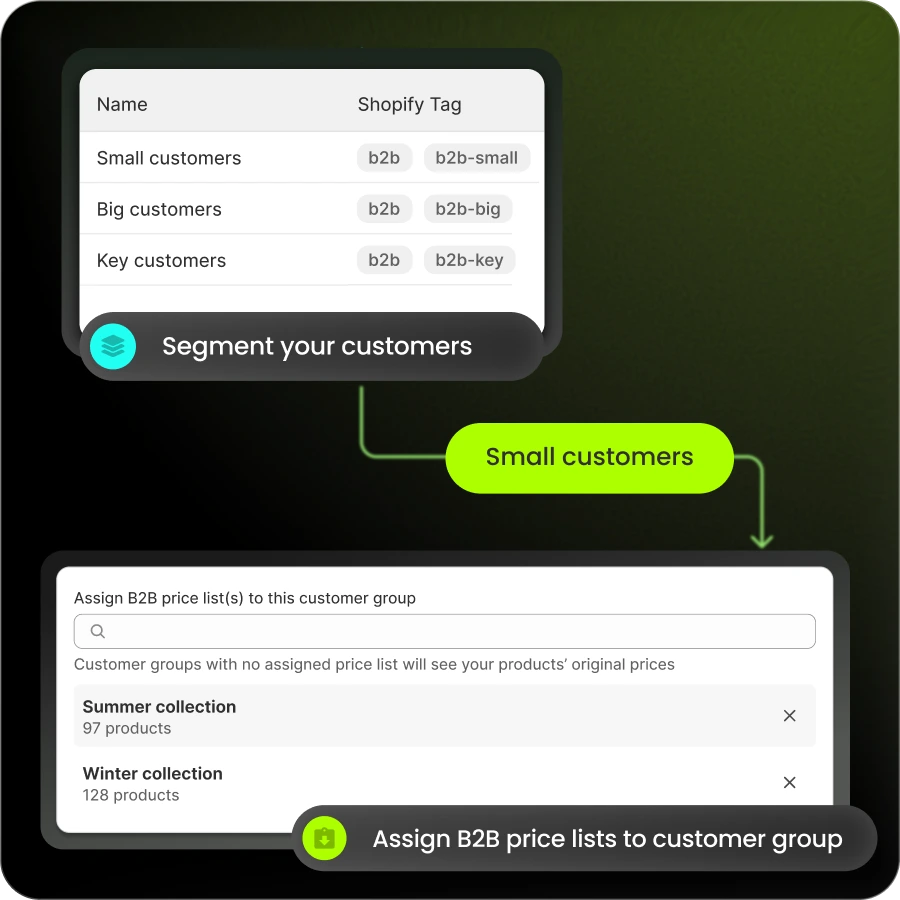
Unlimited Price Lists and Customer Groups
B2Bridge gives you unlimited price lists, customer groups, and B2B orders on any paid plan, starting at $99/month. That’s the headline difference from native, which caps non-Plus stores at three active catalogs. If you run Bronze, Silver, Gold, distributor, and regional pricing, you assign each its own price list without hitting a wall.
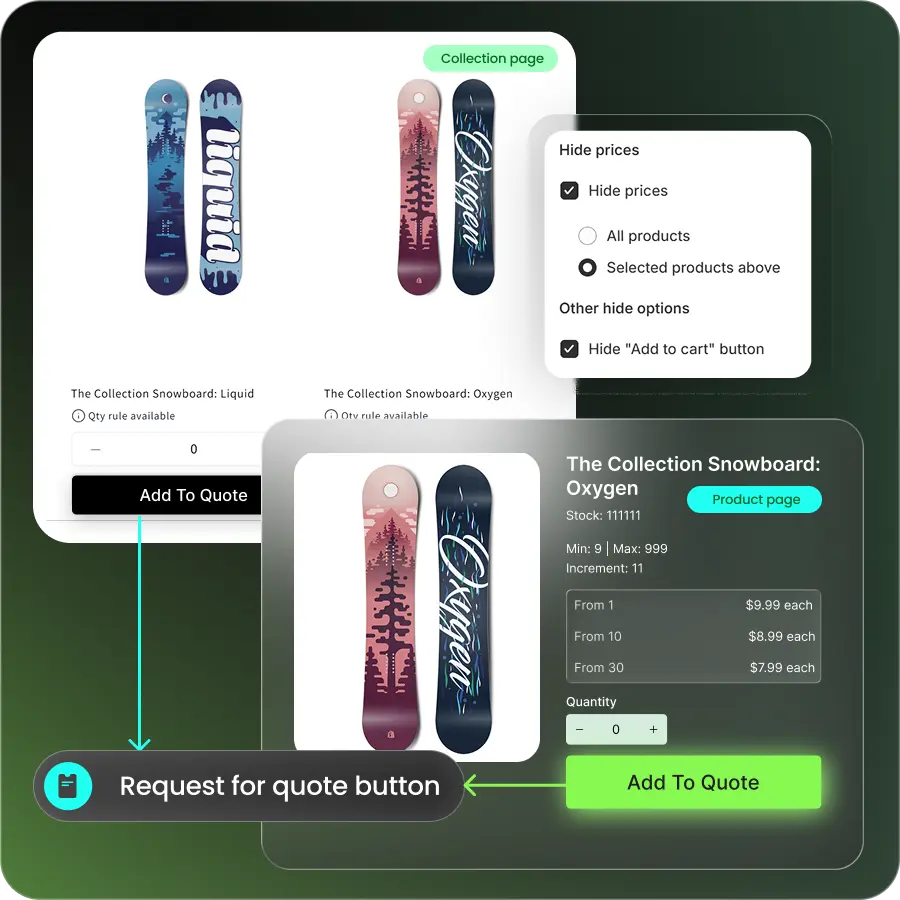
Request for Quote and Quote to Order
B2Bridge includes a built-in RFQ workflow, which native B2B doesn’t offer at any plan. Approved customer groups request quotes directly from product and collection pages; you review, adjust, and convert each accepted quote into a Shopify draft order, with auto-conversion available under a set threshold. RFQ is available on the Growth plan and above.
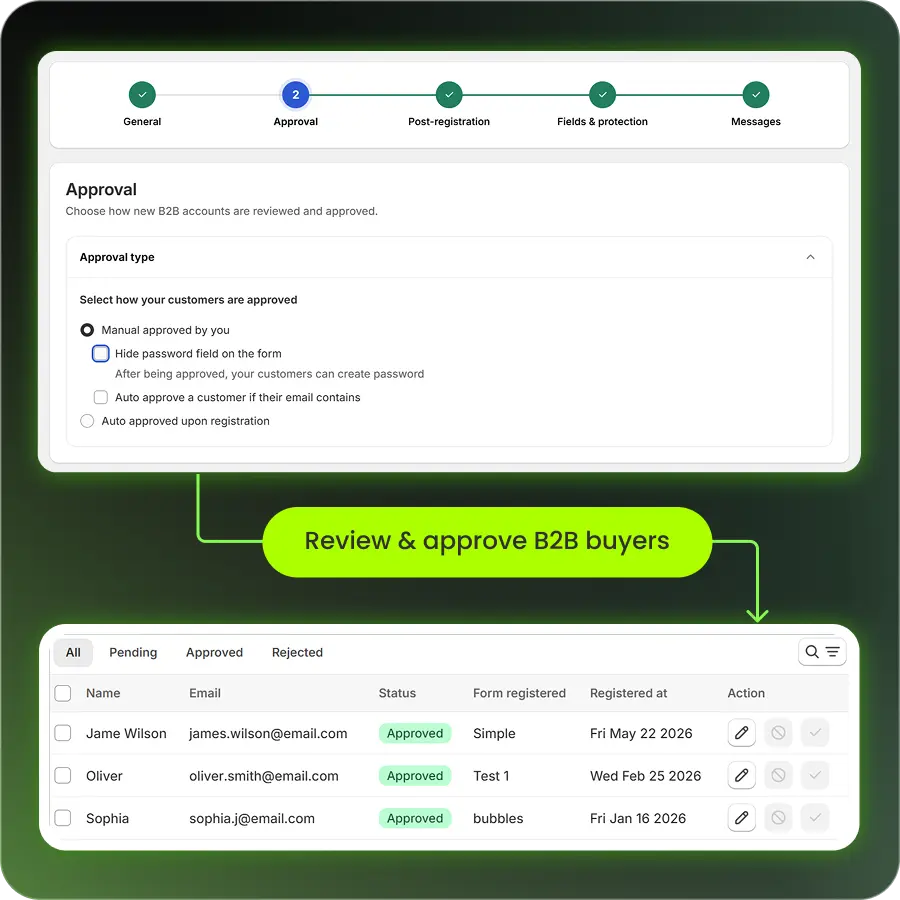
B2B Registration and Approval
B2Bridge turns wholesale onboarding into a self-serve flow, something native B2B leaves to manual admin work. You build customizable registration forms with up to 15 field types and tax-ID validation, review applications, and approve or reject them. On approval, the buyer is auto-tagged, assigned to the right customer group, and given instant access to wholesale pricing.
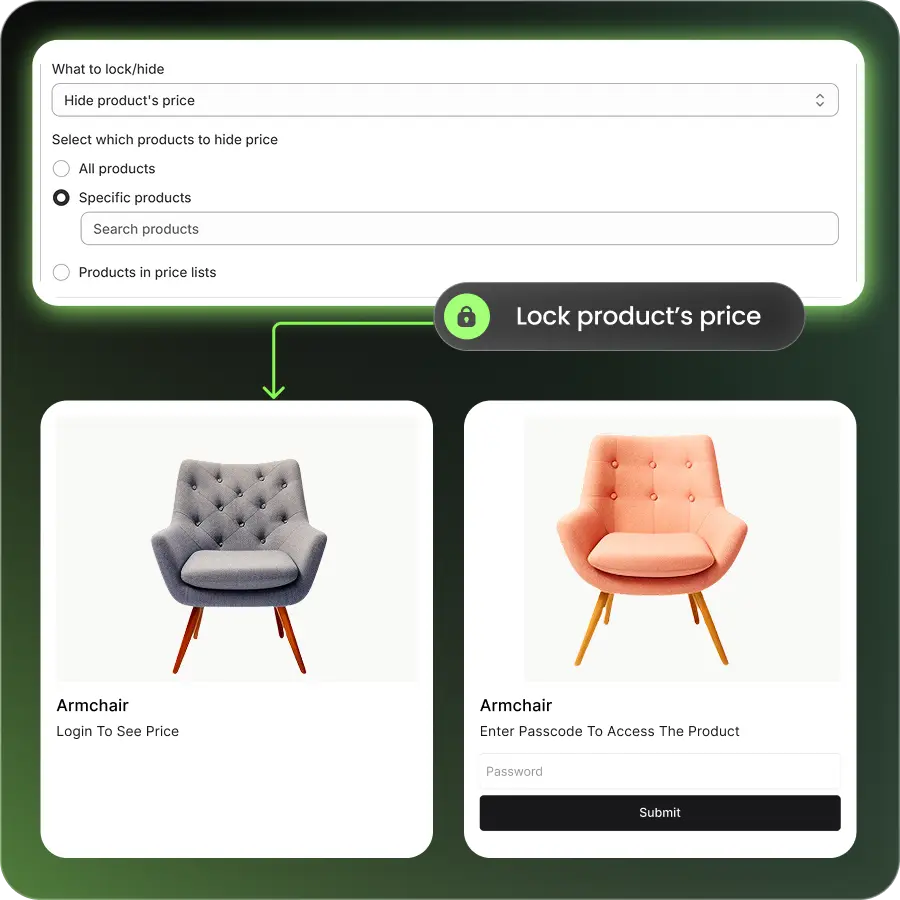
Storefront Lock and Hidden Pricing
B2Bridge lets you hide wholesale prices and gate content from retail visitors — a native gap below Plus. Login-required and password locks can hide prices or the Add to Cart button, protect entire collections, and restrict internal pages like dealer resources. Visibility rules apply by customer group, individual customer, or product tag. It’s included from the Professional plan.
Sales Rep Portal
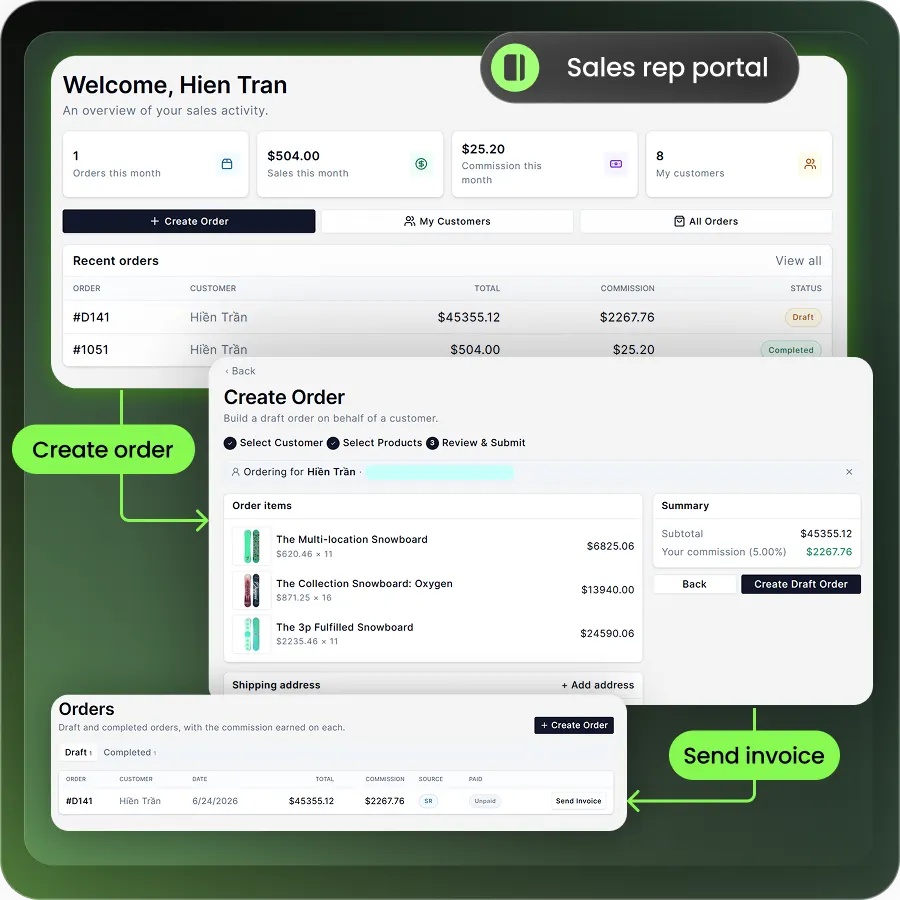
B2Bridge gives sales reps a dedicated portal to place orders on behalf of customers, a near-exclusive feature versus native B2B. Reps log in, order at each customer’s contracted prices, and track commission — without Shopify Admin access. On native, reps are limited to building orders inside the admin’s Draft Orders view. The portal is available on the Growth plan and above.
ERP and CRM Sync
B2Bridge connects your wholesale data to your back office through a Public API, where native relies on Shopify’s standard API with tighter rate limits on non-Plus plans. You can sync price lists, customer groups, and catalog data with NetSuite, Zoho, Odoo, or a custom ERP, so pricing and customers stay aligned without double entry. API access is available on the Advanced plan.
Shopify B2B vs B2Bridge on Pricing and Scale
The real cost comparison is what it takes to scale, not the sticker price. Native B2B is free, but the 3-catalog cap eventually forces a jump to Shopify Plus at around $2,300/month. B2Bridge stays unlimited at a flat $99–$299, so your bill doesn’t spike the moment you add a fourth pricing tier.
| Option | Limit when scaling | Price | Best moment |
| Shopify native (non-Plus) | 3 active catalogs total | Free with plan | First few wholesale accounts |
| Shopify Plus | Unlimited catalogs | ~$2,300/mo | Enterprise scale or a dedicated storefront |
| B2Bridge | Unlimited price lists, groups, orders | $0 / $99 / $199 / $299 | Scaling past native ceilings |
The pattern is that native and Plus price you by scale, while B2Bridge prices you by feature tier. If your only reason to consider Plus is more pricing groups, a B2Bridge plan reaches unlimited for a fraction of the cost and adds workflows Plus still doesn’t include.
Where Shopify Native B2B Hits Its Limits
Native B2B is solid until your wholesale operation gets more complex, and then a predictable set of ceilings appears. Each of the situations below is a common point where merchants add B2Bridge on top of native.
When You Pass Three Catalogs
The 3-catalog cap is the first wall most growing stores hit, because the three are shared across every B2B market. A Bronze, Silver, and Gold structure uses all three before you’ve touched international pricing. B2Bridge solves this with unlimited price lists on any plan.
When You Need Quotes and Negotiation
Native B2B has no quoting workflow at any plan, so negotiated deals happen over email and get re-keyed by hand. B2Bridge’s RFQ captures the request on the storefront and converts the accepted quote straight into a draft order.
When You Onboard Wholesale Applicants
Native offers no self-serve registration or approval — every new account is manual admin work. B2Bridge’s registration forms collect business credentials, run an approval step, and auto-tag approved buyers into the right pricing group.
When Your Sales Team Places Orders
Native reps are stuck in the admin’s Draft Orders, with no storefront view or commission tracking. B2Bridge’s Sales Rep Portal lets reps order on behalf of customers at contracted prices and see their commissions.
When You Sync With an ERP
Native leans on Shopify’s standard API, whose rate limits on non-Plus plans constrain large or frequent syncs. B2Bridge’s Public API is purpose-built to manage price lists and customer groups from NetSuite, Zoho, Odoo, or a custom system.
Outcome: as complexity rises, B2Bridge removes the caps and manual steps that would otherwise slow order processing and force an early jump to Plus.
Who Shopify Native B2B Is Best For
Native B2B is the best fit for merchants with a simple wholesale setup and no appetite for added cost. If your needs map to the basics, there’s no reason to add an app.
Native works well when you have:
- A handful of wholesale accounts and three or fewer pricing tiers
- Straightforward volume pricing and net terms, with no negotiation
- No need for self-serve registration, storefront locking, or a sales rep portal
- No high-volume ERP sync requirement
- A preference to run wholesale at zero additional software cost
Who B2Bridge Is Best For
B2Bridge is the best fit for hybrid brands and distributors scaling wholesale past what native covers. It’s built for the stage where more buyers mean more pricing rules, more workflows, and more systems to keep in sync.
B2Bridge fits when you have:
- More than three pricing tiers, or regional price books across markets
- Negotiated pricing that needs a quote-to-order workflow
- Online wholesale applications that need approval and auto-tagging
- Prices or catalogs that must stay hidden from retail shoppers
- A sales team that orders on behalf of customers and tracks commission
- Pricing and customer data flowing from an ERP like NetSuite, Zoho, or Odoo
This maps closely to the hybrid B2C and B2B brand running both channels from one Shopify store — see how that setup works in the hybrid store guide.
How to Choose Between Shopify B2B and B2Bridge
Start with one question: will your wholesale operation stay within native’s ceilings, or grow past them? If you’ll pass three catalogs, need quotes, run online registration, equip a sales team, or sync an ERP, weight B2Bridge higher. If not, native is enough.
| Your situation | Recommended option |
| ≤3 pricing tiers, few accounts, no quoting/registration/ERP | Shopify native B2B |
| More than 3 pricing tiers or regional price books | B2Bridge (unlimited price lists) |
| You negotiate prices or need quotes | B2Bridge (RFQ) |
| You onboard wholesale applicants online | B2Bridge (registration and approval) |
| A sales team orders on behalf of customers | B2Bridge (sales rep portal) |
| You sync pricing and customers from an ERP | B2Bridge (Public API) |
| You need a fully separate wholesale storefront and domain | Shopify Plus |
Remember that these aren’t mutually exclusive. Because B2Bridge runs on top of Shopify, you can keep native B2B for what it does well and add B2Bridge for the pieces it doesn’t cover.
Scaling Your Shopify B2B Store with B2Bridge
If your wholesale channel is growing past what native B2B covers, B2Bridge is built for exactly that stage. It keeps you on your current Shopify plan while removing the caps that would otherwise push you toward Plus, and it adds the workflows serious wholesale operations depend on.
With B2Bridge you get:
- Unlimited at scale — unlimited price lists, customer groups, and orders at a flat monthly price
- All-in-one — pricing, net terms, RFQ, registration, storefront lock, and self-service portal in a single app
- Sales rep portal and ERP sync — order-on-behalf with commission tracking, plus a Public API for NetSuite, Zoho, and Odoo
Outcome: you scale wholesale on the store you already run, without hitting a catalog wall or stitching together multiple tools.
Ready to see it on your own store? Book a Demo and we’ll map B2Bridge to how you sell.
FAQs about Shopify B2B and B2Bridge
Do you need Shopify Plus to use B2Bridge?
No. B2Bridge works on any Shopify plan, including Basic, Grow, and Advanced. You get unlimited price lists and advanced B2B workflows without upgrading to Plus.
Can you use B2Bridge together with Shopify native B2B?
Yes. B2Bridge installs on top of your existing Shopify store, so you can keep native B2B for the basics and add B2Bridge for the capabilities it doesn’t cover, like RFQ, registration, and a sales rep portal.
How many catalogs or price lists can you have on Shopify B2B?
Shopify native B2B allows up to 3 active catalogs on non-Plus plans, shared across all your B2B markets. B2Bridge supports unlimited price lists on any plan, so extra pricing tiers don’t force an upgrade.
Does Shopify native B2B include RFQ or quotes?
No. There is no native request-for-quote or quoting workflow on any Shopify plan, including Plus. B2Bridge adds RFQ on its Growth plan and above, converting accepted quotes into draft orders.
How much does B2Bridge cost compared to Shopify Plus?
B2Bridge runs from $0 (Starter) to $299/month (Advanced), a flat fee regardless of how much you scale. Shopify Plus starts around $2,300/month — and is usually considered only for enterprise scale or a dedicated storefront.
Can Shopify native B2B sync with an ERP?
Native B2B relies on Shopify’s standard API, which has tighter rate limits on non-Plus plans and can constrain large syncs. B2Bridge provides a Public API built to manage price lists and customer groups directly from NetSuite, Zoho, Odoo, or a custom ERP.

As a Product Marketing Executive at B2Bridge, I focus on the Enterprise B2B Ecommerce domain. I leverage my understanding of product and user psychology to deliver customer-centric content that addresses business challenges and fuels growth.