B2B ecommerce now accounts for over $20 trillion in global transactions annually, yet most wholesale businesses still run on spreadsheets, email threads, and disconnected systems. The gap between what B2B buyers expect and what most sellers deliver is widening fast.
This guide breaks down 15 B2B ecommerce strategies that drive measurable revenue, from pricing and payment workflows to ERP integration and buyer experience, plus how to implement them without a platform migration.
>> See more: B2B Ecommerce SEO: How to Build a Strategy That Converts Buyers
What Is a B2B Ecommerce Strategy
A B2B ecommerce strategy is a coordinated plan for selling products or services online between businesses. The goal is to create an intuitive, self-service digital experience that mirrors B2C convenience while accommodating complex requirements like personalized pricing, bulk ordering, and account management.
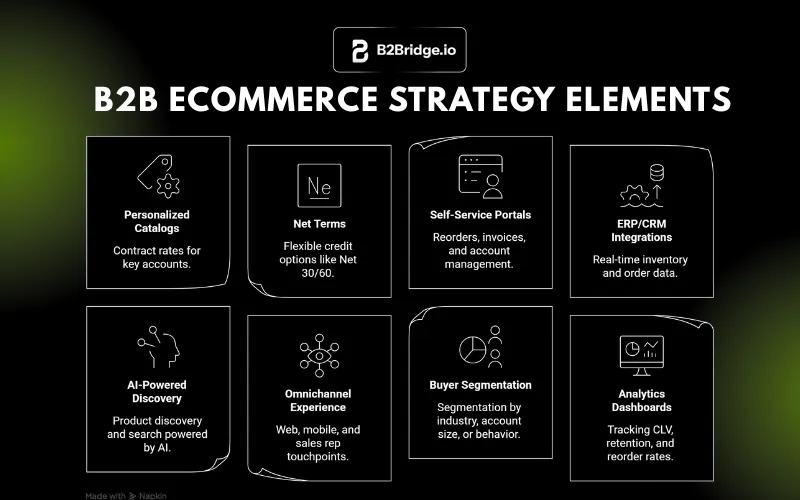
Think of it as the blueprint connecting your pricing logic, buyer experience, back-end systems, and marketing into one cohesive operation. The core components include platform functionality, ERP/CRM integration for real-time data, SEO-driven content for visibility, and tailored portals offering negotiated rates.
- Personalized pricing and catalogs: Tailored rates for each customer segment
- Self-service ordering: Quick reorder, bulk purchasing, account management
- System integration: Real-time sync with ERP, CRM, and inventory
- B2B marketing: SEO content and email nurturing for complex buying cycles
- Flexible payments: Net terms, RFQ, and negotiated pricing models
How B2B Ecommerce Differs From B2C
B2B buying cycles are longer and involve multiple decision-makers. Procurement managers, finance teams, and department heads all weigh in before a purchase order gets approved. B2C transactions, on the other hand, typically involve a single buyer making a quick decision.
Pricing works differently too. B2C stores use fixed retail prices with occasional promotions, while B2B relies on negotiated, tiered, or customer-specific pricing that varies by account, volume, or contract terms.
| Factor | B2B Ecommerce | B2C Ecommerce |
|---|---|---|
| Sales cycle | Longer, multiple stakeholders | Short, individual decision |
| Pricing | Negotiated, tiered, customer-specific | Fixed, promotional |
| Order size | Bulk quantities, high AOV | Single units, lower AOV |
| Payment | Net terms, invoicing, RFQ | Instant card payment |
| Motivation | Efficiency, ROI, partnerships | Convenience, emotion |
Types of B2B Ecommerce Models
Wholesale Ecommerce
Selling products in bulk to retailers or resellers at discounted rates. This is the most common B2B model and the foundation for most wholesale operations.
Manufacturer Ecommerce
Manufacturers selling directly to distributors, retailers, or other businesses, bypassing traditional sales channels and capturing more margin.
Distributor Ecommerce
Distributors acting as intermediaries between manufacturers and end buyers, managing large catalogs, logistics, and often regional fulfillment.
B2B2C Ecommerce
Businesses selling through another business that then sells to consumers. This model requires visibility into both B2B transactions and downstream B2C activity.
Why a Modern B2B Ecommerce Strategy Drives Revenue
Self-service ordering reduces sales rep workload and accelerates order processing. When buyers can log in, see their pricing, and place orders without waiting for a quote email, deals close faster.
Personalized pricing and portals increase average order value and buyer retention. Buyers who see their negotiated rates and can reorder in a few clicks tend to buy more and come back more often.
- Faster order cycles: Buyers complete purchases without waiting for rep involvement
- Higher average order value: Volume pricing and upsell tools encourage larger orders
- Improved retention: Personalized catalogs and reorder tools drive repeat purchases
- Lower operational cost: Automated workflows replace manual pricing and order entry
- Scalable growth: One storefront serves multiple customer segments and markets
15 B2B Ecommerce Strategies That Drive Revenue
1. Centralize Customer-Specific and Contract Pricing
Consolidate all price lists, contract rates, and customer-group pricing into one system so buyers always see their correct price. No more spreadsheet lookups or rep-managed quotes for routine orders.
Outcome: Fewer pricing errors, faster purchasing decisions.
2. Personalize the Storefront for Logged-In B2B Buyers
Replace default product cards, product detail pages, and cart with B2B-optimized interfaces. Surface relevant pricing, volume tiers, and quick-add options only for authenticated wholesale accounts.
Outcome: Higher conversion and larger order sizes.
3. Gate Wholesale Pricing With Account-Based Access
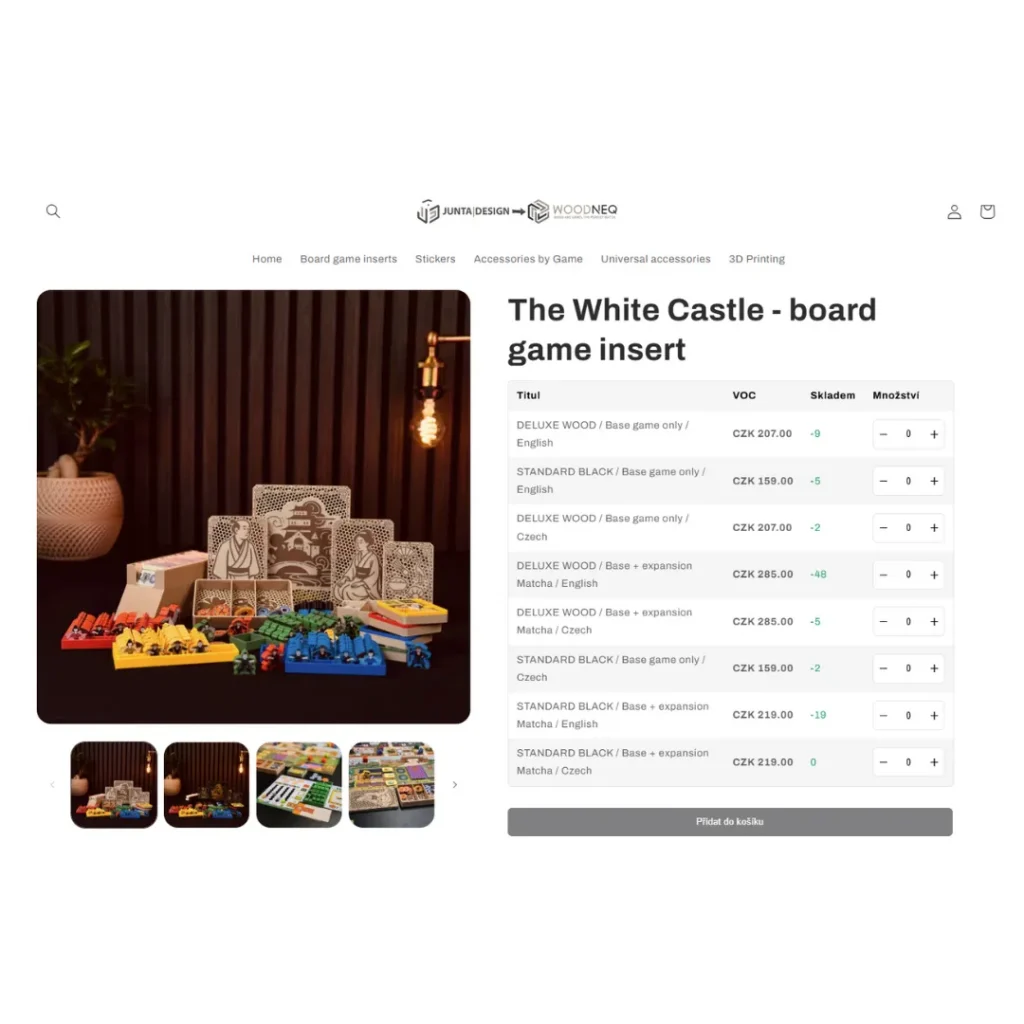
Use login-only access, password protection, or customer-group rules to hide wholesale prices from retail visitors and competitors. This protects margins and creates an incentive for buyer registration.
Outcome: Protected margins and incentive for buyer registration.
4. Streamline Wholesale Registration and Approval
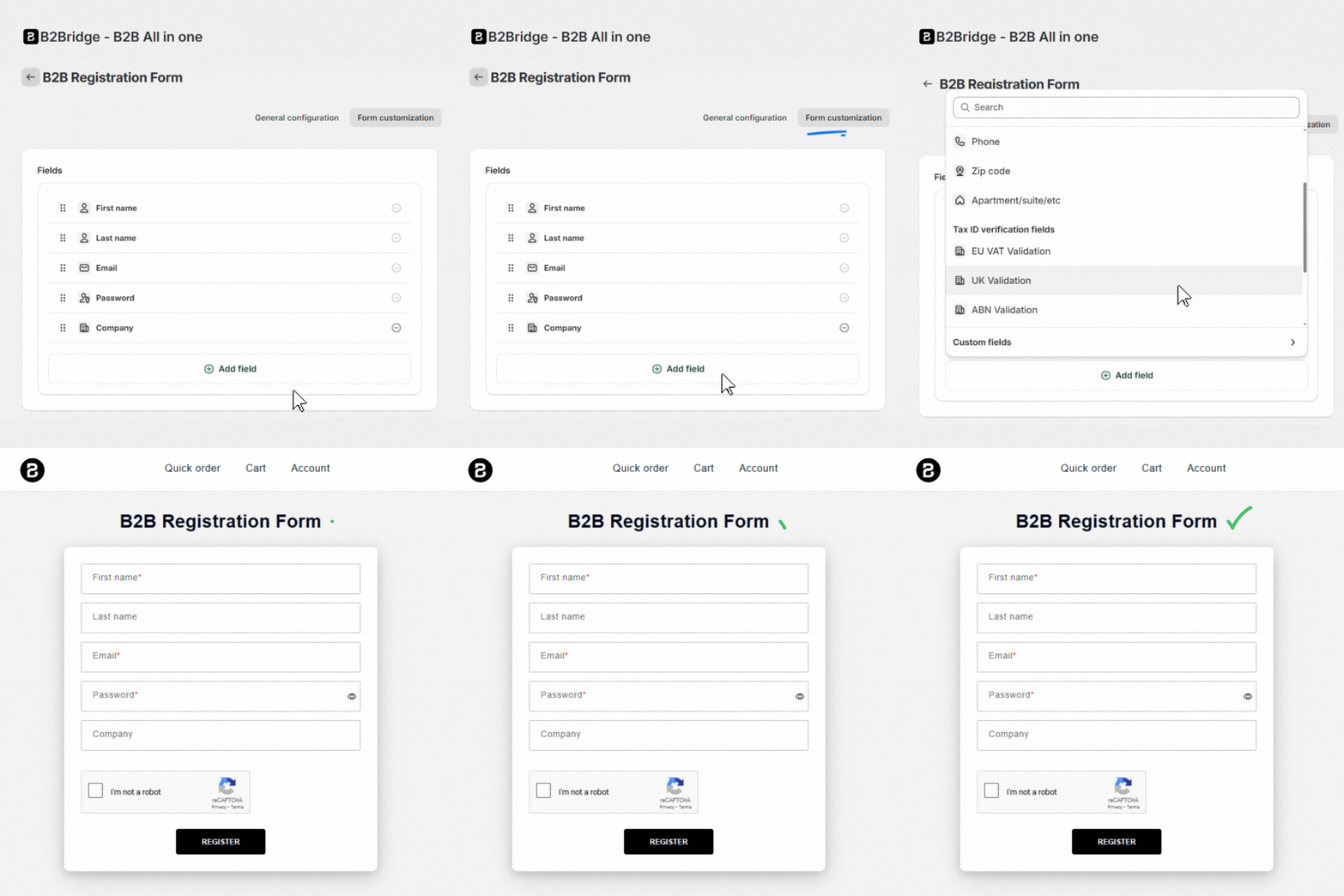
Implement customizable registration forms that capture business credentials like tax ID and resale certificate. Route applications through an approval workflow before granting B2B access.
Outcome: Faster onboarding, better-qualified wholesale accounts.
5. Offer Net Terms and Flexible B2B Payment Options
Enable Net 15, Net 30, or Net 60 payment terms and multiple payment methods by customer group. Net terms allow buyers to pay on invoice rather than at checkout, which is often a procurement requirement.
Outcome: Reduced checkout friction for large buyers, stronger buyer relationships.

6. Digitize Quote-to-Order and RFQ Workflows
Allow buyers to request quotes directly from product pages. RFQ stands for Request for Quote, a standard process for complex or high-value B2B purchases. Review, adjust, and convert quotes to draft orders inside your admin.
Outcome: Faster deal cycles, trackable negotiation process.
7. Add Quick Order and Reorder Tools
Provide quick order pages, saved carts, and one-click reorder options for repeat buyers placing high-SKU or recurring orders. The faster a buyer can restock, the more likely they are to stay with you.
Outcome: Faster reorders, higher retention.

8. Sync Pricing, Customers, and Inventory With Your ERP
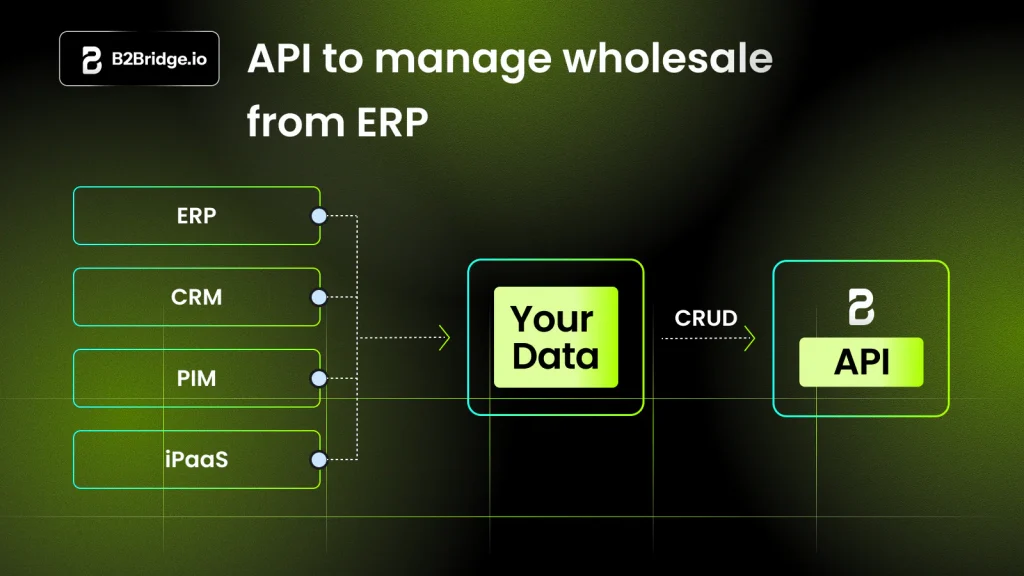
Integrate your ecommerce platform with ERP systems like NetSuite, Zoho, Odoo, or custom solutions via API. ERP stands for Enterprise Resource Planning, the software that manages core business processes. Real-time sync keeps pricing, stock levels, and customer data accurate.
Outcome: Fewer operational errors, faster order processing, predictable revenue flow.
9. Unify B2B and B2C on a Single Storefront
Run both wholesale and retail operations from one store rather than managing separate B2B sites. One catalog and one source of truth reduces duplicate work and simplifies inventory management.
Outcome: Lower operational cost, consistent brand experience.
10. Use Account-Based Marketing to Target High-Value Buyers
Focus marketing resources on specific target accounts using personalized campaigns, tailored landing pages, and sales-marketing alignment. ABM, or Account-Based Marketing, works particularly well for enterprise accounts with long sales cycles.
Outcome: Higher-quality leads, better sales conversion on enterprise accounts.
>> See more: 15 B2B Ecommerce Marketing Strategies That Actually Drive Revenue in 2026
11. Build Content That Earns B2B Search Demand
Create educational content such as buying guides, whitepapers, and product comparisons optimized for B2B search queries. This attracts buyers during the research phase of longer sales cycles.
Outcome: Organic traffic, thought leadership, top-of-funnel demand.
12. Run Lifecycle Email and Reorder Campaigns
Use email marketing to nurture leads, remind buyers to reorder, and share relevant product updates based on purchase history and buyer segment.
Outcome: Increased repeat purchase rate, shorter time between orders.
13. Optimize Mobile and Checkout for B2B Buyers
Ensure your B2B storefront is fully functional on mobile devices. Checkout flows that support B2B-specific requirements like net terms, PO numbers, and multi-address shipping reduce cart abandonment.
Outcome: Buyers can order from anywhere, reduced cart abandonment.
14. Apply AI to Search, Recommendations, and Personalization
Use AI-powered site search, product recommendations, and personalization to surface relevant products and pricing based on buyer behavior and history.
Outcome: Higher engagement, larger orders, faster product discovery.
15. A/B Test High-Stakes Pages in the Buyer Journey
Run split tests on product pages, cart, checkout, and registration forms to identify what drives conversion and average order value for your B2B audience.
Outcome: Data-driven improvements, continuous conversion gains.
How to Choose a B2B Ecommerce Platform
Pricing and Catalog Flexibility
Can the platform support unlimited price lists, customer-specific pricing, volume tiers, and quantity rules without custom development? If you manage multiple buyer segments, this is non-negotiable.
ERP and CRM Integration Depth
Does the platform offer native or API-based integration with systems like NetSuite, Zoho, Odoo, or custom ERPs for real-time data sync? The best platforms keep pricing, inventory, and customer data aligned across systems.
B2B Buyer Experience Out of the Box
Does the platform include quick order, net terms, RFQ, gated access, and B2B registration? Or do you need multiple apps to piece it together?
Scalability Across Plans and Markets
Can you grow from a starter B2B setup to enterprise-grade operations without migrating platforms? Does the platform support multi-currency and international markets?
B2B Ecommerce KPIs Worth Tracking
Wholesale Conversion Rate
The percentage of B2B visitors or registered accounts that complete a purchase. This metric tells you whether your buyer experience is working.
Average Order Value and Reorder Rate
Track order size and frequency to measure pricing strategy and retention effectiveness. Rising AOV usually signals that volume pricing and upsell tools are doing their job.
Time to Quote and Order Processing Time
Measure how long it takes to respond to RFQs and fulfill orders. Shorter times indicate operational efficiency.
Share of Self-Service Orders
The percentage of orders placed directly by buyers without sales rep intervention. A higher share means the self-service experience is working.
Common Barriers to B2B Ecommerce Growth
- Disconnected systems: ERP and CRM are not synced with ecommerce, creating errors and delays
- Rigid or manual pricing processes: Teams rely on spreadsheets, rep-managed quotes, or disconnected pricing logic
- Poor buyer experience: No quick order, no net terms, and no streamlined self-service journey
- Resistance to change: Sales teams are accustomed to manual processes and may hesitate to adopt digital workflows
- Separate B2B and B2C stores: Operating two stores doubles operational work and complicates inventory and catalog management
How to Roll Out Your B2B Ecommerce Strategy
Step 1. Audit Pricing, Customers, and Systems
Document current pricing structures, customer segments, and existing tech stack such as ERP, CRM, and inventory systems. Identify gaps between what you have and what you need.
Step 2. Map the Wholesale Buyer Journey
Analyze how your buyers research, evaluate, and purchase. Identify friction points and self-service opportunities. Where are buyers waiting on reps when they could be ordering directly?
Step 3. Launch a Phase One B2B Storefront
Start with core functionality: customer-specific pricing, gated access, and registration. Avoid scope creep. You can add features later.
Step 4. Integrate ERP, CRM, and Inventory
Connect back-end systems to ensure real-time accuracy in pricing, stock, and customer data. This is where most B2B operations either scale smoothly or hit a wall.
Step 5. Measure, Optimize, and Expand
Track KPIs, run A/B tests, and iterate. Add features like RFQ, quick order, and AI personalization as you scale.
Building a Revenue-Driving B2B Ecommerce Strategy With B2Bridge
Every strategy in this guide comes down to execution. B2Bridge brings customer-specific pricing, net terms, gated access, ERP sync, and quick order to Shopify merchants without the enterprise budget or months of custom development.
- B2B Pricing Engine: Unlimited price lists, volume tiers, customer-group pricing, and quantity rules managed from one place
- Net Terms and RFQ: Let buyers pay on Net 15, Net 30, or Net 60, or request quotes directly from product pages
- B2B Lock: Hide wholesale pricing from retail visitors and competitors with login-only or password-protected access
- B2B Registration: Capture business credentials and route applications through approval workflows before granting access
- ERP/CRM Integration: Sync pricing, customers, and orders with NetSuite, Zoho, Odoo, or custom systems via API
- Unified B2B + B2C: Run wholesale and retail from one Shopify store without a separate platform
B2Bridge works with your team from day one to understand your requirements, launch the setup, and support it after go-live.

FAQs About B2B Ecommerce Strategy
How long does it take to implement a B2B ecommerce strategy on Shopify?
Implementation timelines vary based on complexity. Many merchants launch a functional B2B storefront within weeks when using an all-in-one app like B2Bridge, with deeper ERP integrations and customizations added in subsequent phases.
Do you need Shopify Plus to run B2B ecommerce on Shopify?
No. Apps like B2Bridge provide enterprise-grade B2B features such as customer-specific pricing, net terms, gated access, and quick order on standard Shopify plans without requiring an upgrade to Shopify Plus.
How do you prevent retail shoppers from seeing wholesale prices on a B2B store?
Access control features like login-only pricing, password protection, and customer-group rules hide wholesale prices from unauthenticated visitors and show them only to approved B2B accounts.
Can you run B2B and B2C from a single Shopify store without duplicating operations?
Yes. A unified B2B and B2C storefront lets you manage one product catalog and inventory while showing different pricing, payment options, and experiences to retail versus wholesale buyers based on login status and customer group.
What is the difference between a B2B ecommerce platform and a B2B ecommerce app?
A B2B ecommerce platform is a standalone system purpose-built for B2B selling. A B2B ecommerce app adds B2B functionality to an existing platform like Shopify, enabling you to run B2B operations without migrating to a new system.

Hi, I’m Hanh – a product marketing professional passionate about driving growth, simplifying complex solutions, and creating impactful strategies for Shopify that connect products with customers.