B2B ecommerce is shifting fast. Buyers now expect AI-powered personalization, self-service portals, and purchasing experiences that feel more like Amazon than a phone call with a sales rep.
The businesses winning wholesale deals in 2026 aren’t the ones with the biggest catalogs. They’re the ones making it effortless for buyers to find products, see their pricing, and place orders without waiting on anyone. This guide breaks down the 12 trends reshaping how businesses buy, what’s driving the shift, and how to put these changes to work in your own operation.
What Is B2B Ecommerce and Why It Matters Now
B2B ecommerce is moving toward AI-driven personalization, self-service portals, and buying experiences that feel more like Amazon than a fax machine. Mobile-first research, B2B marketplaces, and AI-powered automation are leading the shift. Meanwhile, the majority of B2B buyers today are Millennials who expect seamless, fast, and transparent transactions.
So what exactly is B2B ecommerce? Put simply, it’s online transactions between businesses. A manufacturer sells to a distributor. A wholesaler supplies a retailer. A brand fulfills orders for resellers. Each represents a distinct type of B2B ecommerce model with its own workflows. Unlike B2C, where a single consumer clicks “buy now,” B2B involves negotiated pricing, bulk quantities, and payment terms that stretch 30, 60, or even 90 days.
The stakes here are real. Businesses still relying on phone orders, emailed spreadsheets, and manual price quotes are losing deals to competitors with frictionless digital experiences. If your wholesale customers can’t self-serve, they’ll find someone who lets them.
>> Read more:
- B2B Ecommerce Case Studies: 13 Real Examples Driving Serious Growth
- 57 B2B Ecommerce Statistics That Define 2026
The Current State of B2B Ecommerce
The global B2B ecommerce market dwarfs B2C in transaction volume. Yet many wholesalers and distributors still operate with disconnected systems, manual workflows, and buyer experiences that feel stuck in 2010.
Here’s how traditional B2B selling compares to modern B2B ecommerce:
| Traditional B2B Selling | Modern B2B Ecommerce |
|---|---|
| Phone, fax, and email orders | Self-service online portals |
| Manual price quotes | Real-time, personalized pricing |
| Sales rep-dependent | Rep-free purchasing option |
| Disconnected ERP and CRM | Integrated commerce stack |
The businesses pulling ahead are investing in digital buying experiences—modeled after leading B2B ecommerce websites—that match what their customers already expect from consumer shopping.
What Is Driving Change in B2B Buying Behavior
Generational Shift to Digital-Native Buyers
The people making purchasing decisions at businesses today grew up with smartphones and one-click ordering. They research independently, compare suppliers online, and often make buying decisions before ever contacting a sales rep. If your digital presence is weak, you’re invisible to them.
Mobile-First Research and Purchasing
More than half of B2B buyers now use mobile devices to research products and interact with suppliers. Mobile-optimized platforms aren’t a nice-to-have anymore. Buyers expect to browse catalogs, check pricing, and place orders from their phones.
Rising Expectations for B2C-Like Experiences
B2B buyers benchmark against Amazon. They want fast search, transparent pricing, easy reordering, and account management that doesn’t require a phone call. This “consumerization of B2B” is pushing wholesalers to rethink every touchpoint.
AI and Automation Lowering the Barrier to Modernize
AI tools that once required enterprise budgets are now accessible to mid-market businesses. Personalization, automated workflows, and intelligent search are becoming standard expectations rather than luxury features.
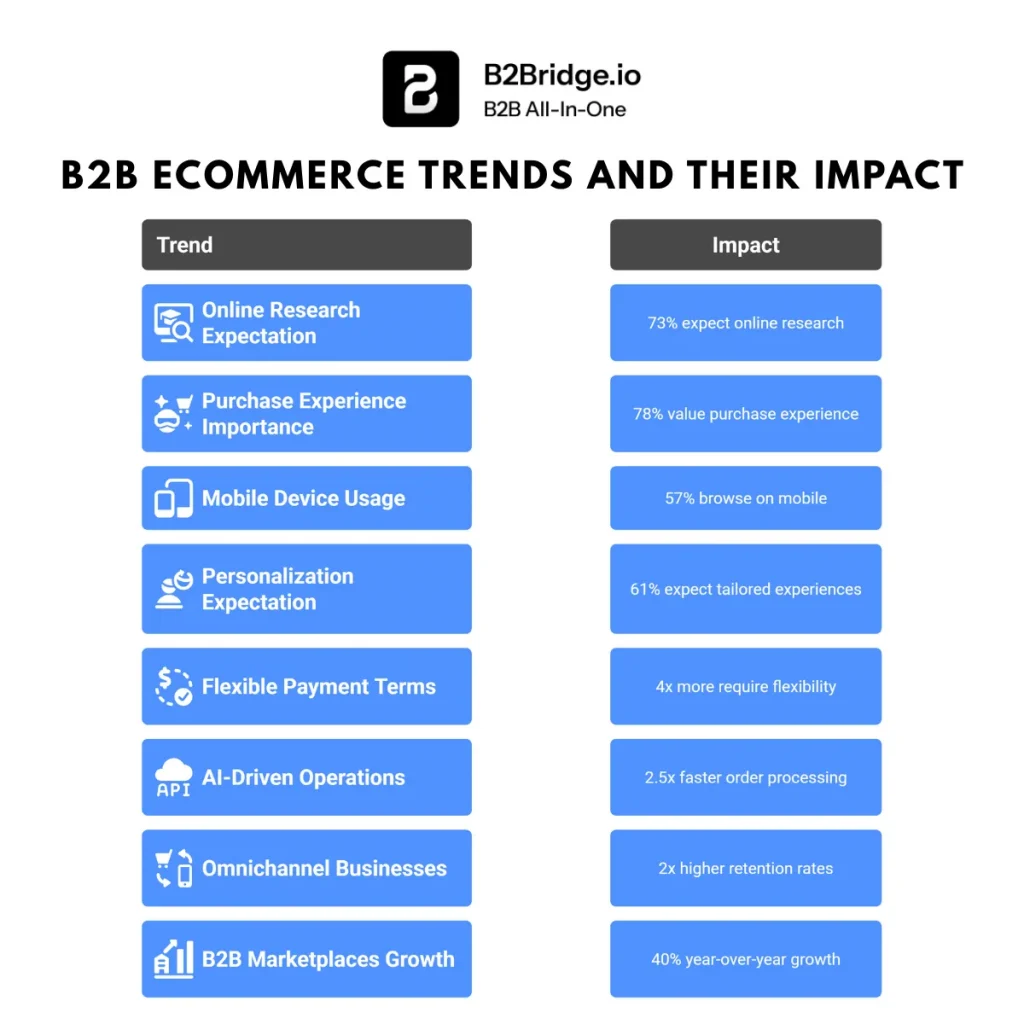
12 B2B Ecommerce Trends Reshaping Wholesale Buying
1. Digital-First Buying Journeys
Digital-first means buyers complete most of their research and purchasing online, often without ever talking to a sales rep. The power has shifted to the buyer, and suppliers who don’t optimize their digital presence lose deals before they know the opportunity existed.
- Self-education: Buyers research through websites, product catalogs, and online reviews before reaching out.
- Invisible competition: A poor digital experience sends buyers to competitors instantly.
- Accessibility: Product information, pricing, and ordering are available without requiring a sales call.
2. AI-Driven Selling and Personalization
AI personalization in B2B means using machine learning to tailor search results, product recommendations, and pricing to individual buyers or accounts. Conversational commerce, where AI chatbots handle procurement questions, is becoming common.
- Personalized search: AI interprets natural language queries like “show me gaskets for pump model X in stock.”
- Dynamic recommendations: Related products appear based on purchase history.
- Automated workflows: AI handles routine tasks like reorder reminders.
3. Self-Service Wholesale Portals
Self-service portals let B2B buyers browse catalogs, see their contracted pricing, place orders, track shipments, and reorder without contacting a sales rep. This is the single most demanded capability by modern B2B buyers.
Buyers can view order history, invoices, and payment status. One-click reorder from past purchases speeds up repeat buying. And your sales team gets freed up to focus on high-value relationships instead of routine order entry.

4. ERP and CRM Native Commerce
ERP (Enterprise Resource Planning) and CRM (Customer Relationship Management) systems hold your pricing, inventory, and customer data. The trend is toward ecommerce platforms that integrate directly with ERP and CRM systems so everything stays synchronized in real time. No more manual data entry or mismatched records.
- Real-time inventory sync: Buyers see accurate stock levels.
- Unified customer data: Orders flow directly into your ERP for fulfillment.
- Automated price list updates: Changes in your ERP reflect instantly in your storefront.
5. Account-Specific and Contract Pricing
B2B pricing is complex. Each customer may have negotiated rates, volume discounts, or contract terms. The trend is toward automated pricing engines that display the correct price to each logged-in buyer without manual intervention.
Contract price lists lock prices per customer agreement. Tiered volume discounts apply automatically based on order quantity. And wholesale pricing stays hidden from retail visitors.

6. Unified B2B and B2C Storefronts
Unified commerce means running both wholesale and direct-to-consumer on a single platform. One inventory, one admin, one tech stack. This eliminates the “two stores, double the work” problem that plagues many wholesalers.
A single inventory source prevents overselling or stock discrepancies between channels. One admin panel and one set of integrations reduce operational overhead. And some customers buy both wholesale and retail, so a seamless experience serves them better.

7. Composable and Headless Architecture
Composable commerce is a modular approach where businesses assemble best-of-breed solutions. A pricing engine here, a checkout there, rather than relying on a monolithic platform. Headless architecture separates the front-end presentation from back-end commerce logic, enabling flexibility and faster adaptation.
This approach lets you swap out components without rebuilding everything. You can add new features by integrating specialized tools. And you’re not locked into a single platform’s roadmap.
8. Digital Net Terms and RFQ Workflows
Net terms (Net 30, Net 60) let buyers pay invoices within 30 or 60 days rather than at checkout. RFQ (Request for Quote) is a formal process where buyers request custom pricing for large orders. The trend is toward digitizing both of these traditionally manual processes.
- Net terms at checkout: Approved buyers select invoice payment during purchase.
- Digital RFQ: Buyers submit quote requests online, and merchants review and convert to orders.
- Reduced friction: Email back-and-forth for standard B2B payment workflows gets eliminated.

9. B2B Marketplaces and Third-Party Channels
B2B marketplaces like Amazon Business, Alibaba, and Faire let multiple suppliers list products. Manufacturers and distributors increasingly use marketplace channels to reach new buyers alongside their own storefronts.
Marketplaces expand reach by giving you access to buyers who prefer marketplace discovery. They can lower acquisition cost since the marketplace brings traffic while you provide inventory. And an omnichannel presence means meeting buyers on the channels they already use.
10. Omnichannel and Hybrid Sales Models
Omnichannel means providing a consistent experience across online, mobile, marketplace, and in-person channels. Hybrid sales models combine self-service digital ordering with human sales support for complex deals. Self-service doesn’t eliminate the sales team. It changes their role.
Routine orders happen through self-service. High-value negotiations still require human touch. And AI chatbots can handle initial inquiries, escalating to reps when needed.
11. Mobile Wholesale Apps and Quick Reordering
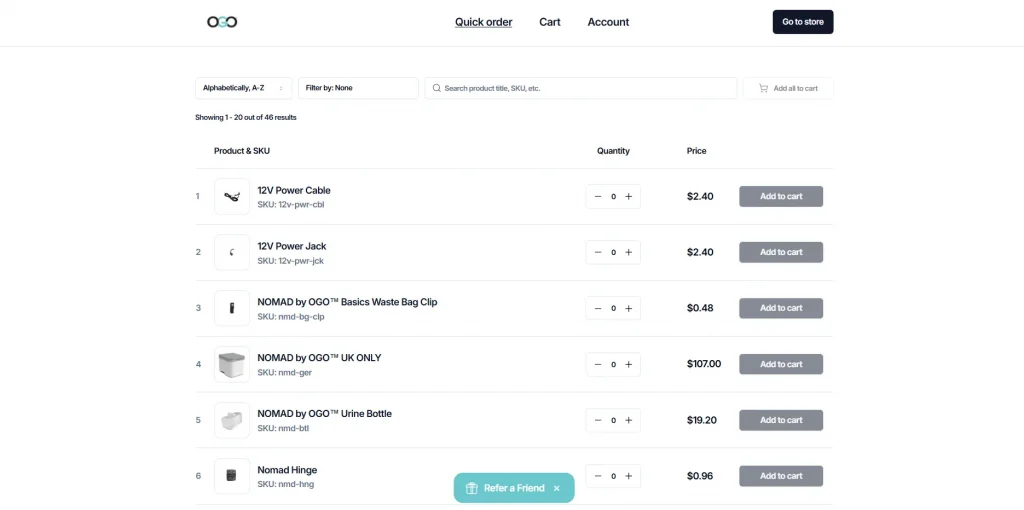
Dedicated mobile apps or mobile-optimized portals let field buyers, purchasing managers, and sales reps place wholesale orders from anywhere. Quick order features like bulk entry, CSV uploads, and saved carts speed up repeat purchasing.
On-the-go ordering means buyers can place orders from trade shows, warehouses, or job sites. Quick order forms let them enter SKUs and quantities directly without browsing catalogs. And saved carts plus reorder lists speed up repeat purchasing.
12. Dynamic Pricing and Real-Time Margin Optimization
Dynamic pricing adjusts prices in real time based on factors like demand, inventory levels, customer segment, or competitive landscape. This helps wholesalers optimize margins while remaining competitive.
Demand-based adjustments shift prices based on stock availability. Segment-specific pricing shows different rates to different customer groups automatically. And margin protection prevents underpricing during supply constraints.
How to Evaluate and Prioritize B2B Ecommerce Trends
Not every trend applies to every business. Here’s a practical framework for deciding where to focus:
Step 1. Assess Business and Buyer Fit
Does a particular trend align with your B2B ecommerce strategy and business model? A manufacturer selling to distributors has different priorities than a brand selling to retailers.
Step 2. Estimate ROI and Revenue Impact
Prioritize trends that solve your biggest revenue leaks or operational bottlenecks. Focus on measurable outcomes.
Step 3. Evaluate Implementation Risk
Consider technical complexity, integration challenges, and change management required for each trend.
Step 4. Check Internal Readiness
Does your team have the skills, bandwidth, and systems to adopt a trend successfully?
Step 5. Benchmark Against Competitors
Monitor which trends competitors have already adopted. Falling behind on table-stakes capabilities costs you deals.
How B2Bridge Brings These Trends to Shopify
Every trend on this list points to the same destination: a frictionless, self-serve wholesale experience powered by smart pricing, integrated systems, and buyer-friendly workflows. B2Bridge brings all of that to Shopify without requiring Shopify Plus or a separate B2B platform.
- Enterprise B2B Pricing Engine: Account-specific pricing, volume discounts, contract price lists, and hidden wholesale pricing, all within Shopify.
- Native ERP and CRM Integrations: Real-time sync with NetSuite, Zoho, Odoo, and custom ERPs keeps pricing, inventory, and orders aligned.
- Conversion-Focused Wholesale UX: Quick order pages, dedicated B2B cart with net terms, RFQ workflows, saved carts, and fast reordering.
- Unified B2B and B2C on a Single Shopify Store: Run wholesale and retail from one admin, one inventory, one tech stack.

If you’re ready to operationalize B2B ecommerce trends on Shopify, Book A Demo to see how B2Bridge can help.
FAQs About B2B Ecommerce Trends
What is the difference between B2B and B2C ecommerce?
B2B ecommerce involves transactions between businesses, like a manufacturer selling to a distributor. B2C involves businesses selling directly to individual consumers. B2B typically involves larger order volumes, negotiated pricing, and payment terms like net invoices.
Do I need Shopify Plus to run B2B ecommerce on Shopify?
Apps like B2Bridge enable enterprise-grade B2B functionality on standard Shopify plans. Customer-specific pricing, net terms, and wholesale registration work without requiring an upgrade to Shopify Plus.
How does AI improve B2B ecommerce conversion rates?
AI improves B2B conversion by personalizing search results, recommending relevant products based on purchase history, and automating routine tasks like reorder reminders and quote generation. This reduces friction and accelerates the path from browsing to purchase.
What features does a B2B ecommerce platform need for wholesale sellers?
A strong B2B ecommerce platform includes customer-specific pricing, volume discounts, minimum order quantities, net payment terms, RFQ workflows, ERP/CRM integration, and a self-service buyer portal. Each of these features addresses the complexity that distinguishes wholesale from retail commerce.

Hi, I’m Ha My Phan – an ever-curious digital marketer crafting growth strategies for Shopify apps since 2018. I blend language, logic, and user insight to make things convert. Strategy is my second nature. Learning is my habit. And building things that actually work for people? That’s my favorite kind of win.