Differential pricing is a strategy where businesses charge different prices for the same product based on customer segment, location, time, or demand. The goal is to capture what each buyer is actually willing to pay rather than leaving money on the table with a single flat price.
In B2B, this isn’t optional—it’s how wholesale works. Distributors expect different rates than retailers, contract accounts negotiate terms that never appear on a public price list, and VIP buyers see pricing that one-time purchasers don’t. This guide covers the core types of differential pricing, real-world examples from companies like Amazon and Uber, and how to implement segmented pricing without creating operational chaos.
What Is Differential Pricing?
Differential pricing is a strategy where businesses charge different prices for the same product based on customer segment, location, time of purchase, or demand. The idea is simple: not every buyer values your product the same way, so charging everyone the same price leaves money on the table or prices out buyers who would have purchased at a lower rate.
You might also hear this called price differentiation, segmented pricing, or discriminatory pricing. The terminology varies, but the concept stays consistent.
In B2B, differential pricing is the norm rather than the exception. Wholesale buyers expect different rates than retail customers. Contract accounts often negotiate terms that never appear on a public price list. And distributors typically see pricing that retailers don’t.
Why Companies Use Differential Pricing
Differential pricing lets businesses capture more value from customers willing to pay more while still reaching price-sensitive segments. A single flat price rarely works across diverse buyer groups.
- Revenue optimization: Higher margins from buyers with greater willingness to pay
- Market expansion: Access to budget-conscious customers without discounting for everyone
- Inventory management: Time-based adjustments help move products during slower periods
- Competitive positioning: Targeted pricing in specific segments or regions without broad price cuts
For wholesalers and distributors, differential pricing often forms the foundation of the entire business model. Distributors see one price, retailers see another, and VIP accounts see a third.
Benefits and Disadvantages of Differential Pricing
| Benefits | Drawbacks |
|---|---|
| Expands market reach across segments | Risk of customer backlash if pricing feels unfair |
| Increases overall revenue | Complexity in managing multiple price points |
| Optimizes production and inventory | Potential legal scrutiny in some industries |
| Improves price management precision | Can trigger price wars with competitors |
Customers generally accept differential pricing when the logic is clear. Volume discounts make sense. Student discounts make sense. Regional pricing makes sense. What erodes trust is pricing that feels arbitrary or hidden.
Types of Differential Pricing
Customer Segment Pricing
Customer segment pricing sets prices by buyer group. A distributor pays one rate, a one-time buyer pays another—a form of dual pricing common across wholesale. Retailers might offer student, senior, or military discounts for the same product.
Volume-Based Pricing
Volume-based pricing ties discounts to quantity purchased. The more you buy, the less you pay per unit. Tiered discounts and case pack pricing fall into this category, and both are common in wholesale operations.
Time-Based Pricing
Time-based pricing adjusts prices based on when the purchase occurs. Seasonal rates, early-bird discounts, and end-of-quarter promotions are all examples. Airlines and hotels have refined this approach, but it applies to B2B as well with clearance pricing on last-season inventory.
Location-Based Pricing
Location-based pricing varies prices by geography or sales channel. Airport stores charge more than suburban locations. International buyers might see currency-adjusted pricing. Regional cost differences in shipping, taxes, and local competition often justify location-based adjustments.
Channel-Based Pricing
Channel-based pricing offers different prices depending on where the sale happens. An online store might price differently than marketplace listings or in-person sales. In B2B, portal pricing often differs from phone orders or assisted sales.
Brand and Product Version Pricing
Sometimes called product versioning, this approach offers different product versions at different price points. Standard vs. premium, basic vs. enterprise. The core product might be similar, but packaging, features, or service levels justify the price gap.
The Three Degrees of Price Discrimination
Economists classify differential pricing into three degrees based on how precisely prices target individual buyers.
First-Degree Price Discrimination
First-degree price discrimination means charging each customer the maximum they’re willing to pay. This is the theoretical ideal for sellers, but it’s rare in practice. Auctions, requests for quote, and one-on-one negotiations come closest.
Second-Degree Price Discrimination
Second-degree price discrimination prices based on quantity or product version purchased. Volume discounts and tiered pricing plans are classic examples. The customer self-selects into a pricing tier based on their own behavior.

Third-Degree Price Discrimination
Third-degree price discrimination charges different prices to identifiable customer groups. B2B vs. B2C pricing, student discounts, and geographic pricing all fall here. This is the most common form because it’s operationally feasible.
Real-World Examples of Differential Pricing
Amazon
Amazon uses customer segment and time-based pricing. Prices fluctuate based on demand, user behavior, and competitive positioning. Prime members sometimes see different offers than non-members.
Uber
Uber’s surge pricing is a textbook example of time and demand-based differential pricing. When demand spikes, prices rise to capture willingness to pay from riders who want a ride immediately. A 2025 study in Econometrica found this approach increases total welfare by 2.15% of gross revenue.
Adobe Creative Cloud
Adobe uses customer segment and product version pricing. Individuals, teams, students, and enterprises all see different subscription tiers with different price points and feature sets.

Delta Airlines
Delta uses time-based and customer segment pricing through fare classes. Book early, pay less. Fly on a Tuesday, pay less. Business travelers often pay more than leisure travelers for the same seat.
Starbucks
Starbucks uses location-based pricing. The same drink often costs more in airports, city centers, or high-rent neighborhoods. The product is identical, but the context justifies the price difference.

Differential Pricing vs Dynamic Pricing vs Price Discrimination
| Term | Definition | Focus |
|---|---|---|
| Differential Pricing | Different prices for different customer segments | Segment characteristics |
| Dynamic Pricing | Prices change in real-time based on supply and demand | Market conditions |
| Price Discrimination | Economic term for any form of charging different prices | Willingness to pay |
Differential pricing is segment-based and relatively stable. Your wholesale customers see one price list, your retail customers see another. Dynamic pricing reacts rapidly to market shifts, sometimes changing prices multiple times per day. Price discrimination is the umbrella term economists use for all of it.
Is Differential Pricing Legal?
Differential pricing is legal in most contexts, but there are boundaries. Businesses cannot discriminate based on protected classes like race, gender, or religion. In B2B, antitrust concerns also come into play.
In the U.S., the Robinson-Patman Act restricts certain forms of price discrimination between business buyers if it harms competition. The key question is whether pricing practices create unfair competitive advantages for some buyers over others.
Transparency and consistent application help reduce risk. When pricing rules are clear and applied uniformly within each segment, businesses are on solid ground.
Conditions Required for Differential Pricing
Four conditions typically enable effective differential pricing:
- Identifiable segments: The ability to distinguish customer groups like B2B vs. B2C, wholesale vs. retail, or new vs. returning
- Different willingness to pay: Segments have varying price sensitivity
- Market separation: Buyers in one segment cannot easily resell to another, which prevents arbitrage
- Pricing infrastructure: Systems exist to manage and enforce multiple price lists
For Shopify merchants running B2B operations, that last point often becomes the bottleneck. Native Shopify features don’t always support the complexity of true differential pricing.
How to Implement a Differential Pricing Strategy
Step 1. Segment Your Customers
Start by identifying meaningful groups. Wholesale vs. retail is the obvious split, but you might also segment by order size, geography, industry, or relationship tenure. The goal is groups with genuinely different willingness to pay.
Step 2. Choose the Right Type of Differential Pricing
Match the pricing type to your business model. Volume-based pricing works well for wholesale. Customer segment pricing fits B2B/B2C hybrids. Time-based pricing might apply to seasonal products or promotional periods.
Step 3. Build Customer-Specific Price Lists
Create price lists or pricing rules for each segment. B2B operations often require contract pricing or negotiated rates that don’t appear on any public-facing page.
Step 4. Prevent Arbitrage Between Segments
Arbitrage happens when lower-priced buyers resell to higher-priced segments. Tactics to prevent arbitrage include gating access, requiring account verification, and limiting resale through contractual terms.
Step 5. Communicate Value to Each Segment
Justify pricing with value-based messaging. Wholesale buyers expect volume discounts. Retail buyers expect convenience and availability. Each segment benefits from understanding why their price makes sense.
Step 6. Monitor, Test, and Iterate
Track margins, conversion rates, and customer feedback. Market conditions shift, costs change, and competitors adjust. Review pricing rules regularly.
Best Practices for Differential Pricing
Use Data-Driven Segmentation
Base segments on purchase behavior, order history, and customer profiles rather than assumptions. The more precise your segmentation, the more effectively you can price.
Anchor Prices to Customer Value
Set prices based on what each segment values, not just cost-plus calculations. A distributor buying in bulk values reliability and margin. A one-time buyer values convenience.
Hide B2B Prices From B2C Buyers
Keep wholesale pricing private to avoid undercutting retail margins or confusing shoppers. Gated portals and login-required pricing solve this problem cleanly.
Stay Compliant With Pricing Laws
Review pricing policies for anti-discrimination and antitrust compliance, especially in B2B. When in doubt, consult legal counsel.
Common Mistakes to Avoid With Differential Pricing
Pricing Without Clear Segments
Inconsistent pricing confuses buyers and erodes trust. If segments aren’t well-defined, pricing will feel arbitrary.
Ignoring Price Sensitivity
Overpricing a segment can drive buyers to competitors. Underpricing leaves money on the table. Test and validate assumptions.
Letting Customer Groups See Each Other’s Prices
B2C customers who see wholesale prices may feel cheated. Wholesale buyers who see retail prices may demand deeper discounts. Access control and price hiding are essential for hybrid stores.
Technology and Tools for Differential Pricing
Managing differential pricing at scale requires the right systems. Spreadsheets work for a while, but they break down as complexity grows. According to McKinsey, one $15 billion B2B distributor gained 200+ basis points of margin improvement by replacing manual pricing with data-driven guidance.
- Price list management: Tools to create, update, and assign multiple price lists per customer group
- ERP and CRM integration: Keeps pricing aligned across systems without manual syncing
- Access control: Gates pricing visibility by customer type or login status
- Volume and quantity rules: Enforces minimum order quantities, case packs, and tiered discounts
Shopify merchants often find that native features don’t fully support B2B differential pricing. Customer-specific price lists, hidden pricing, and volume tiers typically require add-on solutions.
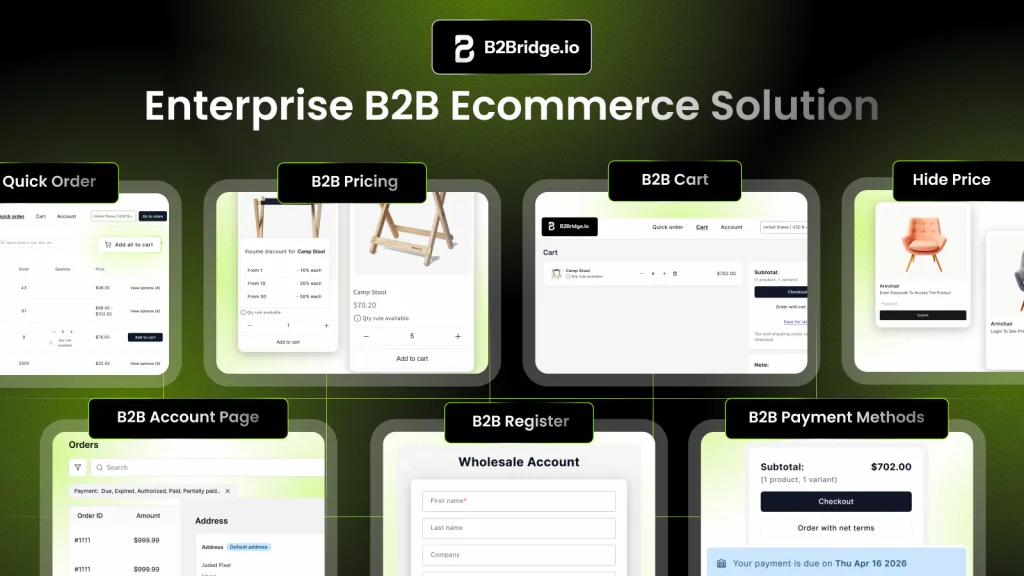
With B2Bridge, you can manage customer-specific pricing, volume discounts, B2B locks, net terms, and wholesale workflows in one centralized Shopify solution — without relying on multiple disconnected apps.
>> Book a demo
Frequently Asked Questions About Differential Pricing
Is differential pricing the same as dynamic pricing?
No. Differential pricing sets different prices for customer segments based on characteristics like buyer type or location. Dynamic pricing adjusts prices in real time based on supply and demand. Both strategies can coexist, but they operate on different triggers.
Is differential pricing illegal?
Differential pricing is legal in most cases. However, businesses cannot discriminate based on protected classes, and B2B operations face antitrust considerations like the Robinson-Patman Act. Transparent, consistently applied pricing rules reduce legal risk.
What is the basis of differential pricing?
Differential pricing is based on customer segmentation. Grouping buyers by characteristics like location, purchase volume, or buyer type allows businesses to set prices that match each group’s willingness to pay.
Can small businesses use differential pricing without enterprise software?
Yes. Small businesses can use Shopify apps like B2Bridge to manage customer-specific price lists, volume discounts, and B2B pricing without custom development or Shopify Plus.

Hi, I’m Ha My Phan – an ever-curious digital marketer crafting growth strategies for Shopify apps since 2018. I blend language, logic, and user insight to make things convert. Strategy is my second nature. Learning is my habit. And building things that actually work for people? That’s my favorite kind of win.