B2B ecommerce case studies document how wholesale businesses digitize operations, integrate systems, and measure outcomes—giving you real-world proof of what works before you invest in your own transformation. The best ones go beyond vanity metrics to show exactly how manufacturers, distributors, and wholesalers solved problems like disconnected ERPs, manual pricing chaos, and low wholesale conversion.
This guide breaks down 13 B2B ecommerce case studies with measurable growth, the patterns that separate high performers from the rest, and the lessons you can apply to your own wholesale strategy today.
What Is a B2B Ecommerce Case Study
A B2B ecommerce case study is a documented account of how a business-to-business company implemented or improved its digital wholesale operations—and what happened as a result. Unlike generic business case studies, B2B ecommerce case studies focus specifically on how manufacturers, distributors, and wholesalers digitize complex operations like customer-specific pricing, ERP integration, and bulk ordering workflows.
The best B2B ecommerce case studies cover platform selection, integration approaches, buyer experience changes, and measurable business outcomes. You’ll typically find real numbers: revenue growth percentages, conversion improvements, and operational hours saved.
- B2B ecommerce case study: A documented account of a wholesale digital transformation with specific challenges, solutions, and results
- Why case studies matter: Real-world proof of what works when selling to other businesses online
- What case studies typically cover: Platform decisions, system integrations, buyer experience redesigns, and quantifiable outcomes
Why B2B Ecommerce Case Studies Matter for Your Wholesale Strategy
Before you invest in a B2B ecommerce platform or overhaul your wholesale operations, studying what worked for similar businesses reduces your risk. Case studies give you a shortcut—you learn from someone else’s implementation without making the same mistakes.
Case studies also help build internal buy-in. When you’re pitching leadership on a B2B ecommerce investment, documented outcomes from comparable companies carry more weight than vendor promises.
- Validate your approach: See how businesses with similar challenges solved problems you’re facing
- Build internal buy-in: Use documented outcomes to justify investment to stakeholders
- Avoid common pitfalls: Learn what went wrong for others before you repeat the same mistakes
- Benchmark expectations: Understand realistic timelines, resource requirements, and growth patterns
How to Read a B2B Ecommerce Case Study Like a Buyer
Not all case studies are created equal. Some are thinly veiled sales pitches, while others offer genuinely transferable lessons. When you’re evaluating a case study, look beyond the headline metrics and dig into the specifics.
| What to Look For | Why It Matters |
|---|---|
| Industry and company size | Determines relevance to your situation |
| Starting point and challenges | Shows whether the problems match yours |
| Platform and integration approach | Reveals technical requirements |
| Buyer experience improvements | Highlights UX patterns you can apply |
| Business outcomes | Validates whether the approach delivered results |
The most useful case studies explain the “how,” not just the “what.” A 40% revenue increase means little if you can’t understand the mechanism that drove it.
13 B2B Ecommerce Case Studies With Measurable Growth
The following case studies span manufacturers, distributors, and wholesalers across industries. Each one offers transferable lessons for your own B2B ecommerce strategy.
Brooklyn Bicycle Co. Streamlines Wholesale Operations & NetSuite Sync
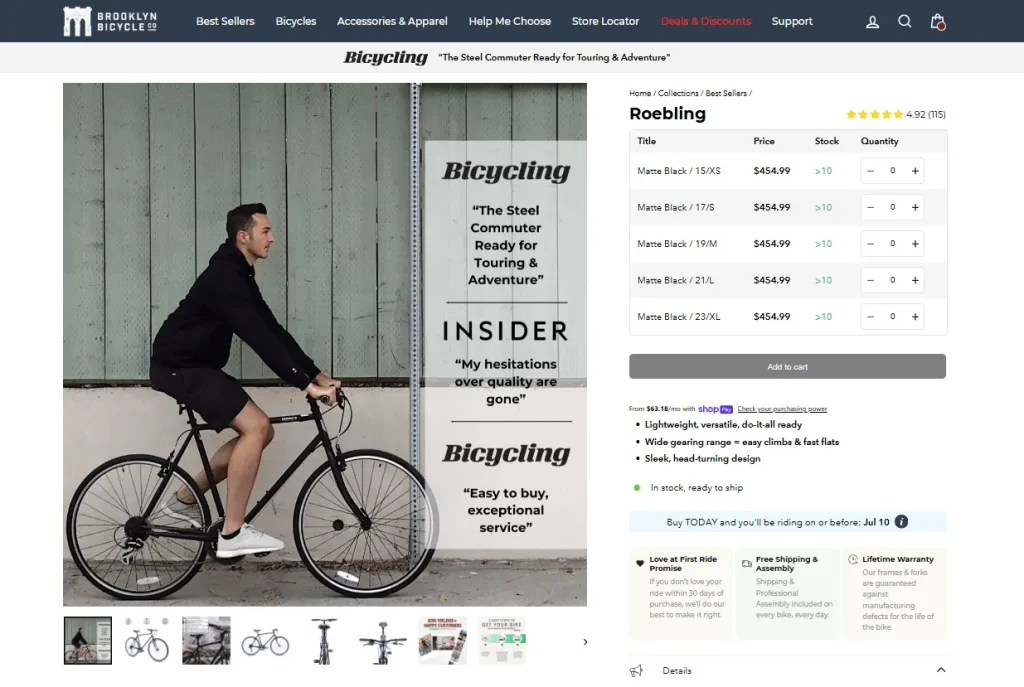
Brooklyn Bicycle Co., a renowned urban bicycle brand in the USA, enabled retail partners to seamlessly place wholesale orders while managing hybrid B2C & B2B operations on Shopify. The portal bridges the gap between storefront sales and enterprise resource planning.
- Standout features: Real-time Shopify and NetSuite synchronization, per-variant wholesale pricing, password-protected (gated) dealer landing pages, multi-user accounts under a single master profile.
- Outcome: Elimination of manual data entry between Shopify and NetSuite, a fully branded and personalized B2B buying experience, and accelerated order fulfillment for retail partners.
Ready to Scale Your B2B Store on Shopify? Streamline your wholesale operations and automate your business workflows today.
👉 Book A Demo with B2Bridge or get started instantly with a Free Install.
Steelcase Manages Massive SKU Combinations With Configurable Commerce

Steelcase, a global furniture manufacturer, faced an extreme product complexity challenge: millions of possible configurations across the catalog. The solution involved configurable commerce that lets buyers customize products while the system automatically calculates pricing and availability.
Standout features: Real-time configuration pricing, guided selling tools, integration with manufacturing systems
Outcome: Reduced quote turnaround time and enabled self-service ordering for complex products that previously required sales rep involvement
Sunbelt Rentals Powers Self Service Ordering at Scale

Sunbelt Rentals, one of the largest equipment rental companies in North America, enabled wholesale buyers to self-serve without calling a branch. The B2B portal now handles everything from availability checks to contract renewals.
Standout features: Real-time inventory visibility, account-based rental history, 24/7 ordering capability
Outcome: Reduction in sales rep workload while increasing order volume from existing accounts
Sealed Air Replaces a Legacy Portal With a Transparent Buyer Experience
Sealed Air (now SEE), a packaging solutions company, replaced an outdated B2B portal that frustrated buyers with hidden pricing and clunky navigation. The new experience prioritized pricing transparency and streamlined reordering.
Standout features: Clear pricing display, simplified checkout, mobile-optimized interface
Outcome: Improved buyer trust and increased repeat purchase rates from existing wholesale accounts
Boehringer Ingelheim Localizes Animal Health Commerce Across Global Markets

Boehringer Ingelheim serves veterinary distributors across multiple countries with localized pricing, currencies, and tax rules. The multi-market B2B ecommerce approach handles regional complexity without requiring separate storefronts.
Standout features: Multi-currency support, localized tax handling, region-specific catalogs
Outcome: Faster market expansion and consistent buyer experience across geographies
FoodServiceDirect Tames a Large SKU Catalog With Headless Commerce

FoodServiceDirect, a foodservice distributor with tens of thousands of SKUs, adopted headless commerce—an architecture where the frontend presentation layer is decoupled from the backend commerce engine. Headless commerce gave the team flexibility to customize the buyer experience without touching core systems.
Standout features: Fast page loads, flexible frontend customization, API-driven catalog management
Outcome: Improved site performance and ability to iterate on buyer experience quickly
ASUS Unifies Its Global Reseller Channel on a Single Platform

ASUS consolidated multiple regional B2B storefronts into a single platform serving resellers worldwide. Consolidation eliminated the operational burden of maintaining separate systems while giving channel partners a consistent experience.
Standout features: Unified partner portal, centralized pricing management, streamlined onboarding
Outcome: Reduced operational costs and faster time-to-market for new products across regions
Transcat Runs Multiple Business Models on One Flexible Storefront

Transcat serves customers who rent equipment, purchase products, and buy calibration services—all from the same company. The B2B platform handles different transaction types without forcing buyers into separate workflows.
Standout features: Multi-model checkout, service scheduling integration, account-based pricing by transaction type
Outcome: Increased cross-selling between business lines and simplified buyer experience
Pitney Bowes Drives ROI Through B2B Marketing Automation

Pitney Bowes integrated marketing automation with the B2B ecommerce platform to nurture leads and segment buyers based on behavior. Marketing automation connected the digital storefront to broader demand generation efforts.
Standout features: Behavioral segmentation, automated nurture campaigns, CRM integration
Outcome: Higher conversion rates from marketing-qualified leads and improved customer lifetime value
HP Builds a Future Ready Wholesale Platform for Long Term Growth

HP designed its B2B platform with scalability as a primary requirement, anticipating future product lines, markets, and buyer segments. The architecture supports rapid expansion without major rebuilds.
Standout features: Modular architecture, API-first design, flexible catalog structure
Outcome: Faster time-to-market for new initiatives and reduced technical debt
Lavazza by Bluespresso Unifies B2B and B2C on a Single Store

Lavazza’s Bluespresso operation runs wholesale and retail from one Shopify storefront, showing different pricing and experiences to logged-in B2B buyers versus retail visitors. Running both channels from one store eliminates the operational duplication of maintaining separate storefronts.
Standout features: Unified inventory management, customer-group-based pricing, single admin interface
Outcome: Reduced operational costs and simplified catalog management
Bob Barker Company Grows Revenue With Ecommerce Integration

Bob Barker Company, a correctional supply distributor, integrated the ecommerce platform with backend ERP systems to keep pricing, inventory, and orders synchronized. ERP integration eliminated manual data entry and reduced errors.
Standout features: ERP synchronization, automated order processing, real-time inventory updates
Outcome: Faster order processing and reduction in pricing errors
Gala Imports Achieves Conversion Growth With B2B Ecommerce

Gala Imports, a wholesale importer, improved conversion rates by implementing B2B-specific UX features like quick order forms, saved carts, and streamlined reordering. The focus was on how wholesale buyers actually purchase.
Standout features: Quick order portal, saved cart functionality, one-click reorder
Outcome: Higher conversion rates and increased average order value from existing accounts
Common Patterns Across High Growth B2B Ecommerce Case Studies
After reviewing the case studies above, several recurring patterns emerge that separate high-growth B2B operations from those that struggle.
Tight ERP and CRM Integration as the Single Source of Truth
The most successful implementations connect the storefront to backend systems like NetSuite, Zoho, or Odoo from day one. ERP (Enterprise Resource Planning) systems manage inventory, pricing, and orders. CRM (Customer Relationship Management) systems track buyer relationships and history.
When ERP and CRM systems stay synchronized with the storefront, you avoid the operational chaos of manual data entry and conflicting information across platforms.
Personalized Pricing and Contract Catalogs per Customer Group
Top performers use customer-specific pricing, tiered discounts, and contract price lists rather than one-size-fits-all pricing. Role-based pricing—where different buyer segments see different prices—increases loyalty and protects margins.
Net Terms RFQ and Quote to Order Workflows Built Into Checkout
B2B buyers expect payment flexibility. Net terms (Net 15, Net 30, Net 60) let buyers pay after delivery rather than at checkout. RFQ (Request for Quote) workflows let buyers request custom pricing for large or complex orders.
The case studies that show the strongest results have net terms and RFQ workflows built directly into checkout, not handled through email side channels.
Unified B2B and B2C Operations on a Single Storefront
Running wholesale and retail from one platform—rather than maintaining separate stores—reduces operational duplication and lowers costs. The key is showing different experiences to different buyer types based on login status and customer group.
Self Service Buyer Portals That Reduce Sales Rep Workload
Quick order pages, saved carts, and reorder functionality enable buyers to transact without sales rep involvement. Self-service portals free your team to focus on high-value activities while improving buyer satisfaction.
Key Lessons and Takeaways From B2B Ecommerce Case Studies
The lessons from the case studies above translate directly into actions you can apply to your own wholesale digital strategy.
1. Audit Your Pricing and Order Logic Before Replatforming
Document your current pricing rules, MOQs (minimum order quantities), quantity increments, and customer tiers before selecting a platform. The implementation goes faster when you know exactly what you’re building.
2. Prioritize Buyer UX Built for Bulk and Reorder Behavior
B2B buyers behave differently than retail shoppers—they buy in bulk, reorder frequently, and want fast checkout. Quick order forms and saved carts matter more than flashy product pages.
3. Connect Your Storefront to Core Systems From Day One
ERP and CRM integration at launch prevents the operational chaos of disconnected systems. Bolting on integrations later is always harder and more expensive.
4. Gate Wholesale Pricing While Keeping Public Storefronts Clean
Access control strategies—password protection, login-only access, hidden wholesale pricing—protect margins without confusing retail visitors. You can run both audiences from one store with the right setup.
5. Treat Your B2B Launch as a Living Program Not a One Time Project
The most successful implementations involve ongoing optimization, support, and iteration. A technical partner who stays with you post-launch makes a difference in long-term results.
KPIs and Metrics Used to Measure B2B Ecommerce Success
The case studies above track specific metrics to prove ROI. Here’s what to measure in your own B2B ecommerce operation.
Average Order Value and Revenue per Customer
AOV (Average Order Value) matters more in B2B than B2C because wholesale transactions are inherently larger. Volume pricing and MOQs drive larger orders when implemented correctly.
Wholesale Conversion Rate and Reorder Frequency
Measure conversion for logged-in B2B buyers separately from retail traffic. Reorder rate is a loyalty indicator—high reorder frequency signals a buyer experience that works.
Operational Hours Saved Through Automation
Quantify time saved by eliminating manual order entry, pricing updates, and customer onboarding. Operational time savings often represent the fastest ROI from B2B ecommerce investments.
Pricing and Order Error Reduction
Automated pricing logic and order rules reduce costly mistakes—wrong prices, missed MOQs, incorrect quantities. Track error rates before and after implementation.
The Future of B2B Ecommerce and What Case Studies Reveal Next
Recent case studies point toward several emerging trends: AI-assisted ordering and search, composable commerce architectures that allow faster customization, deeper ERP automation, and hybrid B2B+B2C models becoming standard rather than exceptional.
The businesses investing in AI-powered search, headless architecture, and unified B2B/B2C storefronts now are positioning themselves for the next wave of wholesale digital transformation.
Launch Your Own B2B Ecommerce Success Story With B2Bridge
The patterns from the case studies above—enterprise pricing logic, ERP integration, unified B2B+B2C operations, net terms and RFQ workflows—are exactly what B2Bridge delivers for Shopify merchants.
- Enterprise pricing engine: Customer-specific pricing, volume discounts, contract price lists, and hidden wholesale pricing
- ERP and CRM integration: Connect to NetSuite, Zoho, Odoo, or custom systems to keep pricing, customers, and orders synchronized
- Unified B2B+B2C stores: Run wholesale and retail from one Shopify store without operational duplication
- Net terms and RFQ workflows: Offer Net 15/30/60 payment terms and quote-to-order processes built into checkout
- Technical partnership: Dedicated support from day one through launch and beyond

Frequently Asked Questions About B2B Ecommerce Case Studies
How long does a typical B2B ecommerce implementation take?
Implementation timelines vary based on catalog complexity, integration requirements, and customization needs. Most merchants can launch a functional B2B storefront within weeks rather than months when using a purpose-built solution.
What is the difference between B2B and B2C ecommerce case studies?
B2B case studies focus on wholesale-specific challenges like customer-specific pricing, net payment terms, ERP integration, and bulk ordering. B2C case studies typically emphasize consumer acquisition, cart abandonment, and retail checkout optimization.
Are there B2B ecommerce case studies for mid market businesses?
Yes, many case studies feature mid-market manufacturers, distributors, and wholesalers rather than enterprise giants. Mid-market case studies often provide more directly applicable lessons for growing businesses with similar resources and challenges.
Can B2B and B2C operations run on the same Shopify store?
Yes, unified B2B and B2C storefronts are increasingly common and reduce operational duplication. Solutions like B2Bridge enable you to show different pricing, payment terms, and product access to logged-in wholesale buyers while maintaining a clean retail experience for consumers.

As a Product Marketing Executive at B2Bridge, I focus on the Enterprise B2B Ecommerce domain. I leverage my understanding of product and user psychology to deliver customer-centric content that addresses business challenges and fuels growth.