AI is already reshaping how wholesale buyers find products, request quotes, and place orders—but most B2B ecommerce teams aren’t sure which use cases actually deliver results versus which ones are still hype. The gap between “AI can do this” and “AI works for our pricing rules, ERP sync, and approval workflows” is where implementation either succeeds or stalls.
This guide breaks down the AI applications that matter for manufacturers, distributors, and wholesalers running B2B operations on Shopify, from predictive demand forecasting to quote-to-order automation.
What Is AI in B2B Ecommerce
AI in B2B ecommerce refers to machine learning, generative AI, and automation applied specifically to wholesale and business-to-business selling workflows. The technology streamlines complex wholesale operations, automates routine tasks, and enables personalized buying experiences tailored to negotiated contracts—all areas where B2B differs fundamentally from consumer selling.
The distinction matters because B2B involves contract pricing, ERP/CRM integrations, multi-buyer accounts, and approval chains that consumer-focused AI tools weren’t built to handle. When you’re managing net payment terms, customer-specific price lists, and quote-to-order workflows, generic ecommerce AI falls short.
- Machine learning: Algorithms that analyze your order history, customer behavior, and inventory data to predict demand and optimize pricing
- Generative AI: Tools that create product descriptions, respond to buyer inquiries, and draft quotes automatically
- Automation: Rules-based and intelligent workflows that handle repetitive tasks like reordering and data sync between systems
How AI in B2B Ecommerce Differs From B2C
B2B buying looks nothing like consumer checkout. Your buyers work with negotiated contracts, net payment terms, and approval workflows involving multiple stakeholders. AI tools built for B2C don’t account for account hierarchies, RFQ processes, or the months-long decision cycles common in wholesale.
| Factor | B2C Ecommerce AI | B2B Ecommerce AI |
|---|---|---|
| Pricing | Standard catalog pricing | Customer-specific, contract, and tiered pricing |
| Buyer journey | Single shopper, fast checkout | Multiple stakeholders, RFQ, approvals |
| Data integration | Basic analytics | Deep ERP/CRM sync required |
| Personalization | Browsing behavior | Account history, order patterns, negotiated terms |
| Order complexity | Simple cart | Bulk orders, MOQs, case packs, net terms |
When evaluating AI solutions, the question isn’t whether they work for ecommerce generally. It’s whether they understand how wholesale buyers actually purchase.
Types of AI Used in B2B Ecommerce
Machine learning and predictive models
Machine learning algorithms analyze historical data—orders, inventory levels, buyer behavior—to forecast demand, recommend products, and flag anomalies. In B2B contexts, they power pricing optimization by identifying patterns across customer segments and churn prediction by spotting accounts at risk of leaving.
Generative AI and large language models
Large language models (LLMs) create text, images, or responses on demand. For B2B catalogs with thousands of SKUs, generative AI scales content creation that would otherwise take months. You can use it for product descriptions, chatbot responses, and email drafts.
Beyond catalog content, LLM-based tools also work on the technical side – Shopify apps such as AI Code Fixer use AI to detect and repair theme and Liquid errors, helping keep your storefront stable as you roll out new B2B features.
Computer vision and visual search
Visual search enables buyers to upload images or scan parts to find matches in your catalog. Industrial distributors with complex SKUs find this particularly valuable when buyers know what a part looks like but not its catalog number.
AI agents and autonomous workflows
AI agents take actions independently rather than just making recommendations. They can place reorders, update prices, and route quotes with human oversight. This concept of “agentic commerce” represents the next evolution in B2B automation.
Benefits of AI for B2B Ecommerce Operations
Higher wholesale conversion and order value
AI-driven recommendations and search help buyers find products faster, which directly increases average order value. When your quick order pages surface relevant add-ons based on purchase history, buyers complete larger orders with less friction.
Operational efficiency across sales and service
AI automates manual tasks like quote generation, order entry, and customer inquiries. Your sales team spends less time on data entry and more time closing deals with high-value accounts.
Faster data-driven decisions
AI surfaces insights from ERP, CRM, and order data so you can adjust pricing, inventory, and campaigns without waiting for manual reports. You respond to market shifts and buyer behavior in real time rather than weeks later.
Scalable personalization for wholesale buyers
AI enables per-customer pricing, product suggestions, and content without requiring manual setup for each account. Every B2B buyer sees relevant products and pricing without adding operational overhead to your team.
Top AI Use Cases in B2B Ecommerce
AI-powered product search and discovery
Natural language and semantic search understands part numbers, synonyms, and complex queries that traditional search engines miss entirely. Buyers can search using real terms like “replacement gasket for Model X” instead of exact SKUs.
- Natural language queries: Buyers describe what they want in plain language
- Synonym matching: AI recognizes that “fitting” and “connector” may refer to the same product
- Visual search: Upload an image of a part to find matches in your catalog
Outcome: Wholesale buyers find products faster, reducing abandoned searches and support tickets.

Personalized product recommendations for B2B buyers
AI recommends products based on account history, past orders, and similar buyer behavior—not just browsing. Cross-sell and reorder suggestions appear at the right moment in the buying process, which differs significantly from B2C recommendation engines that focus on individual sessions.
Dynamic and contract pricing optimization
AI adjusts pricing based on demand, inventory, buyer tier, and competitor signals while respecting contract terms. This works alongside pricing engines that support role-based pricing, contract price lists, and volume rules.
- Demand-based adjustments: Prices flex based on inventory levels and order velocity
- Contract compliance: AI enforces negotiated rates for specific accounts automatically
- Competitor monitoring: Track market pricing to stay competitive without manual research
Predictive demand forecasting and inventory planning
AI predicts which products will sell, when, and in what quantities. When connected to your ERP, forecasts translate directly into smarter purchasing decisions. You order the right inventory at the right time, reducing carrying costs and backorders.
Generative AI for product content and descriptions
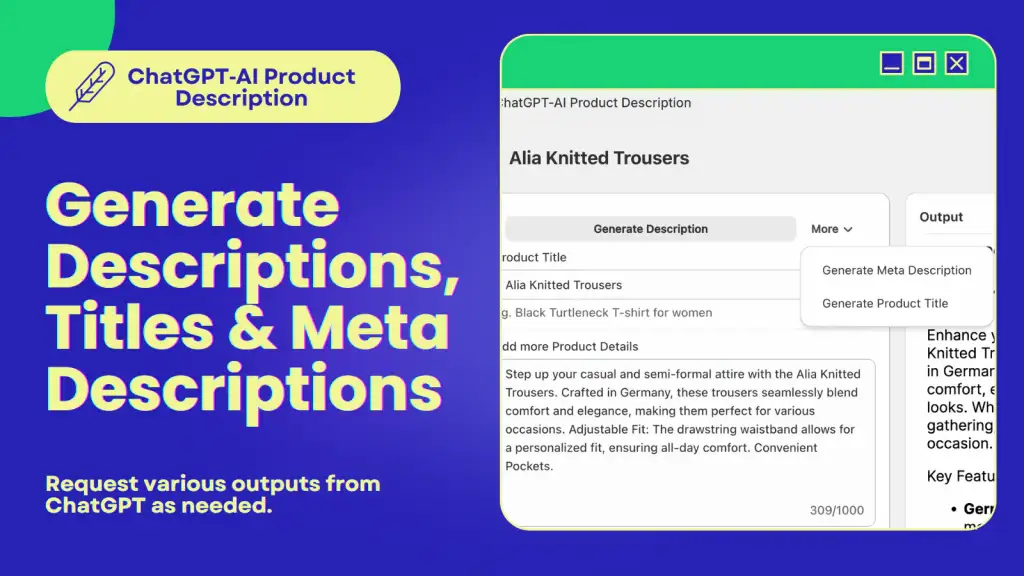
AI generates and optimizes product titles, descriptions, and specifications at scale. For B2B catalogs with thousands of SKUs, this eliminates the content bottleneck that delays product launches.
AI-assisted quote-to-order and RFQ workflows
AI drafts quotes, suggests pricing based on history, and routes approvals automatically. Auto-generated quotes use buyer history and current pricing rules. Quotes above threshold go to the right approver automatically, and accepted quotes convert to orders without manual re-entry.
Outcome: Your sales team closes quotes faster with fewer errors.
AI customer service and sales rep copilots
AI chatbots and copilots handle routine inquiries like order status, product specs, and reorder requests. During calls, they assist reps with account context and purchase history. Buyers get instant answers while your reps focus on complex negotiations.
Fraud detection and payment risk management
AI flags suspicious orders, validates buyer identity, and monitors credit risk. This becomes especially important when you’re extending net payment terms to new accounts. You can extend net terms confidently while reducing payment defaults.
Agentic Commerce and the Future of Autonomous B2B Selling
The shift from AI as a tool to AI as an autonomous actor represents the next frontier. Agentic commerce means AI executes tasks—not just recommends them—with appropriate human oversight.
- Automatic reorder triggers: Agent detects low inventory and creates purchase orders
- Price list updates: Agent syncs new pricing from ERP to storefront without manual intervention
- Proactive outreach: Agent emails buyers when frequently ordered items are back in stock
Human oversight, approval thresholds, and audit trails remain essential when AI acts autonomously. The goal is augmentation, not replacement.
Challenges of Adopting AI in B2B Ecommerce
Disconnected ERP and CRM data
AI requires clean, unified data. Fragmented systems produce poor results because the AI can’t see the full picture of your customers, inventory, and pricing. Prioritizing data unification before deploying AI features creates the foundation AI depends on.
Inaccurate or hallucinated AI outputs
Hallucination refers to AI generating plausible but incorrect information. For pricing, product specs, and customer communications, this creates real business risk. Human review for high-stakes outputs like quotes and pricing changes mitigates this risk.
Internal resistance and change management
Sales teams may resist AI if they fear job displacement or distrust recommendations. Positioning AI as a tool that handles routine tasks so reps can focus on relationships and complex deals helps with adoption.
Cost, customization, and resource allocation
AI implementations require investment in tools, integration, and training—especially for complex B2B workflows with custom pricing and approval chains. Starting with a focused pilot before scaling across your operation reduces risk.
How to Implement AI in Your B2B Ecommerce Store
Step 1. Define your wholesale business objectives
Identify specific goals like reducing quote turnaround, improving search conversion, or automating reorders. Generic “adopt AI” initiatives rarely succeed because they lack clear success metrics.
Step 2. Unify ERP, CRM, and storefront data
Ensure pricing, inventory, customer, and order data is synced and clean before AI can use it effectively. This step often takes longer than the AI implementation itself.
Step 3. Choose AI tools that fit your B2B workflows
Evaluate AI solutions based on how well they handle B2B requirements like contract pricing, bulk ordering, and approval workflows—not just general ecommerce features.
Step 4. Pilot a focused use case
Start with one high-impact area like product search, demand forecasting, or quote generation before expanding. This approach lets you validate results before committing to broader rollout.
Step 5. Measure, govern, and scale across your operation
Track results, establish governance policies, and expand AI to additional workflows once you’ve validated the initial use case.
Run AI-Ready B2B Ecommerce on Shopify With B2Bridge
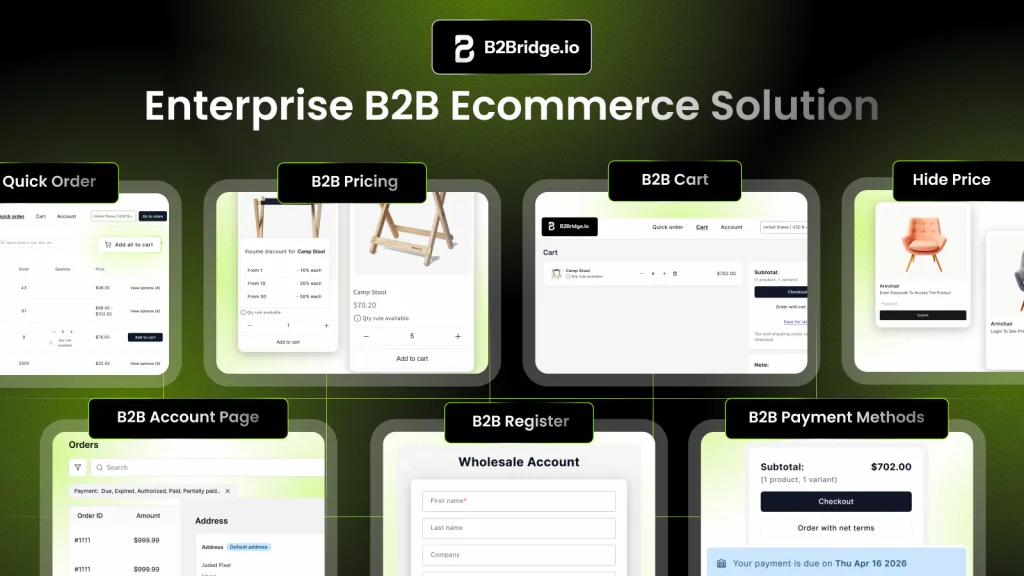
AI adoption depends on having the right foundation—clean data, unified systems, and workflows that support automation. B2Bridge provides that foundation by embedding enterprise-grade B2B operations directly into Shopify.
- Deep ERP/CRM integration: Keeps pricing, inventory, and customer data synced so AI has accurate inputs
- Advanced pricing engine: Supports complex rules like contract, tiered, and per-customer pricing that AI pricing tools enforce
- Quote-to-order workflows: Provides the infrastructure for AI-assisted RFQ and quote automation
- Unified B2B+B2C storefront: Centralizes data on Shopify instead of splitting it across platforms
Book A Demo to see how B2Bridge prepares your wholesale operation for AI-powered growth.
Frequently Asked Questions About AI in B2B Ecommerce
How much does it cost to add AI to a B2B ecommerce store?
Costs vary widely based on the AI tools you choose and the complexity of your integration. Some features are included in existing platforms while others require custom development or enterprise subscriptions.
Can you use AI in B2B ecommerce without upgrading to Shopify Plus?
Yes. Many AI-powered B2B features work on standard Shopify plans when paired with apps that embed enterprise-grade functionality without requiring Plus.
What data do you need before adopting AI for wholesale operations?
You want clean, unified data on products, pricing, inventory, customers, and order history—ideally synced between your ERP, CRM, and ecommerce platform.
Will AI replace B2B sales representatives?
AI handles routine tasks like order status inquiries and quote drafting, but complex negotiations, relationship building, and strategic accounts still require human sales reps.

As a Product Marketing Executive at B2Bridge, I focus on the Enterprise B2B Ecommerce domain. I leverage my understanding of product and user psychology to deliver customer-centric content that addresses business challenges and fuels growth.