The main Shopify Plus alternatives for B2B are B2Bridge, Shopify’s native B2B on Basic, Grow or Advanced, SparkLayer and Wholesale Gorilla if you stay on Shopify. BigCommerce B2B Edition, OroCommerce and Adobe Commerce replace Shopify entirely. The right pick depends on how many price lists you run and how deep your ERP goes.
Plus starts at $2,300 a month on a three-year term (as of 2026). Most of what wholesalers once upgraded for now ships on every Shopify plan, so the real question is which limit you’ll hit next. This guide compares seven options on that limit, plus price, ERP depth and switching effort.
What Is a Shopify Plus Alternative for B2B?
A Shopify Plus alternative is any setup that gives you the wholesale capabilities you’d otherwise buy Plus for, at a lower cost or with fewer limits. It comes in two forms. You either stay on a standard Shopify plan and add a B2B layer, or you move to a platform built for B2B.
Staying on Shopify is the lighter path. You keep your theme, your retail checkout and one admin for both channels. A hybrid B2B and B2C store keeps running as it does today, with wholesale buyers seeing their own prices after login.
Replatforming is a bigger bet. It makes sense when your quoting, approval chains or ERP logic already outgrew what any Shopify app can carry. Expect a migration project measured in months, plus a new license.
Which path fits starts with one question. What does Plus actually give you that a standard plan doesn’t?
What Shopify Plus Still Adds for Wholesale
Shopify Plus now adds only a short list of B2B features. Since April 2026, companies, catalogs, net terms, quantity price breaks and quick order lists run on Basic, Grow and Advanced. Shopify’s plan comparison lists what stays exclusive to Plus.
| B2B capability | Basic, Grow, Advanced | Shopify Plus |
|---|---|---|
| Active B2B catalogs | Up to 3 | Unlimited |
| Catalogs assigned directly to a company | No | Yes |
| Deposits and partial payments | No | Yes |
| Payment requests per fulfillment | No | Yes |
| Net terms, quantity breaks, quick order list | Yes | Yes |
| Checkout to draft (order review) | Yes | Yes |
The three-catalog cap is the limit that bites first. Each negotiated price list uses a catalog. Your fourth contract account forces a choice between Plus and an app.
Deposits matter less often. They’re common in made-to-order manufacturing and rare in hybrid retail brands. If neither the catalog cap nor deposits affect you, a standard plan already covers your wholesale needs.
Shopify Plus Alternatives Compared
Four options keep you on Shopify and three replace it. The columns that decide most comparisons are the scaling limit and the starting price, because those are where your bill grows as wholesale grows.
| Alternative | Type | Starting price (Oct 2026) | Scaling limit | Sales rep tooling | ERP sync | Best for |
|---|---|---|---|---|---|---|
| B2Bridge | Shopify app | $99/mo | Unlimited price lists, orders, customer groups | Sales Rep Portal (Growth) | Public API (Advanced) | Brands scaling wholesale on Shopify |
| Shopify native B2B | Built into Shopify | Included in plan | 3 catalogs | Staff permissions only | Via connectors | Testing wholesale demand |
| SparkLayer | Shopify app | Free, paid from $49/mo | 50, 100 or 150 orders/mo by tier | Sales agents by tier | API on Pro | Fast self-serve setup |
| Wholesale Gorilla | Shopify app | $34.95/mo | Feature tiers | No | Basic | Simple tiered pricing |
| BigCommerce B2B Edition | Platform | Quote-based | Enterprise plan required | Buyer portal | Deep | A SaaS replatform |
| OroCommerce | Platform | Quote-based | Licensed by volume | Built-in CRM | Deep | B2B-first enterprises |
| Adobe Commerce | Platform | Quote-based | Licensed by GMV | Via extensions | Deep | Custom builds with dev teams |
App prices come from each app’s Shopify App Store listing, checked in October 2026. Platform vendors don’t publish B2B pricing, so budget for a sales call and an implementation partner on top of the license.
Best Shopify Plus Alternatives for B2B
Each entry below lists who it’s for, what it does well, where it falls short and what it costs. The first four run on a standard Shopify plan, alongside other Shopify B2B alternatives such as Bold and B2B Wholesale Hub.
B2Bridge for Unlimited B2B on a Standard Shopify Plan
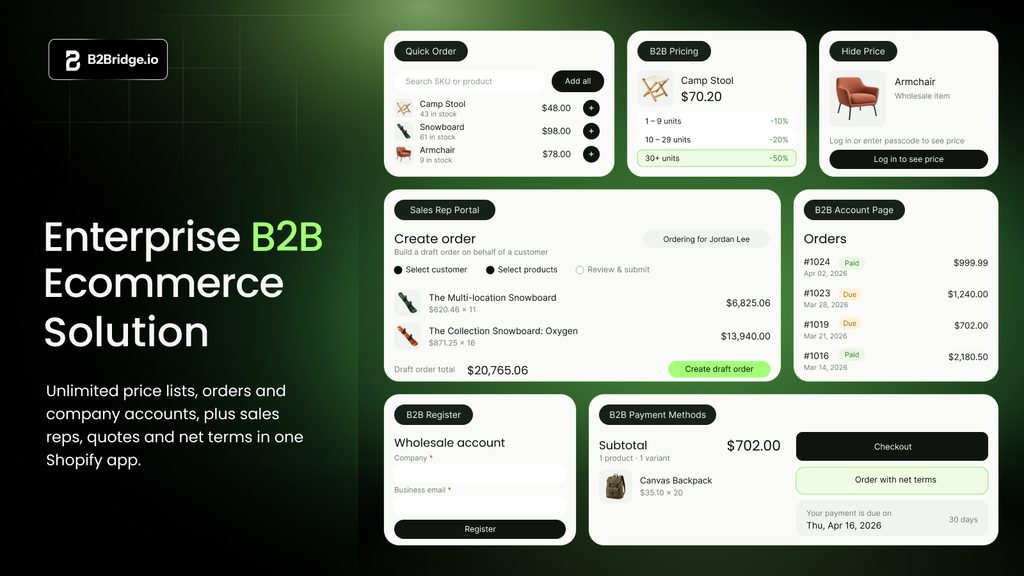
B2Bridge is an all-in-one B2B app that keeps price lists, orders and customer groups unlimited at a flat monthly price. Even Professional at $99 carries no catalog or order cap, so adding a fortieth contract account costs nothing extra.
Best for: Hybrid brands and distributors who’ve hit the three-catalog cap.
Standout features:
- Unlimited contract price lists and customer groups
- Sales Rep Portal with order-on-behalf and commission tracking
- Request for quote, credit limits and company accounts
- Public API for NetSuite, Zoho or a custom ERP
Considerations: Setup runs as a guided project, which is more than a two-tier discount needs.
Pricing: Professional $99, Growth $199, Advanced $299, Enterprise custom. 14-day free trial.
Shopify Native B2B for Testing Wholesale Demand
Shopify native B2B is the free option. It’s included on every paid plan and lives in the same admin as your retail store, which makes it the natural first test before you pay for anything.
Best for: Brands with three or fewer price segments.
Standout features:
- Companies, locations and net payment terms
- Quantity rules and price breaks
- Quick order list and easy reorders
- Checkout to draft for order review
Considerations: Three active catalogs, no quote request form and no rep-facing portal. Mid-market ERPs need a connector.
Pricing: Included in your Shopify plan.

SparkLayer for Fast Self-Serve Wholesale Setup
SparkLayer is a Shopify B2B app that adds a wholesale portal, sales agents and quoting on any plan. Onboarding is quick, and merchant reviews praise its support team.
Best for: Brands that want to go live in hours with low order volume.
Standout features:
- Unlimited price lists on paid plans
- Sales agent ordering
- Quoting and API access on Pro
- Xero and QuickBooks Online connections
Considerations: Every tier caps B2B orders per month (50, 100 or 150), so your bill rises with order volume.
Pricing: Free plan, then $49, $149 and $299 a month. Enterprise from $499. Rated 4.9 from 388 reviews.

Wholesale Gorilla for Simple Tiered Wholesale Pricing
Wholesale Gorilla is a long-running Shopify app for wholesale price rules and gated access. It launched in 2018 and keeps setup simple: approved buyers log in and see their rates.
Best for: Smaller wholesalers with straightforward pricing.
Standout features:
- Unlimited price rules and customer price groups
- Quick order form and net terms on Advanced
- Store locks and volume discounts on Premium
- Wholesale shipping rules
Considerations: No quote workflow or sales rep portal. ERP sync is basic.
Pricing: $34.95, $69.95 and $149.95 a month. Rated 4.8 from 317 reviews.

BigCommerce B2B Edition for a SaaS Replatform
BigCommerce B2B Edition is the closest hosted platform to Shopify with B2B built in. You trade Shopify’s app ecosystem for B2B features that ship with the platform.
Best for: Brands leaving Shopify that still want hosted SaaS.
Standout features:
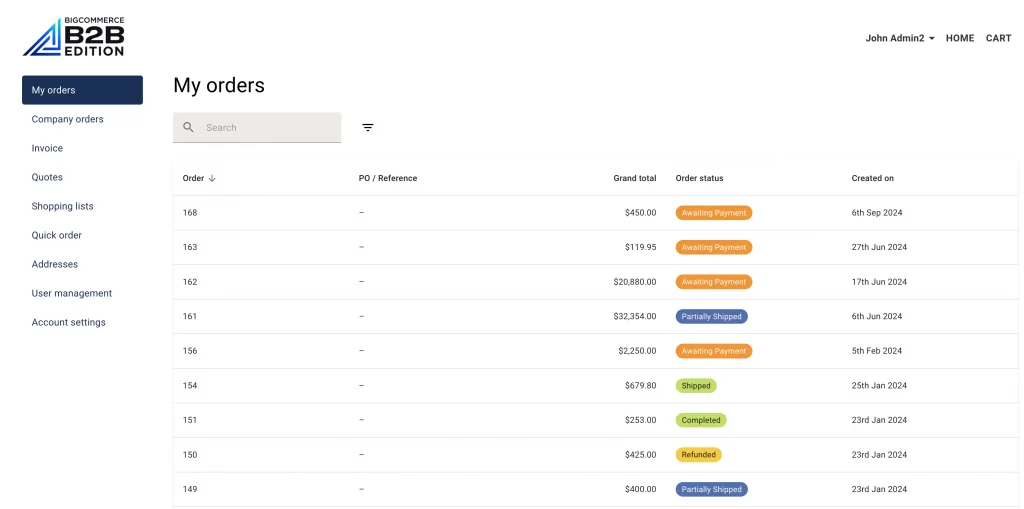
- Company accounts with buyer roles
- Quote management
- Buyer portal with invoices
- Shared and customer-specific price lists
Considerations: You rebuild your theme and apps. B2B Edition sits on top of an Enterprise plan.
Pricing: Quote-based. BigCommerce doesn’t publish it.
OroCommerce for B2B-First Enterprise Workflows
OroCommerce is a standalone platform designed for B2B from the start. Quotes, approvals and account hierarchies are core objects, which suits sales teams that negotiate most orders.
Best for: Manufacturers with multi-level accounts and RFQ-driven sales.
Standout features:
- Built-in CRM
- Corporate account hierarchies
- Native RFQ and approval workflows
- Multi-organization selling
Considerations: A full migration off Shopify. Retail DTC isn’t its strength.
Pricing: Quote-based license.

Adobe Commerce for Custom Builds with In-House Developers
Adobe Commerce (formerly Magento) is an open, heavily customizable enterprise platform with a B2B module. You own the code, which means you can build almost anything and also have to maintain it.
Best for: Large catalogs with a dedicated development team.
Standout features:
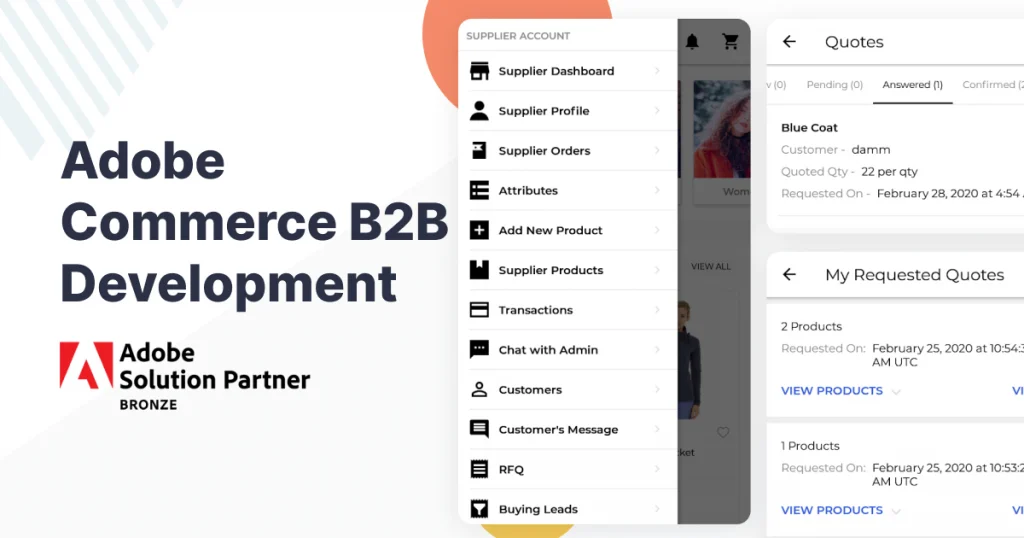
- Company accounts and shared catalogs
- Quotes and purchase orders
- Approval rules
- Full code access
Considerations: Hosting, patching and extensions add cost and need developers.
Pricing: Quote-based license.
How to Choose a Shopify Plus Alternative
Which limit will you hit in the next 12 months? Answer that, and the shortlist gets short.
| Your situation | Best fit |
|---|---|
| 3 or fewer price segments, few orders | Shopify native B2B |
| More than 3 price lists, growing orders | B2Bridge |
| Low order volume, want to launch this week | SparkLayer |
| Simple tiers, small budget | Wholesale Gorilla |
| Leaving Shopify, want hosted SaaS | BigCommerce B2B Edition |
| Complex RFQ and multi-level accounts | OroCommerce |
| Heavy customization, in-house developers | Adobe Commerce |
Scale is the tiebreaker. If you’ll pass three catalogs or a few hundred orders a month, weight unlimited plans higher than a lower starting price. Order caps and catalog caps both turn growth into upgrades.
Replatforming earns its cost only when your workflows can’t live inside Shopify at all. The Shopify B2B vs Shopify Plus comparison covers that line in more detail.
How to Leave Shopify Plus Without Breaking B2B
Moving from Plus to a standard plan with an app takes four steps. Your store, theme and customers stay put.
1. Export Your Catalogs and Company Data
Export every B2B catalog, company, location and payment term. Note which companies use directly assigned catalogs, since those don’t exist on non-Plus plans.
2. Map Plus-Only Features to Your New Setup
List each Plus-only feature you use today. Direct company catalogs become per-customer price lists in your app. Deposits need a different payment flow.
3. Pilot with a Few Wholesale Accounts
Move a small group of buyers first. Check their prices, net terms and order sync against your ERP before anyone else switches.
4. Downgrade and Switch the Rest
Change your plan once the pilot is clean. Watch orders closely for two weeks and keep support ready for buyer questions.
Scale Wholesale Past the Catalog Cap with B2Bridge
You probably looked at Plus for one reason: more price lists than three catalogs allow. B2Bridge removes that cap on a standard Shopify plan, and it doesn’t meter your orders as wholesale grows.
- Unlimited price lists, orders and customer groups at a flat price, where Shopify native B2B stops at three catalogs
- Pricing, net terms, RFQ and company accounts in one app
- Sales Rep Portal for order-on-behalf and commission tracking
- Public API for NetSuite, Zoho and custom ERPs
Brands like Brooklyn Bicycle run a gated B2B portal with NetSuite sync on B2Bridge. Book A Demo to map your price lists before you commit to Plus.
FAQs about Shopify Plus Alternatives
Do I need Shopify Plus for B2B?
No. Shopify B2B runs on Basic, Grow and Advanced with up to three catalogs. You need Plus, or an app like B2Bridge, only when you outgrow that cap or need direct company catalogs.
How much does Shopify Plus cost?
Shopify Plus starts at $2,300 a month on a three-year term, or $2,500 on a one-year term, as of 2026. High-volume stores move to a variable platform fee.
What’s the cheapest Shopify Plus alternative for wholesale?
Shopify native B2B is free on any paid plan. Among apps, Wholesale Gorilla starts at $34.95 a month and SparkLayer has a free plan capped at five orders.
Can I run B2B and B2C on one store without Plus?
Yes. Native Shopify B2B and every app on this list support one storefront. Retail shoppers see public prices, and approved wholesale buyers log in to see theirs.
Will I lose customer data when I downgrade from Plus?
No. Customers, companies and order history stay on your Shopify store. Only Plus-only settings, such as direct company catalogs and deposit rules, need rebuilding in your new setup.

As a Product Marketing Executive at B2Bridge, I focus on the Enterprise B2B Ecommerce domain. I leverage my understanding of product and user psychology to deliver customer-centric content that addresses business challenges and fuels growth.