Wholesale ecommerce is the online B2B process of selling products in bulk to other businesses, retailers, or distributors. It replaces catalogs, phone orders, and manual invoicing with digital storefronts. These storefronts handle negotiated pricing, minimum order quantities, and automated fulfillment workflows.
This guide covers how wholesale ecommerce works, the platform features that matter, pricing models, common mistakes, and how to launch a B2B operation that scales.
What Is Wholesale Ecommerce
Wholesale ecommerce is the online B2B process of selling products in bulk to other businesses, retailers, or distributors. Buyers log into a portal and see pricing specific to their account. They place orders on their own schedule without phone calls or fax.
The shift from offline to online replaces several traditional methods:
- Catalogs: replaced by online product browsing with real-time inventory
- Phone orders: replaced by self-service ordering available 24/7
- Manual invoicing: replaced by automated order processing and payment terms
Most wholesale ecommerce platforms include negotiated pricing, minimum order quantities (MOQs), and automated backend workflows that sync with inventory and fulfillment systems.
How Wholesale Ecommerce Works
A B2B buyer registers on your site, gets approved either automatically or manually, and then sees pricing specific to their account or customer group. From there, they place bulk orders and pay according to agreed terms—often Net 30 or Net 60 rather than immediate checkout.
MOQs ensure buyers meet minimum purchase thresholds. Price lists assign different rates to different customer segments. Net payment terms let trusted buyers pay after delivery.
The typical flow looks like this:
- Buyer submits a registration request
- You approve the account and assign a customer group
- Buyer logs in and sees their custom pricing
- Buyer places an order meeting MOQ requirements
- Order syncs to your ERP and fulfillment begins
- Buyer pays according to their payment terms
Wholesale Ecommerce vs B2C Ecommerce
The differences go beyond order size. Wholesale ecommerce involves negotiated pricing, longer payment cycles, and ongoing buyer relationships. B2C ecommerce—business-to-consumer—sells individual items at fixed prices to end consumers who typically pay immediately.
Your wholesale price has to leave room for the retailer’s markup. Otherwise, they can’t profit from reselling your products.
| Factor | Wholesale Ecommerce | B2C Ecommerce |
|---|---|---|
| Buyer type | Retailers, distributors, resellers | End consumers |
| Order size | Bulk quantities | Individual units |
| Pricing model | Negotiated, tiered, or contract-based | Fixed retail price |
| Payment terms | Net 30, Net 60, credit limits | Immediate payment |
| Fulfillment | Pallets, cases, freight shipping | Individual packages |
Types of Wholesale Ecommerce Business Models
Manufacturer to Retailer
Manufacturers sell directly to retailers online, bypassing traditional distribution channels. This model works well for brands with production capacity seeking retail partnerships without intermediaries.
Distributor and Merchant Wholesaler
Distributors buy from manufacturers and resell to retailers or smaller wholesalers. They often carry multiple brands and serve as inventory buffers, handling storage and logistics that manufacturers prefer to outsource.
Brand Direct Wholesale
Brands sell wholesale alongside their direct-to-consumer (DTC) channel. Consumer goods, apparel, and lifestyle brands commonly use this approach when expanding into B2B while maintaining their retail presence.
Hybrid B2B and B2C
Running both retail and wholesale from a single storefront reduces operational overhead. You maintain one product catalog, one inventory system, and one admin—while showing different prices to different buyer types.
Benefits of Wholesale Ecommerce for B2B Businesses
Higher Average Order Value
Bulk purchasing leads to larger transactions per order. A single wholesale order might equal dozens or hundreds of retail transactions.
Lower Cost to Serve per Customer
Self-service ordering reduces sales rep time and eliminates manual order entry. Your team handles exceptions rather than routine reorders.
Faster Order Processing and Fewer Errors
Automation eliminates the manual data entry that causes fulfillment mistakes. Orders flow directly from your storefront to your ERP without rekeying.
Scalable Expansion Into New Markets
Digital storefronts let you reach buyers in new regions without physical presence. A retailer in another country can browse your catalog and place orders without a sales call.
Better Data for Pricing and Forecasting
Digital orders create trackable data for demand planning, inventory management, and pricing optimization. You see patterns that phone orders never revealed.
Key Features of a Wholesale Ecommerce Platform
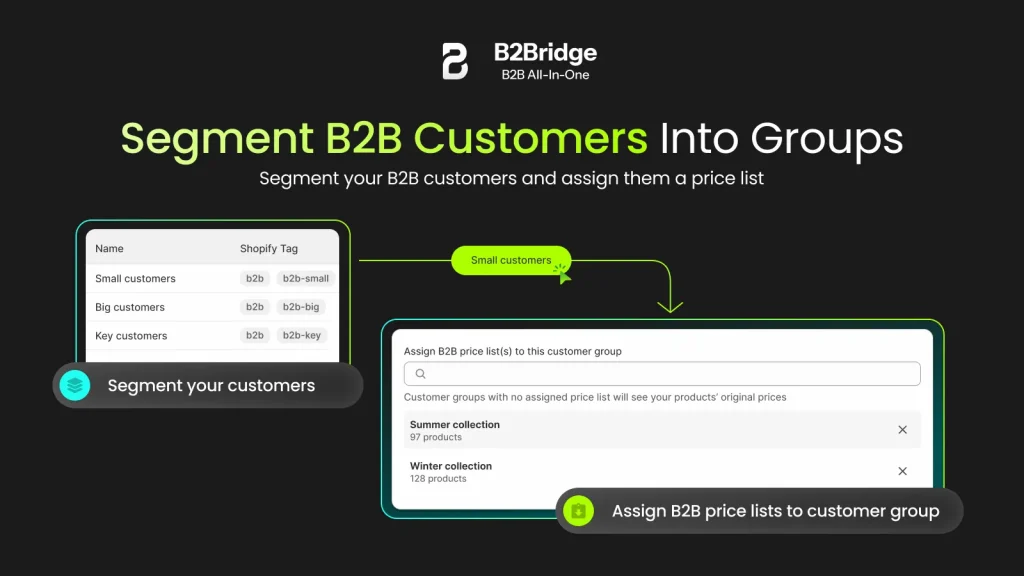
Customer Group and Price List Management
Grouping buyers by tier, region, or relationship—and assigning different price lists to each group—is foundational. Your distributors might see one set of prices, your retailers another.
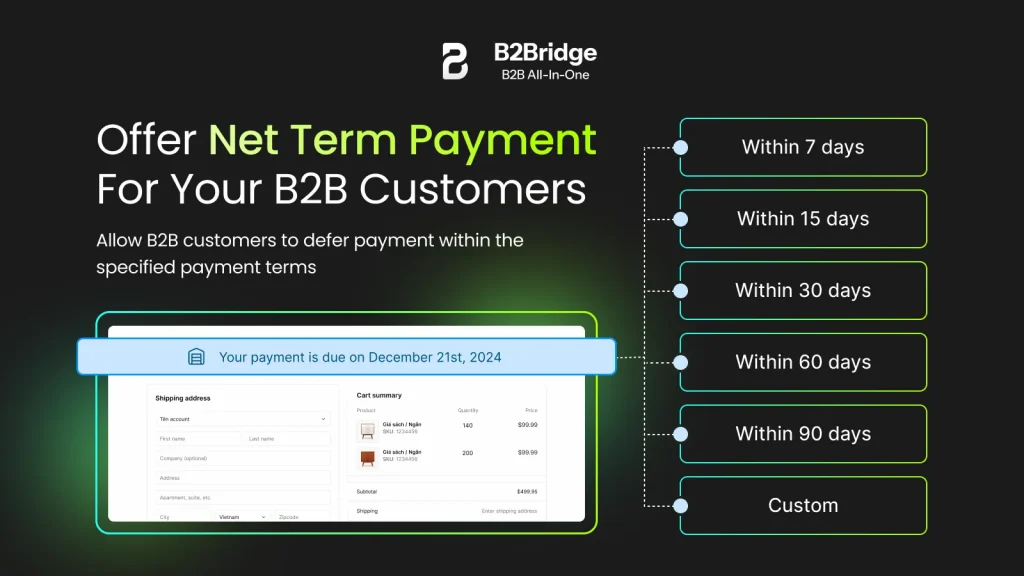
Net Payment Terms and Credit Control
Net payment terms like Net 30 and Net 60 let trusted buyers pay after delivery—a Hokodo study found two-thirds of B2B buyers abandon a purchase without flexible terms. Credit limits cap how much a buyer can owe before requiring payment.
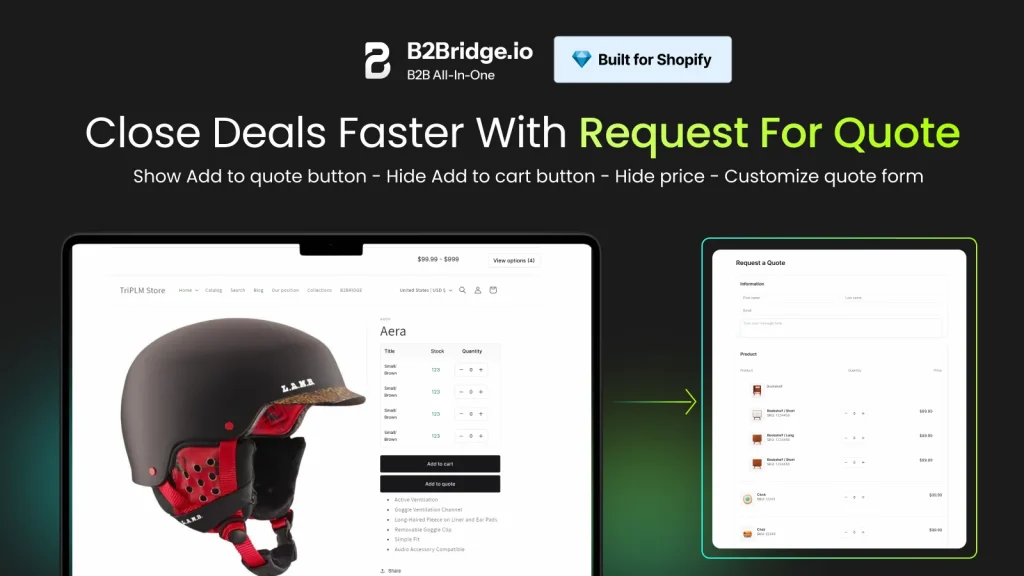
Quote to Order and RFQ Workflows
RFQ stands for request for quote. Large buyers often request custom pricing before committing to big orders. A quote-to-order workflow lets you negotiate, approve, and convert quotes into orders.
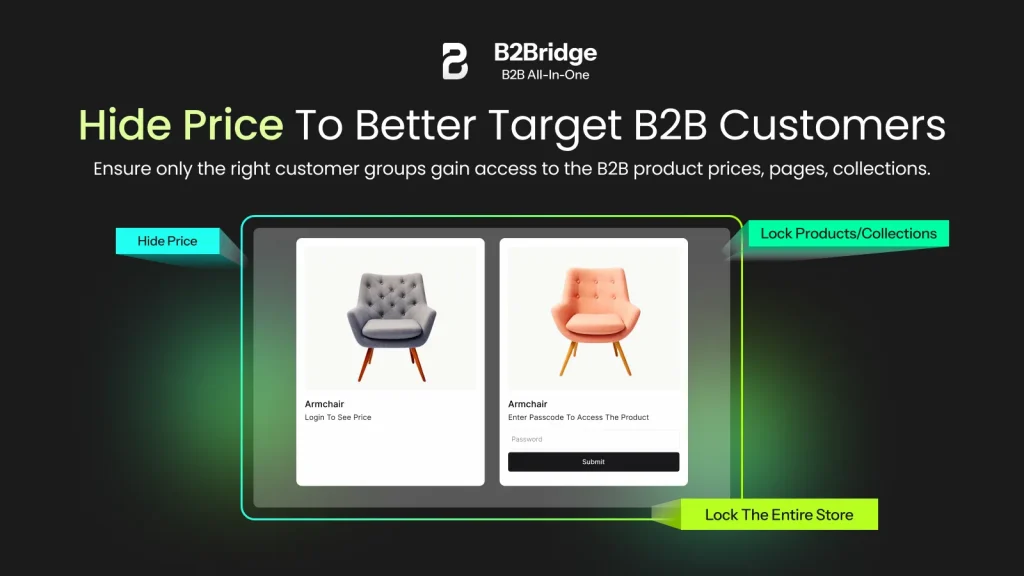
Gated Catalogs and Access Control
Hiding wholesale prices—or entire product collections—from non-approved visitors protects your pricing strategy. Only verified buyers see B2B rates.
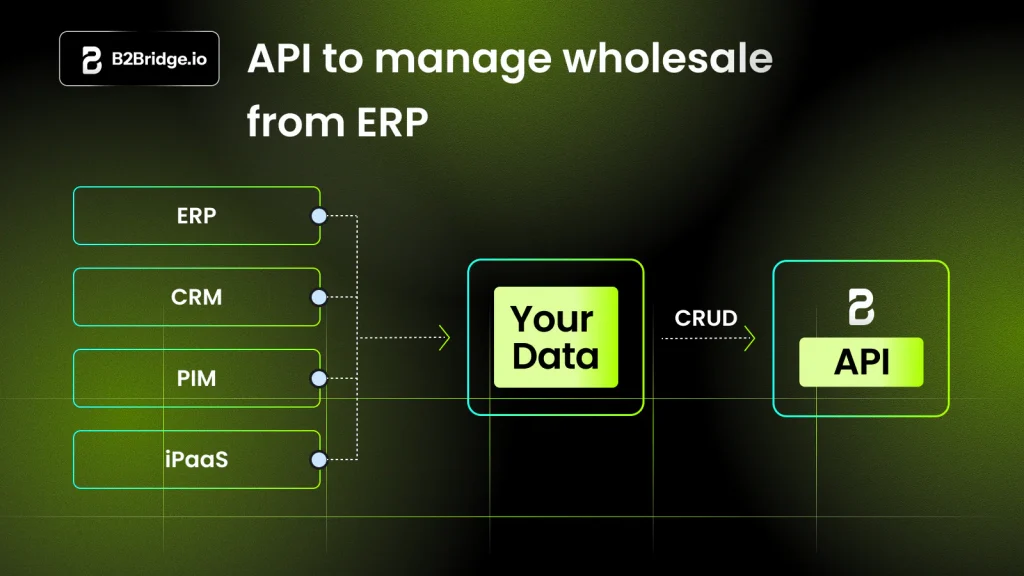
ERP and CRM Integration
ERP (enterprise resource planning) systems manage inventory, orders, and financials. CRM (customer relationship management) systems track buyer relationships. Syncing both with your ecommerce platform prevents pricing errors and duplicate data entry.
B2B Optimized Storefront and Checkout
Quick order pages, variant selectors, saved carts, and reorder tools speed up repeat purchasing. Contentful’s B2B Buyer Benchmark Report found 84% of B2B buyers say self-service tools are critical when choosing a vendor. Wholesale buyers want to order fast, not browse.
B2B Pricing Models in Wholesale Ecommerce
Wholesale pricing is rarely one-size-fits-all. Most operations use a combination of approaches.
Customer Specific Contract Pricing
Negotiated prices unique to a single buyer, often based on volume commitments or long-term contracts. Your largest accounts typically expect custom rates.
Volume and Tiered Discounts
Volume discounts based on quantity purchased. The more a buyer orders, the lower the unit price.
Unit and Case Pack Pricing
Case packs require buyers to purchase in set increments—say, cases of 12 or pallets of 48. Unit pricing applies to items sold by weight or measure rather than individual count.
Multi Currency and Tax Exempt Pricing
International buyers expect pricing in their local currency. Verified resellers often qualify for tax exemptions. Without multi-currency support, global wholesale becomes unnecessarily complicated.
How ERP and CRM Integration Powers Wholesale Ecommerce
When your ERP, CRM, and ecommerce platform don’t talk to each other, you get pricing errors and inventory mismatches. Manual data entry slows everything down.
What syncs between systems:
- Pricing: pushed from ERP to storefront automatically
- Orders: flow back to ERP without rekeying
- Customer data: stays aligned across sales, support, and fulfillment
- Inventory: updates in real time to prevent overselling
Common integrations include NetSuite, Zoho, Odoo, and custom ERPs connected via API.
Best Wholesale Ecommerce Platforms for B2B
Shopify With a B2B App Layer
Standard Shopify merchants can add wholesale functionality through apps without upgrading to Plus. This approach suits growing brands wanting to run B2B and B2C together on one store.
Shopify Plus
Built-in B2B features for enterprise merchants, including native price lists and company accounts. Higher cost, but fewer apps required.
BigCommerce B2B Edition
Native B2B features for complex catalogs and customer groups. Suits mid-market to enterprise wholesalers who want B2B capabilities out of the box.
Adobe Commerce
Highly customizable enterprise option with significant development requirements. Best for large operations with dedicated technical teams.
OroCommerce
Purpose-built B2B platform for manufacturers and distributors with complex workflows. Designed specifically for wholesale rather than adapted from retail.
How to Start a Wholesale Ecommerce Business
Step 1. Define Your Wholesale Niche and Buyer
Identify the industries, buyer types, and products you’ll serve before building anything. Clarity here shapes every decision that follows.
Step 2. Build a Pricing and Payment Terms Strategy
Decide on pricing models—tiered, contract, volume-based—and payment terms like Net 30 or prepay. Document pricing before platform setup.
Step 3. Choose a Wholesale Ecommerce Platform
Select based on your budget, integration requirements, and whether you want B2B-only or hybrid B2B/B2C functionality.
Step 4. Set Up Customer Groups and Gated Access
Create buyer tiers, assign price lists, and configure registration or approval workflows. Access control determines who sees what pricing.
Step 5. Connect Your ERP and CRM
Integrate backend systems to sync pricing, inventory, and customer data with your storefront.
Step 6. Launch a B2B Optimized Storefront
Configure quick order tools, variant selectors, and account management features. The goal is a buying experience built for repeat wholesale orders.
Step 7. Onboard Wholesale Buyers and Sales Reps
Invite existing customers, train your team on the platform, and promote the new ordering channel.
How to Choose the Right Wholesale Ecommerce Platform
Budget and Total Cost of Ownership
Consider platform fees, app costs, development, and ongoing maintenance—not just the subscription price. A cheaper platform with expensive customization often costs more long-term.
B2B Pricing and Catalog Flexibility
Assess whether the platform supports your pricing models, customer groups, and product complexity. If you can’t replicate your current pricing structure, the platform won’t work.
Integration Depth With Existing Systems
Evaluate native integrations and API capabilities for your ERP, CRM, and fulfillment tools.
Buyer Experience and Conversion Tools
Look for B2B-specific UX features—quick order, reorder, saved carts, account portals—that drive repeat purchasing.
Common Mistakes in Wholesale Ecommerce
Treating B2B Like B2C Pricing
Applying retail pricing logic to wholesale buyers creates friction. B2B requires negotiated, tiered, and contract pricing—not fixed rates.
Running B2B and B2C as Separate Stores
Maintaining two storefronts doubles operational work. Unified stores reduce overhead and simplify catalog management.
Skipping ERP and CRM Sync
Manual data entry between systems causes pricing errors, inventory mismatches, and delayed orders.
Ignoring Buyer Side UX
Forcing B2B buyers through B2C checkout flows slows purchasing. Wholesale buyers expect bulk ordering tools and account management features.
Wholesale Ecommerce Trends Shaping B2B
AI Driven Search and Recommendations
AI personalizes product discovery and suggests reorders based on buyer history.
Self Service B2B Buyer Portals
According to Gartner, 67% of B2B buyers prefer a rep-free experience, managing orders, invoices, and accounts through self-service B2B portals.
Unified B2B and DTC Commerce
Running wholesale and retail from a single platform and storefront is becoming standard.
Embedded Payments and Net Terms Automation
Integrated financing and automated payment term management are replacing manual invoicing.
Scaling Wholesale Ecommerce on Shopify With B2Bridge
B2Bridge brings enterprise-grade B2B capabilities to Shopify without requiring Shopify Plus.
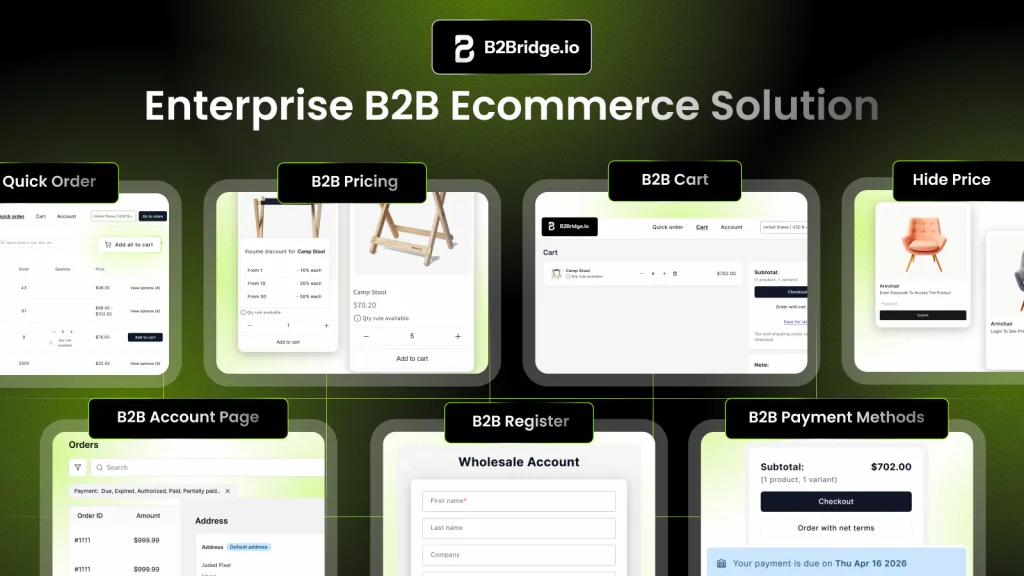
- Advanced pricing engine: Customer-group pricing, volume tiers, MOQs, and quantity increments configured from your Shopify admin
- Gated pricing: Wholesale prices stay invisible to retail shoppers and unapproved visitors
- ERP and CRM integration: Sync with NetSuite, Zoho, Odoo, or custom systems via API
- Multi-currency and tax-exempt logic: Sell globally without manual workarounds
- Net payment terms and RFQ: Offer Net 30/60/90 and quote-to-order workflows natively
- Hybrid B2B/B2C: Run both channels from one Shopify store
Most stores launch in days, not months. And you don’t need Shopify Plus to get started.
Frequently Asked Questions About Wholesale Ecommerce
What is the difference between wholesale ecommerce and retail ecommerce?
Wholesale ecommerce sells products in bulk to other businesses at negotiated prices. Retail ecommerce sells individual items directly to consumers at fixed prices.
Do you need an LLC for a wholesale ecommerce business?
Business structure requirements vary by location. Forming an LLC isn’t mandatory to start selling wholesale, but it can provide liability protection and tax benefits.
What is an example of wholesale ecommerce?
A manufacturer selling cases of products through an online portal to retailers—who then resell to consumers—is a common example.
Do you need Shopify Plus to run a wholesale ecommerce store?
No. Shopify merchants on standard plans can add B2B functionality through apps like B2Bridge without upgrading to Shopify Plus.
How long does it take to launch a wholesale ecommerce store?
Most wholesale ecommerce stores launch within days to a few weeks, depending on platform choice, integration complexity, and catalog size.
Related reading: How To Become A Wholesaler on Shopify and How To Sell a B2B Service on Shopify.

As a Product Marketing Executive at B2Bridge, I focus on the Enterprise B2B Ecommerce domain. I leverage my understanding of product and user psychology to deliver customer-centric content that addresses business challenges and fuels growth.