B2B ecommerce is the online sale of goods or services from one business to another. Manufacturers sell to distributors, and wholesalers restock retailers. Buyers log in to a store, see their negotiated prices, and order on payment terms without calling a sales rep. It’s the digital version of the wholesale order desk.
The channel is already large. In its 2022 forecast, Forrester projected that US B2B ecommerce would reach $3 trillion by 2027. This guide covers how B2B ecommerce works and how four Shopify brands run their wholesale channel online today.
What Is B2B Ecommerce
B2B ecommerce is any online transaction where both the buyer and the seller are businesses. Your customers might be retailers stocking your products or manufacturers sourcing components for their own builds.
The defining trait today is self-service. An approved buyer logs in, sees their contract pricing, and reorders at 10 p.m. without waiting for a callback. Your reps stop keying in orders. They spend that time on the accounts that need a person.
A B2B store also differs from a retail store in what sits behind the product page. Prices change by customer. Payment often lands 30 or 60 days after delivery. Orders have to reach an ERP or inventory system without anyone retyping them. Those requirements are why a standard storefront with a discount code rarely holds up once wholesale volume grows.
How different is that from the B2C store you may already run?
B2B vs B2C Ecommerce Explained
B2B and B2C share the same checkout mechanics, but buyers, prices and payment timing split apart fast. The table shows where.
| Factor | B2B Ecommerce | B2C Ecommerce |
|---|---|---|
| Buyer | Businesses, procurement teams | Individual consumers |
| Order size | Bulk quantities, high AOV | Single items, lower AOV |
| Pricing | Negotiated, tiered, contract-based | One public price |
| Payment | Net terms (Net 30/60), invoicing | Paid at checkout |
| Sales cycle | Longer, several decision-makers | Short, often impulse-driven |
| Relationship | Long-term, account-based | Transactional |
Pricing sets B2B apart most. A B2C store shows one price to everyone. A B2B store may show a distributor, a retailer, and a VIP account three different prices for the same SKU.
Payment adds a second layer. Business buyers expect net payment terms, and they go back to phone orders when your checkout can’t offer them. Our full B2B vs B2C ecommerce comparison covers each difference in depth.
Types of B2B Ecommerce
The model you run decides which features you need first. Most sellers fit one of five B2B ecommerce models, and many combine two.
| Model | Who sells | Who buys | First feature to get right |
|---|---|---|---|
| Wholesale | Brands, wholesalers | Retailers, resellers | Price lists and minimum order quantities |
| Manufacturer and distributor | Makers, distributors | Dealers, contractors | Gated catalogs and ERP sync |
| B2B2C | Brands selling through partners | Retailers that reach consumers | Partner pricing |
| B2B marketplace | Many sellers on one platform | Businesses comparing vendors | Listings and vendor management |
| Hybrid B2B and B2C | One brand, one store | Consumers and wholesale accounts | Separate prices and access in one storefront |
Hybrid is where most Shopify brands land. A hybrid B2B and B2C store keeps one catalog and one inventory while showing retail and wholesale buyers different prices.
B2B marketplaces such as Alibaba.com and Faire work differently. The platform owns the buyer relationship, and you compete on its terms.
How B2B Ecommerce Works
A B2B order moves through the same seven steps in most industries, from approval to reorder.
- A business applies with its tax ID or resale certificate, and you approve the account.
- The approved buyer logs in and sees a catalog with their contract pricing.
- The buyer builds an order, often through a quick order form for bulk SKUs.
- Checkout offers card payment or net terms, depending on the account.
- The order syncs to your ERP or inventory system.
- Shipping updates and tracking appear in the buyer’s account.
- Next month, the buyer reorders from order history in a few clicks.
Every step that runs on its own is one your team doesn’t touch. That’s where the time savings come from.

What does that flow look like inside a real Shopify store?
B2B Ecommerce Examples on Shopify
These four brands run wholesale on Shopify with B2Bridge, and each uses a different model. The details below come from their published B2Bridge customer stories.
Brooklyn Bicycle Co. for Hybrid Retail and Wholesale
Brooklyn Bicycle sells city bikes to riders and retail partners from one Shopify store. The brand sets wholesale prices per variant, runs login-only landing pages for approved dealers, and syncs orders and fulfillment with NetSuite.
Trailer Valet for Manufacturer Wholesale Without a Second Site
Trailer Valet makes trailer movers and jacks in California. It wanted dealer and bulk-buyer sales without a separate wholesale subdomain. Its setup adds company registration, custom price lists, and net terms, with each product entered once for both channels.
MIDAN for a Wholesale-Only Distributor Store
MIDAN distributes LED lighting in Canada and sells only to verified businesses. The store stays locked until a registration form is approved. Each approved account then sees its own price list, in English or French.
OGO Toilet for an International Dealer Network
OGO Toilet makes composting toilets in Ohio and sells through dealers in more than 40 countries. Dealers used to email purchase orders that staff rekeyed by hand. Now they log in, see their own SKUs and prices, and order themselves.
Benefits of B2B Ecommerce
Why invest in a B2B channel when phone orders have worked for years? The short answer is scale. The longer answer shows up in four places.
Larger Orders With Less Back-and-Forth
Buyers order when it suits them, without waiting for a callback. Volume pricing shown on the product page nudges them toward bigger orders before any negotiation starts. Fewer emails, bigger carts.
Fewer Order Entry Errors
Pricing rules replace manual quote math, and orders reach fulfillment without rekeying. OGO Toilet’s staff used to cross-check dealer SKUs on every emailed purchase order. Self-service ordering removed that step entirely.
One Store for Two Channels
Running retail and wholesale from one platform means one catalog and one inventory to maintain. Trailer Valet chose this setup specifically to avoid running a separate wholesale site alongside its retail store.
Cleaner Data Across Systems
An ERP connection keeps prices, stock, and orders aligned between Shopify and your back office. Brooklyn Bicycle’s NetSuite sync keeps wholesale orders apart from retail ones without manual sorting.
Key Features of a B2B Ecommerce Platform
Not every ecommerce platform handles wholesale well. These six features separate a real B2B platform from a retail store with a discount code.
| Feature | What it does |
|---|---|
| Customer group and contract pricing | Gives each buyer segment its own price list |
| Volume discounts and quantity rules | Tiered pricing lowers unit cost as quantity rises, while minimums and case packs protect margin |
| Net terms and request for quote | Lets approved buyers pay in 15, 30, or 60 days, and routes large orders through a request for quote workflow |
| Wholesale gating | Hides wholesale prices or whole collections from anyone who isn’t an approved buyer |
| Registration and approval | Collects tax ID and business details before you grant access |
| ERP and CRM integration | Syncs prices, customers, orders, and stock with systems like NetSuite, Zoho, or Odoo |
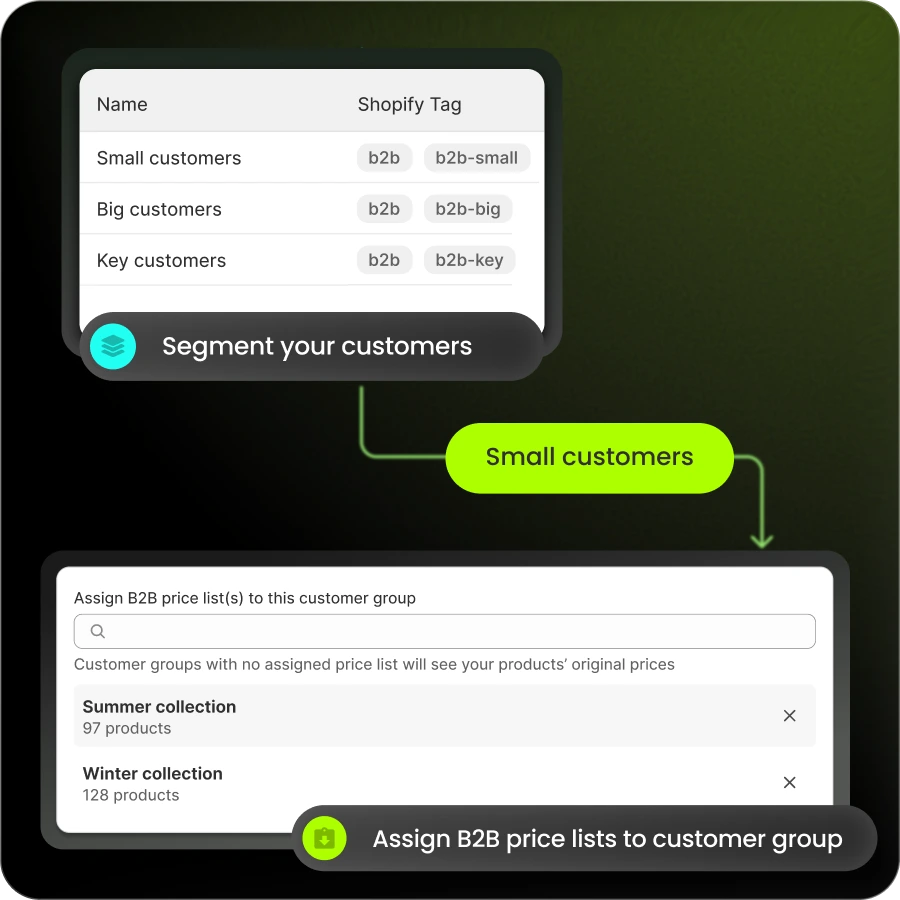
Shopify now covers part of this list on its own. The rest is where an app comes in.
B2B Ecommerce on Shopify With Native Tools or an App
Shopify’s native B2B tools run on every paid plan, so the starting point is built in. Since April 2026, Basic, Grow, and Advanced stores get company accounts, catalogs, volume pricing, quantity rules, and net terms. The catch is scale. Non-Plus stores can run only three active B2B catalogs, shared across all markets. Shopify Plus removes that cap, but it starts around $2,300 per month on a three-year term.
| Need | Shopify native (non-Plus) | Shopify Plus | B2Bridge app |
|---|---|---|---|
| Price lists or catalogs | Up to 3 active | Unlimited | Unlimited |
| Company accounts and net terms | Yes | Yes | Yes |
| Request for quote | No | No | Yes (Growth plan) |
| Sales Rep Portal | No | No | Yes (Growth plan) |
| ERP sync | Through third-party apps | Through third-party apps | Public API (Advanced plan) |
| Monthly cost | Included in your plan | From about $2,300 | From $99 on any plan |
This comparison is written and published by the B2Bridge team, and B2Bridge competes with Shopify’s native B2B tools, so weigh it with that context. Our Shopify B2B vs B2Bridge breakdown goes feature by feature.
Common Misconceptions About B2B Ecommerce
A few myths keep wholesale sellers on phone and email. Here’s what holds up in practice.
- Business buyers will order online when the store shows their prices and makes reordering fast. OGO Toilet’s dealers moved from emailed purchase orders to logging in themselves.
- Moving online doesn’t end the relationship. Reps stop entering orders and spend that time on accounts that need attention.
- Selling online doesn’t require public pricing. Login-gated catalogs keep wholesale rates private, as MIDAN’s wholesale-only store shows.
- Complex orders work online too. Quote requests, net terms, and long multi-line orders all run through a B2B checkout.
How to Build a B2B Ecommerce Strategy
Moving from phone orders to digital wholesale takes more than installing an app. Our B2B ecommerce strategy guide goes deeper, but these five steps cover the core.
- Define your buyer segments, then map pricing, terms, and access for each one.
- Audit where pricing, customer data, and orders live today, and find the manual steps causing delays.
- Decide whether retail and wholesale can share one store or need separate storefronts.
- Configure price lists, volume discounts, net terms, and gated access by segment.
- Track conversion rate, average order value, reorder frequency, and processing time, then adjust.
Start small. Most brands launch with one or two buyer segments, then add more once the first accounts order without help.
Choosing a B2B Ecommerce Platform
How do you pick the right platform? Start with how you sell today.
A hybrid brand on Shopify needs flexible pricing, gated access, and room to add price lists without a forced upgrade. A distributor with a large catalog needs ERP sync first. Weigh four factors against your model: pricing flexibility, B2B and B2C in one store, integration depth, and the cost of adding more accounts.
Look ahead too. B2B ecommerce trends like AI search and mobile reordering keep raising what buyers expect from a portal. We compare the leading options, from Shopify apps to enterprise suites, in our guide to the best B2B ecommerce platforms.
Scaling B2B Ecommerce on Shopify With B2Bridge
B2Bridge turns Shopify into a full B2B platform that never penalizes you for growing. You get unlimited price lists, orders, and customer groups at a flat monthly price, on any Shopify plan. Native Shopify stops at three catalogs below Plus. With B2Bridge, your 50th wholesale account costs the same as your fifth.
B2Bridge runs the whole wholesale workflow in one app:
- Customer-group pricing, contract price lists, volume discounts, and quantity rules
- Net 15, 30, and 60 terms, credit limits, and request for quote
- A Sales Rep Portal where reps order on behalf of accounts and track commission
- Wholesale gating, registration forms, and B2B plus B2C in one Shopify admin
- ERP and CRM sync with NetSuite, Zoho, Odoo, or custom systems through the Public API
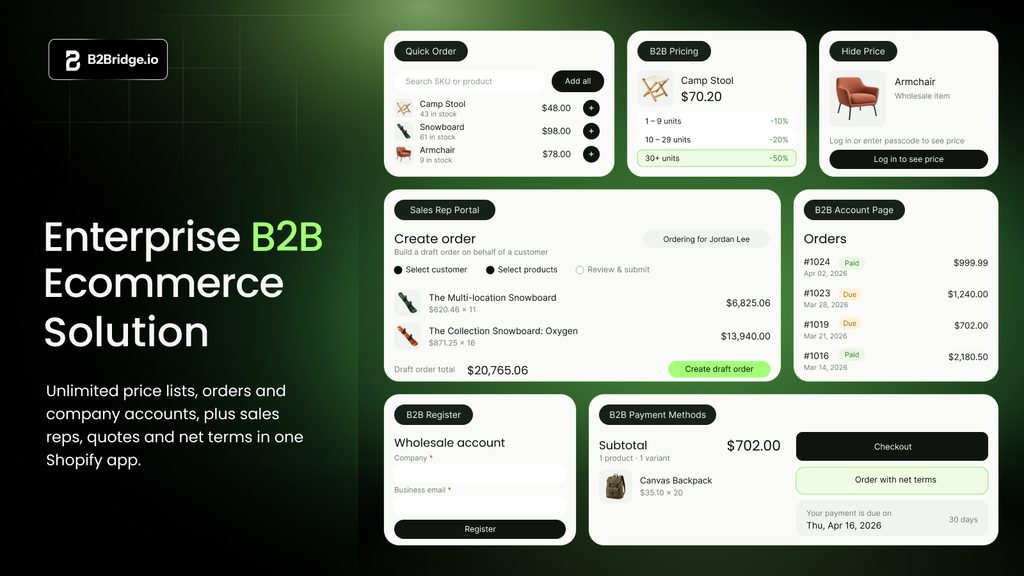
Plans start at $99 per month with a 14-day free trial, and the B2Bridge team helps with setup, as it did for Brooklyn Bicycle and OGO Toilet. Book a Demo to see it on your own store, or compare plans on the pricing page.
FAQs About B2B Ecommerce
What is B2B and what are some examples?
B2B, or business-to-business, means one company sells to another. A manufacturer selling parts to an assembler is B2B, and so is a distributor like MIDAN selling lighting to verified business buyers.
Is Amazon a B2C or B2B company?
Amazon runs both models. Amazon.com sells to consumers, while Amazon Business is a separate B2B marketplace with bulk pricing, business accounts, and purchasing tools built for organizations.
How big is the B2B ecommerce market?
The US market alone runs into the trillions. Forrester’s 2022 forecast projected US B2B ecommerce would reach $3 trillion by 2027. Our B2B ecommerce statistics roundup tracks newer figures.
What is an example of a B2B ecommerce website?
Alibaba.com is the best-known B2B marketplace, and distributors like Grainger run large B2B portals. On Shopify, Trailer Valet runs retail and dealer ordering from a single storefront with B2Bridge.
Do you need Shopify Plus to run B2B ecommerce on Shopify?
No. Native B2B has run on every paid Shopify plan since April 2026, with a three-catalog cap below Plus. Apps like B2Bridge add unlimited price lists, RFQ, and a Sales Rep Portal on any plan.
How long does it take to launch a B2B ecommerce store?
Most of the work is mapping buyer groups and pricing, then testing one full order. With an existing Shopify store and a B2B app, launch is a configuration job rather than custom development.

Hi, I’m Hanh – a product marketing professional passionate about driving growth, simplifying complex solutions, and creating impactful strategies for Shopify that connect products with customers.