B2B ecommerce for distributors is the use of online platforms to sell products to business buyers—retailers, resellers, contractors, and commercial accounts—replacing or supplementing traditional phone, fax, and sales rep ordering with digital self-service.
Distributors who delay going digital aren’t just missing a trend. They’re watching buyers migrate to competitors who let them order at midnight, see their contract pricing instantly, and reorder from history with one click. This guide covers the features, platform decisions, and implementation steps that separate distributors who compete from those who get left behind.
What Is B2B Ecommerce for Distributors
B2B ecommerce for distributors refers to online platforms where distributors sell products to business buyers—retailers, resellers, contractors, and commercial accounts—rather than individual consumers. Instead of relying on phone calls, fax orders, or sales rep visits, buyers log into a portal, see their negotiated pricing, and place orders whenever it works for them.
Distributors sit in the middle of the supply chain. They buy from manufacturers and sell downstream to businesses that either resell or use the products. B2B ecommerce brings that relationship online while keeping the complexity intact: contract pricing, bulk quantities, credit terms, and long-term account relationships all carry over to the digital channel.
- B2B ecommerce: Online selling between businesses, typically involving bulk orders, negotiated pricing, and account-based purchasing
- Distributor role: The intermediary that buys from manufacturers and sells to downstream businesses
How B2B Ecommerce Differs From B2C Ecommerce
Consumer ecommerce platforms assume fixed, public pricing. B2B distribution doesn’t work that way. Pricing varies by customer, contract, and volume—sometimes down to the individual SKU.
B2B buyers also purchase differently. They place large orders, reorder frequently, and expect to pay on terms rather than at checkout. The relationship is ongoing, not one-and-done.
| Factor | B2B Ecommerce | B2C Ecommerce |
|---|---|---|
| Pricing | Contract-based, customer-specific, volume tiers | Fixed public pricing |
| Ordering | Bulk quantities, reorders, quick order forms | Single-item cart |
| Payment | Net terms, credit limits, invoicing | Immediate payment |
| Buyer relationship | Account-based, long-term | Transactional, anonymous |
| Catalog access | Gated, verified buyers only | Open to all visitors |
Why B2B Ecommerce Matters for Distributors
Buyer expectations have shifted. The same purchasing managers who order supplies for their business also shop on Amazon at home. They now expect similar convenience from their distributors—24/7 access, easy reordering, and instant visibility into pricing and inventory.
There’s also an operational ceiling to consider. Phone and email orders require manual entry, which limits how many accounts your team can realistically serve. Digital self-service removes that bottleneck and frees your staff for higher-value work.
- Buyer expectations: Business buyers expect the same convenience they experience on consumer sites
- Competitive pressure: Distributors without digital ordering lose accounts to competitors who offer it
- Operational ceiling: Manual order processing caps how many accounts a team can handle
Benefits of B2B Ecommerce for Distributors
Higher Wholesale Revenue and Larger Order Values
Self-service ordering means buyers can place orders at 2 AM if that’s when they’re doing inventory. That availability alone increases order frequency. When buyers can see volume discounts and related products on screen, average order values tend to climb as well.
Stronger Buyer Loyalty and Retention
When buyers have their pricing, order history, and saved carts in one place, switching to a competitor becomes inconvenient. Personalized portals create switching costs that generic catalogs can’t match.
Streamlined Operations and Lower Order Costs
Every order that flows directly into your system without manual entry saves time and reduces errors. When your ecommerce platform syncs with your ERP, the savings compound across fulfillment, invoicing, and inventory management.
Faster Expansion Into New Markets and Channels
A digital storefront lets you reach new geographies and buyer segments without hiring additional sales reps. The same platform that serves existing accounts can onboard new ones with minimal incremental cost.
Essential Features of a B2B Ecommerce Platform for Distributors
Customer-Specific Pricing and Contract Price Lists
Price lists assigned per customer or customer group form the foundation of B2B distribution. Your platform displays each buyer’s negotiated rates automatically—no manual adjustments, no confusion.

Volume Discounts, MOQs, and Case Pack Rules
MOQ stands for minimum order quantity, and it protects margins on small orders. Tiered pricing rewards larger purchases, while case-pack rules ensure buyers order in quantities that match your fulfillment process—say, multiples of 12 or full pallets.

Net Payment Terms and Credit Limits
Business buyers expect to pay on terms—Net 15, Net 30, Net 60—rather than at checkout. Credit limits prevent overexposure while giving trusted accounts the flexibility they expect.

Gated Catalogs and Verified Buyer Registration
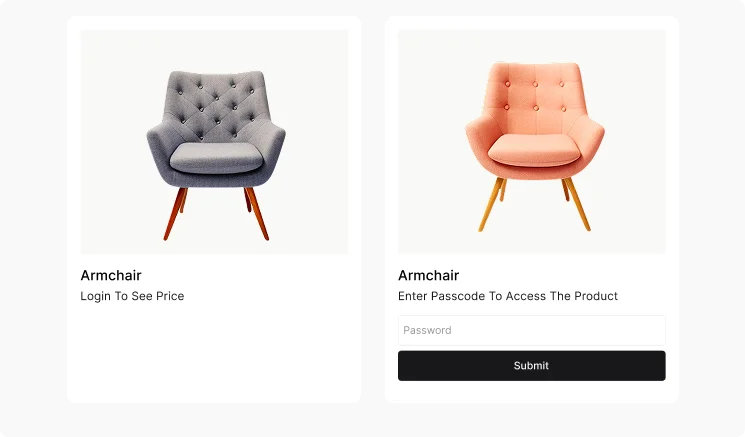
Hiding prices or entire product collections from public visitors protects your wholesale pricing. Verification workflows ensure only legitimate business buyers gain access to your B2B portal.
Quick Order Pages, Reorders, and Saved Carts
Repeat buyers don’t want to browse. They want to enter SKUs directly, upload a CSV, or reorder from their history with one click. Fast ordering interfaces respect their time and reduce friction.
ERP and CRM Integration
Syncing customers, pricing, inventory, and orders with systems like NetSuite, Odoo, or Zoho keeps data aligned across your operation. Without integration, you’re managing two sources of truth—and they’ll inevitably conflict.
Quote-to-Order and Manual Order Workflows
RFQ (request for quote) workflows handle large or complex deals that require negotiation. Manual order entry supports phone and email orders that still flow through your system properly.
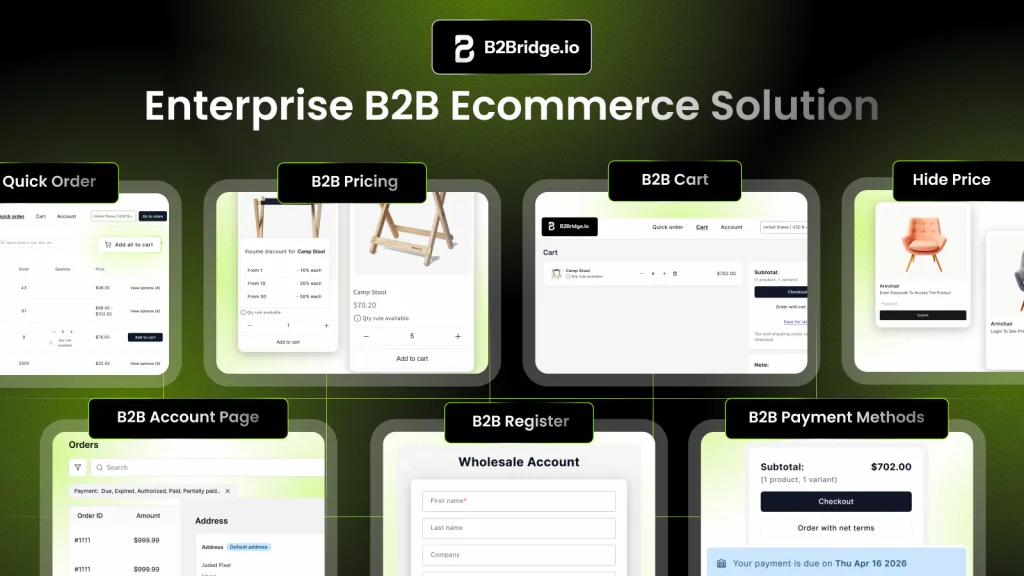
Try a B2B Ecommerce App for Shopify
How to Choose a B2B Ecommerce Platform for Distributors
Match the Platform to Your Pricing Complexity
Start by mapping your pricing logic. Do you have contract prices per customer? Volume tiers? Multi-currency requirements? The platform you choose handles your specific rules without workarounds—or it doesn’t.
Evaluate ERP, CRM, and WMS Integration Depth
Basic connectors that push orders one way aren’t enough for most distributors. Look for bi-directional sync that keeps pricing, inventory, and customer data aligned in real time across systems.
Confirm Hybrid B2B and B2C Support
Many distributors sell both wholesale and direct-to-consumer. Running two separate stores doubles operational work. A single store that serves both audiences—with appropriate access controls—simplifies everything.
Assess Implementation Speed and Total Cost of Ownership
Enterprise platforms often require months of implementation and significant custom development. Factor in ongoing fees, middleware costs, and the internal resources required to maintain the system over time.
Validate Specialist B2B Support and Roadmap
A vendor with dedicated B2B expertise understands distribution challenges in ways a generalist consumer platform doesn’t. Ask about their roadmap—are they investing in B2B features or treating wholesale as an afterthought?
>> See more: 20+ Best B2B Ecommerce Platforms in 2026
How to Build a B2B Ecommerce Site for Distributors
Step 1: Define Project Requirements and Goals
Identify what success looks like before selecting technology. That might mean a specific percentage of orders flowing through the portal, a target for buyer adoption, or measurable reductions in order processing time.
Step 2: Structure Your Catalog and Pricing Logic
Map your product hierarchy, customer groups, and pricing rules on paper first. This exercise reveals complexity that’s easy to overlook until you’re mid-implementation and scrambling.
Step 3: Plan ERP, CRM, and Fulfillment Integrations
Document the data flows between your ecommerce platform, ERP, CRM, and warehouse systems. Decide which system is the source of truth for each data type—pricing, inventory, customer records.
Step 4: Select Your B2B Ecommerce Technology
Choose a platform based on the criteria above. For Shopify merchants, apps like B2Bridge add enterprise B2B capabilities without requiring Shopify Plus or a separate storefront.
Step 5: Build Your Internal and Implementation Team
Assign a project owner who can make decisions and a technical lead who understands your systems. Identify whether you need agency or vendor support for implementation.
Step 6: Migrate Wholesale Accounts and Contract Pricing
Import customer records, price lists, and historical data into the new platform. Clean your data before migration—errors in your source data will carry over.
Step 7: Launch, Train Buyers, and Optimize Post Go-Live
Roll out in phases if possible, starting with your most engaged accounts. Communicate clearly with buyers about how to use the new portal, then iterate based on their feedback.
Common B2B Ecommerce Challenges for Distributors
Disconnected ERP and Ecommerce Data
When your ecommerce platform and ERP don’t sync properly, you end up with duplicate entry, inventory mismatches, and pricing errors. Integration isn’t optional for distributors—it’s foundational.
Complex Pricing That Breaks Standard Platforms
Consumer ecommerce platforms assume fixed pricing. When your pricing varies by customer, volume, contract, and currency, standard platforms require extensive customization or simply can’t cope.
Channel Conflict With Field Sales Reps
Sales reps sometimes view ecommerce as competition rather than a tool. Aligning incentives—crediting reps for portal orders in their territory, for example—turns resistance into adoption.
Low Buyer Adoption of Self-Service Ordering
Buyers default to familiar habits. Driving portal usage requires clear communication about benefits, training, and sometimes incentives like exclusive online pricing or faster fulfillment for digital orders.
Compliance, Tax, and Cross-Border Requirements
Global distributors face VAT validation, tax-exempt handling, and multi-currency pricing. Without built-in support for international requirements, cross-border B2B transactions become manual and error-prone.
How Distributors Compete With Amazon Business and Digital Marketplaces
Deliver Consumer-Grade UX With B2B Controls
Match the ease and speed of marketplace ordering while retaining the contract pricing, account controls, and payment terms that marketplaces can’t offer. Buyers want convenience, but they also want their negotiated rates.
Use Contract Pricing as a Competitive Moat
Personalized pricing and negotiated terms are something Amazon Business can’t replicate at scale. Your relationships and pricing flexibility are genuine differentiators worth protecting.
Combine Self-Service With Assisted Sales
The best B2B experiences blend digital convenience with human support. Buyers order routine items online while reps handle complex quotes and strategic conversations.
Personalize Catalogs by Buyer and Region
Show relevant products, pricing, and inventory based on buyer segment or geography. A contractor in Texas and a retailer in Ontario have different needs—your portal can reflect that.
Best Practices for Launching Distributor B2B Ecommerce
Onboard Existing Buyers Before Acquiring New Ones
Your current accounts already know your products and trust your business. Focus initial adoption efforts on them before using the portal to acquire new customers.
Train Sales Reps to Sell With the Portal
Equip reps to use the portal during calls—pulling up customer pricing, placing orders together, demonstrating features. When reps see the portal as a tool rather than a threat, adoption accelerates.
Measure Adoption, AOV, and Reorder Rate
Track portal login frequency, average order value, and repeat purchase rate. These metrics tell you whether buyers are actually using the system and finding value in it.
Iterate on Pricing Rules and Catalog Structure
Your first configuration won’t be perfect. Use buyer feedback and order data to refine pricing tiers, product organization, and ordering workflows over time.
Run Distributor B2B Ecommerce on Shopify With B2Bridge
For distributors already on Shopify—or considering it—B2Bridge adds enterprise B2B capabilities without requiring Shopify Plus or a separate storefront. The platform handles the pricing complexity, payment terms, and access controls that standard Shopify lacks.
- No Shopify Plus required: Run B2B and B2C on standard Shopify plans
- Advanced pricing engine: Customer-specific pricing, volume rules, contract price lists
- ERP and CRM sync: Connect NetSuite, Zoho, Odoo, or custom systems
- Fast implementation: Most stores launch in days, not months
- Ongoing support: Technical partnership through scaling, not just setup

Frequently Asked Questions About B2B Ecommerce for Distributors
Can distributors run B2B ecommerce on standard Shopify without Shopify Plus?
Yes. Apps like B2Bridge add enterprise B2B capabilities—customer-specific pricing, net terms, gated catalogs—to standard Shopify plans without requiring a Plus upgrade.
How long does it typically take to launch a B2B ecommerce site for a distributor?
With the right platform and preparation, most distributor B2B sites launch within a few days to a few weeks depending on catalog complexity and integration requirements.
How does B2B ecommerce integrate with a distributor’s ERP system?
B2B platforms sync customers, pricing, inventory, and orders with ERPs like NetSuite or Odoo through native connectors or APIs, keeping data aligned across systems.
How do distributors prevent channel conflict between ecommerce and field sales reps?
Distributors align incentives by crediting reps for portal orders in their territory and positioning the site as a tool that frees reps for higher-value conversations.
Is a distributor considered a B2B business?
Yes. Distributors are B2B businesses because they sell products to other businesses—retailers, contractors, resellers—rather than directly to individual consumers.

As a Product Marketing Executive at B2Bridge, I focus on the Enterprise B2B Ecommerce domain. I leverage my understanding of product and user psychology to deliver customer-centric content that addresses business challenges and fuels growth.