B2B ecommerce marketing is the use of digital strategies—SEO, personalized content, account-based advertising, and platform-level tactics—to drive bulk sales and build lasting partnerships between businesses through online channels. With B2B ecommerce sales expected to exceed $3 trillion by 2028, the brands winning right now are the ones treating their digital storefront as a revenue engine, not just a catalog.
This guide breaks down 15 proven B2B ecommerce marketing strategies, what separates B2B from B2C approaches, and the specific tactics you can implement to turn your wholesale channel into a growth driver.
What is B2B ecommerce marketing
B2B ecommerce marketing uses digital channels like SEO, personalized content, and account-based advertising to drive bulk sales and build lasting partnerships between businesses. Unlike general B2B marketing, B2B ecommerce marketing ties directly to online purchasing. You’re not just generating leads; you’re moving buyers toward completing transactions through your digital storefront.
- B2B ecommerce: The online sale of goods or services between businesses
- B2B ecommerce marketing: The promotional tactics used to attract, convert, and retain business buyers through your online sales channel
The distinction matters because your marketing efforts connect to measurable ecommerce outcomes: registrations, first orders, reorder rates, and average order value.
How B2B ecommerce marketing differs from B2C
The differences between B2B and B2C ecommerce are structural, not cosmetic, and forcing B2C tactics on wholesale buyers usually backfires. Business buyers operate on logic, not impulse. They’re accountable to procurement teams, finance departments, and sometimes entire committees.
| Factor | B2B Ecommerce Marketing | B2C Ecommerce Marketing |
|---|---|---|
| Buyer motivation | ROI, efficiency, logic | Emotion, convenience, price |
| Purchase decision | Committee-based, multi-stakeholder | Individual |
| Order size | High-volume, bulk quantities | Single units |
| Buying cycle | Weeks to months | Minutes to days |
| Pricing | Negotiated, account-specific | Fixed, transparent |
| Relationship focus | Long-term partnerships | Transactional |
Your B2B ecommerce marketing has to address buying committees, support complex pricing structures, and build trust over time. A flashy discount banner won’t close a $50,000 wholesale order.
Types of B2B ecommerce that shape your marketing approach
Your marketing tactics depend heavily on which B2B model you operate.
Here’s a quick breakdown:
Wholesale ecommerce
Selling products in bulk to retailers or resellers at wholesale pricing. Marketing focuses on volume incentives, tiered pricing visibility, and streamlined reordering.
Manufacturer ecommerce
Manufacturers selling directly to businesses or distributors. Marketing emphasizes product specifications, technical documentation, and integration with procurement systems.
Distributor ecommerce
Distributors acting as intermediaries between manufacturers and end buyers. Marketing highlights inventory availability, fast fulfillment, and multi-brand catalogs.
Hybrid B2B and B2C models
Businesses operating both wholesale and direct-to-consumer channels from a single storefront. Marketing here requires segmenting audiences and showing appropriate pricing to each buyer type, which trips up many growing brands.
15 B2B ecommerce marketing strategies that drive revenue
The following strategies move from foundational platform-level tactics to channel-specific approaches. Each one addresses a specific friction point in the B2B buying journey.
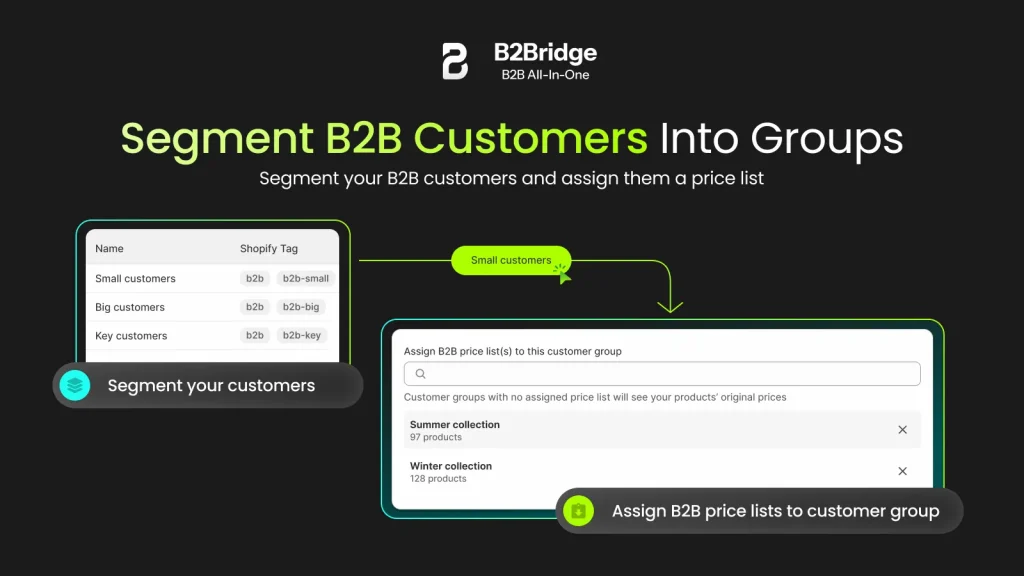
1. Personalize pricing and catalogs by customer group
Customer group pricing means different prices for different buyer segments. Distributors see one rate, retailers see another. When buyers log in and immediately see their negotiated rates, you remove a major friction point.
Outcome: Set up customer groups with role-based pricing tied to your ERP or pricing engine.
2. Gate wholesale pricing to capture qualified leads
Price gating hides wholesale prices from unauthenticated visitors. Gating protects your margins from competitors, qualifies leads before they access B2B pricing, and creates a clear incentive to register.
Outcome: Implement login-required access for wholesale catalogs and pricing.
3. Streamline B2B registration as a conversion event
B2B registration isn’t just an admin task. It’s a marketing conversion. The form captures business credentials, tax IDs, and segment data that powers your entire personalization strategy.
Outcome: Create custom registration forms that auto-assign buyers to customer groups upon approval.
4. Offer net terms and RFQ to reduce checkout friction
Net terms (Net 30, Net 60) let buyers pay on invoice rather than at checkout. RFQ (Request for Quote) workflows let buyers negotiate pricing on large orders. Both reduce cart abandonment for high-value purchases.
Outcome: Enable net terms by customer group and RFQ workflows for orders above a certain threshold.
5. Build quick order and reorder flows for repeat revenue
B2B buyers reorder frequently and value speed over browsing. Quick order forms let buyers enter SKUs directly, while saved carts and one-click reorder from order history accelerate repeat purchases.
Outcome: Add quick order forms and one-click reorder functionality to your buyer portal.
6. Activate account-based marketing for target buyers
ABM (Account-Based Marketing) targets specific high-value accounts with personalized campaigns rather than broad audience marketing. ABM works for B2B because you’re dealing with a smaller buyer pool and higher deal values.
Outcome: Identify your top target accounts and create personalized landing pages, ads, and email sequences for each.
7. Build a B2B SEO program around buyer search intent
B2B SEO focuses on specific, intent-driven keywords like product specs, part numbers, and “wholesale [product]” rather than broad terms. Your buyers search differently, often for technical specifications or solutions to operational problems.
Outcome: Create product pages optimized for technical queries and publish solution-focused content for problem-aware searches.
8. Run segmented email campaigns synced with your CRM
Email marketing for B2B works best when segmented by customer group, purchase history, and lifecycle stage. Campaigns include reorder reminders, new product announcements, and credit term updates.
Outcome: Sync your ecommerce platform with your CRM to trigger automated, behavior-based email sequences.
9. Publish buyer-focused content for multi-stakeholder committees
B2B content marketing includes technical guides, product sheets, and white papers that help buying committees justify purchases. Your content has to address multiple roles: procurement, finance, and operations all have different concerns.
Outcome: Create content assets for each stakeholder role in your buyer’s organization.
10. Use paid advertising to reach in-market B2B buyers
Paid advertising for B2B includes LinkedIn ads, Google Ads for commercial intent keywords, and retargeting. Focus on reaching decision-makers and procurement professionals actively researching solutions.
Outcome: Run retargeting campaigns for visitors who viewed product pages but didn’t register or purchase.
11. Leverage social media for B2B awareness and trust
LinkedIn and industry-specific platforms build brand awareness and trust with B2B buyers. Focus on thought leadership, customer success stories, and product education rather than promotional content.
Outcome: Share customer results and product use cases on LinkedIn consistently.
12. Apply AI for B2B personalization and automation
AI applications in B2B ecommerce marketing include personalized product recommendations, predictive reorder prompts, and automated customer segmentation. AI tools surface relevant products based on buyer history and segment.
Outcome: Implement AI-powered search and recommendations tailored to each buyer’s purchase patterns.
13. Optimize B2B checkout and cart conversion
B2B checkout optimization differs from B2C. You’re supporting PO numbers, multiple shipping addresses, split shipments, and saved payment methods. Reduce steps for logged-in buyers wherever possible.
Outcome: Audit your checkout for B2B-specific fields and remove unnecessary friction for authenticated buyers.
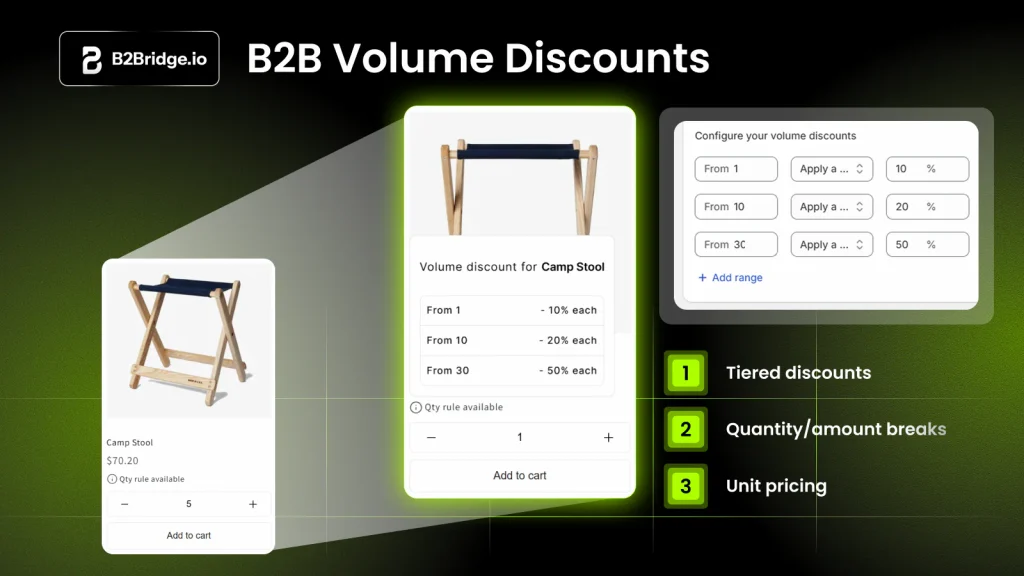
14. Upsell and cross-sell with volume and tiered pricing
Volume pricing (discounts at quantity thresholds) and visible tiered pricing tables incentivize larger orders. When buyers see the price-per-unit drop at the next quantity break, they often increase their order size.
Outcome: Display tiered pricing tables on product pages showing price-per-unit at each quantity break.
15. Build partner and distributor co-marketing programs
Co-marketing with channel partners extends your reach. Provide partners with marketing assets, co-branded materials, and MDF (Market Development Funds) programs to amplify your message.
Outcome: Create a partner portal with downloadable marketing assets and co-marketing guidelines.
Common patterns across high-performing B2B ecommerce marketing programs
Looking across successful B2B ecommerce operations, a few patterns emerge consistently:
- Unified data across systems: ERP, CRM, and ecommerce platforms share customer, pricing, and inventory data
- Self-service as the default: Buyers can place orders, check status, and reorder without contacting sales
- Personalization tied to customer identity: Pricing, catalogs, and payment terms adjust automatically by buyer segment
- Content that supports long buying cycles: Resources address every stage from awareness to purchase justification
- Frictionless repeat purchasing: Quick order, saved carts, and reorder flows prioritize returning buyers
The common thread? Reducing friction at every touchpoint while maintaining the personalization that B2B buyers expect.
B2B ecommerce marketing KPIs and metrics to track
The following metrics tell you whether your B2B ecommerce marketing is actually working:
- Customer Acquisition Cost (CAC): Cost to acquire a new B2B account
- Customer Lifetime Value (CLV): Total revenue expected from a customer relationship
- Average Order Value (AOV): Mean value per order, tracked by customer segment
- Reorder Rate: Percentage of customers who place repeat orders
- Registration-to-First-Order Conversion: How many registered B2B accounts convert to buyers
- Quote-to-Order Conversion: Percentage of submitted quotes that become orders
- Time to First Order: Days between registration approval and first purchase
Track each metric by customer segment, not just in aggregate. Your distributor segment likely behaves very differently from your retailer segment.
How to get started with a B2B ecommerce marketing plan

If you’re building a B2B ecommerce marketing program from scratch, here’s a practical sequence:
Step 1. Audit your current B2B funnel and buyer segments
Review existing customer data to identify your highest-value segments, common purchase paths, and drop-off points. Document which buyer types exist and how they currently find and purchase from you.
Step 2. Connect your ERP, CRM, and ecommerce data
Ensure pricing, customer records, and inventory sync between systems. Integration enables personalized pricing, accurate availability, and automated marketing triggers.
Step 3. Launch gated pricing and registration workflows
Implement B2B registration forms and price gating so you capture qualified leads and control who sees wholesale pricing. Set up approval workflows to verify business credentials.
Step 4. Activate personalized campaigns by customer group
Use your customer segments to send targeted email campaigns, display relevant pricing, and serve personalized product recommendations. Start with reorder reminders and new product announcements.
Step 5. Measure, iterate, and scale winning channels
Track the KPIs defined above, identify which channels drive the most qualified buyers and orders, and reallocate budget toward top performers.
B2B ecommerce marketing trends shaping the market
Several shifts are reshaping how B2B ecommerce marketing works in practice:
Unified B2B and B2C storefronts on a single platform
Brands are consolidating wholesale and retail into one storefront with segmented experiences, reducing operational overhead and enabling hybrid business models.
AI-driven personalization at the account level
AI is moving beyond product recommendations to account-level personalization, including predicting reorder timing, suggesting contract renewals, and automating pricing adjustments.
Self-serve buying experiences for enterprise buyers
Enterprise buyers increasingly prefer self-service over sales rep interactions for routine orders, pushing B2B platforms to deliver B2C-style convenience with B2B-grade functionality.
Embedded quote and net terms workflows
Quote-to-order and invoice payment workflows are being embedded directly into ecommerce checkout rather than handled through separate systems or email chains.
How B2Bridge helps you execute B2B ecommerce marketing on Shopify
The strategies above require specific platform capabilities. B2Bridge brings enterprise-grade B2B functionality to Shopify merchants without requiring Shopify Plus or a separate wholesale platform.
Here’s how B2Bridge capabilities map to the strategies covered:
- B2B Pricing Engine: Enables personalized pricing by customer group and volume/tiered pricing displays
- B2B Lock: Enables gated wholesale pricing and catalog access
- B2B Registration: Turns registration into a conversion event with custom forms and auto-assignment
- B2B Payment with Net Terms and RFQ: Enables net payment terms and quote workflows
- Quick Order and Saved Carts: Enables reorder flows for repeat revenue
- ERP and CRM Integration: Enables segmented campaigns synced with your systems
The result: you can run B2B ecommerce marketing on Shopify with the same capabilities that enterprise platforms offer, without the enterprise complexity.

Book a Demo to see how B2Bridge can power your B2B ecommerce marketing on Shopify.
Frequently asked questions about B2B ecommerce marketing
What is the 95/5 rule in B2B marketing?
The 95/5 rule suggests that at any given time, only about 5% of your potential B2B buyers are actively in-market to purchase, while 95% are not yet ready to buy. Your marketing has to focus on building awareness and trust with the larger out-of-market audience so you’re top of mind when they enter a buying cycle.
What are the four types of B2B marketing?
The four commonly referenced types are product marketing (promoting specific products to business buyers), content marketing (educational resources that support buying decisions), account-based marketing (targeting specific high-value accounts), and digital marketing (online channels including SEO, email, and paid advertising).
What are the 7 Ps of B2B marketing?
The 7 Ps extend the traditional marketing mix to include Product, Price, Place, Promotion, People, Process, and Physical Evidence. People, Process, and Physical Evidence are especially important in B2B where relationships, buying workflows, and proof of capability influence purchase decisions.
How long does B2B ecommerce marketing take to show results?
B2B ecommerce marketing typically requires several months to show meaningful results because B2B buying cycles are longer and involve multiple stakeholders. However, tactics like email campaigns to existing customers can generate faster returns than awareness-focused approaches.
Can you run B2B ecommerce marketing on Shopify without Shopify Plus?
Yes. Apps like B2Bridge add B2B capabilities including customer group pricing, gated access, net terms, and wholesale registration to standard Shopify plans, with no Plus upgrade required.

As a Product Marketing Executive at B2Bridge, I focus on the Enterprise B2B Ecommerce domain. I leverage my understanding of product and user psychology to deliver customer-centric content that addresses business challenges and fuels growth.