Pricing a B2B ecommerce website feels like trying to hit a moving target—platform fees, integration costs, and hidden expenses stack up in ways that vendor pricing pages rarely make clear. The gap between a $15,000 starter build and a $250,000 enterprise project comes down to decisions you make early, often before you’ve talked to a single vendor.
This guide breaks down exactly what drives B2B ecommerce website costs in 2026, from platform licensing models to the integration work that quietly becomes your largest line item. You’ll walk away with a framework for calculating your true total cost of ownership across any platform you’re evaluating.

What B2B Ecommerce Website Pricing Actually Includes
When you’re budgeting for a B2B ecommerce website, you’re paying for a stack of interconnected components rather than a single line item. Each category carries its own cost structure, and understanding the breakdown helps you compare platforms accurately.
- Platform licensing or subscription: The recurring fee you pay to access the ecommerce software. SaaS platforms like Shopify and BigCommerce charge monthly, while open-source platforms like Adobe Commerce have different licensing structures.
- Implementation and development: One-time costs for setup, customization, theme development, and launch. For mid-market and enterprise builds, implementation is often the largest line item.
- ERP and CRM integrations: Connecting your ecommerce site to backend systems so pricing, inventory, customers, and orders stay synchronized. Complexity here varies widely based on your existing tech stack.
- Design and storefront customization: Tailoring the buyer-facing experience for B2B workflows, including quick order pages, B2B cart functionality, and gated pricing displays.
- Hosting and infrastructure: Server costs if not bundled into your platform subscription. SaaS platforms typically include hosting, while open-source platforms do not.
- Ongoing maintenance and support: Monthly or annual costs for updates, bug fixes, security patches, and technical assistance after launch.
Why B2B Ecommerce Websites Cost More Than B2C
If you’ve priced out a standard DTC store before, B2B pricing can feel like a different universe. The gap exists because B2B ecommerce carries structural complexity that B2C simply doesn’t require.
- Customer accounts are organizations, not individuals: B2B requires company-level accounts with multiple buyers, roles, and approval workflows rather than a single login per customer.
- Pricing is per-account, not public: You need systems for customer-specific pricing, contract price lists, and volume discounts rather than a single price visible to everyone.
- Checkout involves financial controls: B2B buyers expect net payment terms (Net 30/60/90), RFQ workflows, and purchase order support instead of instant card payments.
- Integrations are a core requirement: Syncing with ERPs and CRMs is essential for B2B operations, adding complexity and cost that most B2C stores never encounter.
How Much a B2B Ecommerce Website Costs
Pricing varies dramatically based on your business size, feature requirements, and integration complexity. Here’s how the market typically breaks down across three tiers.
Small and Starter B2B Builds
At the lower end, you’re looking at a basic Shopify or BigCommerce store with a B2B app, minimal customization, and limited integrations. This tier works well for businesses testing wholesale or running simple B2B alongside an existing DTC operation. Expect to invest roughly $10,000 to $30,000 for setup, plus ongoing app and platform fees.
Mid-Market B2B Builds
The middle tier typically involves Shopify Plus or BigCommerce Enterprise, moderate customization, ERP integration, and professional design. Growing wholesalers, distributors, and manufacturers with multiple customer segments usually land here. Budget $30,000 to $100,000 for implementation, with monthly platform and app costs scaling accordingly.
Enterprise B2B Builds
At the high end, you’re looking at Adobe Commerce, OroCommerce, or heavily customized Shopify Plus with deep ERP/CRM sync, complex pricing logic, and custom workflows. Large manufacturers and distributors with high transaction volume and sophisticated operations typically fall into this category. Builds can range from $100,000 to $250,000+ for implementation alone, with significant ongoing costs.
Factors That Influence B2B Ecommerce Website Pricing
What drives the final price of your B2B ecommerce build? Several variables interact to determine your total investment.
Platform Choice
The platform you select—Shopify, Shopify Plus, BigCommerce, Adobe Commerce, OroCommerce—sets your baseline cost and determines what’s included natively versus what requires add-ons or custom development.
B2B Features and Functionality
The depth of B2B functionality you require directly affects pricing. Customer group pricing, volume discounts, quote-to-order workflows, and net terms all add cost. Platforms lacking native B2B features require apps or custom builds to fill the gaps.
ERP and CRM Integrations
Connecting to systems like NetSuite, Zoho, Odoo, or custom ERPs adds significant cost depending on complexity and data sync requirements. For enterprise builds, integration work is often the single largest variable.
Design and Storefront Customization
A custom B2B UX—quick order pages, B2B cart, gated pricing—costs more than using default templates. The more tailored your buyer experience, the higher the development investment.
Hosting and Infrastructure
SaaS platforms bundle hosting into your subscription. Open-source platforms require separate hosting costs, which can add thousands annually depending on traffic and performance requirements.
Ongoing Maintenance and Support
Support plans, app subscriptions, and technical maintenance add recurring costs post-launch. Many merchants underestimate this category during initial budgeting.
B2B Ecommerce Pricing Models Explained
Platforms charge for B2B ecommerce in different ways. Understanding pricing models helps you compare options on equal footing.
Flat Subscription Pricing
You pay a fixed monthly or annual fee regardless of sales volume. Shopify and BigCommerce use this model for their standard plans. It’s predictable, though advanced B2B features may require additional apps.
GMV Based Licensing
Your fee scales with your Gross Merchandise Value—the total value of goods sold through your store. Shopify Plus uses this model at higher tiers. Costs can increase significantly as revenue grows.
Open Source With Commercial Licensing
The software itself is free, but you pay for hosting, enterprise support, and extensions. Adobe Commerce (Magento) and OroCommerce follow this model. Lower upfront licensing, but higher implementation and maintenance costs.
App and Add On Pricing on Shopify
Shopify’s base plans lack native B2B features, so you add functionality through paid apps. App pricing is typically a flat monthly fee per feature set or plan tier—solutions like B2Bridge fit into this category.
B2B Ecommerce Platform Pricing Comparison
| Platform | Pricing Model | Native B2B Features | Best For |
|---|---|---|---|
| Shopify Plus | Subscription + GMV at scale | Basic B2B catalogs, customer accounts | Mid-market to enterprise hybrid B2B+B2C |
| Shopify + B2B App | Flat subscription + app fee | Depends on app (e.g., B2Bridge adds full B2B suite) | Growing brands avoiding Shopify Plus cost |
| BigCommerce | Tiered subscription | Native B2B Edition available | Mid-market B2B-first sellers |
| Adobe Commerce | Open source + enterprise licensing | Extensive but requires development | Large enterprise with dev resources |
| OroCommerce | Open source + commercial tiers | Purpose-built for B2B | Complex B2B-only operations |
Shopify Plus B2B
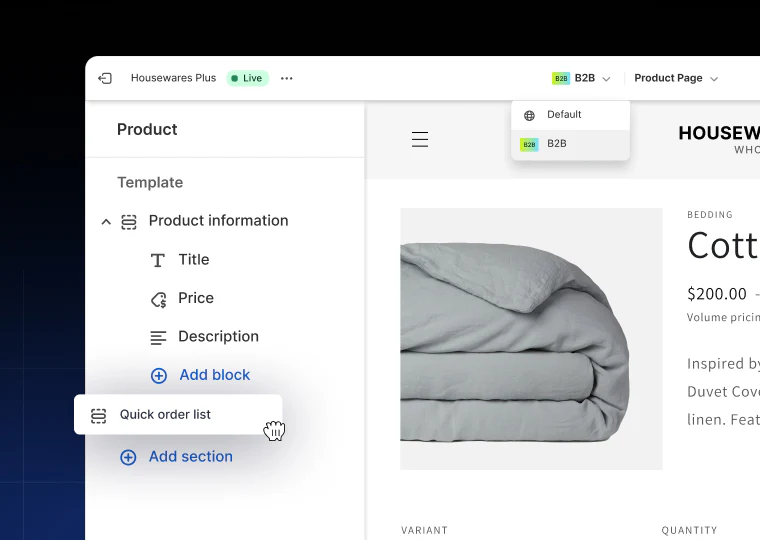
Shopify Plus includes basic B2B catalogs and customer accounts natively. However, many wholesale features—like advanced pricing rules, net terms, and RFQ workflows—still require apps or customization to implement fully.
Shopify With a B2B App
Merchants on standard Shopify plans can add B2B functionality through apps like B2Bridge, avoiding the Shopify Plus price jump while gaining enterprise B2B features like customer-specific pricing, net terms, and gated access.

BigCommerce B2B
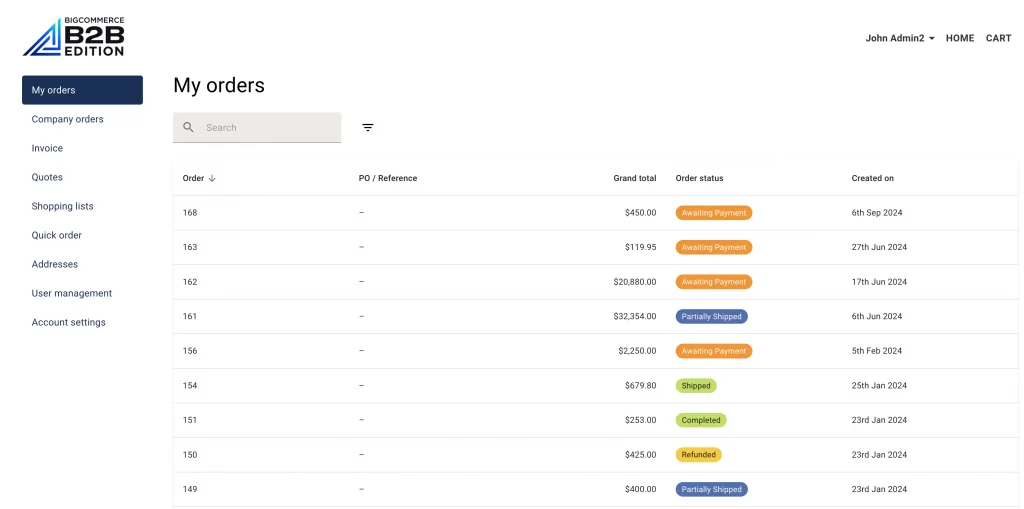
BigCommerce offers a B2B Edition with native features for price lists, company accounts, and quote management. It’s a strong option for mid-market B2B-first sellers who want built-in functionality without extensive customization.
Adobe Commerce
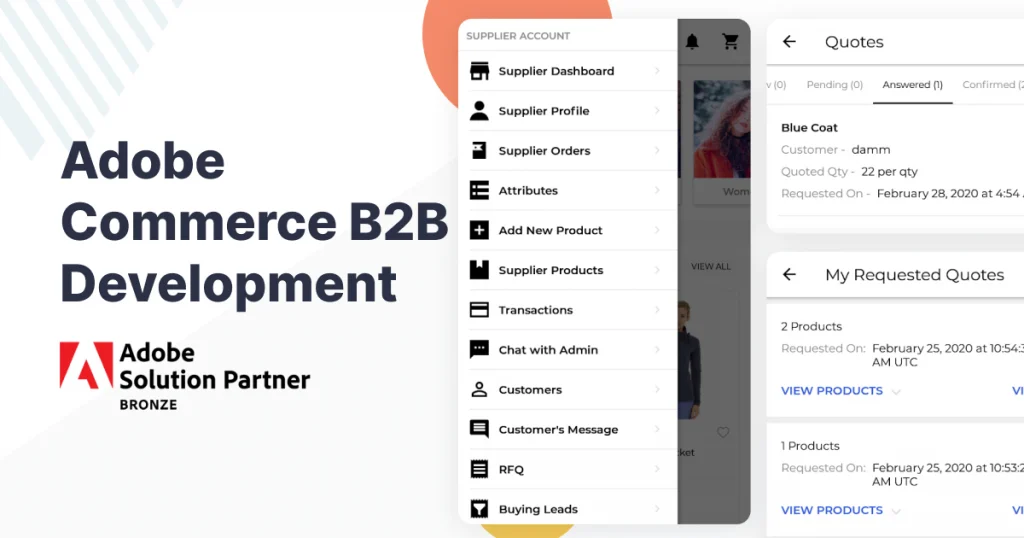
Adobe Commerce (Magento) offers extensive B2B capabilities but requires significant development resources. Licensing is complex, and implementation costs run high compared to SaaS alternatives.
OroCommerce
OroCommerce is purpose-built for B2B with native RFQ, corporate account hierarchies, and flexible pricing rules. It’s open-source with commercial support tiers, designed for complex B2B-only operations.

Hidden Costs of a B2B Ecommerce Website
What costs don’t show up on pricing pages? Several expenses tend to surprise merchants after launch.
Integration Maintenance
ERP and CRM integrations require ongoing maintenance as systems update, data structures change, or business rules evolve. Budget for integration work as a recurring cost rather than a one-time expense.
Custom Development for Missing B2B Features
Platforms lacking native B2B functionality—like MOQs, tiered pricing, or net terms—require custom builds that add cost both upfront and over time as your requirements change.
Upgrade and Migration Costs
Platform upgrades, migrations between platforms, or moving from Shopify to Shopify Plus incur additional cost. Factor potential migration into your multi-year planning.
Operational Overhead on Your Team
Complex B2B setups can require more staff time for order management, customer support, and manual workarounds if systems aren’t unified. This is a real cost, even if it doesn’t appear on an invoice.
How to Calculate Your Total Cost of Ownership
Why does TCO matter more than year-one cost? Because the cheapest upfront option often costs more over three to five years due to hidden costs, limitations, and scaling challenges.
Step 1. Map Direct Platform Costs
List licensing fees, transaction fees, app subscriptions, and hosting (if separate). These form your baseline recurring costs.
Step 2. Estimate Integration and Development Costs
Include ERP/CRM integration, custom feature development, and third-party connectors. Get quotes early—these numbers vary widely based on your existing systems.
Step 3. Project Upgrade and Maintenance Costs
Factor in platform upgrades, re-platforming risk, and ongoing support contracts. Consider what happens if you outgrow your current setup within three years.
Step 4. Add Operational Costs Absorbed by Your Team
Include staff time for manual processes, training, and workarounds for missing features. These overhead costs are real even if they’re not line items on a vendor invoice.
Step 5. Total and Compare Across Platforms
Sum costs across all categories and compare platforms on a three-to-five-year basis rather than just initial price. The picture often looks very different when you extend the timeline.
Best Practices to Reduce B2B Ecommerce Website Costs
How can you lower your total cost without sacrificing B2B functionality? A few approaches consistently pay off.
1. Choose Native B2B Over Bolted On B2B
Platforms or apps with built-in B2B logic reduce custom development and ongoing maintenance. You’re not paying to reinvent features that already exist elsewhere.
2. Unify B2B and B2C on a Single Store
Running separate B2B and B2C stores doubles operational cost. A unified store with role-based access—like what B2Bridge enables on Shopify—cuts complexity significantly.
3. Scope ERP and CRM Integrations Before Selecting a Platform
Understanding your integration requirements upfront prevents costly surprises during implementation. Not every platform handles your ERP the same way.
4. Launch With an MVP and Iterate
Starting with core functionality and adding features over time reduces initial investment and risk. You learn what your buyers actually use before over-building.
5. Plan for Multi Year TCO Instead of Year One Cost
The cheapest upfront option often costs more over three to five years due to hidden costs and limitations. Run the full calculation before committing to a platform.
How B2Bridge Lowers B2B Ecommerce Website Pricing on Shopify
B2Bridge embeds enterprise B2B functionality directly into Shopify without requiring Shopify Plus, reducing licensing costs while providing advanced features that typically require expensive custom development.
- B2B Pricing Engine: Customer-specific pricing, volume discounts, and contract price lists without custom development.
- ERP and CRM Integration: Native connectors for NetSuite, Zoho, Odoo, and custom ERPs via enterprise API.
- Unified B2B + B2C Store: Run both channels on one Shopify store, eliminating duplicate operational costs.
- B2B UX Built for Conversion: Quick order pages, B2B cart with net terms, and wholesale registration without Shopify Plus.

Future Outlook for B2B Ecommerce Website Pricing
Several trends are reshaping what B2B ecommerce costs—and what you get for your investment.
API-first architectures are reducing integration costs by making systems more interoperable. Composable commerce is enabling faster customization without full platform rebuilds. AI-driven pricing optimization is emerging as a competitive advantage for larger operations.
Meanwhile, the shift toward unified B2B+B2C platforms—particularly on Shopify—is lowering the barrier to entry for growing brands. You no longer require enterprise budgets to run enterprise-grade B2B operations.
Making the Right B2B Ecommerce Investment for Your Business
The right B2B ecommerce investment depends on understanding your true cost drivers, calculating TCO over multiple years, and choosing platforms that match your B2B complexity. The operational cost of running disconnected systems often exceeds the cost of doing it right the first time.
Start by mapping your requirements—pricing logic, integrations, buyer workflows—and then evaluate options based on total value rather than upfront price alone.Book A Demo
Frequently Asked Questions about B2B Ecommerce Website Pricing
Do you need Shopify Plus to run a B2B ecommerce website?
No. B2B apps like B2Bridge add enterprise B2B functionality to standard Shopify plans, letting you run customer-specific pricing, net terms, and wholesale workflows without upgrading to Shopify Plus.
How long does it take to launch a B2B ecommerce website?
Timeline depends on complexity. A simple Shopify store with a B2B app can launch in a few weeks. Enterprise builds with deep ERP integrations and custom development typically take several months.
Can you run B2B and B2C on the same ecommerce website to save cost?
Yes. Unified B2B+B2C stores reduce operational overhead by eliminating duplicate inventory, order, and customer management. Solutions like B2Bridge enable role-based pricing and access on a single Shopify storefront.
How much does ERP integration cost in a B2B ecommerce project?
ERP integration costs vary widely based on the complexity of data sync, the number of systems involved, and whether you use native connectors or require custom middleware. Scope requirements thoroughly before selecting a platform.
What ongoing monthly cost should you budget for a B2B ecommerce website after launch?
Budget for platform subscription, app fees, hosting (if applicable), support contracts, and staff time for maintenance. Ongoing costs often equal or exceed year-one implementation costs over a three-to-five-year period.

Hi, I’m Hanh – a product marketing professional passionate about driving growth, simplifying complex solutions, and creating impactful strategies for Shopify that connect products with customers.