Cost-plus pricing is a pricing strategy where you set the selling price by adding a fixed markup percentage to your total unit cost—covering materials, labor, and overhead while guaranteeing a specific profit margin on every sale.
The formula is simple, but getting the inputs right is where most businesses stumble. This guide breaks down the cost-plus pricing formula, walks through calculation steps with examples, and explains when the strategy works well versus when it falls short.
What is cost-plus pricing
Cost-plus pricing is a pricing strategy where a company sets the selling price by adding a fixed percentage markup to the total unit cost. The approach guarantees that production costs—materials, labor, overhead—are covered while building in a specific profit margin per unit.
You’ll also hear this called markup pricing. The logic is identical either way: figure out what it costs to make something, decide how much profit you want, then add that percentage on top.
The method is inward-looking by design. Unlike value-based pricing, which considers what customers are willing to pay, cost-plus pricing focuses entirely on your own numbers. That simplicity is both its greatest strength and its most significant limitation.
- Total unit cost: All expenses required to produce one unit, including raw materials, direct labor, and allocated overhead
- Markup percentage: The fixed percentage added to cover profit, expressed as a decimal (40% becomes 0.40)
- Selling price: The final price charged to the buyer after markup is applied
Cost-plus pricing formula
The core formula is straightforward: Selling Price = Total Unit Cost × (1 + Markup Percentage)
So if your total cost per unit is $50 and you want a 40% profit margin, the math looks like this: $50 × 1.40 = $70.
Breaking down total unit cost takes more work than the formula itself. You’re combining direct materials, direct labor, and an allocation of overhead expenses. Miss any of these components, and your “profit” margin quietly disappears.
| Component | What it includes | Example |
|---|---|---|
| Direct materials | Raw goods, packaging, components | $20 per unit |
| Direct labor | Wages for production workers | $15 per unit |
| Overhead allocation | Rent, utilities, equipment depreciation | $15 per unit |
| Total unit cost | Sum of all components | $50 per unit |
How to calculate cost-plus pricing
Step 1. Calculate total production cost
Start by listing every direct cost required to produce one unit. Raw materials, labor, packaging, inbound shipping—all of it. Don’t estimate. Track actual costs, because even small oversights compound across large orders.
Step 2. Divide total cost by output
If you’re calculating costs at the batch level, divide your total production cost by the number of units produced. A $10,000 production run yielding 1,000 units gives you a $10 cost per unit.
Step 3. Set the markup percentage
Markup percentages vary widely by industry. Apparel wholesalers often target 50%–100%, while electronics typically run 20%–30%. Choose a percentage that sustains growth while keeping you competitive.
Step 4. Add the markup to unit cost
Apply the formula. If your unit cost is $50 and your markup is 40%, multiply $50 by 1.40 to get a $70 selling price.
After calculating, validate your result against market rates. If competitors charge significantly less for similar products, you may want to revisit your cost structure or accept a lower margin.
>> Try our wholesale pricing calculator here:
Cost-plus pricing examples
Manufacturing example: A furniture maker calculates $200 in materials, $100 in labor, and $50 in overhead per chair. Total cost: $350. With a 30% markup, the wholesale price becomes $350 × 1.30 = $455.
Wholesale distribution example: A distributor’s landed cost for a case of products is $80, including freight and handling. Adding a 25% markup yields a B2B selling price of $100 per case.
Retail example: A boutique purchases handbags at $40 wholesale. Applying a 100% markup sets the consumer price at $80.
Notice how the markup percentage shifts depending on the industry and buyer type. Wholesale markups tend to run lower than retail because B2B buyers purchase in volume and expect room for their own margins.
Advantages of cost-plus pricing
Simple to calculate and communicate
No market research, demand forecasting, or competitor analysis required. You know your costs, you pick a markup, and you have a price. The transparency also makes it easier to explain pricing to buyers who ask how you arrived at a number.
Predictable profit margins
Every sale covers costs and delivers a known profit. There’s no guesswork about whether you’ll make money on a transaction—the margin is built into the formula from the start.
Easy to justify to wholesale buyers
B2B customers often expect cost-based negotiations. When you can show that your price reflects actual production costs plus a reasonable markup, conversations become more straightforward —especially when you run B2B alongside DTC on the same store.
Low research and forecasting overhead
You don’t have to analyze what competitors charge or estimate customer willingness to pay. For businesses with limited pricing resources, this simplicity is genuinely valuable.
Disadvantages of cost-plus pricing
Ignores customer value and willingness to pay
A product might be worth far more to buyers than your cost-plus calculation suggests. Or you might price yourself out of the market entirely. Cost-plus pricing doesn’t account for either scenario.
Disconnected from competitor pricing
If a competitor’s costs are lower—or they’re willing to accept thinner margins—they can undercut you without you even realizing it. Cost-plus pricing operates in a vacuum.
Rewards operational inefficiency
Here’s the uncomfortable truth: if costs are simply passed to the customer, there’s little pressure to reduce waste or improve processes. Inefficiency gets baked into the price rather than eliminated.
Vulnerable to inaccurate cost data
Garbage in, garbage out. If your overhead allocation is wrong, your material costs are outdated, or you’ve missed hidden expenses, your “profitable” price might actually be losing money.
When to use cost-plus pricing
Cost-plus pricing works best in specific situations:
- Stable, predictable costs: When production expenses don’t fluctuate significantly month to month
- Custom or made-to-order products: Where each order has unique costs that are difficult to standardize
- Long-term contracts: Government and B2B contracts often require transparent, auditable pricing
- Low competition environments: Where price sensitivity is minimal and buyers prioritize reliability over cost
The approach is less effective in highly competitive markets or when customer willingness to pay varies significantly. If your competitors use value-based or dynamic pricing, cost-plus can leave you either overpriced or underpriced.
Industries that use cost-plus pricing
Manufacturing
High fixed costs and predictable production runs make cost-plus straightforward. Manufacturers can calculate unit costs with reasonable accuracy and apply consistent markups across product lines.
Wholesale and distribution
Distributors typically add markup to their landed cost—the price they paid plus freight and handling. This approach is standard practice for B2B resale.
Retail and ecommerce
Retailers apply markup to wholesale cost. The keystone method (doubling cost) is essentially cost-plus pricing with a 100% markup.
Construction and government contracts
Many government and construction contracts explicitly require cost-plus terms. The transparency and auditability make it easier to justify expenses and comply with regulations.
Cost-plus pricing vs other pricing strategies
| Strategy | How price is set | Best for |
|---|---|---|
| Cost-plus | Cost + fixed markup | Stable costs, transparent B2B relationships |
| Value-based | Customer perceived value | Differentiated products, strong brands |
| Competitive | Based on market rivals | Commoditized markets, price-sensitive buyers |
| Dynamic | Real-time demand signals | High-volume ecommerce, perishable inventory |
Cost-plus pricing vs value-based pricing
Value-based pricing sets price based on what customers believe a product is worth, not what it costs to make. A luxury brand might charge $500 for a product that costs $50 to produce—something cost-plus would never allow.
Cost-plus pricing vs competitive pricing
Competitive pricing watches the market and adjusts accordingly. Cost-plus pricing ignores competitors entirely, which can be either a strength (consistency) or a weakness (blindness to market shifts).
Cost-plus pricing vs markup pricing
These terms are used interchangeably. Both refer to adding a fixed percentage to cost to determine selling price.
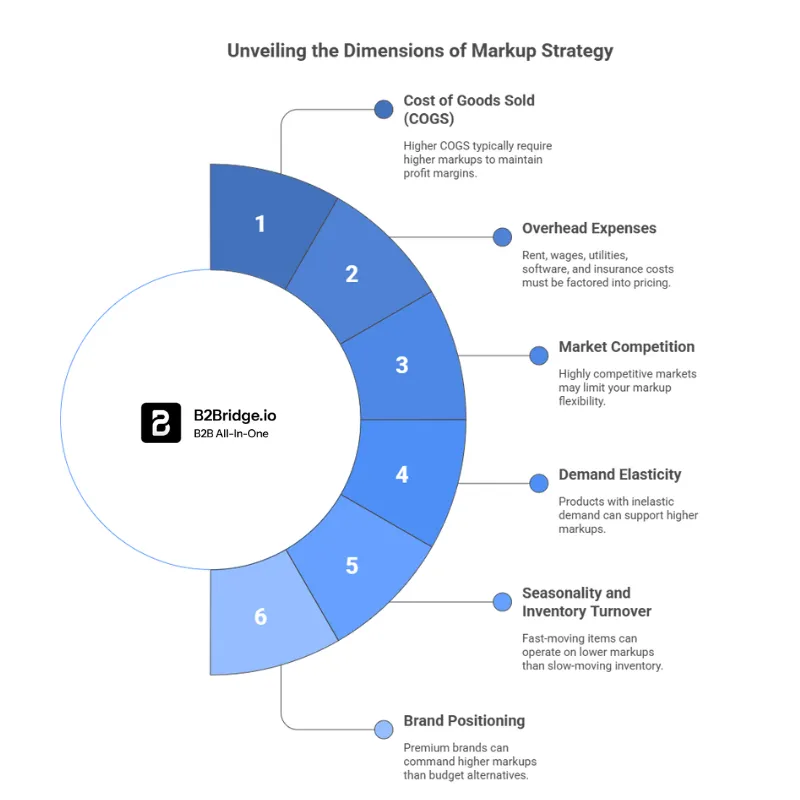
Cost-plus pricing vs dynamic pricing
Dynamic pricing adjusts in real time based on demand, inventory levels, and competitor activity. Cost-plus pricing remains static regardless of market conditions.

Cost-plus pricing in B2B and wholesale
Cost-plus pricing is especially common in wholesale and B2B contexts. Business buyers expect transparency, and cost-based pricing provides it.
That said, B2B pricing rarely stops at a single markup percentage. Most wholesale operations layer cost-plus with additional rules:
- Volume discounts: Larger orders get lower per-unit prices
- Customer-specific pricing: Different markups for distributors, retailers, and VIP accounts
- Contract terms: Negotiated rates for long-term relationships
- Net payment terms: Extended payment windows (Net 30, Net 60) that affect effective pricing
The base price might follow cost-plus logic, but the final price a specific buyer sees often reflects their relationship, order history, and negotiated terms.
Common mistakes with cost-plus pricing
- Underestimating overhead: Forgetting to allocate rent, utilities, insurance, and administrative costs leads to prices that don’t actually cover expenses. A clear overhead cost calculation method prevents this.
- Using outdated cost data: Material costs change, labor rates shift—if your pricing formula uses last year’s numbers, your margins are probably wrong
- Ignoring market shifts: Competitors may adjust faster than you, and a cost-plus price that worked six months ago might be uncompetitive today
- Applying a single markup to all products: Some products warrant higher margins while others need lower prices to move
- Not revisiting markup regularly: Costs and competitive dynamics drift over time, so annual pricing reviews are the minimum
Applying cost-plus pricing in Shopify and your ERP
For ecommerce merchants and wholesalers, operationalizing cost-plus pricing means keeping cost data accurate and price lists updated across systems.
- Sync cost data from ERP: When production costs change, your Shopify prices can update automatically through integration
- Automate price list updates: Manual updates introduce errors and delays, while automation keeps pricing current
- Apply markup rules by customer group: Different B2B buyers can see different markups based on their tier or relationship
- Hide B2B prices from B2C shoppers: Maintain dual pricing logic on a single store without exposing wholesale rates
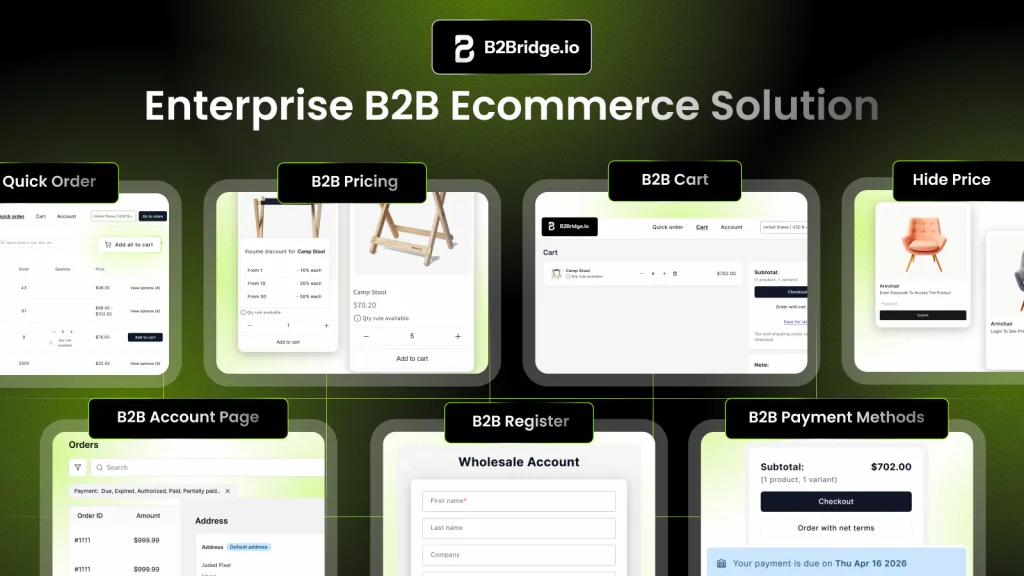
B2Bridge connects Shopify to ERPs like NetSuite, Zoho, and Odoo, keeping pricing aligned across systems. Customer-group pricing, volume tiers, and automated price list management reduce the manual work that makes cost-plus pricing operationally painful.
FAQs about cost-plus pricing
What is cost-plus fee pricing?
Cost-plus fee pricing is a variation where the seller is reimbursed for actual costs plus an agreed-upon fee (either fixed or percentage-based). It’s commonly used in government and construction contracts where costs are difficult to estimate upfront.
What is a typical markup percentage in wholesale?
Markup percentages vary widely by industry. Wholesale markups generally run lower than retail—often 15%–50%—because B2B buyers purchase in volume and expect room for their own margins.
Is cost-plus pricing the same as markup pricing?
Yes. Cost-plus pricing and markup pricing are used interchangeably. Both refer to adding a fixed percentage to cost to determine selling price.
Can cost-plus pricing be automated in ecommerce?
Yes. B2B ecommerce platforms and ERP integrations can automate cost-plus calculations by syncing cost data and applying markup rules to price lists automatically.
Contact us to get expert guidance on implementing cost-plus pricing in your wholesale operation.

As a Product Marketing Executive at B2Bridge, I focus on the Enterprise B2B Ecommerce domain. I leverage my understanding of product and user psychology to deliver customer-centric content that addresses business challenges and fuels growth.