Custom pricing in B2B sales is a strategy where prices are tailored specifically for individual customers, accounts, or buyer groups based on negotiated terms, order volume, and business relationships. Unlike consumer personalized pricing that uses AI to predict willingness to pay, B2B custom pricing is contract-driven and built on actual agreements between businesses.
This guide covers how custom pricing works in practice, how it compares to dynamic and tiered pricing models, and the steps to implement it on your ecommerce storefront without creating operational chaos.
>> See more: Best Shopify Custom Pricing Apps for B2B Merchants in 2026
What Is Custom Pricing in B2B Sales
Custom pricing is a strategy where the price of a product gets tailored specifically for an individual customer, account, or buyer group. In B2B sales, that tailoring happens based on negotiated terms, order volume, and the business relationship between seller and buyer.
You might be thinking: isn’t that the same as personalized pricing? Not quite. Consumer-facing personalized pricing uses AI to analyze browsing history, location, and device type to predict what someone will pay. B2B custom pricing works differently. It’s relationship-driven and contract-based, built on actual agreements between businesses rather than algorithmic guesses.
A few terms worth knowing upfront:
- Price lists: Predefined catalogs of prices assigned to specific customer groups or individual accounts
- Customer groups: Segments like distributors, wholesalers, retailers, or VIP buyers who share common pricing rules
- Contract pricing: Fixed rates locked in by agreement for a specific period or volume commitment
This approach is standard in wholesale, manufacturing, and distribution. A one-size-fits-all price rarely reflects how business buyers actually purchase.

How Custom Pricing Works in B2B Ecommerce
Setting up custom pricing connects your customer data, pricing logic, and storefront experience into one workflow. Here’s how the process typically flows.
Step 1. Segment customers into groups and accounts
Start by organizing buyers into meaningful categories. You might group them by type (distributor vs. retailer), relationship tier (Gold, Silver, Bronze), or geography. In Shopify, this often means applying customer tags or assigning accounts to specific groups in your B2B app or CRM.
Step 2. Build tailored price lists and contracts
Next, create separate price lists for each segment. Price lists can include fixed wholesale prices, percentage discounts off retail, or negotiated contract rates for specific SKUs. The goal is to reflect the actual terms you’ve agreed to with each buyer type.
Step 3. Apply order rules like MOQ and volume tiers
Custom pricing often layers on additional rules. Minimum order quantities (MOQs) ensure buyers meet a threshold before accessing wholesale rates. Volume tiers reward larger purchases with deeper discounts. Quantity increments enforce case packs or pallet quantities.
Step 4. Sync pricing across ERP, CRM, and storefront
If you manage pricing in an ERP like NetSuite, Zoho, or Odoo, that data can flow automatically to your storefront through B2B ecommerce integration. Without sync, you risk showing outdated prices or creating mismatches between what sales reps quote and what buyers see online.
Step 5. Approve and deliver quotes to buyers
For large or complex orders, many B2B sellers use quote-to-order workflows. A buyer submits a request for quote (RFQ), your team reviews and adjusts pricing if needed, and the approved quote converts directly into an order.
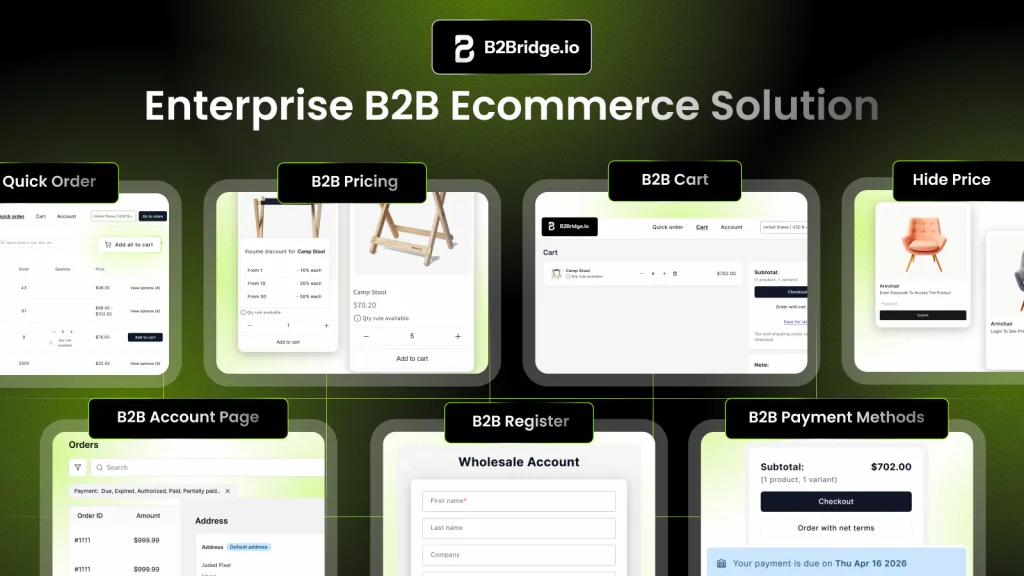
>> Try B2Bridge B2B wholesale app for free!
Custom Pricing vs Dynamic Pricing vs Tiered Pricing vs Contract Pricing
Custom pricing is one of several pricing models in B2B. Understanding how they differ helps you choose the right approach for each buyer relationship.
| Pricing Type | How It Works | Best For |
|---|---|---|
| Custom Pricing | Unique prices per account or group | Negotiated wholesale relationships |
| Dynamic Pricing | Real-time price changes based on demand or inventory | Commodities, perishable goods |
| Tiered/Volume Pricing | Price decreases as quantity increases | Encouraging larger orders |
| Contract Pricing | Fixed prices locked by agreement | Long-term distributor deals |
Dynamic pricing
Dynamic pricing adjusts in real time based on factors like demand, inventory levels, or competitor pricing. It’s common in travel and commodities but less typical in B2B wholesale, where buyers expect price stability.
Tiered and volume pricing
Tiered pricing offers quantity-based discounts. Buy more, pay less per unit. This model often works alongside custom pricing, giving wholesale buyers additional incentives to increase order size.

Contract pricing
Contract pricing locks in specific rates for a defined period or volume commitment. It’s a subset of custom pricing, typically used for long-term distributor agreements where both parties want predictability.
Personalized and account-specific pricing
Account-specific pricing assigns unique prices to individual customer accounts based on negotiated terms, not AI or browsing behavior. This is the most granular form of B2B custom pricing.
Common Examples of Custom Pricing in B2B
Seeing custom pricing in action makes the concept concrete. Here are scenarios you’ll recognize if you sell wholesale.
Negotiated distributor rates
A manufacturer offers a specific distributor a locked-in wholesale rate based on annual volume commitments. The distributor sees their negotiated price when logged in, while other buyers see standard wholesale or retail pricing.
Volume discount tiers for VIP wholesalers
Gold-tier buyers automatically receive deeper discounts than Silver-tier buyers on the same products. The pricing engine applies the correct tier based on the customer’s group assignment without manual intervention.
Customer-specific catalogs with hidden wholesale prices
Logged-in B2B buyers see their custom prices on product pages and in the cart. Retail visitors or unapproved accounts see standard pricing, or no price at all until they register and get approved.
Quote-to-order pricing for enterprise buyers
Large buyers submit RFQs directly from the storefront. Your team reviews the request, adjusts pricing if needed, and sends back a quote. Once approved, the quote converts to an order with all terms locked in.

Benefits of Custom Pricing for Wholesale Sellers
Custom pricing directly impacts revenue, relationships, and operational efficiency.
- Larger average order values: Volume-based custom pricing incentivizes bulk purchases
- Stronger buyer relationships: Negotiated rates reward loyalty and long-term partnerships
- Competitive differentiation: Pricing flexibility lets you win deals that fixed-price competitors cannot match
- Reduced pricing errors: Automated price list assignment eliminates manual quote adjustments
- Faster purchasing decisions: Transparent, personalized pricing reduces back-and-forth negotiation
The outcome: buyers trust that they’re getting their agreed rate, and your team spends less time on manual pricing work.
Challenges and Risks of Custom Pricing
Custom pricing introduces complexity. Without the right systems and governance, it can create more problems than it solves.
- Pricing complexity: Managing multiple price lists across customer groups increases admin overhead
- Inconsistent pricing across channels: Without ERP sync, prices may differ between sales reps and storefront
- Margin erosion: Poorly governed discounting can undercut profitability over time
- Buyer confusion: If pricing isn’t transparent at checkout, buyers may abandon carts
- Approval bottlenecks: Custom discounts without workflows can slow order processing
The key is building guardrails through approval workflows, regular audits, and centralized pricing management.
How to Implement Custom Pricing in B2B Ecommerce
If you’re ready to set up custom pricing on your storefront, here’s a practical path forward.
1. Define customer groups and eligibility rules
Set clear criteria for who qualifies for each pricing tier. Use B2B registration forms to capture business credentials like tax IDs, resale certificates, or company size. Then route approved buyers into the right group automatically.
2. Configure price lists and volume rules
Build price lists for each group with the rates, discounts, and rules that apply. Add volume tiers, MOQs, and quantity increments where they make sense for your products and packaging.
3. Connect ERP and CRM data
Sync customer groups, price lists, and orders with systems like NetSuite, Zoho, or Odoo. This creates a single source of truth and prevents pricing mismatches between your backend and storefront.
4. Add net payment terms and RFQ workflows
Enable Net 30/60 terms for approved buyers who expect to pay on invoice. For enterprise accounts, add RFQ functionality so they can request quotes and convert approved quotes to orders.
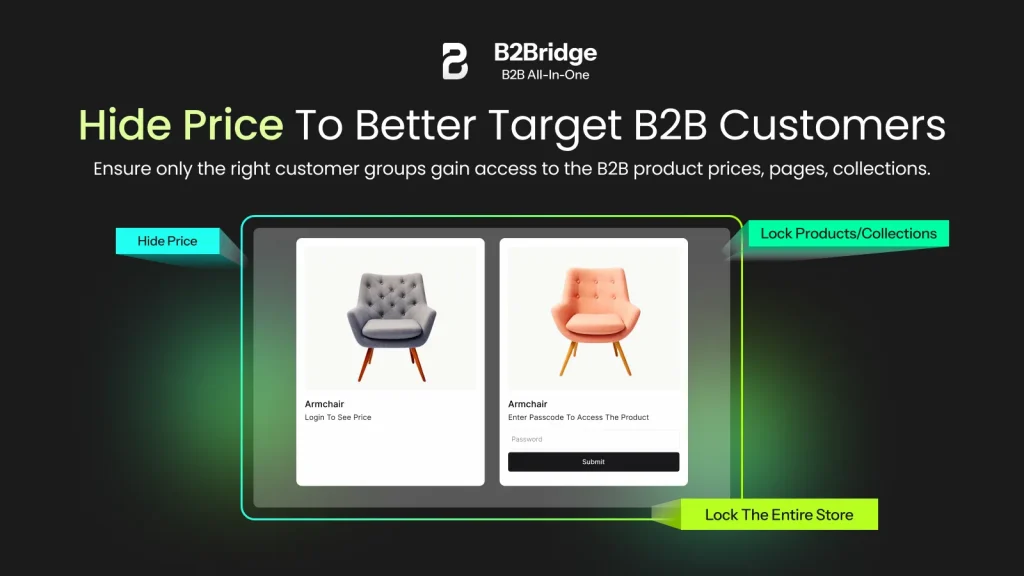
5. Lock wholesale pricing from retail shoppers
Use access controls to hide B2B prices from logged-out visitors or B2C customers. This protects your margins and creates an incentive for business buyers to register.
Best Practices for Managing Custom Pricing Responsibly
Custom pricing works best when it’s governed, not ad hoc. A few practices that keep things running smoothly:
- Use approval workflows: Require manager sign-off for discounts beyond set thresholds
- Audit price lists regularly: Review for outdated rates or margin-eroding discounts quarterly
- Centralize pricing in your ERP: Manage price lists in one system and sync to your storefront
- Communicate pricing clearly: Show custom prices on product pages for logged-in B2B buyers
- Segment strategically: Avoid over-segmentation that creates admin burden without revenue lift
The goal is to give your team flexibility while maintaining control over margins and consistency.
Scaling Custom Pricing on Shopify With B2Bridge
If you’re running on Shopify and want enterprise-grade custom pricing without migrating to Shopify Plus or building custom code, B2Bridge makes it straightforward.
Here’s what B2Bridge puts in your corner:
- B2B Pricing Engine: Unlimited price lists, customer-group pricing, volume tiers, and variant-level pricing managed from your Shopify admin
- ERP and CRM integration: Sync pricing, customers, and orders with NetSuite, Zoho, Odoo, or custom systems via enterprise API
- B2B Lock: Hide wholesale prices from retail visitors and competitors
- B2B Registration: Capture business credentials and auto-assign approved buyers to the right pricing groups
- Quote-to-order workflows: Let buyers submit RFQs and convert approved quotes directly to orders
The result: wholesale businesses using B2Bridge run custom pricing at scale while cutting manual order processing and pricing errors.
Frequently Asked Questions About Custom Pricing
Is personalized pricing legal in B2B sales?
Yes. B2B custom pricing based on negotiated contracts, volume commitments, or customer segments is legal and standard practice in wholesale commerce. Unlike discriminatory consumer pricing, B2B pricing reflects business agreements between parties.
What are the four main types of pricing strategy?
The four main types are cost-plus pricing, competitive pricing, value-based pricing, and dynamic pricing. Custom pricing in B2B typically combines elements of value-based and contract-based approaches.
What is the difference between custom pricing and negotiated pricing?
Negotiated pricing is a subset of custom pricing where rates are set through direct buyer-seller discussion. Custom pricing also includes automated rules like volume tiers or customer-group discounts that don’t require negotiation.
Can you offer custom pricing on Shopify without Shopify Plus?
Yes. Apps like B2Bridge enable full custom pricing functionality, including price lists, customer groups, volume discounts, and hidden wholesale pricing, on any Shopify plan without requiring Shopify Plus.

As a Product Marketing Executive at B2Bridge, I focus on the Enterprise B2B Ecommerce domain. I leverage my understanding of product and user psychology to deliver customer-centric content that addresses business challenges and fuels growth.