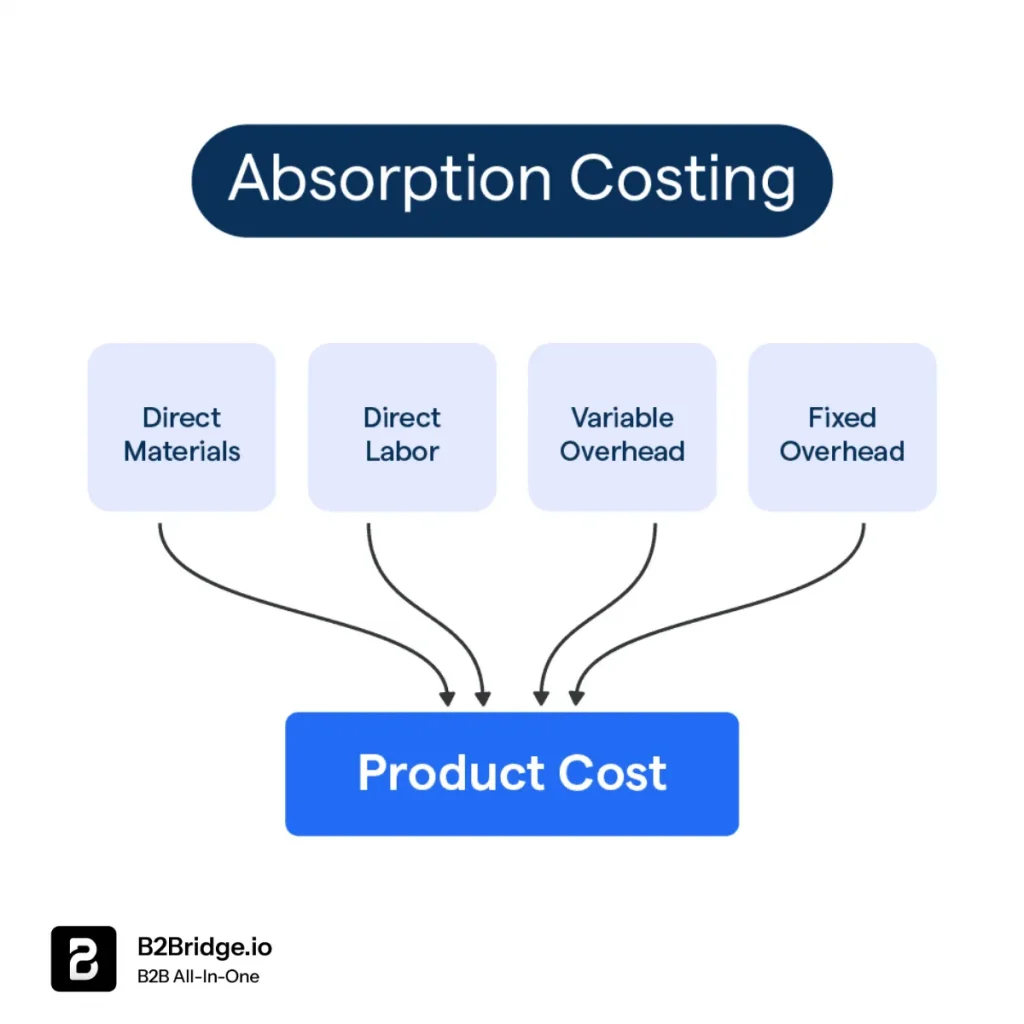
Absorption costing is a managerial accounting method that assigns all manufacturing costs—direct materials, direct labor, variable overhead, and fixed overhead—to each unit produced. It’s required under GAAP and IFRS for external financial reporting because it matches production costs with the period when related revenue is recognized.
Get the calculation wrong, and you either overvalue inventory or misrepresent profitability to stakeholders, leading to what Keiter CPA calls significant financial misstatements. This guide covers the formula, step-by-step calculation process, a worked example, and how absorption costing compares to variable costing for different business decisions.
What is absorption costing
Absorption costing is a managerial accounting method that assigns all manufacturing costs—direct materials, direct labor, variable overhead, and fixed overhead—to each unit produced. You might also hear it called full costing or full absorption costing. GAAP and IFRS require this method for external financial reporting because it matches production costs with the period when related revenue is recognized.
The key idea here is that every expense tied to production gets “absorbed” into inventory value. So if you make 1,000 widgets but only sell 800, the costs for those 200 unsold widgets stay on your balance sheet rather than hitting your income statement right away.
- Full cost allocation: All production costs flow into inventory
- GAAP compliance: Required for external financial statements and tax reporting
- Inventory impact: Fixed overhead stays on the balance sheet until units sell

How absorption costing works
The process follows a straightforward flow. First, you gather all manufacturing expenses for a period—essentially the cost of goods manufactured—everything from raw materials to factory rent. Then you spread those costs across all units produced during that period. Finally, costs move from inventory to cost of goods sold (COGS) on the income statement only when units actually sell.
This timing matters more than you might expect. If you produce 1,000 units but only sell 800, the costs tied to those 200 unsold units remain in inventory. They won’t appear as expenses until those units eventually sell.
Key cost components in absorption costing
Absorption costing captures four categories of manufacturing costs—with overhead alone representing 20–40% of total production expenses. Getting each component right helps you calculate accurate unit costs and avoid underpricing your products.
Direct materials
Direct materials are the raw materials that become part of the finished product and can be traced directly to specific units. For a furniture manufacturer, that’s the wood, fabric, and hardware. For a food producer, it’s the ingredients that go into each package.
Direct labor
Direct labor includes wages paid to workers who physically manufacture the product. The key distinction is traceability—if you can tie the labor hours directly to production activity, it counts as direct labor. Assembly line workers and machine operators typically fall into this category.
Variable manufacturing overhead
Variable overhead covers indirect production costs that fluctuate with output volume. Utilities, production supplies, and equipment maintenance typically fall here. Produce more units, and these costs rise proportionally. Produce fewer, and they drop.
Fixed manufacturing overhead
Fixed overhead includes indirect production costs that remain constant regardless of how many units you produce. Factory rent, equipment depreciation, and salaried supervisors are common examples.
This last component is what distinguishes absorption costing from variable costing. Under absorption costing, fixed overhead gets allocated to each unit rather than expensed immediately.
| Cost Component | Examples | Behavior |
|---|---|---|
| Direct materials | Raw goods, components | Variable |
| Direct labor | Production wages | Variable |
| Variable overhead | Utilities, supplies | Variable |
| Fixed overhead | Rent, depreciation, salaries | Fixed |
Absorption costing formula
The core formula combines all four cost components:
Absorption Cost per Unit = (Direct Materials + Direct Labor + Variable Manufacturing Overhead + Fixed Manufacturing Overhead) ÷ Total Units Produced
Each input represents actual costs incurred during the production period. The fixed overhead allocation is where most of the complexity lives—you’re spreading costs that don’t change with volume across units that do.
Here’s a quick example of how that plays out. If your factory rent is $10,000 per month and you produce 5,000 units, each unit absorbs $2 of that rent. Produce 10,000 units instead, and each unit absorbs only $1. Same rent, different per-unit cost.
How to calculate absorption costing
Step 1. Total all manufacturing costs
Add up all four cost components for the reporting period: direct materials, direct labor, variable manufacturing overhead, and fixed manufacturing overhead. Don’t include selling expenses or administrative costs—those are period costs, not product costs, and they get expensed separately.
Step 2. Allocate overhead to units produced
Divide total manufacturing overhead by the number of units produced. This gives you the overhead cost per unit. The allocation base you choose—whether it’s units, labor hours, or machine hours—affects how costs distribute across products.
Step 3. Assign costs to inventory and COGS
Multiply the per-unit absorption cost by units still in inventory. That amount stays on your balance sheet. Then multiply by units sold—that amount moves to cost of goods sold on your income statement.
>> Try calculating your absorption costing with B2Bridge’s calculator:
Absorption Costing Calculator
Absorption Costing Calculator
Calculate Absorption Cost per Unit using the
formula:
(Direct Materials + Direct Labor + Variable Manufacturing Overhead +
Fixed Manufacturing Overhead) ÷ Number of Units Produced
Tip: Ensure the units produced is greater than 0. Fixed overhead is included in absorption costing and spreads across units produced.
Absorption costing example
Let’s walk through a simple scenario. A manufacturer produces 10,000 units in a month with the following costs:
| Cost Category | Total Cost |
|---|---|
| Direct materials | $50,000 |
| Direct labor | $30,000 |
| Variable overhead | $10,000 |
| Fixed overhead | $20,000 |
| Total manufacturing costs | $110,000 |
Per-unit absorption cost: $110,000 ÷ 10,000 units = $11 per unit
Now suppose the company sells 8,000 units and keeps 2,000 in inventory:
- COGS: 8,000 × $11 = $88,000
- Ending inventory: 2,000 × $11 = $22,000
The $22,000 in inventory includes $4,000 of fixed overhead ($2 per unit × 2,000 units) that won’t hit the income statement until those units sell.
Absorption costing vs variable costing
The fundamental difference comes down to how each method treats fixed manufacturing overhead.
Absorption costing includes fixed overhead in product costs, so it gets capitalized in inventory. Variable costing treats fixed overhead as a period expense, meaning it hits the income statement immediately regardless of how many units sell.
| Factor | Absorption Costing | Variable Costing |
|---|---|---|
| Fixed overhead treatment | Allocated to units | Expensed immediately |
| Required for GAAP | Yes | No |
| Best use case | External reporting | Internal decisions |
| Inventory value | Higher | Lower |
| Profit when inventory rises | Higher net income | Lower net income |
Here’s the practical implication: if you build inventory—whether to meet minimum order quantities or to lower per-unit costs—absorption costing reports higher profits because fixed costs stay “trapped” in inventory. Variable costing shows lower profits in the same scenario because those fixed costs expense right away.
When to use absorption costing
External financial reporting
GAAP and IFRS require absorption costing for published financial statements. Investors, lenders, and regulators expect to see inventory valued with full production costs included.
Tax compliance
Tax authorities typically require absorption costing for inventory valuation. The timing of when costs hit your income statement affects taxable income, so the method you use matters for tax planning.
Inventory valuation
When you want a complete picture of what inventory is worth—including the share of fixed overhead each unit carries—absorption costing delivers that view. Balance sheet accuracy depends on capturing all production costs in inventory value.
Full product cost visibility
For pricing decisions, especially in B2B and wholesale contexts, knowing the true total cost of manufacturing helps you calculate markup and set prices that actually cover all expenses. If you’re managing customer-specific price lists or volume discounts, starting with accurate absorption costs prevents margin erosion.
Pros and cons of absorption costing
Advantages of absorption costing
- GAAP and IFRS compliance: Meets external reporting requirements without adjustments
- Complete cost picture: Captures all manufacturing costs in product valuation
- Matches costs to revenue: Expenses align with the period when related sales occur
- Pricing foundation: Provides a baseline for setting prices that cover full costs
Disadvantages of absorption costing
- Can distort profitability: Building inventory increases reported profit even without additional sales
- Less useful for short-term decisions: Fixed cost allocation can mislead make-vs-buy or special order analysis
- Overhead allocation challenges: Choosing an allocation base involves judgment and can skew unit costs
- Hides cost behavior: Blending fixed and variable costs obscures how costs change with volume
Common absorption costing mistakes to avoid
Misallocating fixed overhead
Using an inappropriate allocation base—like direct labor hours when production is highly automated—skews unit costs. If your factory runs mostly on machines, machine hours might be a better allocation base than labor hours. The goal is to pick a base that reflects how overhead actually gets consumed.
Ignoring idle capacity
When production runs below normal capacity, spreading fixed overhead across fewer units inflates per-unit costs. Some companies use “normal” capacity—required under ASC 330—rather than actual production to normalize overhead allocation and avoid penalizing slow periods.
Disconnecting cost data from pricing systems
Accurate absorption costs don’t help if they never reach the systems where pricing decisions happen. For B2B merchants managing multiple customer groups and volume tiers, ensuring cost data flows into pricing tools prevents margin erosion across wholesale accounts.
Applying absorption costing to wholesale and B2B pricing
Knowing full product costs through absorption costing helps manufacturers and distributors set profitable wholesale prices. When you know exactly what each unit costs—including its share of fixed overhead—you can build price lists that protect wholesale profit margins across different customer segments.
This becomes especially important for businesses managing tiered pricing, volume discounts, and customer-specific rates. If your absorption cost is $11 per unit, you know that any wholesale price below that threshold loses money before you even factor in selling expenses.
B2B merchants on Shopify often use pricing apps to translate accurate product costs into customer-group price lists, ensuring that volume discounts and negotiated rates still cover full production costs.
How B2Bridge Simplifies Wholesale Costing and Pricing on Shopify
For businesses selling through wholesale channels, accurate product costing becomes even more critical as pricing strategies must account for different customer segments and volume requirements. B2Bridge transforms how Shopify merchants manage their wholesale operations by providing sophisticated tools that complement absorption costing methodologies.
Simplify wholesale management: Run B2B as easily as B2C with B2Bridge’s all-in-one wholesale tools that integrate seamlessly with your existing cost accounting processes. The platform automatically applies your calculated absorption costs to different customer tiers, ensuring consistent pricing across all channels.
Protect your pricing: Hide wholesale prices from retail shoppers and show the right price to the right customer based on your absorption costing calculations. B2Bridge’s tiered pricing system allows you to implement cost-plus pricing strategies that reflect your true manufacturing costs while maintaining appropriate margins for different customer segments.
Frequently asked questions about absorption costing
Does GAAP require absorption costing?
Yes. U.S. GAAP requires absorption costing for external financial reporting because it matches production costs with the period in which related revenue is recognized. IFRS follows the same principle.
What are the four main methods of costing?
The four common methods are absorption costing, variable costing, activity-based costing, and job order costing. Each suits different production environments and reporting needs.
Is absorption costing the same as full costing?
Yes. Absorption costing is also called full costing or full absorption costing because it includes all manufacturing costs—both variable and fixed—in product valuation.
How does absorption costing affect net income?
When inventory levels rise, absorption costing reports higher net income because fixed overhead stays in inventory rather than expensing immediately. When inventory decreases, the reverse occurs—previously capitalized fixed costs flow to COGS, reducing reported profit.
Can absorption costing be used for internal decision-making?
It can, though variable costing is often preferred for internal analysis. Variable costing separates fixed and variable costs, making contribution margin and break-even calculations clearer for short-term decisions.

Hi, I’m Ha My Phan – an ever-curious digital marketer crafting growth strategies for Shopify apps since 2018. I blend language, logic, and user insight to make things convert. Strategy is my second nature. Learning is my habit. And building things that actually work for people? That’s my favorite kind of win.