Markup price is the amount added to a product’s cost to set its selling price—calculated as a percentage of the cost rather than the selling price. Get the formula wrong, and you either underprice yourself into losses or overprice yourself out of deals.
This guide covers the core markup formula, step-by-step calculations, real examples at different markup levels, and how B2B operations apply markup across customer groups and volume tiers.
What Is Markup Price
Markup price is the amount added to the cost of a product to determine its selling price. The purpose is straightforward: cover your expenses—materials, labor, overhead—and generate profit on every sale. Most businesses express markup as a percentage of the cost price rather than a flat dollar amount.
When someone says they use a “50% markup,” they mean they add half of their cost on top of the original cost. So a product that costs $20 to produce would sell for $30. The markup covers what you spent and leaves room for profit.
- Definition: The percentage added to cost to set the selling price
- Purpose: Recovers production costs and operating expenses while generating profit
- Expression: Usually shown as a percentage of cost, not selling price

Markup Price Formula
The core formula for calculating markup percentage is:
Markup % = ((Selling Price – Cost Price) / Cost Price) × 100
Cost price includes everything you spend to acquire or produce the product. Selling price is what the buyer pays. The difference between them—your gross profit—gets divided by cost to show how much you’ve added relative to what you spent.
You can also express markup as a multiplier. A 50% markup means multiplying your cost by 1.5. A 100% markup means multiplying by 2. This multiplier approach makes quick calculations easier when you’re pricing on the fly.
How to Calculate Markup Price
Step 1. Determine the cost price
Start by identifying every production cost that goes into one unit of your product. This includes raw materials, manufacturing labor, packaging, and inbound shipping to your warehouse. Track actual costs rather than estimates, because small oversights compound quickly across large orders.
Step 2. Choose the markup percentage
Your markup percentage depends on your industry, competitive landscape, and profit goals. Apparel wholesalers often work with higher markups, while electronics distributors typically run lower. The right number balances profitability with what the market will bear.
Step 3. Apply the markup formula
Multiply your cost price by (1 + your markup percentage as a decimal). If your cost is $40 and you want a 25% markup, the calculation looks like this: $40 × 1.25 = $50 selling price.
Step 4. Set the final selling price
Round your calculated price to a clean number if needed, then check it against competitor pricing. If you’re significantly higher, revisit your costs or accept a lower margin. If you’re lower, you might be leaving money on the table.
How to Calculate Selling Price From Cost and Markup
When you know your cost and desired markup, finding the selling price is a single calculation:
Selling Price = Cost Price × (1 + Markup Percentage)
Say your product costs $60 to produce and you want a 40% markup. The math: $60 × 1.40 = $84 selling price. This formula works whether you’re pricing one SKU or building a price list for thousands of products.
How to Calculate Cost Price From Selling Price and Markup
Sometimes you work backward—maybe you’re analyzing a competitor’s pricing or reverse-engineering a target price point. The formula flips:
Cost Price = Selling Price / (1 + Markup Percentage)
If a competitor sells a similar product for $75 and you estimate they’re using a 50% markup, their cost would be: $75 / 1.50 = $50. This insight helps you understand whether you can compete on price or whether you’re working with a cost disadvantage.
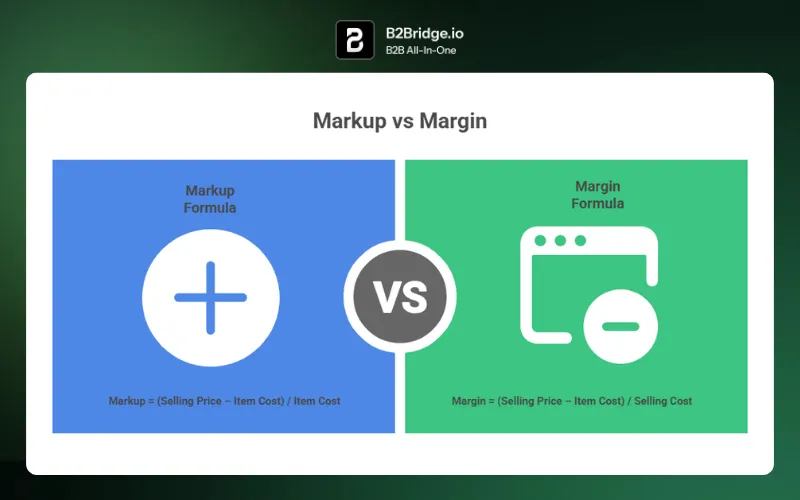
Markup vs Margin
Markup and margin get confused constantly, but they measure different things. Markup is profit relative to cost. Profit margin is profit relative to selling price.
| Metric | Formula | Base |
|---|---|---|
| Markup | (Profit / Cost) × 100 | Cost price |
| Margin | (Profit / Selling Price) × 100 | Selling price |
Here’s why the distinction matters. A product that costs $60 and sells for $100 has a $40 profit. The markup is 66.7% ($40 / $60), but the margin is only 40% ($40 / $100). Same transaction, very different percentages. Confusing the two leads to pricing errors that quietly erode profitability.
Markup Price Examples
20% markup example
A product costs $50 to produce. With a 20% markup: $50 × 1.20 = $60 selling price. Your gross profit is $10 per unit.
30% markup example
A product costs $80. With a 30% markup: $80 × 1.30 = $104 selling price. Your gross profit is $24 per unit.
50% markup example
A product costs $40. With a 50% markup: $40 × 1.50 = $60 selling price. This markup level is common across many retail and wholesale categories.
100% markup example (keystone pricing)
A product costs $25. With a 100% markup: $25 × 2.00 = $50 selling price. This keystone pricing approach—doubling the cost—is standard practice in fashion, accessories, and general retail.
Average Markup by Industry
Markup percentages vary significantly across industries, driven by factors like competition, perceived value, and operating costs.
Retail and consumer goods
Moderate markups are typical in retail. Keystone pricing remains common for apparel, accessories, and home goods.
Wholesale and distribution
Markups are generally between 5% and 40%, reflecting the volume-based nature of B2B transactions. Relationships and repeat orders matter more than per-unit profit.
Manufacturing
Markups vary widely based on product complexity and customization. Accurately calculating your cost of goods manufactured is critical here, since standard components carry lower markups than engineered-to-order products.
Food and beverage
Higher markups are common, especially for prepared foods and restaurant items where labor and presentation add significant value.
Benefits of Markup Pricing
Markup pricing remains popular because it’s practical and scalable.
- Simplicity: One formula applies across your entire catalog
- Cost recovery: Every sale covers your costs by design
- Consistency: Standardizes pricing decisions across teams and product lines
- Scalability: Easy to adjust when costs change or when expanding into new markets
When to Use Markup Pricing
Markup pricing works best in specific scenarios:
- Stable cost structures: When your production costs are predictable month to month
- Large product catalogs: When you’re pricing hundreds or thousands of SKUs and consistency matters
- Wholesale and B2B: When you’re setting different prices for different customer groups or volume tiers
- Cost-plus contracts: When your agreements with buyers are based on transparent cost structures
Factors to Consider When Setting Markup
Cost of goods sold
Include all direct costs: materials, labor, packaging, and inbound freight. Undercounting here means your markup won’t actually cover what you think it covers.
Overhead and operating costs
Fixed costs like rent, utilities, salaries, and software subscriptions don’t show up in cost of goods sold but still affect profitability. An absorption costing approach allocates a portion of that overhead into your per-unit cost so your markup calculation covers the full picture.
Market conditions and competition
Competitive pressure may limit how high your markup can go. If similar products sell for less, you’ll either reduce costs, accept lower margins, or differentiate on value.
Customer segment and sales channel
B2B buyers expect different pricing than retail customers. Wholesale markups are typically lower than direct-to-consumer markups because order volumes are higher and acquisition costs are lower.
Common Mistakes With Markup Pricing
- Confusing markup with margin: Mixing up the two leads to pricing errors that can mean a 15–20% loss in expected profitability
- Ignoring overhead costs: Pricing based only on direct costs leaves you short when rent and salaries come due
- Applying flat markup across all products: Some products face more competition or have different demand elasticity
- Not reviewing markup regularly: Costs shift with inflation—U.S. CPI rose 3.3% year-over-year in early 2026—supplier changes, and supply chain disruptions
How to Apply Markup Pricing in Wholesale and B2B
B2B pricing adds complexity because you’re often serving multiple buyer types with different expectations and order patterns.
Customer group price lists
Assigning different markups to different buyer segments—distributors versus retailers versus VIP accounts—is standard practice. A price list defines which markup or price each customer group sees.

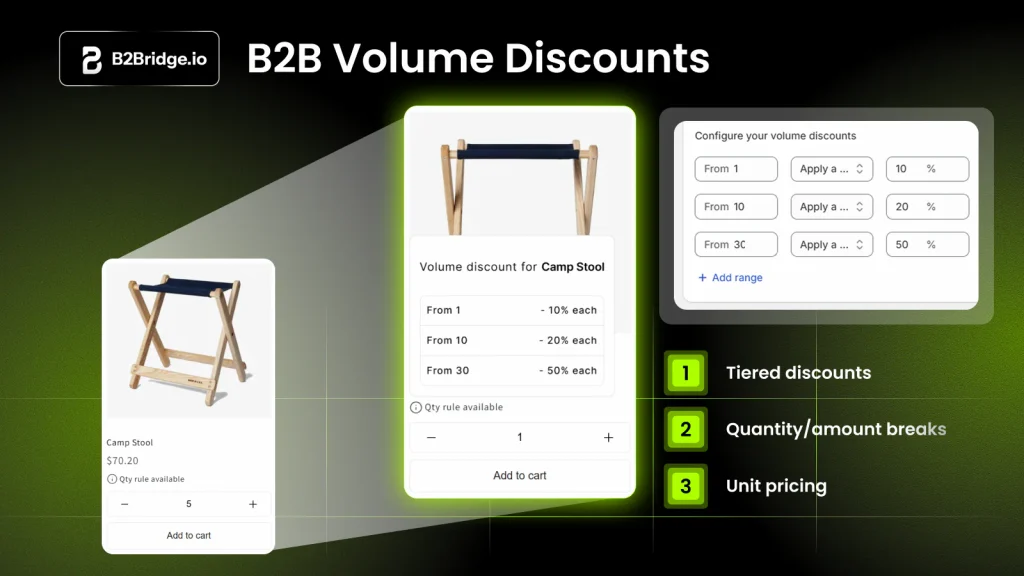
Volume and tiered markup rules
Markup often decreases as order quantity increases. A buyer ordering 100 units might see a 40% markup, while someone ordering 1,000 units sees 25%. Volume discount tiers incentivize larger orders.
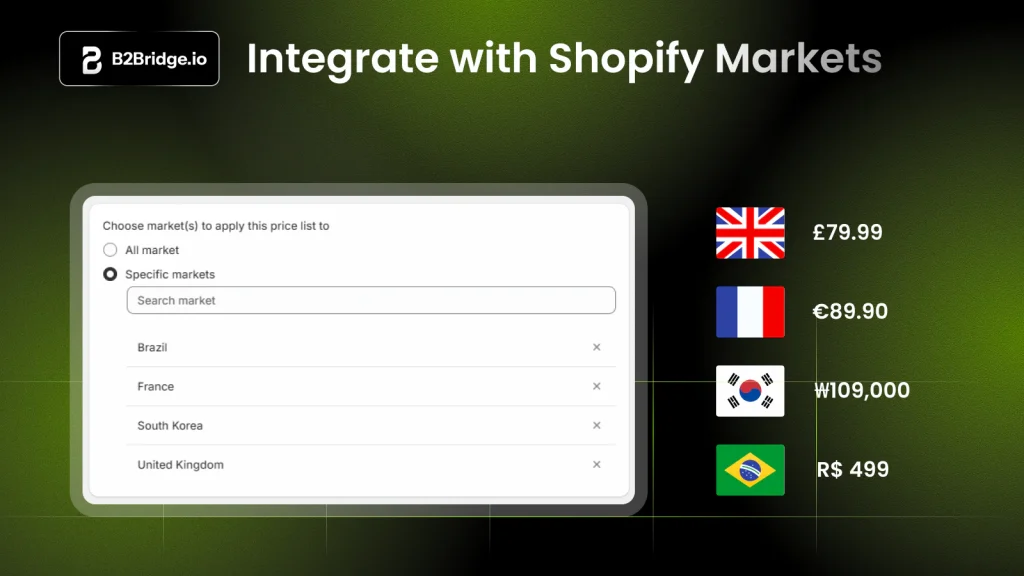
Multi-currency wholesale markup
When selling B2B internationally, markup calculations get more complex. Currency conversion, regional pricing expectations, and local competition all factor in.
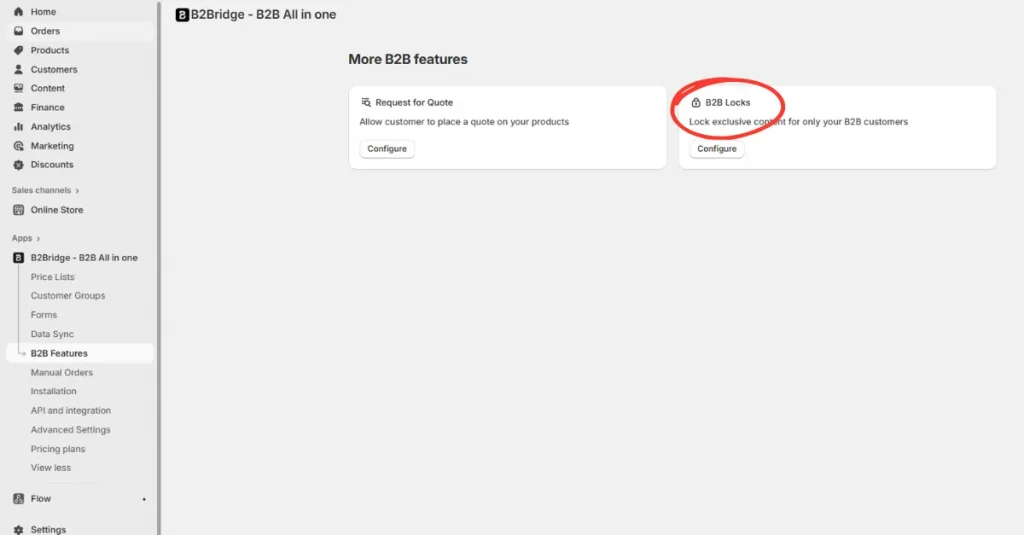
Hiding B2B markup from retail buyers
When you run a dual pricing setup with both B2C and B2B on the same store, wholesale prices stay hidden from retail shoppers. Access control—login-only pricing, gated catalogs—prevents channel conflict.
Scaling Markup Pricing With a Shopify B2B App
Managing multiple price lists, customer-specific markups, and volume rules manually is error-prone and time-consuming. Spreadsheets work until they don’t—and by then, you’ve already shipped orders at the wrong price.
A B2B pricing app like B2Bridge automates markup rules, syncs with ERP systems, and keeps B2B pricing hidden from B2C shoppers within Shopify.
- Automated price lists: Set markup rules by customer group without manual updates
- Volume pricing: Tiered markup that adjusts automatically with quantity
- Access control: Gate B2B prices so retail visitors never see wholesale rates
- ERP sync: Keep markup consistent across Shopify, NetSuite, Zoho, or custom systems
Contact us to get expert guidance on implementing market-based pricing for your wholesale operations.
FAQs About Markup Price
What does a 30% markup mean?
A 30% markup means the selling price is 30% higher than the cost price. If a product costs $100, a 30% markup sets the selling price at $130.
What is a good markup percentage for wholesale?
There’s no universal answer—it depends on your industry, competition, and operating costs. Wholesale markups are generally lower than retail markups because order volumes are higher and per-transaction costs are lower.
Can markup be more than 100%?
Yes. A markup over 100% means the selling price is more than double the cost. This is common in industries like food service, jewelry, and specialty retail where perceived value or preparation costs justify higher prices.
Is markup pricing the same as cost-plus pricing?
They’re closely related. Cost-plus pricing is a strategy that uses markup as its mechanism—you add a fixed percentage to your cost to determine the selling price. Markup is the calculation; cost-plus is the approach.
How often should markup percentages be reviewed?
Review your markup whenever costs change significantly, when entering new markets, or at regular intervals like quarterly or annually. Costs shift with inflation—U.S. CPI rose 3.3% year-over-year in early 2026—supplier changes, and supply chain disruptions.

Hi, I’m Ha My Phan – an ever-curious digital marketer crafting growth strategies for Shopify apps since 2018. I blend language, logic, and user insight to make things convert. Strategy is my second nature. Learning is my habit. And building things that actually work for people? That’s my favorite kind of win.