Keystone pricing is a cost-based pricing strategy where you double your wholesale cost to set the retail price—a 100% markup that produces a 50% gross margin on every sale. It’s been a retail staple for decades, particularly in jewelry, furniture, and fashion, because the math is simple and the margins are predictable.
But simplicity has limits. This guide covers the keystone formula, when the strategy works, when it falls short, and how B2B operations can move beyond a flat markup to pricing that actually fits how wholesale buyers purchase.
What is keystone pricing
Keystone pricing is a retail pricing strategy where the selling price of an item is set at double its wholesale cost—a 100% markup that produces a 50% gross margin. The name comes from the architectural keystone, the central stone that holds an arch together, because this pricing method has long served as the foundational approach for many retailers.
You’ll find keystone pricing most often in jewelry, furniture, fashion, and specialty retail. In these industries, the 50% margin typically covers rent, staff, marketing, and other operating costs while leaving room for profit. The appeal is simplicity: no complex calculations, no market research, just double your cost and move on.
The keystone pricing formula and how it works
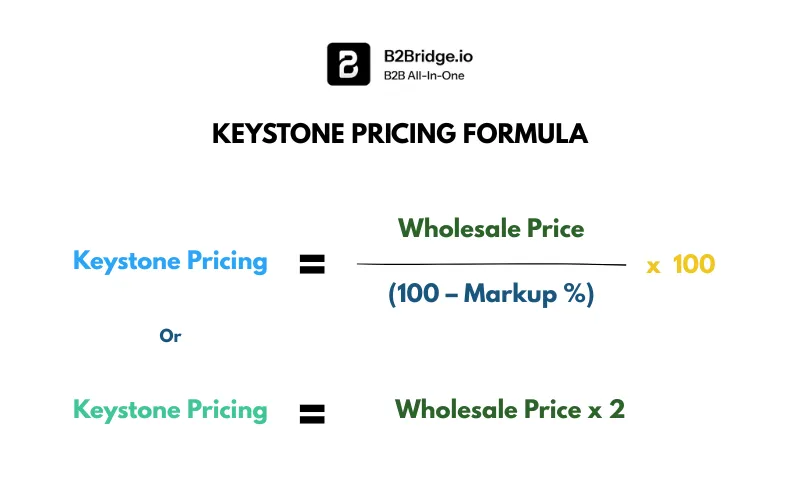
The formula is as simple as it gets: Wholesale Cost × 2 = Retail Price.
Wholesale cost means the total amount you pay to get a product into your hands. This includes the supplier’s price plus shipping, duties, and any handling fees—essentially your cost of goods sold on a per-unit basis. When you double that number, you arrive at your retail price.
- Wholesale cost: The total landed cost to acquire the product
- Retail price: What the end customer pays
- Gross margin: 50% of every sale
The predictability is the main draw here. Every product follows the same rule, so pricing decisions happen fast and margins stay consistent across your entire catalog.
Markup vs margin in keystone pricing
Markup and margin sound similar, but they measure different things—and mixing them up leads to pricing mistakes.
Markup is the percentage added to your cost. Margin is the percentage of your selling price that counts as profit. With keystone pricing, you’re applying a 100% markup, yet your margin is only 50%.
| Term | Formula | Keystone Example |
|---|---|---|
| Markup | (Price − Cost) ÷ Cost | 100% |
| Margin | (Price − Cost) ÷ Price | 50% |
Here’s why this distinction matters: if a buyer asks for a 50% margin, they expect half of the selling price to be profit. If you calculate a 50% markup instead, you’ll end up with roughly a 33% margin. That’s a significant difference when you’re negotiating wholesale deals.

Retail price vs wholesale price
Retail price is what consumers pay at checkout. Wholesale price is what businesses pay when buying products in bulk for resale.
Keystone pricing connects the two. A manufacturer sets the wholesale price, and the retailer doubles it to reach the retail price. This relationship only works when the wholesale price leaves enough room for the retailer’s own markup. Otherwise, the retailer can’t profit, and the partnership breaks down.
In B2B, you might be setting both prices—the wholesale rate for your buyers and the suggested retail price they’ll use downstream. Understanding how the two relate helps you structure deals that work for everyone in the chain.
Keystone pricing example in retail and wholesale
While keystone pricing works extremely well for many product categories, it is not a one-size-fits-all solution. Success depends heavily on the product type, competition level, customer expectations, and perceived value. Below is a practical table with 10 real-world examples, including when the strategy typically succeeds and when it often fails.
| # | Category | Real-World Example | Real Brand Examples | When It Works Well | When It Breaks |
|---|---|---|---|---|---|
| 1 | Apparel / T-shirts | $10 cost → $20 | Many Shopify indie brands, Fashion Nova basics | High-volume basics, strong branding, low return rates | Heavy competition (Shein, Temu), price-sensitive buyers |
| 2 | Jewelry | $150 necklace → $300 | Independent jewelers, Blue Nile (entry lines), Tiffany-inspired boutiques | Emotional & gift purchases, high perceived value | Price comparison tools, counterfeit products |
| 3 | Footwear | $50 shoes → $100 | Allbirds (mid-tier lines), many DTC sneaker brands | Mid-tier fashion sneakers, good product photography | Premium/luxury segments or frequent discount expectations |
| 4 | Home Décor & Gifts | $18 vase/candle → $36 | Etsy sellers, Anthropologie-inspired stores, Candle brands like Yankee Candle partners | Impulse buys, seasonal gifts, Instagram-friendly items | Functional products where customers compare value |
| 5 | Accessories (Bags, Belts) | $50 handbag → $100 | Coach (entry accessories), many Shopify bag stores | Upsell opportunities, bundle offers | High return rates, cheaper fast fashion alternatives |
| 6 | Beauty & Skincare | $12 serum → $24 | The Ordinary (some lines), many DTC beauty Shopify brands | Strong brand story, quality ingredients | Highly competitive market with transparent low-price brands |
| 7 | Kitchenware & Mugs | $9 custom mug → $18 | Printful/Printify POD stores, Starbucks-inspired merch brands | Personalized & print-on-demand gifts | Generic items easily found cheaper on Amazon |
| 8 | Activewear / Sportswear | $25 leggings → $50 | Gymshark (entry items), Lululemon-inspired DTC brands | Lifestyle branding, influencer marketing | Performance buyers comparing technical specifications |
| 9 | Electronics Accessories | $8 phone case → $16 | Many Spigen partners, generic dropshipping stores | Impulse add-ons at checkout, low shipping cost | Low-cost Chinese sellers offering much cheaper options |
| 10 | Novelty & Gift Items | $15 funny hoodie → $30 | Redbubble, Teespring/Spreadshirt sellers | Viral products, holiday seasons, strong social proof | Short-lived trends or when it feels overpriced |
How to set a keystone price step by step
Step 1. Confirm your true landed cost
Start by calculating your actual cost to acquire the product—not just the invoice price. Landed cost includes the product itself plus shipping, duties, handling, and any fees that get it to your warehouse. For manufactured goods, you’ll also want to factor in your production costs. Small oversights here compound across large orders.
Step 2. Apply the 100 percent markup
Multiply your landed cost by two. If your landed cost is $15, your keystone price is $30. This step is intentionally straightforward.
Step 3. Validate against market and competitor prices
Keystone pricing ignores what competitors charge and what customers are willing to pay. Before finalizing, check whether your price is competitive. If you’re significantly higher than similar products, you may want to revisit costs or accept a lower margin. If you’re lower, you might be leaving money on the table.
Step 4. Adjust for customer groups and channels
Different buyers often require different price points. Your retail customers might pay the full keystone price, while your wholesale accounts expect a discount. Many businesses maintain separate price lists for each customer group—a practice that becomes essential as B2B operations scale.
With B2Bridge, you can assign custom price lists to different customer groups automatically, ensuring every buyer sees the right pricing based on their account, market, or wholesale tier.

>> Book a demo
Pros and cons of keystone pricing
Pros of keystone pricing
- Simplicity: Easy to calculate without complex analysis
- Predictable margins: Guarantees consistent gross profit across your catalog
- Quick implementation: Works as a reliable baseline for new products
- Discount flexibility: Creates room for promotions while maintaining profitability
Cons of keystone pricing
- Ignores demand: Does not account for what customers are willing to pay
- Ignores competition: May result in prices higher or lower than market rates
- One-size-fits-all: Assumes all products can support the same markup
- Potential lost revenue: May underprice high-demand items or overprice slow movers
When to use keystone pricing
Keystone pricing fits certain scenarios better than others.
New businesses often use it as a starting point before gathering sales data. High-overhead industries like furniture and jewelry rely on it because the 50% margin covers substantial operating costs. And when you want uniform margins across a product category, keystone pricing keeps things simple.
If you’re launching a new product line and don’t yet have demand data, keystone pricing gives you a defensible starting point. You can always adjust later as you learn what the market will bear.
When to avoid keystone pricing
On the other hand, keystone pricing creates problems in certain situations.
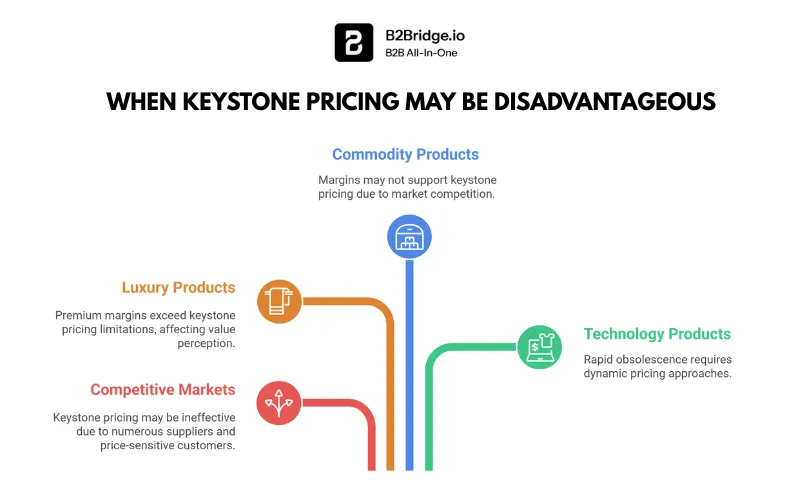
Commoditized products with aggressive competitor pricing rarely support a 100% markup. Low-margin categories like electronics typically run on much thinner margins—NYU Stern data shows general retail averages just 30.9%. B2B wholesale buyers expect tiered pricing and volume discounts, not a flat markup. And in markets where demand and costs fluctuate frequently, a rigid formula can’t keep up.
Keystone pricing vs other pricing strategies
Keystone pricing vs cost plus pricing
Cost-plus pricing adds a variable markup percentage to your total costs—say, 30% or 40%—rather than a fixed 100%. Keystone pricing is technically a specific type of cost-plus approach, just with a predetermined markup. Cost-plus offers more flexibility when different products require different margins.
Keystone pricing vs value based pricing
Value-based pricing sets prices according to perceived customer value rather than cost. A product that solves a significant problem or carries strong brand equity might command a price far above the 2× markup. This approach requires more market research but often captures more revenue on differentiated products.
Keystone pricing vs competitive pricing
Competitive pricing matches or undercuts competitors regardless of your own cost structure. Keystone pricing ignores competitors entirely. In price-sensitive markets, competitive pricing may be necessary—even if it means accepting lower margins.
Keystone pricing vs tiered wholesale pricing
Tiered pricing offers different rates based on order volume or customer groups. A buyer ordering 1,000 units pays less per unit than one ordering 100. This model is standard in B2B, where larger buyers expect discounts that reflect their purchasing power.
| Strategy | Basis for Price | Best For |
|---|---|---|
| Keystone pricing | Fixed 100% markup on cost | Simple retail, quick baseline |
| Cost-plus pricing | Variable markup on cost | Flexible margin targets |
| Value-based pricing | Perceived customer value | Premium products |
| Competitive pricing | Competitor rates | Price-sensitive markets |
| Tiered wholesale pricing | Volume or customer group | B2B and wholesale |

Is keystone pricing still worth it for modern wholesale
The honest answer: it depends on your operation.
For a small retailer or a brand just launching wholesale, doubling your cost is a fast, defensible way to set prices. You don’t need sophisticated tools or deep market analysis to get started.
However, modern wholesale typically demands more flexibility. B2B buyers expect customer-specific pricing, volume discounts, and negotiated terms. They want to see different rates based on their relationship with you, their order size, or their market. A flat 100% markup across the board rarely satisfies those expectations.
Most B2B operations outgrow keystone pricing as they scale—a McKinsey survey found 65–85% plan to adopt AI-driven pricing within three years. The approach works as a starting point—a baseline you can adjust as you gather data and build relationships.
Applying keystone pricing in B2B ecommerce on Shopify
If you’re running wholesale on Shopify, you might start with keystone pricing to establish baseline margins. As your customer base grows, though, you’ll likely find yourself managing multiple price lists, volume tiers, and customer-specific rates.
Shopify’s native tools handle basic pricing, but they weren’t built for B2B complexity. Many merchants end up juggling spreadsheets, manual updates, and workarounds that create operational friction.
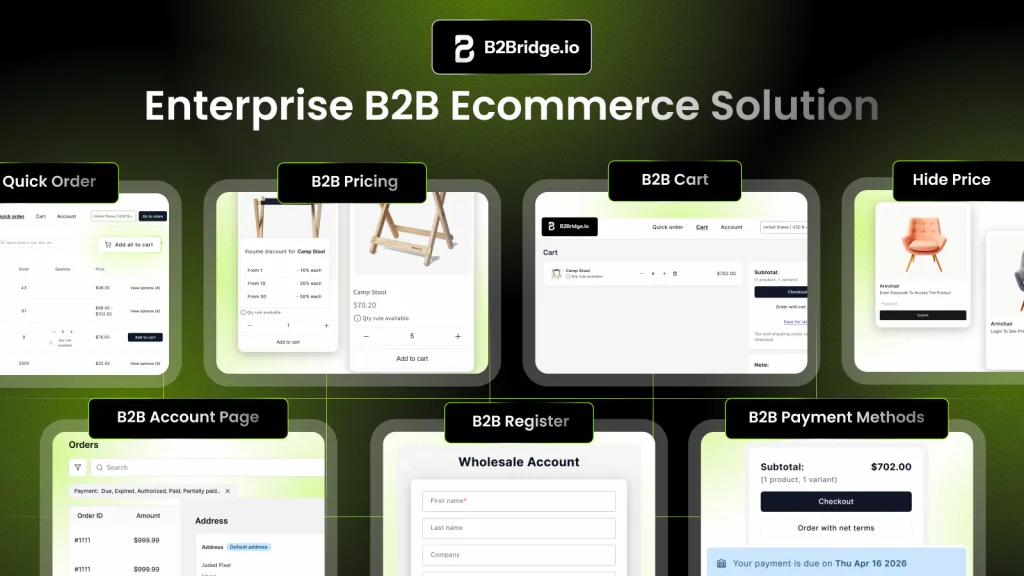
B2Bridge brings enterprise-grade B2B pricing to Shopify without requiring Shopify Plus. You can create customer-group price lists, set volume discounts, enforce minimum order quantities, and hide wholesale prices from retail shoppers—all from your Shopify admin. The platform also syncs with ERPs like NetSuite, Zoho, and Odoo, so your pricing stays aligned across systems.
Frequently asked questions about keystone pricing
What is keystone markup?
Keystone markup is a traditional retail pricing strategy where the selling price is set at double the wholesale cost. For example, if a product costs $50 wholesale, the retail price would be $100. This approach simplifies pricing and typically results in a 50% gross margin for retailers.
What does keystone mean in retail?
In retail, “keystone” refers to a pricing method where the retail price is set at double the wholesale cost. For example, a product bought for $40 would be sold for $80. The term is commonly used to describe a standard 100% markup or roughly a 50% profit margin.
Is keystone pricing the same as a 100 percent markup?
Yes. Keystone pricing specifically refers to doubling the wholesale cost, which equals a 100% markup on the original price.
What industries still use keystone pricing?
Keystone pricing remains common in jewelry, furniture, apparel, and specialty retail—industries where higher markups are standard and operational costs require substantial margins.
Can Shopify merchants apply keystone pricing automatically?
Shopify doesn’t include built-in keystone pricing automation. However, apps like B2Bridge allow merchants to create price lists and apply markup rules across customer groups.
Does keystone pricing work for B2B wholesale customers?
Keystone pricing can serve as a baseline, but most B2B buyers expect tiered pricing, volume discounts, or negotiated rates that require more flexible pricing tools.

Hi, I’m Ha My Phan – an ever-curious digital marketer crafting growth strategies for Shopify apps since 2018. I blend language, logic, and user insight to make things convert. Strategy is my second nature. Learning is my habit. And building things that actually work for people? That’s my favorite kind of win.