Wholesale pricing strategy is how you set prices when selling products in bulk to retailers—typically at 50% or less of the suggested retail price—while maintaining profitability through economies of scale. Get the formula wrong, and you either leave money on the table or price yourself out of deals entirely.
This guide covers the core formulas, calculation steps, and pricing models that help wholesalers protect margins and scale B2B operations.
What is a wholesale pricing strategy
A wholesale pricing strategy is how you set prices when selling products in bulk to retailers, distributors, or resellers—typically at 50% or less of the suggested retail price—while maintaining profitability through economies of scale. The price covers your production costs, overhead, and profit margin, and it leaves enough room for buyers to apply their own markup and still sell competitively.
Get the formula wrong, and you either leave money on the table or price yourself out of deals entirely—McKinsey found that a 1% price increase yields 8.7% more operating profit. Price too high, and retailers look elsewhere. Price too low, and you’re working harder for less profit.
- Bulk sales model: Lower per-unit prices in exchange for larger order volumes
- Retailer margin protection: Your wholesale price leaves room for the retailer’s markup to MSRP
- Profitability through scale: Higher volume offsets lower per-unit margins
>> Read more:
- Bulk Pricing Examples: 10 Real-World Cases from Top Brands
- Best Shopify Custom Pricing Apps for B2B Merchants

How does wholesale pricing work?
Wholesale pricing works through a tiered pricing structure where manufacturers or suppliers sell products to retailers at discounted bulk rates, typically 50% off the retail price. Here’s how it works:
- Manufacturers set wholesale prices by calculating break-even costs (supplies + overhead + labor) and multiplying by 2 or more for profit
- Retailers buy in bulk at wholesale prices, then mark up the price by 2x (keystone pricing) to set retail price. For example, if a product retails for $50, the wholesale price is typically $25, and retailers charge customers the full $50
- Both parties profit: Manufacturers profit from large-volume sales, while retailers cover their overhead (rent, staffing, merchandising) and earn profit from the markup
Wholesale pricing vs retail pricing
The difference comes down to who’s buying and why. Wholesale pricing is bulk pricing for resellers who plan to mark up and resell your products. Retail pricing is the final price end consumers pay.
Your wholesale price has to leave enough margin for the retailer to profit. Otherwise, the relationship falls apart before it starts.
| Factor | Wholesale Pricing | Retail Pricing |
|---|---|---|
| Buyer type | Retailers, distributors, resellers | End consumers |
| Order volume | Bulk quantities | Individual units |
| Markup expectation | Lower markup, higher volume | Higher markup, lower volume |
| Price visibility | Often hidden or gated | Publicly displayed |
| Payment terms | Net terms common (Net 30, Net 60) | Immediate payment |
>> Read more: Distributor Pricing: Types, Strategies, and How to Get It Right
Wholesale pricing formulas
Several formulas exist for calculating wholesale prices. The right one depends on your business model, industry, and cost structure.
Keystone pricing formula
Keystone pricing means doubling your cost of goods to set the retail price, then offering half that price to wholesale buyers. If your cost is $25, your retail would be $100 and your wholesale would be $50.
This approach is widely used in fashion and apparel because it provides predictable margins and leaves room for retailers to apply their own keystone markup.
Cost-plus pricing formula
Cost-plus pricing adds a fixed percentage markup to your total production costs. The formula is: Total Cost × (1 + Markup %) = Wholesale Price.
This method works well when costs are predictable. It’s common in food, beverage, and commodity industries where margins run tight.
Absorption pricing formula
Absorption pricing includes all fixed and variable costs in the unit price before adding margin. The formula is: (Variable Cost + Allocated Fixed Cost) + Profit Margin = Wholesale Price.
This approach ensures full cost recovery on every sale. It’s often used in electronics and manufacturing where overhead runs high.
MSRP-based pricing formula
Some businesses work backward from the Manufacturer’s Suggested Retail Price. The formula is: MSRP × Wholesale Discount Rate = Wholesale Price.
This method is common when brands want to protect retail price consistency across channels and prevent price undercutting.
Bulk pricing examples
Bulk pricing (quantity pricing) is a strategy where the unit price decreases as customers buy larger quantities. The more you buy, the lower the cost per unit, benefiting both buyers and sellers. Here are specific bulk pricing examples:
| Quantity | Price per Unit | Discount |
|---|---|---|
| 1–9 units | $10.00 | None |
| 10–49 units | $9.00 | 10% off |
| 50–99 units | $8.50 | 15% off |
| 100+ units | $8.00 | 20% off |

How to calculate wholesale price step by step
Step 1. Calculate total cost of goods
Start by listing every direct cost required to produce one unit. Raw materials, labor, packaging, inbound shipping—all of it. Don’t estimate. Track actual costs, because even small oversights compound across large orders.
- Direct materials: Raw materials and components
- Direct labor: Production wages per unit
- Packaging: Boxes, labels, protective materials
- Allocated overhead: Rent, utilities, equipment depreciation divided across units
Step 2. Set a target profit margin
Margin is the percentage of the selling price retained as profit after costs. It’s different from markup, which is a percentage added to cost.
Profit margins vary by industry. Apparel wholesalers often target higher markups—gross margins average around 52% industry-wide—while electronics typically run lower. Choose a margin that sustains growth while keeping you competitive.
Step 3. Benchmark against market rates
Research what competitors charge for similar products. If your price is significantly higher, you may want to revisit costs or accept a lower margin. If it’s lower, you might be leaving money on the table.
Step 4. Define your retail and MSRP anchors
Set the retail price first, then work backward to ensure wholesale pricing leaves adequate margin for both you and the retailer. MSRP anchors help maintain price consistency across sales channels.
Step 5. Apply volume and customer group adjustments
Layer in volume discounts, tiered pricing, and customer-specific rates. This is where B2B pricing becomes complex—different buyers may warrant different price lists based on order size or relationship.
>> Try our free Wholesale price calculator here!
Wholesale markup vs margin
Markup and margin get confused constantly, but they measure different things. Markup is the percentage you add to your cost. Margin is the percentage of your selling price that represents profit.
| Term | Formula | What it measures |
|---|---|---|
| Markup | (Price − Cost) ÷ Cost | How much you add to cost |
| Margin | (Price − Cost) ÷ Price | How much of price is profit |
A 50% markup on a $10 cost gives you a $15 price. But that same $15 price only represents a 33% margin. Knowing the difference helps you communicate clearly with buyers and avoid pricing errors.
Types of wholesale pricing strategies
Customer-specific and tiered pricing
Assign different price lists to different customer groups based on relationship, volume commitment, or buyer type. Your distributors might see one set of prices, your retailers another, and your VIP accounts a third.
Volume and quantity break pricing
Offer lower per-unit prices as order quantities increase. This incentivizes larger orders and rewards bulk purchasing behavior—a standard practice for distributors and manufacturers.
Contract and negotiated pricing
Set fixed prices for specific customers based on agreements. This is common for large accounts with committed purchase volumes over time.
Penetration pricing
Set lower initial wholesale prices to gain market share or win new retail accounts. The key is having a plan to raise prices once you’re established.
Competitive pricing
Benchmark against competitor wholesale prices to stay within market range. This requires ongoing market research but keeps you from pricing yourself out of deals.
Bundle pricing
Combine multiple products at a discounted package rate. Bundle pricing increases average order value and can help move slow-selling inventory.
Geographic and multi-currency pricing
Adjust prices by region to account for shipping costs, local competition, or currency differences. This is essential for international wholesale operations.
MAP and MSRP pricing
MAP (Minimum Advertised Price) is the lowest price retailers can publicly advertise. MSRP (Manufacturer’s Suggested Retail Price) is the recommended consumer price. Both policies protect brand value and retailer margins by preventing price undercutting.
Your wholesale pricing strategy should do more than offer discounts. It should support different buyer types, protect margins, and simplify ordering at scale.
Multiple unit pricing
Multiple unit pricing (also called multiple pricing) offers customers a discount when buying more than one of the same item, encouraging them to purchase in larger quantities. The store’s POS system automatically applies the discount when the customer buys the specified quantity.
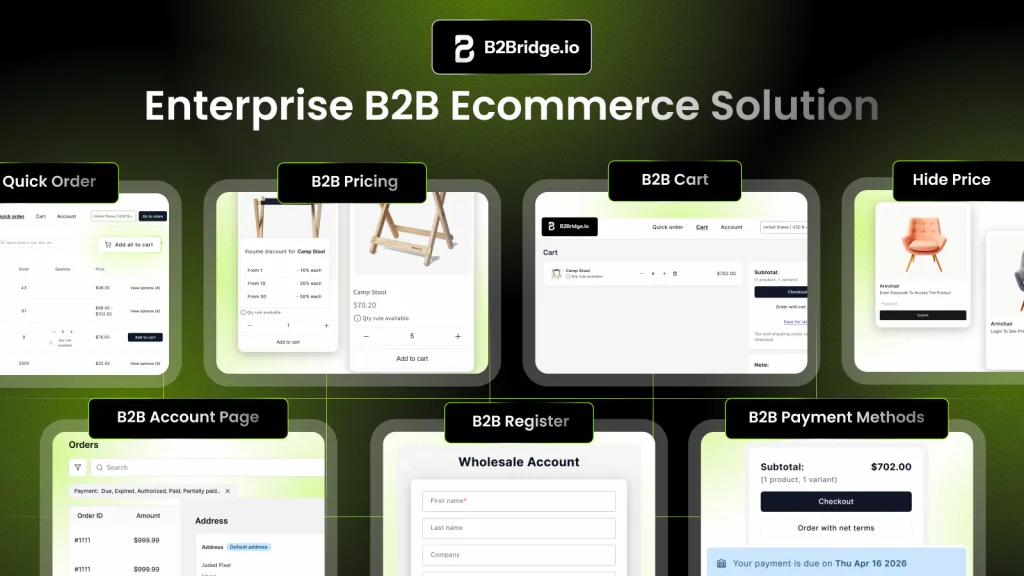
With B2Bridge, you can create customer-specific price lists, volume discounts, unit pricing, and net terms — all inside one Shopify B2B solution.
Try a Wholesale Pricing App For Free
Common wholesale pricing mistakes to avoid
Ignoring hidden costs like storage and shipping
Failing to account for warehousing, freight, and handling costs means your wholesale price doesn’t cover true expenses. Build indirect costs into pricing from the start.
Copying competitor prices without margin analysis
Matching competitors without understanding your own cost structure is risky. Your costs, positioning, and value proposition may differ significantly from theirs.
Managing price lists in disconnected spreadsheets
Version control errors, manual update delays, and syncing issues across systems are common when you rely on spreadsheets. A Bain survey found 85% of B2B leaders say pricing needs improvement, and automated pricing tools reduce operational risks significantly.
Letting B2B prices leak to retail shoppers
When retail customers see wholesale prices, you create channel conflict and erode margins. Gated or hidden pricing—visible only to approved buyers—solves this problem.
How to change wholesale prices without losing customers
Price increases are inevitable, but how you handle them determines whether buyers stick around.
- Communicate early: Give advance notice before price changes take effect
- Explain the rationale: Tie increases to rising costs or added value, not arbitrary decisions
- Phase increases gradually: Smaller incremental adjustments are easier for buyers to absorb than sudden jumps
- Refresh your catalog: Introduce new products or improved offerings alongside price updates—the conversation shifts from “you’re charging more” to “you’re offering more”
How to manage wholesale price lists and customer groups
Build customer groups for tiered pricing
Segment B2B customers into groups—distributors, retailers, VIP accounts—and assign price lists to each group. This enables differentiated pricing without manual overrides on every order.
Sync price lists with your ERP and CRM
Keep pricing aligned across systems to prevent discrepancies between what’s quoted and what’s invoiced. Integration with platforms like NetSuite, Zoho, or Odoo reduces manual data entry and errors.
Hide wholesale prices from B2C shoppers
Gate wholesale pricing behind login or account verification so only approved B2B buyers see discounted rates. This protects retail pricing integrity and prevents channel conflict.
Automate volume rules and minimum order quantities
Set up rules that automatically apply quantity breaks and enforce MOQs (minimum order quantities). This reduces manual intervention and ensures pricing consistency across orders.
If you are setting these rules at the variant level first, Egnition’s guide on how to set minimum order quantity in Shopify explains the native settings, increment logic, and theme-level checks in detail, as well as how to manage these rules more easily with the Commetiq: MOQ & Order Limits app.
FAQs about wholesale pricing strategy
What is an example of multiple unit pricing?
An example of multiple unit pricing is “4 for $1.00” (or “$1.00 for 4 items”). More common examples:
| Multiple Unit Pricing | Unit Price |
|---|---|
| 6 for $5.00 | $0.83 per unit |
| 3 for $1.00 | $0.33 per unit |
| 2 for $2.50 or buy 1 get 1 free | $1.25 per unit |
| 5 for $88 | $17.60 per unit |
| 7 for $1.00 | $0.14 per unit |
What is wholesale discount rate?
The wholesale discount rate is the percentage off the retail price that suppliers offer retailers buying in bulk. It typically ranges from 30% to 50%, with 40–50% being most common. This discount allows retailers to add their own markup while still selling at competitive retail prices, representing the difference between wholesale and retail prices.
What is a good wholesale profit margin?
A sustainable wholesale margin covers all costs and leaves profit after the retailer takes their cut. The right margin depends on industry, cost structure, and competitive positioning.
Should wholesale prices be visible to retail customers?
No. Wholesale prices exposed to retail shoppers undercut retail partners and erode brand value. Gated access or login requirements ensure only verified wholesale buyers see B2B pricing.
How often should wholesale prices be updated?
Review pricing at least annually or whenever significant cost changes occur. Regular reviews prevent margin erosion from rising material, labor, or shipping costs.
What is the difference between MSRP and MAP pricing?
MSRP is the manufacturer’s suggested retail price. MAP is the minimum price at which retailers can advertise the product. MAP policies protect brand value by preventing public price undercutting.
Can I run wholesale pricing on a standard Shopify plan?
Yes. Apps like B2Bridge enable full wholesale pricing functionality on standard Shopify plans without requiring Shopify Plus—including customer-specific pricing, volume discounts, and gated B2B access.

Hi, I’m Ha My Phan – an ever-curious digital marketer crafting growth strategies for Shopify apps since 2018. I blend language, logic, and user insight to make things convert. Strategy is my second nature. Learning is my habit. And building things that actually work for people? That’s my favorite kind of win.