Market-based pricing sets your prices according to what competitors charge and what buyers in your market are willing to pay—not just what it costs you to produce. It’s the pricing approach most businesses default to in competitive markets, and for good reason: McKinsey found that a 1% price improvement yields 6% more profit for a typical S&P 500 company—price too far above the going rate without justification, and you lose deals; price too far below, and you leave margin behind.
This guide covers how market-based pricing works, when it makes sense, the strategies you can use, and how to avoid the mistakes that erode margins over time.
What Is Market-Based Pricing
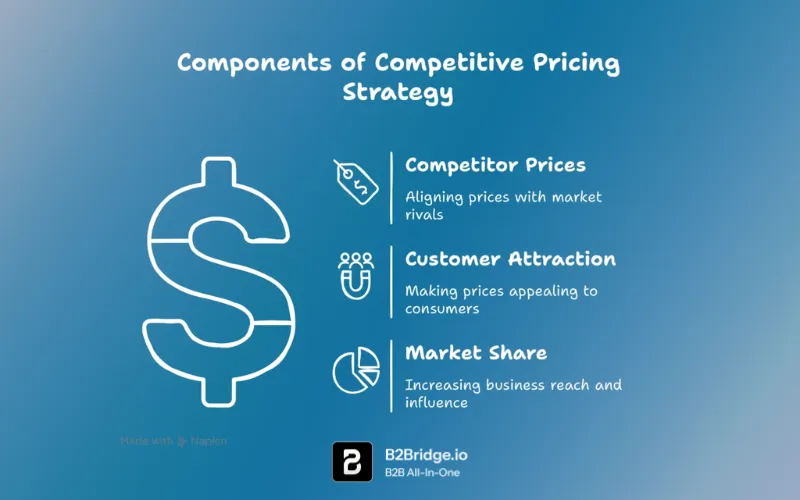
Market-based pricing is a strategy where you set product prices based on what competitors charge and what customers are willing to pay, rather than calculating prices purely from your internal costs. Instead of starting with production expenses and adding a markup, you look outward first—at competitor prices, industry benchmarks, and buyer expectations—then position your price relative to that data.
The goal is to stay aligned with current market conditions. You might price at parity with competitors, above them to signal premium value, or below them to capture market share quickly. The “right” position depends on your brand, cost structure, and what you’re trying to achieve.
This approach works especially well in competitive markets where buyers can easily compare options. Price too far above the going rate without a clear reason, and you lose sales. Price too far below, and you leave margin on the table—or accidentally signal lower quality.
- External focus: Prices anchor to competitor data and market trends, not just internal cost structures
- Dynamic adjustments: Prices shift as competitors move or demand changes
- Perceived value: What customers will pay relative to alternatives matters as much as what it costs you to produce
How Market-Based Pricing Works
Implementing market-based pricing follows a logical sequence. Each step builds on the previous one, and skipping steps usually leads to pricing that’s either disconnected from reality or unsustainable.
1. Define the competitive set
Start by identifying who you’re actually competing against. A wholesale distributor of industrial lighting competes with other industrial lighting distributors—not with consumer retail brands selling decorative lamps. The clearer your competitive set, the more useful your price data becomes.
2. Gather competitor and industry price data
Collect current pricing from your competitive set through manual research, pricing intelligence tools, industry reports, or competitor websites and catalogs. The more accurate and current your data, the better your positioning decisions.
3. Benchmark against industry averages
Compare your product costs and target margins to the average market price. If the market average for a product category is $50 and your cost is $40, you know your margin ceiling before you even set a price.
4. Set your market price position
Decide where you want to sit relative to the market. At parity? Above it to signal premium quality? Below it to gain share quickly? Your positioning depends on your brand strategy, cost structure, and competitive advantages.
5. Monitor and adjust prices continuously
Market-based pricing isn’t a one-time exercise. Competitors change prices, demand shifts seasonally, and new entrants disrupt categories. Regular monitoring—weekly or monthly in fast-moving markets—keeps your pricing relevant.

Key Factors That Influence Market-Based Pricing
Several variables shape how you set and adjust market-based prices. Some are external and largely outside your control, while others are internal and give you room to maneuver.
Competitor prices
This is the most direct input. What are similar products selling for right now? Competitor prices set the baseline for your positioning decisions.
Industry averages
Benchmark data across your category signals the “going rate.” Industry reports, trade associations, and pricing databases provide this context.
Customer demand and willingness to pay
Perceived value matters here. A product with strong brand recognition or unique features can command prices above the market average—even if production costs are similar to competitors.
Production and operating costs
Your internal baseline. Market-based pricing still requires covering costs. If the market price won’t support your cost structure, you either reduce costs or accept that you can’t compete profitably in that segment.
Product lifecycle stage
New products entering a market often warrant different positioning than mature products. Launch pricing might sit below market to build share, while established products with loyal customers can hold premium positions.
Examples of Market Pricing
Market-based pricing shows up across industries, though the specifics vary based on product type, buyer behavior, and competitive intensity.
Consumer electronics
Smartphone manufacturers price new models relative to competitors like Apple and Samsung. When Apple releases a new iPhone at a certain price point, Android competitors position their flagship devices in relation to that anchor—sometimes matching it, sometimes undercutting it to attract price-sensitive buyers.
Automotive
Used car dealerships adjust prices based on local market supply and competitor listings. A 2021 Honda Civic’s price in Phoenix depends heavily on what other dealerships in Phoenix are charging for similar vehicles, not just what the dealer paid at auction.
Wholesale and distribution
B2B distributors adjust catalog prices based on competitor pricing and industry benchmarks. A lighting distributor might set prices slightly below the market leader to win new accounts, then adjust as relationships mature and value becomes clearer.
>> See more: Distributor Pricing: Types, Strategies, and How to Get It Right
Market-Based Pricing Strategies
Within market-based pricing, you have several strategic positions to choose from. Each serves different business objectives.
Price parity strategy
Match competitor prices and compete on non-price factors like service, quality, or convenience. Price parity works when your product is similar to competitors and you want to avoid price wars while differentiating elsewhere.
Premium positioning strategy
Price above the market to signal higher value, quality, or exclusivity. Premium positioning requires a clear reason for the higher price—better materials, stronger brand, superior service—or buyers will simply choose cheaper alternatives.
Penetration pricing strategy
Price below market temporarily to gain market share quickly. Penetration pricing sacrifices short-term margin for long-term volume. It works best when you can scale efficiently and eventually raise prices once you’ve established a customer base.
Below-market discount strategy
Consistently price lower than competitors to attract price-sensitive buyers. Unlike penetration pricing, this is a permanent positioning choice that requires a cost structure supporting lower prices sustainably.
Benefits of Market-Based Pricing
Market-based pricing offers several advantages, particularly in competitive markets where buyers have options.
- Competitive positioning: Prices align with what the market expects, reducing the risk of being priced out of consideration
- Higher sales volume: Pricing in line with demand increases the likelihood of conversions
- Market relevance: Prices stay responsive to real-world conditions rather than becoming disconnected from buyer expectations
- Faster market entry: Provides a clear benchmark for pricing new products without extensive customer research
Drawbacks of Market-Based Pricing
The approach has real limitations, and ignoring them leads to margin erosion or strategic drift.
- Margin pressure: Fierce competition can squeeze profit margins, especially in commoditized categories
- Price wars: Competitors may undercut your prices, triggering a race to the bottom that hurts everyone
- Constant monitoring required: Prices become stale without active, ongoing market surveillance
- Ignores unique value: Differentiated products may be undervalued if priced purely against commodity competitors

Market-Based Pricing vs Cost-Based and Value-Based Pricing
Market-based pricing is one of three primary pricing approaches. Understanding how they differ helps you choose the right strategy—or combine them.
| Factor | Market-Based | Cost-Based | Value-Based |
|---|---|---|---|
| Primary input | Competitor prices and market data | Production costs plus markup | Customer perceived value |
| Focus | External market conditions | Internal cost recovery | Customer willingness to pay |
| Best use case | Competitive markets with many alternatives | Stable costs and predictable demand | Differentiated products with clear value |
| Risk | Margin erosion in price wars | Ignores market realities | Requires deep customer insight |
Market-based pricing vs cost-based pricing
Cost-based pricing sets prices by adding a markup to production costs. Approaches like keystone pricing are simple and ensure cost recovery, but they ignore what competitors charge and what customers will pay. Market-based pricing flips this—it starts with external data and works backward to determine if your costs allow profitable participation.
Market-based pricing vs value-based pricing
Value-based pricing sets prices based on perceived customer value, often capturing higher margins than market-based approaches. However, it requires deep customer research to understand willingness to pay. Market-based pricing is faster to implement when you lack that insight.
When to Use Market-Based Pricing
Market-based pricing fits certain situations better than others:
- Entering a crowded, competitive market where buyers compare options easily
- Selling commoditized products with many substitutes
- Lacking deep customer research for value-based pricing
- Needing to respond quickly to competitor price changes
- Operating in industries where the “going rate” is well established
Market-Based Pricing for B2B Wholesale and Distribution
In B2B contexts, market-based pricing often serves as a starting point rather than the final answer. Wholesale relationships involve layers of complexity that consumer pricing doesn’t.
Market prices establish a baseline, but actual transaction prices vary by customer. A distributor might use market benchmarks to set wholesale prices, then apply negotiated discounts for specific accounts based on volume commitments or relationship tenure.
- Contract-based selling: Market prices serve as a baseline for negotiated agreements, with discounts or premiums applied per contract
- Customer-specific pricing: Different buyers receive differential adjustments from the market rate based on volume, relationship, or strategic importance
- Volume and tiered pricing: Larger orders warrant volume discounts from market price, creating incentive structures that reward bigger commitments
Common Mistakes With Market-Based Pricing
Even straightforward strategies go wrong when execution slips.
- Ignoring costs entirely: Market price still has to cover production and operating expenses. Pricing at market while losing money on every sale isn’t sustainable.
- Copying competitors blindly: Competitors may have different cost structures, strategic goals, or be making their own pricing mistakes.
- Failing to monitor continuously: Prices become stale if not updated with market shifts. What was competitive six months ago may be overpriced today.
- Neglecting customer value: Differentiated products may deserve premium positioning. Pricing a superior product at market average leaves margin on the table.
How to Implement Market-Based Pricing in Shopify and ERP Systems
Operationalizing market-based pricing requires systems that can manage price lists, segment customers, and keep data aligned across platforms.aligned across platforms.
For Shopify merchants running B2B operations, this means connecting your storefront pricing to your back-office systems. When market conditions change, you want price updates to flow through automatically—not require manual updates across multiple spreadsheets and platforms.
- Centralized price lists: Manage market-based prices in one system and sync across channels to avoid version control issues
- Customer group pricing: Apply different market adjustments for B2C vs. B2B segments, or for different tiers of wholesale buyers
- ERP integration: Keep pricing aligned between Shopify and back-office systems like NetSuite, Zoho, or Odoo
- Automated updates: Use pricing tools to adjust prices as market data changes, reducing manual work and lag time

Run Market-Based Pricing With a Wholesale Pricing App
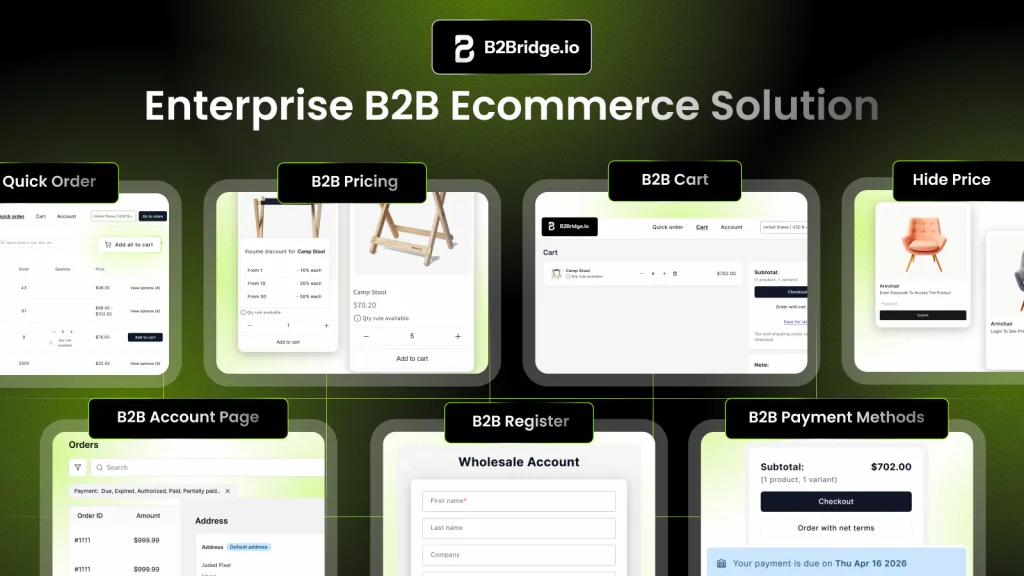
If you’re running B2B operations on Shopify and want to implement market-based pricing with customer-specific adjustments, B2Bridge provides the infrastructure to make it work. The platform supports customer-group pricing, volume discount tiers, and contract-based price lists—all the layers that sit on top of your market benchmarks.
- Customer-group price lists: Set different market positions for different buyer segments
- Volume and tiered pricing: Layer quantity-based discounts on top of market benchmarks
- ERP sync: Keep Shopify pricing aligned with NetSuite, Zoho, Odoo, or custom systems
- Hidden B2B pricing: Keep wholesale prices invisible to retail shoppers
Contact us to get expert guidance on implementing market-based pricing for your wholesale operations.
Frequently Asked Questions About Market-Based Pricing
What is the market-based pricing definition in simple terms?
Market-based pricing means setting your product price based on what competitors charge and what the market will bear, rather than only looking at your internal costs. You research the going rate for similar products and position your price relative to that benchmark.
How often should market-based prices be updated?
Prices benefit from regular review—weekly or monthly in fast-moving markets—to stay aligned with competitor and demand shifts. In stable industries, quarterly reviews may suffice.
Is market-based pricing the same as competitive pricing?
They’re closely related, but market-based pricing also considers broader market factors like demand trends and industry averages, not just direct competitor prices. Competitive pricing focuses more narrowly on matching or beating specific competitors.
Can market-based pricing be automated?
Yes. Pricing software and ecommerce tools can automate competitor monitoring and price adjustments based on market data. Automation reduces manual work and keeps prices current.
How does market-based pricing work with B2B contract pricing?
Market prices often serve as a baseline, with negotiated discounts or premiums applied per customer contract or volume tier. The market benchmark establishes the starting point, and the relationship determines the final price.

Hi, I’m Ha My Phan – an ever-curious digital marketer crafting growth strategies for Shopify apps since 2018. I blend language, logic, and user insight to make things convert. Strategy is my second nature. Learning is my habit. And building things that actually work for people? That’s my favorite kind of win.