Bulk pricing, also known as volume pricing or tiered pricing, is a powerful ecommerce strategy where customers receive a lower price per unit when they purchase larger quantities. This approach has become increasingly popular among both B2C and B2B online stores because it effectively boosts Average Order Value (AOV), reduces order processing costs, and encourages repeat purchases.
In this article, we’ll explore 10 practical bulk pricing examples from well-known brands. You’ll see exactly how these companies structure their discounts and learn when this strategy works best.
What is bulk pricing?
Bulk pricing offers customers discounted rates based on the quantity or amount they buy. Instead of charging a fixed price, brands create pricing tiers — the more you buy, the less you pay per item.
This strategy is especially effective because it:
- Increases AOV by 20-35% on average
- Improves inventory turnover
- Builds customer loyalty through better value
- Helps compete with big players like Amazon and Costco
How to calculate bulk pricing?
The method for calculating bulk pricing varies by pricing type. Below are the formulas and specific examples for each type:
1. Tiered Pricing (All-Units Discount)
This is the most popular method. Once the order reaches a higher tier, all units get the new lower price.
How it works: The discounted price applies to every unit in the order.
Example:
| Tier | Quantity | Price per Unit |
|---|---|---|
| 1 | 1 – 10 | $10 |
| 2 | 11 – 50 | $8 |
| 3 | 51+ | $6 |
Calculation: Total Price = Quantity × Price per unit of the applicable tier
Example: Buying 45 units → All 45 units are charged at $8 → Total = 45 × $8 = $360
2. Block / Bundle Pricing
You sell products in fixed bundles at a special package price.
How it works: A set price for a specific quantity (e.g., 100 units for $500).
Formula:
Number of Full Bundles = floor(Quantity ÷ Bundle Size)
Remainder = Quantity % Bundle Size
Total Price = (Number of Bundles × Bundle Price) + (Remainder × Regular Price)
Example: Bundle = 100 units for $500 ($5/unit) Regular price = $6/unit
Buying 250 units:
- 2 full bundles = 2 × $500 = $1,000
- 50 remaining units × $6 = $300
- Total Price = $1,300
3. Percentage Discount Pricing
You apply a percentage off the original price once a minimum quantity is reached.
Formula: Total Price = Quantity × Original Price × (1 – Discount Percentage)
Example:
- Original price = $10 per unit
- 20% discount for 50+ units
Buying 60 units: Total Price = 60 × $10 × (1 – 0.20) = 60 × $10 × 0.80 = $480
4. Volume Pricing (Incremental / Marginal Discount)
Different from Tiered Pricing — only the units within each tier get that tier’s price.
Formula: Total Price = Σ (Units in Tier × Price of that Tier)
Example (Incremental):
| Tier | Quantity Range | Price per Unit |
|---|---|---|
| 1 | 1 – 20 | $10 |
| 2 | 21 – 50 | $8 |
| 3 | 51+ | $6 |
Buying 60 units:
- First 20 units × $10 = $200
- Next 30 units × $8 = $240
- Last 10 units × $6 = $60
- Total Price = $500
10 Real Bulk Pricing Examples
1. Chewy
Chewy.com excels at bulk pricing for pet supplies. A 13.5-lb bag of dog food might cost $14.98, but buying a 20-lb bag or multiple bags together significantly reduces the price per pound. They also combine bulk pricing with their Autoship subscription for even deeper discounts.

2. Anker
Anker offers clear bulk pricing on chargers, cables, and power banks. A single Anker Nano 45W charger might cost $27.99, but customers buying 10+ units for business or resale can access special corporate pricing with noticeable discounts.

3. The Body Shop
The Body Shop frequently runs “Buy More, Save More” campaigns directly within the shopping cart to encourage customers to increase their order volume.
For example, when a customer adds the Dewberry Body Yogurt to their cart:
- Buy 1 item: The original price is £14.
- Buy 2 items: The total price drops to £20 (which makes it just £10 per unit, saving the customer £8 instantly).
These volume-based discounts are automatically calculated and clearly highlighted in the mini-cart as items are added, creating an immediate incentive for shoppers to add more to their bag to unlock better value.

4. Printful
Printful provides one of the best bulk pricing tables in the industry. A custom hoodie costs about $35 for 1 piece, drops to $28 for 10–24 pieces, and goes as low as $22 for 50+ pieces. The tiered table is very clear and professional.

5. Thrive Market
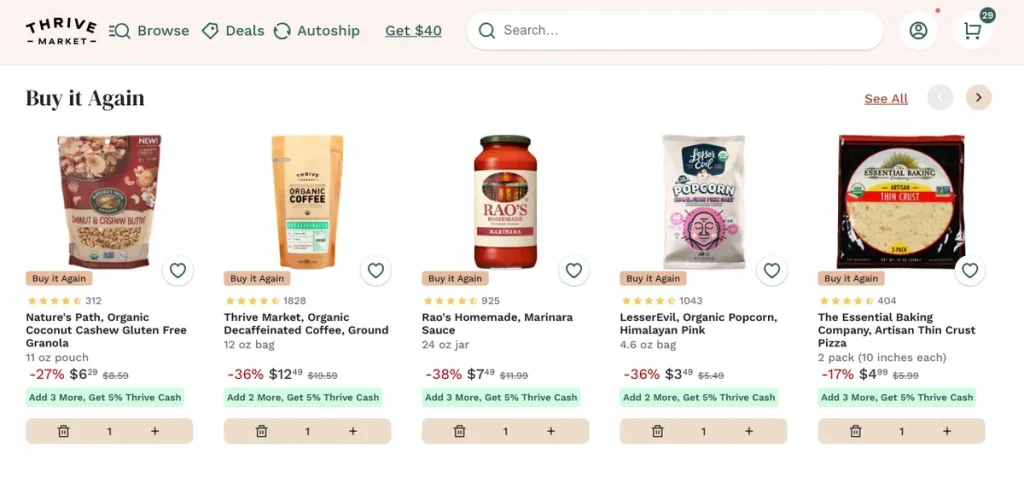
Thrive Market drives average order value (AOV) by blending massive discounts with a gamified pricing strategy directly in the product grid:
- Thrive Cash Rewards: Gamifies quantity thresholds with clear prompts like “Add 2 More, Get 5% Thrive Cash”, incentivizing larger bundles with immediate store credit.
- Dynamic Value Pricing: Prominently displays deep, tiered discounts (e.g., -27% to -38%) against strikethrough regular prices, proving instant bulk savings.
6. Amazon Business
Amazon Business drives high-volume orders by highlighting deep multi-pack discounts over individual items. The interface showcases an immediate -38% savings on a 10-count pack with a clear per-unit price breakdown. Combined with a cross-pack comparison matrix (e.g., 1-pack vs. 18-pack), it psychologically pushes buyers to upgrade to higher configurations for maximum value.

7. Bombas
Bombas drives volume through a strategic pack-pricing model. On product pages, customers can seamlessly toggle between Single items and 4-Pack, 8-Pack, or 12-Pack options. The interface directly highlights clear volume discounts (e.g., 19% Pack Savings), encouraging larger orders while seamlessly connecting purchases to their “One Purchased = One Donated” mission.

8. Blueland
Blueland’s pricing strategy focuses on Starter Kits featuring lifetime reusable bottles paired with affordable, plastic-free tablet refills. Through their “Build Your Bundle” feature, customers unlock tiered savings—10% off for three items and 15% off for four or more—incentivizing bulk purchases that maximize savings while minimizing shipping emissions and packaging waste.

9. The Ordinary (by Deciem)
The Ordinary focuses on a transparent, flat-rate wholesale pricing strategy for bulk buyers. Instead of tiered retail discounts, verified B2B partners and stockists unlock direct wholesale margins with fixed box-quantities, ensuring predictable, high-volume sourcing without gimmicks.

10. Alibaba / Supplier Wholesale Model
Many suppliers on Alibaba use a tiered wholesale pricing structure based on volume (often featuring a low MOQ for electronics):
- MOQ 2 – 99 pcs = $17.80/unit
- MOQ 100 – 999 pcs = $17.50/unit
- MOQ 1,000 – 9,999 pcs = $17.20/unit
- MOQ 10,000+ pcs = $16.50/unit
This is a classic volume discount structure for mid-range smartwatches and consumer electronics on B2B e-commerce platforms.

Optimize Your Bulk Pricing on Shopify With B2Bridge
If you’re looking to implement a bulk pricing strategy on Shopify that actually drives volume, B2Bridge handles the complexity without requiring an expensive Shopify Plus upgrade.
- Advanced bulk & tiered pricing: Set custom quantity thresholds and per-unit rates that calculate instantly and automatically at checkout.
- Flexible volume discount rules: Easily set up “Buy More, Save More” programs or tiered structures tailored to your margins.
- Wholesale customer groups: Assign specific bulk price lists to different buyer segments or VIP wholesale accounts.
- MOQs and case packs: Enforce minimum order quantities and strict packaging increments to protect your shipping and production costs.
- Seamless ERP sync: Keep your bulk tier rates perfectly aligned with NetSuite, Zoho, Odoo, or custom systems via API.

Frequently Asked Questions (FAQ)
What are bulk pricing examples?
Bulk pricing examples include tiered discounts offered by brands like Chewy, Anker, and Uniqlo, where customers pay less per unit when buying larger quantities.
How much discount should I offer?
Most successful stores offer 15-30% off for bulk purchases, depending on product margins and competition.
Is bulk pricing suitable for small stores?
Yes. Even small Shopify stores can benefit by starting with simple “Buy 2 Save 10%, Buy 3 Save 20%” rules.
What’s the difference between bulk pricing and wholesale pricing?
Bulk pricing is usually for end consumers buying larger quantities, while wholesale pricing is typically reserved for retailers and distributors.

As a Product Marketing Executive at B2Bridge, I focus on the Enterprise B2B Ecommerce domain. I leverage my understanding of product and user psychology to deliver customer-centric content that addresses business challenges and fuels growth.