Value-based pricing sets prices based on what customers believe a product is worth—not what it costs to make or what competitors charge. It’s the difference between asking “what did this cost me?” and “what is this worth to the buyer?”
For B2B and wholesale operations, where different customers perceive different value from the same product, this approach unlocks pricing flexibility that cost-plus methods can’t match. This guide covers the core framework, formula, implementation steps, and common mistakes to avoid when applying value-based pricing to your business.
What Is Value-Based Pricing
Value-based pricing is a strategy that sets prices based on the customer’s perceived value or willingness to pay, rather than on production costs or competitor prices. Instead of calculating what something costs to make and adding a markup, you’re figuring out what the product is actually worth to the buyer. The focus lands on benefits—time savings, efficiency gains, reduced risk, or status—that a product delivers to a specific customer segment.
This approach works especially well for differentiated products where alternatives don’t quite match what you’re offering. In B2B and wholesale, perceived value often varies significantly across customer types, which makes value-based pricing a natural fit for segmented price lists.
- Customer-centric focus: pricing relies on what buyers actually care about, not internal cost structures
- Perceived value: includes both tangible benefits like cost savings and intangible benefits like convenience or trust
- Differentiated worth: the price reflects how much better your product performs compared to the next-best alternative

How Value-Based Pricing Works
The mechanics start with research. You determine perceived value through customer interviews, surveys, competitive analysis, and sometimes direct observation of how buyers use your product. The goal is to quantify—or at least estimate—the economic impact your offering delivers.
Once you understand what customers value, you set prices accordingly. A buyer who saves $10,000 annually by using your product might willingly pay $2,000 for it, even if your production cost is only $200. The price captures a portion of the value created, not just the cost incurred.
This contrasts with cost-plus logic, where you add a fixed markup to your expenses regardless of what the market will bear.
The Value Stick Framework and Willingness to Pay
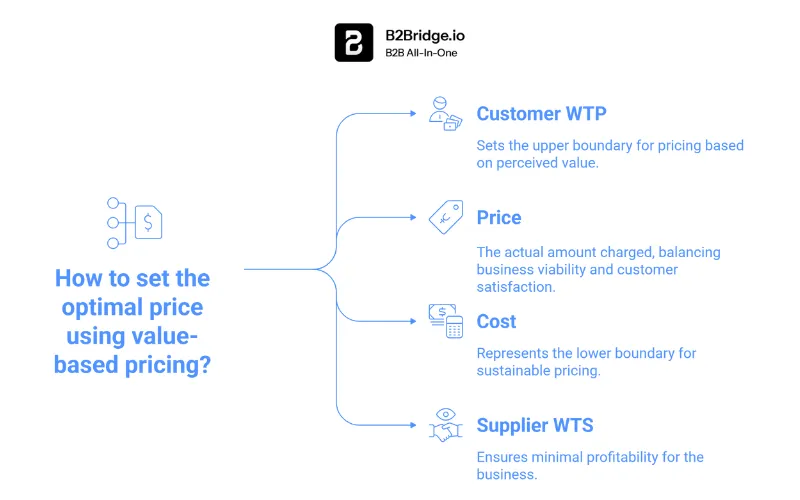
The value stick is a visual framework that helps you understand how value gets created and distributed among buyers, sellers, and suppliers. Think of it as a vertical bar with four key points stacked on top of each other.
Willingness to Pay
Willingness to pay is the maximum price a customer would accept before walking away. It sets the ceiling for value-based pricing. Everything above this point is value the customer keeps; everything below is value you can potentially capture.
Price
Price sits between willingness to pay and cost. The higher your price moves toward willingness to pay, the more value you capture as the seller. The gap between willingness to pay and price represents the customer’s surplus—the “deal” they feel they’re getting.
Cost
Cost is your total expense to produce and deliver the product. The gap between price and cost is your profit margin. Lowering costs without affecting perceived value increases the value available to distribute.
Willingness to Sell
Willingness to sell is the minimum suppliers or employees would accept for their inputs. Lowering this figure—through better supplier relationships or operational efficiency—creates more value in the system overall.

Types of Value-Based Pricing
Two main approaches fall under the value-based umbrella, and they serve different market conditions.
Good Value Pricing
Good value pricing offers the right combination of quality and service at a fair price. It’s common in competitive markets where buyers compare options closely and expect reasonable value without premium positioning. Think of it as “value for money” pricing—matching what customers expect to pay for what they receive.
Value-Added Pricing
Value-added pricing attaches features, services, or benefits that justify a premium. The focus shifts from matching competitors to differentiating from them. Brands with strong reputations or unique capabilities often use this approach to command higher prices than cost-based methods would suggest—McKinsey reports BASF achieved 20% higher margins after adopting value-based pricing.
Value-Based Pricing Formula
A practical formula for calculating value-based price looks like this:
Value-Based Price = Reference Price + Differentiation Value
- Reference price: the price of the closest competing product or alternative the buyer would otherwise choose
- Differentiation value: the monetary worth of additional benefits your product provides over that alternative
If your competitor charges $500 and your product saves the buyer an extra $200 in labor costs annually, your differentiation value is $200. Your value-based price could reasonably land anywhere between $500 and $700, depending on how much of that value you want to capture versus share with the buyer.
>> Download: 15+ Wholesale Price List Templates For Your B2B Store
Value-Based Pricing vs Cost-Based and Competitor-Based Pricing
Value-based pricing isn’t the only option. Understanding when each approach fits helps you choose the right one for your situation.
| Pricing Strategy | Price Based On | Best For | Limitation |
|---|---|---|---|
| Value-based | Customer’s perceived value | Differentiated products, B2B, SaaS | Requires deep customer insight |
| Cost-based (cost-plus) | Production cost + markup | Commodities, low-differentiation goods | Ignores what customers will pay |
| Competitor-based | Competitors’ prices | Mature markets, price-sensitive buyers | Leads to margin erosion |
Cost-based pricing is straightforward but leaves money on the table when customers would pay more. Competitor-based pricing keeps you in the game but often triggers race-to-the-bottom dynamics. Value-based pricing captures more margin when you can demonstrate clear differentiation—according to McKinsey, a 1% price improvement yields 6% higher profitability for the typical S&P 500 company.
Examples of Value-Based Pricing in B2B and Wholesale
Contract Pricing for Strategic Accounts
Large accounts often receive negotiated pricing based on volume commitments, relationship history, and strategic importance—not just cost. A distributor who commits to annual minimums and provides reliable forecasts perceives value in the partnership, and pricing can reflect that mutual benefit.
Tiered Pricing for Customer Segments
Different customer groups perceive different value. Distributors, retailers, and contractors might each receive distinct price lists reflecting their willingness to pay and the value they extract from your relationship. A contractor who values next-day delivery might pay more than a retailer who plans purchases months ahead.
Personalized Pricing for High-Value Buyers
Buyers who generate repeat orders, require minimal support, or order in configurations that simplify your operations create mutual value. Custom pricing for these accounts reflects the reduced cost-to-serve and strengthens the relationship over time.
>> See how customers have transformed their pricing with B2Bridge through Midan Ventes’ success story:

Advantages and Disadvantages of Value-Based Pricing
Advantages:
- Higher profit margins: captures more value when customers perceive high worth—Bain & Company finds B2B companies earn an 8% increase in operating profit for every 1% improvement in realized price
- Improved brand perception: reinforces product quality and differentiation
- Market insight: requires ongoing customer feedback, keeping you attuned to demand shifts
- Customer alignment: prices reflect what buyers actually care about
Disadvantages:
- Research-intensive: requires deep understanding of customer segments
- Harder to justify internally: less straightforward than cost-plus
- Difficult for commodities: works best when products are differentiated
- Requires segmentation: one-size-fits-all pricing undermines the approach
When to Use Value-Based Pricing
Value-based pricing fits best when certain conditions are present:
- Differentiated or unique products: where alternatives don’t match your offering
- B2B and wholesale: where customers have varying willingness to pay
- Long sales cycles: where buyers evaluate total value, not just price
- Recurring relationships: where lifetime value and service quality matter
If you’re selling undifferentiated commodities in a price-transparent market, value-based pricing becomes harder to execute. Even then, service levels, payment terms, and reliability can create perceived value worth pricing for.
How to Implement Value-Based Pricing
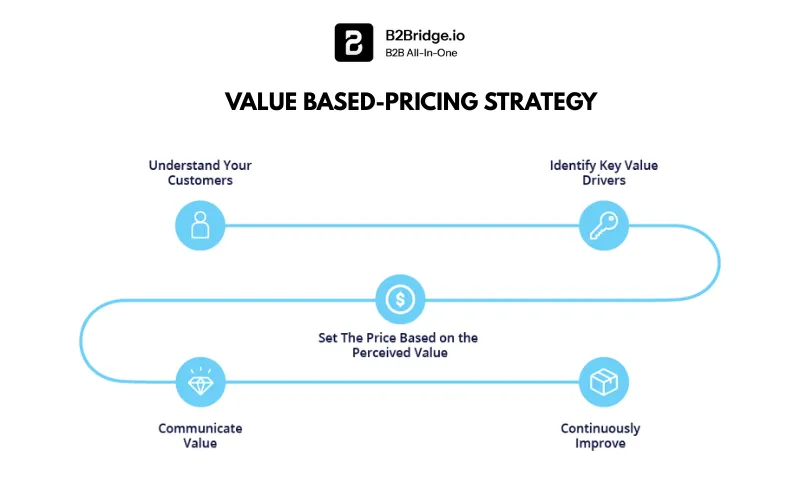
1. Segment Customers by Willingness to Pay
Group customers by how they perceive value—by industry, order size, service requirements, or strategic importance. A one-size-fits-all price ignores the variation in what different buyers will pay.
2. Quantify Perceived Value
Use customer interviews, surveys, and analysis of competitor alternatives to estimate the economic impact your product delivers. What problem does it solve? What’s that solution worth in dollars?
3. Set Price Anchors and Differentials
Establish a reference price (the next-best alternative) and add a premium based on your differentiation value. This gives you a defensible rationale for your pricing decisions.
4. Build Price Lists and Customer Groups
Operationalize value-based pricing through structured price lists assigned to customer segments. Tools like B2Bridge’s pricing engine help Shopify merchants manage this complexity without relying on spreadsheets.
5. Test, Measure, and Iterate
Monitor sales, margins, and customer feedback. Perceived value shifts over time—due to competition, market trends, or product evolution—and prices can follow.
Common Mistakes in Value-Based Pricing
Confusing Value-Based Pricing With Premium Pricing
Value-based pricing isn’t about charging more—it’s about aligning price with perceived value. For some segments, that might mean lower prices than cost-plus logic would suggest.
Ignoring Customer Segmentation
Applying one price to all customers defeats the purpose. Different buyers perceive different value, and pricing can reflect that variation.
Relying Only on Internal Estimates of Value
Guessing what customers value without market research or direct feedback leads to mispricing. The customer’s perception matters, not yours.
Failing to Update Prices as Value Shifts
Perceived value changes over time. New competitors, shifting market conditions, and product improvements all affect what buyers will pay. Static pricing leaves money on the table or prices you out of deals.
How to Operationalize Value-Based Pricing for B2B Ecommerce
Use Price Lists and Customer Groups
Create distinct price lists for each customer segment and assign buyers to groups based on their value profile. This structure makes value-based pricing manageable at scale without manual intervention on every order.
Sync Pricing With ERP and CRM
Keeping pricing aligned across systems ensures sales, finance, and operations see the same data. B2Bridge’s ERP and CRM integrations with platforms like NetSuite, Zoho, and Odoo maintain consistency without manual reconciliation.
Combine Value-Based Pricing With Volume Discounts and Net Terms
Layering value-based pricing with quantity breaks, tiered discounts, and payment terms reflects total relationship value. A buyer who orders large volumes and pays on time might warrant better pricing than one who doesn’t.
Hide B2B Pricing From B2C Shoppers
Gating value-based B2B prices prevents retail customers from seeing wholesale rates. B2Bridge’s access control features keep pricing visible only to approved buyers, avoiding channel conflict.
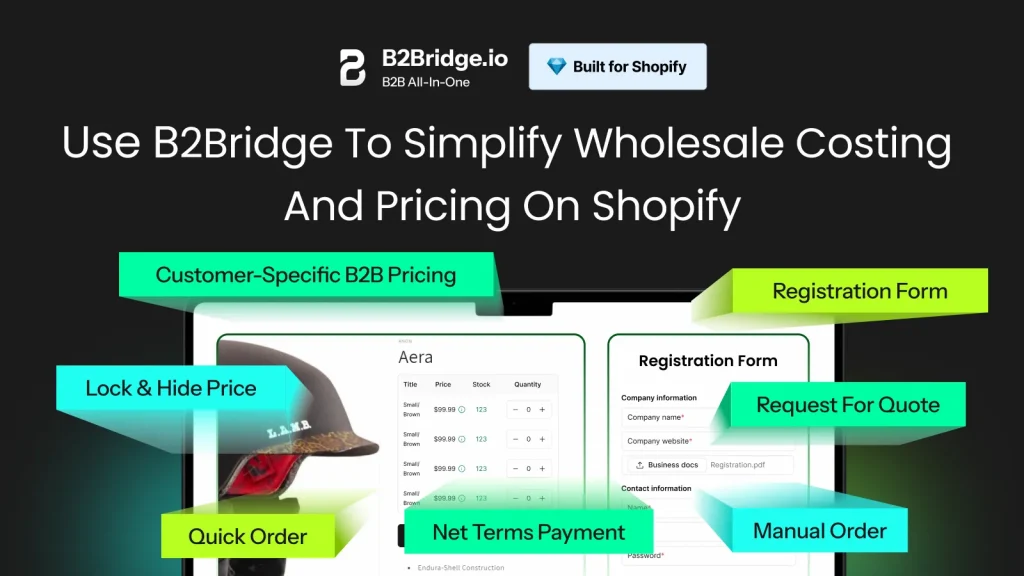
How B2Bridge Supports Pricing Flexibility and Wholesale Management on Shopify
For businesses implementing sophisticated pricing strategies like value-based pricing across multiple sales channels, managing different price points and customer segments creates operational complexity that can undermine strategic pricing effectiveness. B2Bridge addresses these challenges by providing comprehensive wholesale management tools that support flexible pricing strategies while maintaining operational efficiency.
Simplify wholesale management: Run B2B as easily as B2C with B2Bridge’s all-in-one wholesale tools that seamlessly accommodate value-based pricing strategies across different customer segments. Whether you’re implementing tiered pricing based on customer value perception or segment-specific pricing models, B2Bridge automates the complex process of showing appropriate prices to the right customers without manual intervention.
FAQs About Value-Based Pricing
Value-based pricing sets prices based on what customers believe a product is worth, not what it costs to make. For example, a B2B software company might price its tool based on the time it saves buyers rather than development costs.
Value-based pricing sets prices based on what customers believe a product is worth, not what it costs to make. For example, a B2B software company might price its tool based on the time it saves buyers rather than development costs.
The four common pricing strategies are value-based pricing, cost-based pricing, competitor-based pricing, and dynamic pricing—each anchored to a different reference point.
Yes, though it requires segmentation. Different buyers may perceive different value based on service, reliability, payment terms, or relationship factors beyond the product itself.

Hi, I’m Ha My Phan – an ever-curious digital marketer crafting growth strategies for Shopify apps since 2018. I blend language, logic, and user insight to make things convert. Strategy is my second nature. Learning is my habit. And building things that actually work for people? That’s my favorite kind of win.