The main Shopify B2B alternatives are B2Bridge, SparkLayer, Wholesale Gorilla, Bold Custom Pricing, B2B Wholesale Hub and OroCommerce. Five of them layer wholesale onto your existing Shopify store on any plan. OroCommerce replaces Shopify. Which one fits depends on your price list count and your ERP.
Shopify’s native B2B stopped being a Plus-only feature in April 2026. Companies, price lists, net payment terms and quick order lists now ship with Basic, Grow and Advanced at no extra cost.
That solved one problem and created another. Non-Plus plans cap at three active B2B catalogs, and unlimited catalogs stay locked to Plus at $2,300 a month. This guide compares six alternatives on the limits that actually bite as you scale.
Shopify B2B Alternatives Compared
Every option below runs on a standard Shopify plan except OroCommerce, which replaces Shopify. The columns that matter are the ones that bite as you scale.
| Alternative | Starting price | Price lists / catalogs | Monthly order cap | Sales rep portal | ERP sync | App Store rating | Best for |
|---|---|---|---|---|---|---|---|
| Shopify native (non-Plus) | Included in plan | 3 catalogs | None | No | No | n/a | Testing wholesale demand |
| Shopify Plus | $2,300/mo (3-yr term) | Unlimited | None | No | No | n/a | Enterprises already on Plus |
| B2Bridge | $99/mo | Unlimited | None | Yes, Growth $199 | Yes, API at $299 | 5.0 | Hybrid brands scaling wholesale |
| SparkLayer | $49/mo | Unlimited | 50 / 100 / 150 by tier | Agent portal | Moderate | 4.9 (329 reviews) | Brands wanting fast setup |
| Wholesale Gorilla | $34.95/mo | Tiered | None | No | Basic | 4.8 (317 reviews) | Simpler wholesale operations |
| Bold Custom Pricing | $29/mo | Tiered | None | No | Basic | 533 reviews | Stores already using Bold apps |
| B2B Wholesale Hub (Orbit) | $39/mo | Tiered | None | No | Basic | 4.7 (660+ reviews) | Basic wholesale pricing tiers |
| OroCommerce | Quote-based | Unlimited | None | Built-in CRM | Enterprise | n/a | Full replatform away from Shopify |
Why you might need a Shopify B2B alternative
The stakes are high. According to the U.S. International Trade Administration, the global B2B ecommerce market is projected to reach $36 trillion by 2026, growing at a 14.5% compound annual growth rate. Getting B2B commerce right is no longer optional.
When you’re searching for a Shopify B2B alternative, the decision usually comes down to two paths: leaving Shopify entirely for a purpose-built B2B platform, or adding dedicated wholesale plugins to bypass the $2,300/month Shopify Plus tier. Shopify does offer native B2B features, but they’re locked behind Plus. Even then, the functionality often falls short for manufacturers and wholesalers with complex operations.
The gap becomes obvious when your pricing rules outgrow what Shopify can handle natively. Contract pricing for specific accounts, volume-based discounts, min/max order quantities, and per-customer price lists all require workarounds or third-party apps on standard Shopify plans.
Here are common signs you’ve hit the ceiling:
- Your wholesale accounts expect tiered discounts, negotiated rates, or role-based pricing that Shopify can’t deliver out of the box
- Your ERP or CRM doesn’t sync with Shopify, so your team manually enters orders and reconciles data across platforms
- Wholesale customers can’t request quotes, pay on net terms, or quickly reorder without calling your sales team
- You’re running a separate B2B store or duplicating catalog management across multiple sites
If any of this sounds familiar, a B2B alternative (whether an app layered onto Shopify or a standalone platform) can close the gaps without forcing a full rebuild.
Where Shopify native B2B and Shopify Plus fall short
Shopify’s native B2B covers the basics on every plan. Where it falls short is predictable, and which gap you hit first decides whether you need an app or a new platform.
Limited pricing rules and contract pricing
The cap is three. Merchants on Basic, Grow and Advanced run up to three active B2B catalogs through Markets. Only Plus lifts that to unlimited and assigns a catalog straight to a company. Per-customer contract pricing needs a price list each, so the fourth negotiated account breaks the model.
No Sales Rep Tooling
Shopify has no sales rep portal on any plan, Plus included. A rep can’t log in, order on behalf of an assigned customer at contract price, or track commission. Quote-to-order sits in the same gap, so both workflows fall back to manual entry and a spreadsheet.
Shallow ERP and CRM integration
Shopify native B2B ships with no ERP sync. Connecting NetSuite, Zoho or Odoo takes middleware, a paid connector, or an app with a public API. Nothing bidirectional comes built in, so pricing set in your ERP won’t reach the storefront on its own.
The cost of Shopify Plus for wholesale
Plus starts at $2,300 a month on a three-year term, or $2,500 on one year, before transaction fees. If unlimited catalogs is your only reason to upgrade, a standard plan plus a B2B app lands between $130 and $380 a month instead.
Gaps in B2B buyer experience and RFQ workflows
While Shopify B2B includes quick order pages, easy reorder, and net payment terms on all plans, some wholesale buyer expectations remain unmet natively across all plans. Quote-to-order workflows (RFQ), embedded B2B registration, and a dedicated B2B cart with advanced net payment customization are either missing or limited.
When your buyers can’t quickly request quotes or need a more tailored ordering experience, they’ll find a supplier who makes it easier.
What to look for in a Shopify B2B alternative
Before comparing specific solutions, it helps to know what separates a basic wholesale app from an enterprise-grade B2B layer. The following criteria will help you evaluate options against your actual wholesale requirements rather than marketing promises.
Advanced B2B pricing engine
Look for pricing capabilities that match how you actually sell to wholesale buyers. The pricing engine is often the most important differentiator between basic wholesale apps and enterprise-grade solutions.
Key capabilities to evaluate include:
- Different prices for different buyer tiers through role-based customer group pricing
- Per-customer or per-vendor negotiated pricing through contract price lists
- Min/max order quantities, case packs, and tiered discounts through volume and quantity rules
- Prices visible only to logged-in wholesale buyers
- Support for global wholesale accounts with multi-currency and tax-exempt logic
A solution that forces you to simplify your pricing model will create friction with buyers who expect their negotiated rates. The right platform adapts to your pricing logic rather than requiring you to change how you sell.

Deep ERP and CRM integration
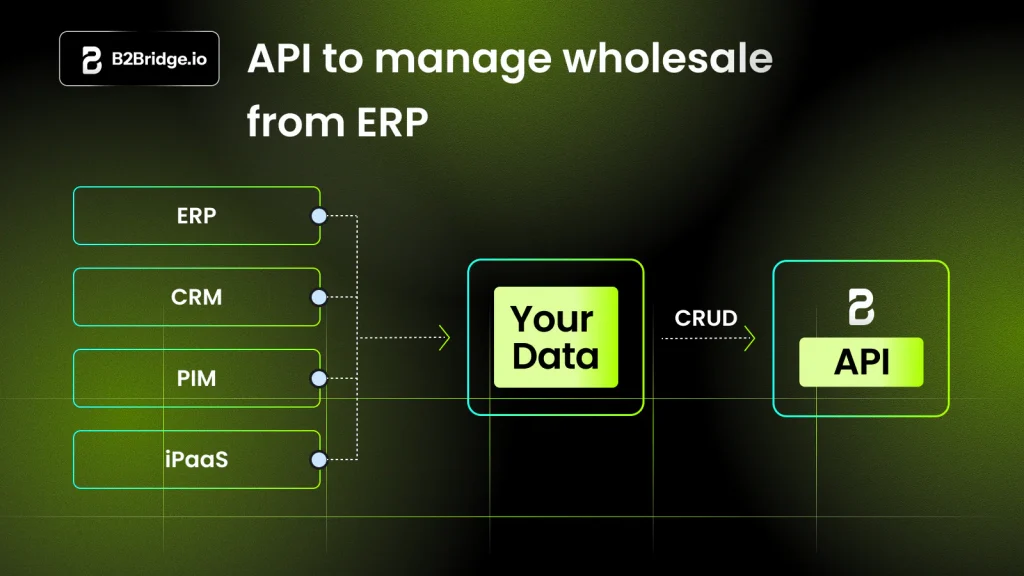
There’s a meaningful difference between surface-level integrations (basic data export) and deep integration (bidirectional sync of pricing and orders, plus customer records). Look for solutions that connect with NetSuite, Zoho, Odoo, or offer an enterprise API for custom ERPs.
Deep integration means fewer manual reconciliation errors and less time spent fixing order discrepancies. When your ERP is the source of truth for pricing and your B2B platform pulls that data automatically, you eliminate the risk of manual update errors. When orders flow back to your ERP without re-keying, you save staff time and reduce fulfillment mistakes.
B2B UX built for wholesale conversion
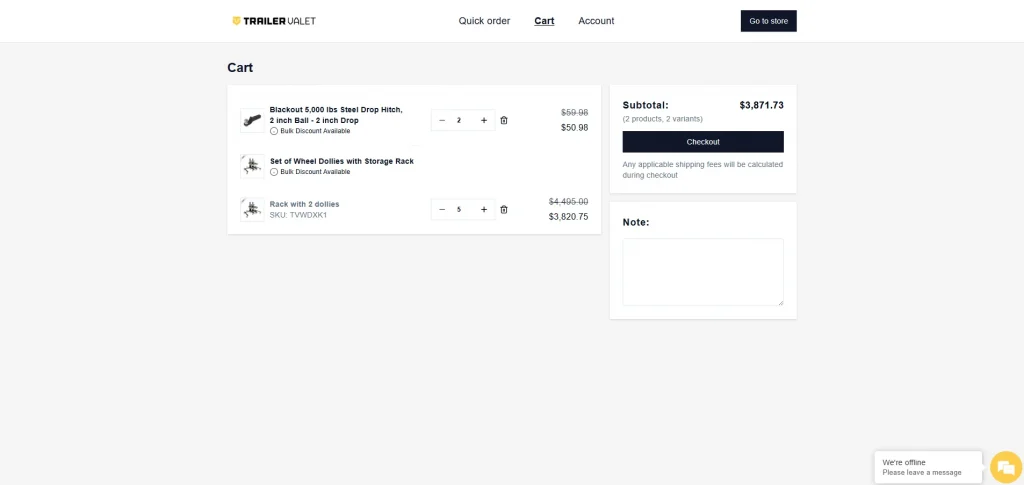
The buyer-facing experience matters as much as backend features. Quick order pages let buyers add dozens of SKUs in seconds without clicking through individual product pages. A dedicated B2B cart supports net payment terms and credit limits, letting buyers order on account rather than paying upfront. Quote request workflows handle large or negotiated purchases where standard pricing doesn’t apply. Smart account management gives buyers access to order history, reorders, and saved carts so they can complete repeat purchases quickly.
Wholesale buyers expect a self-service experience that matches what they get from enterprise suppliers. If your portal feels clunky or requires phone calls for basic tasks, buyers will shift their volume to competitors who make ordering easier.
Unified B2B and B2C storefront
Running both channels on one Shopify store reduces duplicate work and keeps inventory and customer data synced. A separate B2B site means double the maintenance and more opportunities for data to fall out of sync.
Look for solutions that let retail customers see standard public pricing while verified B2B buyers access their own gated experience after logging in. This approach means one product catalog, one inventory count, and one admin interface, with the B2B layer handling the wholesale-specific logic on top.

Total cost of ownership and support model
Evaluate beyond monthly fees. Implementation support, onboarding, customization, and ongoing technical partnership all factor into total cost. Complex B2B operations benefit from hands-on support rather than self-serve-only apps.
A lower monthly fee can mask higher total cost if you spend dozens of hours configuring the platform yourself or troubleshooting integration issues without help. Conversely, a higher-priced solution with dedicated implementation support may deliver faster time-to-value and fewer ongoing headaches. Factor in staff time, opportunity cost, and the risk of delayed launches when comparing options.
6 Shopify B2B alternatives that actually work
Each alternative below serves a different segment of the B2B market. The right choice depends on your wholesale complexity, existing tech stack, and growth trajectory.
1. B2Bridge
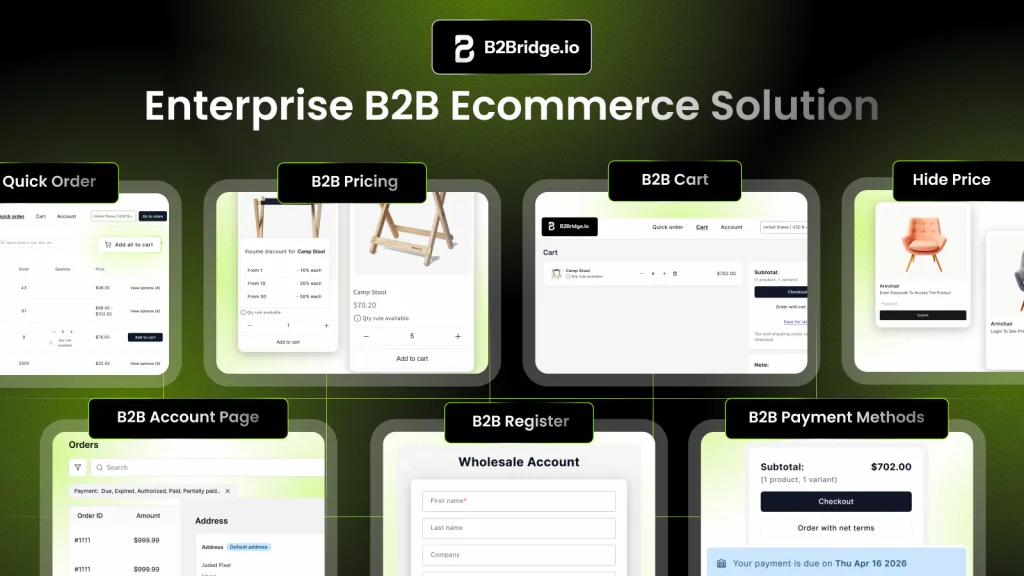
B2Bridge is an all-in-one B2B layer for Shopify built around one promise. Your price lists, customer groups and B2B orders stay unlimited at a flat monthly price, so selling more wholesale never triggers an upgrade.
Best for: Hybrid brands running B2C and B2B on one storefront, plus manufacturers and distributors who need gated pricing and a real sales workflow.
Standout features: A sales rep portal on Growth, where reps log in, order for assigned customers at contract prices, reorder from history and track commission. Growth also adds request for quote, company accounts with custom roles, and credit limits on net terms. Advanced opens a public API into NetSuite, Zoho or an in-house ERP.
Considerations: Implementation runs as a project with discovery, configuration, testing and go-live. That’s an advantage on a complex catalog and overkill on a two-tier discount, where a lighter app is faster.
Pricing: From $99 a month on Professional. Sales rep portal and request for quote unlock on Growth at $199. Public API on Advanced at $299.
2. SparkLayer
SparkLayer is a popular Shopify B2B app positioned as a Shopify Plus alternative. It adds a wholesale storefront, quoting, and self-service invoicing on any Shopify plan.
SparkLayer works well for brands wanting to add B2B capabilities without upgrading to Shopify Plus. The platform offers quick setup with a B2B-focused feature set and transparent pricing tiers. Merchants can enable wholesale ordering, customer-specific pricing, and basic quoting workflows relatively quickly.
The platform may fall short for complex ERP integration scenarios or highly customized pricing models. Brands with straightforward wholesale needs will find it capable, while those with enterprise-grade requirements may need deeper customization options.

3. Wholesale Gorilla
Wholesale Gorilla is a straightforward wholesale app for Shopify that covers the basics without overwhelming complexity.
Wholesale Gorilla works well for merchants with simpler wholesale operations who need a fast path to B2B functionality. The platform is easy to use with an intuitive interface. Core features include tiered pricing, wholesale customer registration, and basic discount rules that let merchants offer different prices to verified buyers.
The platform lacks depth for complex B2B operations or enterprise ERP sync. Merchants who need advanced contract pricing, quote-to-order workflows, or bidirectional data sync with backend systems will likely outgrow its capabilities.

4. Bold Custom Pricing for Wholesale B2B
Bold offers B2B capabilities that integrate with their broader app ecosystem on Shopify. The platform builds on Bold’s experience in Shopify app development, adding wholesale features to stores already using Bold’s suite of tools.
Bold Commerce B2B works well for merchants already invested in Bold’s ecosystem who want to add wholesale capabilities without switching vendors. The platform integrates with other Bold apps for subscriptions, bundles, and custom pricing options. Merchants familiar with Bold’s interface will find the learning curve minimal.
The platform has gaps in deep ERP integration compared to purpose-built B2B solutions. Merchants with complex backend requirements or those needing advanced bidirectional sync may find it limiting as their wholesale operations scale.

5. B2B Wholesale Hub (Formerly B2B Wholesale Club)
Wholesale Club is a wholesale pricing and discount app focused on simplicity. The platform prioritizes ease of use over feature depth, making it accessible for merchants new to B2B commerce.
Wholesale Club works well for merchants adding basic wholesale pricing tiers to their existing Shopify store. The platform offers simple setup with discount rules tied to customer tags. Merchants can create tiered pricing structures and offer different discounts to different customer groups without complex configuration.
The platform is less suited for quote-to-order workflows or deep system integration. Merchants who need RFQ capabilities, advanced net terms, or ERP connectivity will find Wholesale Club too limited for their operations.

6. OroCommerce
OroCommerce is a standalone B2B ecommerce platform, not a Shopify app. It’s purpose-built for B2B with advanced workflows and enterprise features designed from the ground up for wholesale commerce.
OroCommerce works well for enterprises considering a full replatform away from Shopify. The platform is purpose-built for B2B with a built-in CRM that unifies sales and commerce data. Corporate account management handles complex buyer hierarchies with multiple locations, roles, and approval workflows. Deep ERP integrations support bidirectional sync with enterprise systems.
The platform requires leaving Shopify entirely, which involves significant migration effort. Data migration, theme rebuilding, and staff retraining add time and cost. Merchants should weigh the benefits of a purpose-built B2B platform against the disruption of a full replatform.

How to choose the right Shopify B2B alternative for your business
The right B2B solution depends on where your wholesale operation sits today and where you expect it to go. Here’s how to match your situation to the best fit.
For growing wholesalers on standard Shopify plans
If you’re on a standard Shopify plan and wholesale revenue is growing, look for solutions that work without Shopify Plus. Many B2B apps deliver comparable functionality at a fraction of the cost, so you can avoid premature upgrades.
The goal at this stage is to validate B2B demand and build operational muscle before committing to enterprise infrastructure. A lighter B2B app lets you test pricing strategies, buyer workflows, and ordering experiences without a major financial commitment.
For manufacturers and distributors with complex pricing
Contract pricing, volume rules, per-customer price lists, and multi-currency support require an advanced pricing engine. Look for solutions that adapt to your pricing models rather than forcing you into a rigid template.
The right solution should handle negotiated rates for specific accounts, tiered volume discounts, and case pack requirements. If your pricing logic lives in an ERP, the B2B layer needs to sync that data rather than duplicate it manually.
For enterprise brands with ERP and CRM dependencies
Deep, bidirectional integration capabilities and enterprise APIs matter most here. Keeping pricing and orders synced across systems reduces manual reconciliation and the errors that come with it.
Evaluate whether the solution supports real-time sync or batch updates, and whether it can handle the data volume your operations generate. Custom API access becomes important when you need to connect systems beyond the standard integrations.
For hybrid B2B and B2C stores
A unified storefront reduces operational overhead from maintaining separate stores. Look for solutions that keep inventory synced and let you manage both channels from one Shopify admin.
The best hybrid solutions let retail customers see standard pricing while verified B2B buyers get their own gated experience with wholesale prices, net terms, and quick ordering. This approach eliminates the need to maintain two separate catalogs or reconcile inventory across sites.
How to roll out a Shopify B2B alternative without replatforming
You don’t have to leave Shopify or rebuild your store. The right B2B solution adds a wholesale layer on top of your existing setup. This five-step process minimizes disruption while ensuring your B2B buyers get a professional experience from day one.
Step 1. Audit your current B2B workflows and tech stack
Document existing pricing models and customer groups. Note which ERP/CRM systems you use and where pain points exist. Identify what’s working and what’s causing friction before evaluating solutions.
Map out how orders flow from initial inquiry through fulfillment. Note where manual steps slow things down or introduce errors. This audit becomes your baseline for measuring improvement after implementation.
Step 2. Map pricing rules, customer groups, and ERP sync requirements
Define requirements clearly. List pricing tiers, contract customers, volume rules, and which system data requires sync. This becomes your evaluation checklist.
Be specific about edge cases. Do certain customers get prices that override standard tiers? Do you need to support different pricing by location or region? Are there products that should only be visible to certain buyer groups? The more precisely you define requirements upfront, the less rework you’ll face during implementation.
Step 3. Pilot the B2B layer with a subset of wholesale buyers
Start with a controlled rollout to test workflows, gather buyer feedback, and catch issues before full launch. A pilot reduces risk and builds confidence.
Select a small group of trusted wholesale customers who represent your typical buyer profiles. Their feedback on the ordering experience, pricing accuracy, and account features will shape refinements before you go live with your full customer base.
Step 4. Migrate price lists and customer accounts
Work with the solution provider to import existing B2B data, including order history. Your customers can then access their history and pricing from day one.
A clean data migration prevents disruption for your buyers. They should be able to log in, see their negotiated prices, and reorder from past purchases without starting over. The migration process also validates that your pricing rules translate correctly to the new system.
Step 5. Launch and iterate with ongoing B2B optimization
Go live and continue refining based on buyer behavior, order patterns, and operational feedback. A technical partner who supports you beyond launch makes this process smoother.
Monitor key metrics after launch: order volume, average order value, and buyer adoption rates. These indicators reveal whether the B2B layer is delivering value and where further optimization is needed. Ongoing iteration keeps your wholesale operations competitive as buyer expectations evolve.
Run enterprise B2B on Shopify with B2Bridge
B2Bridge embeds enterprise-grade B2B commerce directly into Shopify. More than 500 Shopify merchants run wholesale on B2Bridge today. You get an advanced pricing engine, deep ERP/CRM integration, and B2B-optimized UX, all without Shopify Plus or a separate B2B site.
The platform adapts to your workflows with hands-on implementation and ongoing support. The B2Bridge team works as a technical partner from the first discovery call through launch and ongoing support. Your wholesale operations run inside Shopify, keeping pricing and orders aligned across systems.
Book A Demo to see how B2Bridge can power your wholesale operations on Shopify.
Frequently asked questions about Shopify B2B alternatives
Does Shopify have a built-in B2B platform?
Yes. Since April 2026, Shopify’s native B2B tools run on Basic, Grow, Advanced and Plus. Non-Plus plans cap at three B2B catalogs; Plus unlocks unlimited catalogs and direct company assignment.
Do you need Shopify Plus to run B2B on Shopify?
No. Native B2B works on every Shopify plan since April 2026. You only need Plus for unlimited catalogs, or a B2B app like B2Bridge, which lifts the same cap from $99 a month.
How much does Shopify Plus cost compared to B2B apps?
Shopify Plus starts at $2,300 a month on a three-year term. B2B apps range from $29 to $299 a month, so a standard plan plus an app costs far less.
Can you run B2B and B2C on the same Shopify store?
Yes. Shopify native and every B2B app on this list support one storefront for both. Retail buyers see public prices; verified wholesale buyers log in for their own pricing and net terms.
What is a B2B sales rep portal?
A sales rep portal lets your reps log in, place orders on behalf of assigned wholesale customers at their contract prices, view order history and track commission. Shopify native has none.

As a Product Marketing Executive at B2Bridge, I focus on the Enterprise B2B Ecommerce domain. I leverage my understanding of product and user psychology to deliver customer-centric content that addresses business challenges and fuels growth.