B2B buyers research suppliers online long before they ever contact a sales rep—and if your wholesale store doesn’t show up in those searches, you’re invisible during the most critical phase of the buying journey. The challenge is that generic ecommerce SEO advice rarely accounts for the realities of B2B: part number searches, gated pricing, RFQ workflows, and buying committees that take months to make decisions.
This guide breaks down how to build a B2B ecommerce SEO strategy that actually converts business buyers, from technical foundations and keyword research to optimizing the pages that drive quotes and account registrations.
What Is B2B Ecommerce SEO
B2B ecommerce SEO is the practice of optimizing a wholesale or business-to-business online store to rank in search engines and attract qualified buyer traffic. The focus is on driving high-quality leads and nurturing long sales cycles by targeting industry-specific, long-tail, and technical keywords.
Unlike consumer SEO, success in B2B ecommerce SEO is measured by RFQ submissions (Request for Quote), account registrations, and technical information searches rather than immediate purchases. You’re optimizing for procurement managers, engineers, and purchasing committees who search by part numbers, material specifications, and industry terminology.
The practice combines traditional SEO principles with the unique requirements of B2B buying: longer decision timelines, multiple stakeholders involved in each purchase, and account-based purchasing workflows that look nothing like consumer checkout.

Why B2B Ecommerce SEO Matters for Wholesale Revenue
Business buyers research suppliers online before ever contacting a sales rep. Organic search captures procurement managers at the research stage, when they’re actively looking for solutions but haven’t committed to a vendor yet.
Organic traffic compounds over time without per-click costs. While paid ads stop generating leads the moment you pause spending, SEO-driven content continues working months after publication. For wholesale operations with high customer lifetime values, this compounding effect makes SEO one of the highest-ROI channels in any B2B ecommerce strategy.
Different team members search at different stages of the buying process. SEO captures the engineer researching specifications, the procurement manager comparing suppliers, and the finance lead verifying compliance, all from a single investment in content and technical optimization.
How B2B Ecommerce SEO Differs from B2C SEO
Generic ecommerce SEO advice often falls short for wholesale operations because the differences between B2B and B2C run deeper than keyword selection.
| Factor | B2C Ecommerce SEO | B2B Ecommerce SEO |
|---|---|---|
| Keywords | Product names, broad terms | SKUs, part numbers, specs, industry terms |
| Buyer intent | Immediate purchase | Research, comparison, RFQ |
| Content | Reviews, lifestyle imagery | Technical specs, datasheets, compliance docs |
| Conversion | Add to cart | Request quote, create account, contact sales |
| Sales cycle | Single session | Weeks to months |
| Decision maker | Individual | Committee or procurement team |
B2B keywords are often highly technical or involve part numbers that consumer SEO tools don’t recognize as search terms. Your content centers on building authority with detailed technical resources rather than emotional appeals or lifestyle imagery.
How to Build a B2B Ecommerce SEO Strategy
Step 1. Audit your current B2B ecommerce SEO performance
Before making changes, you want a clear picture of where you stand. Start by checking which pages are indexed and which are blocked, since large B2B catalogs often have crawlability issues that prevent search engines from discovering deep product pages.
Identify your current keyword rankings for product and category pages, review site speed and Core Web Vitals scores, and assess your existing backlink profile. This baseline tells you where to focus first.

Step 2. Research buyers, competitors, and keywords
Interview your sales team for common buyer questions and the exact terminology customers use. The language in your CRM notes often differs from what marketing assumes buyers search for.
Analyze competitor rankings to find gaps and opportunities, then build keyword lists around specifications, SKUs, industry verticals, and use cases rather than just product categories.
Step 3. Fix technical SEO and site architecture
Large B2B catalogs have unique technical challenges. Ensure search engines can crawl deep catalog pages by structuring categories and collections logically for both users and crawlers.
Implement proper canonicalization for variant-heavy products. If you sell the same item in multiple sizes, materials, or configurations, search engines can get confused about which page to rank without clear canonical tags.

Step 4. Optimize on-page SEO and content
Write unique descriptions for products instead of copying manufacturer text. Duplicate content across thousands of distributor sites means search engines have no reason to rank yours over competitors.
Optimize category pages as landing pages for industry searches, and include the technical specifications that buyers actually search for rather than just marketing copy.
>> You may also like: 20 Shopify B2B Examples: Real Wholesale Stores and What They Get Right
Step 5. Build authority with off-page SEO
Create linkable content like guides, calculators, and industry resources that other sites want to reference. Pursue partnerships with industry publications and trade associations that can provide relevant backlinks.
Leverage supplier and distributor relationships for link opportunities. Manufacturers often maintain partner directories, and getting listed builds both referral traffic and domain authority.
Step 6. Measure, iterate, and scale
Track keyword rankings for priority terms weekly or monthly. Monitor organic traffic to category and product pages, and connect SEO metrics to actual leads and revenue where possible.
B2B SEO typically shows measurable ranking improvements within three to six months, with significant traffic gains taking six to twelve months depending on competition and your starting point.
B2B Keyword Research for Specs, Part Numbers, and Long-Tail Queries
Spec and part number keywords
B2B buyers frequently search by manufacturer SKUs, model numbers, and technical specifications. Pull SKUs and part numbers from your product data and include them in page content and metadata.
Target replacement part searches with specific identifiers. Queries like “3M 2090 tape 48mm” often have high purchase intent and low competition because consumer-focused competitors ignore them entirely.
Industry and vertical keywords
Create landing pages for each major industry you serve. A page targeting “wholesale packaging supplies for food manufacturing” captures more qualified traffic than a generic “packaging supplies” page.
Use industry-specific terminology your buyers actually use. The language varies significantly between verticals, even for similar products.
Long-tail buyer-intent keywords
Longer, more specific phrases often indicate higher purchase intent and face less competition. Target phrases that signal B2B intent:
- Bulk order modifiers: “bulk order [product]” or “[product] wholesale pricing”
- Business identifiers: “distributor,” “supplier,” “OEM,” “industrial”
- Specification searches: “[product] [specific dimension]” or “[material grade] [product type]”
Competitor keyword gaps
Use SEO tools to export competitor rankings and compare them to yours. Identify high-value keywords where you’re close to page one, since moving from position 12 to position 8 often requires less effort than ranking for entirely new terms.
Find categories or product types competitors neglect. Gaps in their coverage become opportunities for your content.
Technical SEO for B2B Ecommerce Catalogs
Site architecture and internal linking
Create clear category > subcategory > product hierarchies. Use internal links to connect related products and categories, ensuring important pages are reachable within a few clicks from the homepage.
Deep catalog pages that require ten clicks to reach often never get discovered by crawlers or by buyers.
Schema markup for products and offers
Structured data (also called schema markup) helps B2B product pages appear with rich results in search. Implement Product schema with SKU, brand, and availability. Add Offer schema for pricing where publicly visible.
Use Organization and BreadcrumbList schema for site-wide context that helps search engines understand your business structure.
Crawlability of gated and faceted pages
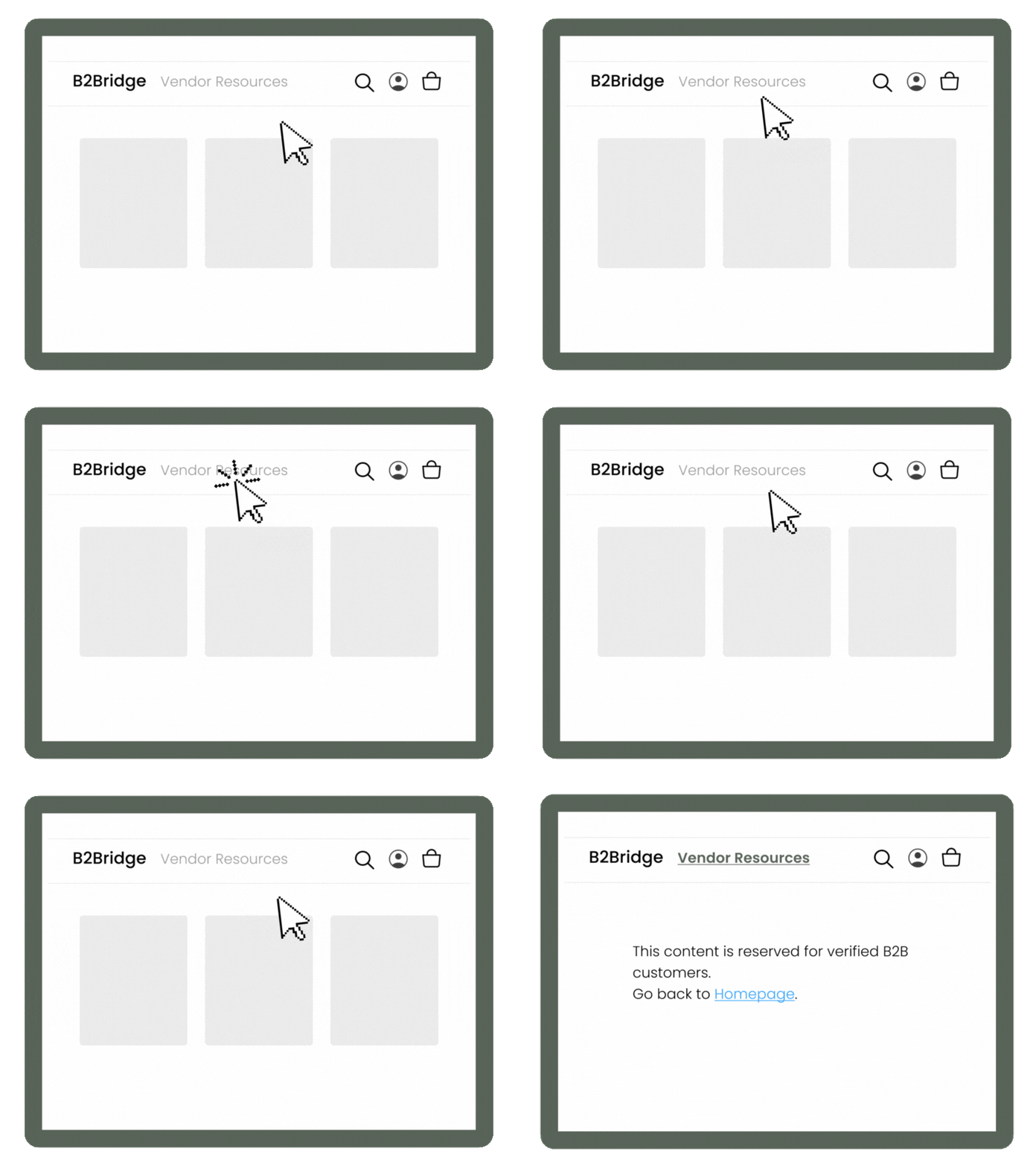
B2B sites with login-required pricing face a unique challenge: you want to protect wholesale pricing while still letting search engines index your products. The solution is separating what visitors log in to see (pricing) from what search engines index (product information, specs, and images).
Handle faceted navigation carefully to avoid creating thousands of duplicate pages from filter combinations. Use canonical tags or noindex directives on filtered URLs.
On-Page SEO for B2B Category and Product Pages
Industry-specific landing pages
Create pages like “Wholesale [Product] for [Industry]” that include industry-specific use cases and terminology. Link to relevant product categories from each landing page.
Industry landing pages capture searches from buyers who identify by their vertical first, product need second.
Category and collection page optimization
Add unique descriptive content to category pages rather than leaving them as simple product grids. Optimize category titles and meta descriptions for target keywords.
Category pages often have more ranking potential than individual product pages because they target broader, higher-volume terms.
Product detail pages with unique descriptions
Write original descriptions instead of copying manufacturer text. Include technical specs, dimensions, and compatibility information that buyers search for.
Add answers to common buyer questions directly on the B2B product page. This content serves both SEO and conversion by addressing objections before they arise.
How to Measure B2B Ecommerce SEO Performance
Connecting rankings and traffic to actual business outcomes requires tracking the right metrics for B2B contexts.
| Metric | What It Measures | Why It Matters for B2B |
|---|---|---|
| Keyword rankings | Search position for target terms | Indicates visibility for buyer searches |
| Organic sessions | Traffic from search engines | Shows reach of your SEO efforts |
| Pages per session | Catalog engagement depth | B2B buyers research multiple products |
| RFQ/quote submissions | Lead generation from organic | Connects SEO to pipeline |
| Account registrations | New B2B customer acquisition | Measures buyer conversion |
Focus on Cost per Lead (CPL) and RFQ volume rather than just traffic numbers. A hundred visits from qualified procurement managers beats ten thousand visits from consumers who can’t buy wholesale.
Common B2B Ecommerce SEO Mistakes to Avoid
- Using manufacturer descriptions verbatim: Creates duplicate content that search engines ignore across thousands of distributor sites
- Ignoring category page optimization: Missing opportunities to rank for high-volume terms that drive significant traffic
- Blocking too much content behind login: Prevents search engines from indexing valuable pages that could rank
- Neglecting mobile optimization: B2B buyers increasingly research on mobile devices, even if they complete purchases on desktop
- Focusing only on branded terms: Missing non-brand searches from new buyers who don’t know your company yet
- No internal linking strategy: Deep catalog pages never get discovered by crawlers or passed authority from stronger pages
Conversion-Focused SEO for Gated Pricing and RFQ Pages
SEO with hidden wholesale pricing
You can maintain SEO value when pricing is visible only to logged-in buyers. Keep product descriptions, specs, and images publicly crawlable while gating only the pricing information itself.
Use clear calls-to-action for account registration to see pricing, including volume discounts and tiered structures. This approach protects margins while still capturing organic traffic from product searches.

Optimizing RFQ and quote-to-order workflows
Create landing pages that explain your RFQ process for organic searchers. Target searches like “request quote [product]” or “[product] wholesale pricing.”
RFQ landing pages serve both SEO and conversion. They rank for high-intent queries and guide visitors toward your quote workflow rather than leaving them to search for a contact form.
B2B registration and account pages
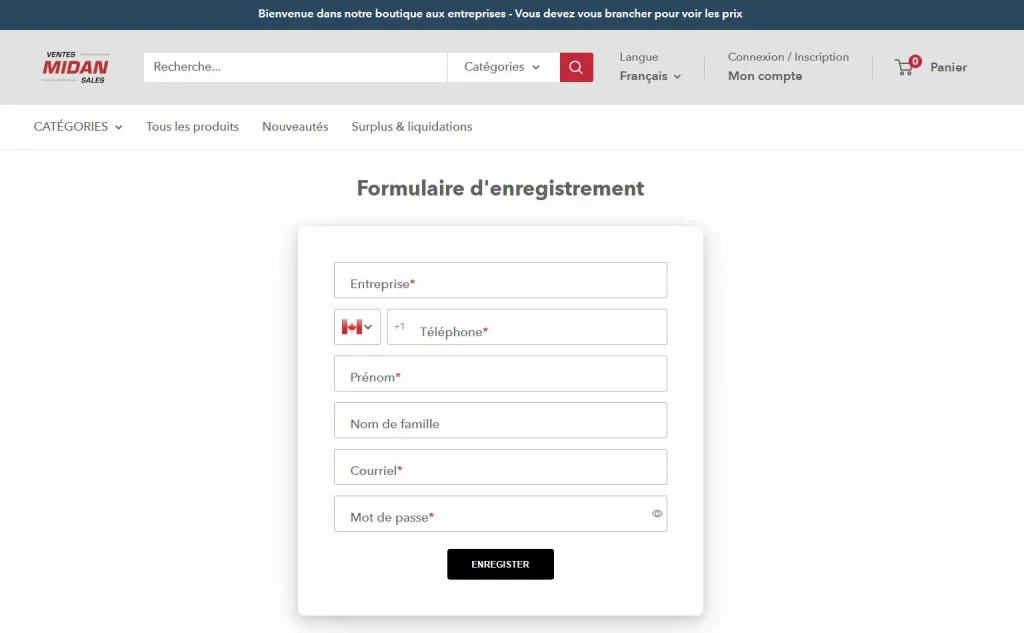
Create a dedicated wholesale registration landing page targeting searches like “become a [brand] distributor” or “wholesale account application.”
Include information about benefits and requirements publicly. This content ranks for partnership-related searches and pre-qualifies applicants before they submit.
Scale B2B Ecommerce SEO Inside Shopify with B2Bridge
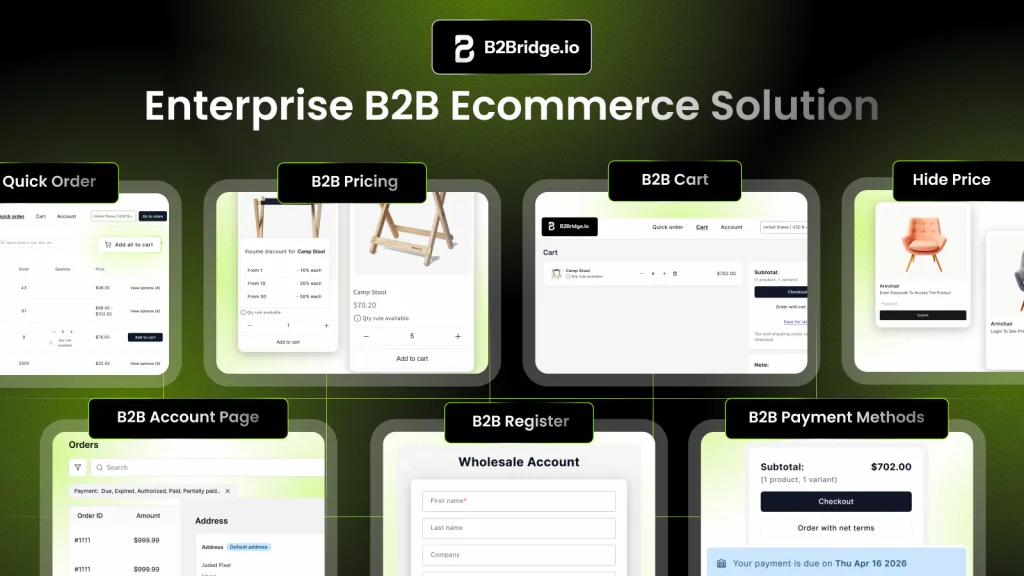
Running a unified B2B + B2C store on Shopify doesn’t mean sacrificing SEO for either channel. B2Bridge lets you keep product pages crawlable while gating wholesale pricing for approved buyers only.
The platform supports B2B conversion elements like quick order forms, net terms, and RFQ workflows within Shopify’s SEO-friendly structure. Your product pages remain indexable while the B2B buying experience stays protected for verified wholesale customers.
Deep ERP integrations maintain accurate product data that supports SEO. When your inventory, pricing, and specifications sync automatically, your catalog pages stay current without manual updates that often fall behind.
Book A Demo to see how B2Bridge supports SEO-friendly B2B ecommerce on Shopify.
FAQs about B2B Ecommerce SEO
How long does B2B ecommerce SEO take to show results?
Most B2B ecommerce sites see measurable ranking improvements within three to six months, with significant traffic gains taking six to twelve months depending on competition and starting point.
Can you do B2B ecommerce SEO if wholesale pricing is hidden?
Yes. You can gate pricing while keeping product descriptions, specifications, and images publicly crawlable so search engines can index and rank your pages.
How does AI search change B2B ecommerce SEO?
AI-generated search results prioritize clear, authoritative answers, making structured content and comprehensive topic coverage more important than keyword density alone.
Does running a hybrid B2B and B2C store hurt SEO?
A unified B2B and B2C store can actually strengthen SEO by consolidating domain authority rather than splitting it across separate sites. The key is structuring your site so search engines understand which pages target which audience.

As a Product Marketing Executive at B2Bridge, I focus on the Enterprise B2B Ecommerce domain. I leverage my understanding of product and user psychology to deliver customer-centric content that addresses business challenges and fuels growth.