The global B2B ecommerce market is roughly five times the size of B2C — and it’s growing fast. Shopify B2B sales were up 130% year-over-year in early 2024, and brands across fashion, food, beauty, manufacturing, and automotive are proving that running a professional wholesale operation on Shopify isn’t just possible. It’s becoming the standard.
But abstract features don’t help you visualize what your own store could look like. Real examples do. This guide covers 20 actual Shopify B2B examples, organized by industry, with a clear breakdown of what each one gets right and what you can apply to your own setup. You’ll also find the specific B2B features that power these stores, along with a step-by-step framework for building your own.
What Makes a Shopify B2B Store Work
Not every Shopify store qualifies as a genuine B2B ecommerce experience. What separates the examples in this article from a standard retail store comes down to three structural capabilities: login-gated pricing, customer-specific price lists, and buyer-friendly ordering workflows. Stores that get all three right are the ones wholesale buyers return to.
The B2B ecommerce market has also matured. Business buyers now expect the same frictionless experience they get as consumers — with the addition of net payment terms (Net 30, 60, or 90), minimum order quantities (MOQs), and bulk ordering tools. The brands in this article have built those expectations into the fabric of their stores.
The Core Structure Every Shopify B2B Store Shares
Every functional Shopify B2B store runs on the same foundational architecture: Price List → Customer Group → Customer. Logged-in buyers automatically see the prices assigned to their group. Here’s how the sequence works:
- A buyer submits a registration form and is approved by the merchant.
- The merchant assigns the buyer to a Customer Group (e.g., “Tier 1 Distributors”).
- That Customer Group is linked to a Price List defining B2B prices for each product.
- When the buyer logs in, the Price List activates — B2B prices appear on product pages, collection pages, and at checkout.
This is meaningfully different from discount codes. Override Price — the pricing method used by best-in-class B2B setups — sets the actual product price at the variant level for each logged-in buyer. No “promotions” flag in reporting, no retail price visible to wholesale buyers, no confusion. The order shows the true B2B price.
What B2B Buyers Expect vs. What Retail Stores Deliver
Understanding the gap between a standard Shopify store and a B2B-configured store is the fastest way to understand why these examples stand out.
| B2B Buyer Expectation | Standard Retail Store | Shopify B2B Store |
| Account-specific pricing | Same price for everyone | Per-group Price Lists |
| Net 30/60/90 payment | Pay at checkout only | Net Terms checkout flow |
| Bulk ordering by SKU | Product-by-product add to cart | Quick Order Page |
| Reorder from history | Not available | B2B Account Page |
| Custom PO number field | Not available | B2B Cart custom fields |
| Tax exemption | Tax applied to all | Toggle per Customer Group |
| Gated wholesale pricing | Prices visible to everyone | B2B Lock / login-required |
Every store in the examples below hits at least three of these expectations. The best ones hit all seven.
Shopify B2B Examples by Industry
B2B on Shopify isn’t limited to one sector. Manufacturers, distributors, food brands, beauty wholesalers, and specialty retailers are all running successful programs. What follows are real Shopify B2B stores, organized by industry, with the key lesson each one teaches.
Hiut Denim
Hiut Denim is a premium Welsh denim brand with a clean balance between retail and wholesale. Wholesale buyers apply for a trade account through a gated registration flow; once approved, they access bulk pricing and minimum order quantities.
Key lesson: Trade account registration functions as a brand filter, not just a gating mechanism. By requiring an application, Hiut signals that their wholesale relationships are curated — which appeals to boutiques and stockists who want exclusivity.

Maguire Shoes
Maguire Shoes is a Canadian footwear brand operating a hybrid B2B and DTC store from a single Shopify instance. Wholesale buyers get login-based access to exclusive pricing and bulk ordering; retail visitors see standard prices.
Key lesson: You don’t need two Shopify stores to serve B2B and retail customers simultaneously. A login-gated wholesale pricing layer keeps the two channels cleanly separated on a single platform.

SANJO
SANJO, a Portuguese footwear brand, uses trade login accounts and tiered pricing for its retail buyer network. Larger orders automatically unlock deeper discounts without any manual calculation.
Key lesson: Tiered volume pricing removes the negotiation overhead from repeat wholesale relationships. Buyers know exactly what they’ll pay at each quantity level — which makes ordering decisions faster.

eFashion Paris
eFashion Paris operates as a wholesale marketplace for trade buyers. The site emphasizes product discoverability — strong categorization, filtering, and high-quality imagery — so buyers can browse and commit to bulk purchases confidently.
Key lesson: Product discoverability matters as much as pricing for B2B buyers managing large catalogs. Advanced search and filter options reduce the time between login and checkout.

Artisaire
Artisaire offers home décor and lifestyle products with a dedicated wholesale catalog and trade pricing that’s clearly distinct from their DTC range.
Key lesson: Separating your B2B product catalog from your retail range gives you the flexibility to offer exclusive B2B SKUs, bundle configurations, and case-pack options that retail buyers never see.

Tony’s Chocolonely
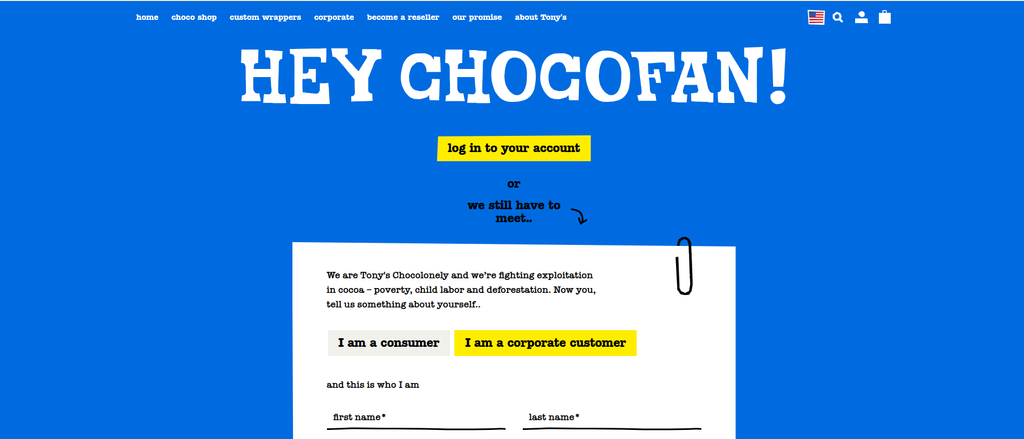
Tony’s Chocolonely runs one of the most recognized B2B portals in the consumer goods space — their “ChocoPortal.” Wholesale buyers manage tiered pricing, flexible payment options, and volume discounts inside a purpose-built branded portal that pulls data from the same Shopify instance as their DTC store.
Outcome: Double-digit revenue growth across four markets. Unified inventory, order, and customer data — no duplication between wholesale and retail systems.
Key lesson: A branded B2B portal built around your brand mission attracts retail partners who share your values. Tony’s ethical sourcing story isn’t separate from their wholesale sales pitch — it is the pitch.

Picky Bars
Picky Bars serves both DTC consumers and B2B buyers. Their wholesale channel supports subscription ordering, so café and distributor accounts can set up recurring deliveries without placing a manual order each cycle.
Key lesson: Subscription-based wholesale ordering makes sense for any consumable category — food, supplements, cleaning supplies. Recurring orders reduce buyer effort and reduce merchant churn from wholesale accounts simultaneously.

Rave Coffee
Rave Coffee is a UK specialty coffee brand with a wholesale store that mirrors its DTC brand exactly: same fonts, same colors, same UX logic. There’s no jarring handoff between the retail and B2B experience.
Key lesson: Brand consistency between B2C and B2B builds buyer trust. When a wholesale buyer visits a portal that looks identical to the consumer site, the experience feels intentional — not like a bolted-on afterthought.

Kraft Heinz
Kraft Heinz runs large-scale foodservice and distribution B2B operations on Shopify. Their implementation emphasizes catalog searchability and integration with logistics management for high-volume distributor accounts.
Key lesson: At enterprise scale, the infrastructure that matters most is catalog search, order management, and ERP (Enterprise Resource Planning) connectivity — not just pricing. The store is only as reliable as the systems it’s connected to.

AMR Hair & Beauty
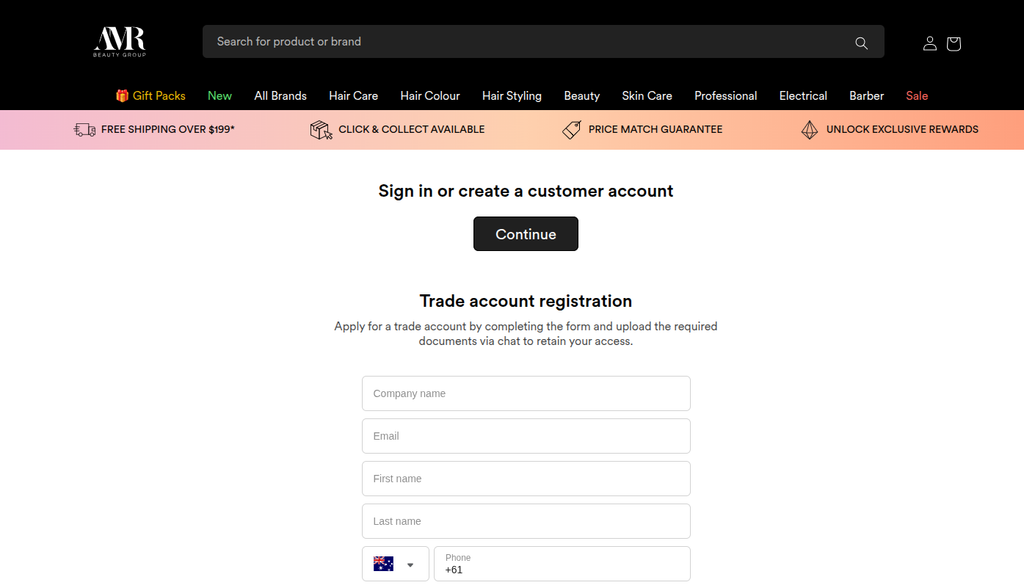
AMR Hair & Beauty is an Australian professional beauty distributor with over 6,000 products. Their Shopify store runs two login types — one for public consumers, one for B2B buyers — with 10 different pricing tiers for the B2B side. The correct tier activates automatically on login based on the buyer’s Customer Group assignment.
Outcome: 77% rise in B2B average order value (AOV), 200% increase in sales, and 93% growth in conversion rate year-over-year.
Key lesson: Multi-tier pricing isn’t complex to manage if your B2B platform handles the logic automatically. AMR didn’t manually apply 10 different price lists — the system did it for them on every login.

Dermalogica Pro
Dermalogica Pro is a professional skincare brand with an entirely gated B2B site for licensed skin therapists. Beyond pricing, the site functions as an educational hub: a learning library with on-demand workshops, clinical product fact sheets, and FaceMapping PRO — a digital platform for professionals to run client consultations.
Key lesson: B2B loyalty is built on value beyond price. When your portal gives buyers professional tools, education, and resources they can’t get elsewhere, switching to a competitor means losing those capabilities — not just finding a lower price.

Mooncup
Mooncup sells sustainable personal care products through a wholesale landing page that leads with brand story, product benefits, and testimonials before presenting the registration form. Prospective B2B buyers can explore FAQs and product options before committing to an application.
Key lesson: The registration page is a sales page — treat it like one. Brands that invest in the content surrounding the form (mission, product education, testimonials) convert more qualified wholesale applicants than those who present a blank form.

Angelus Direct
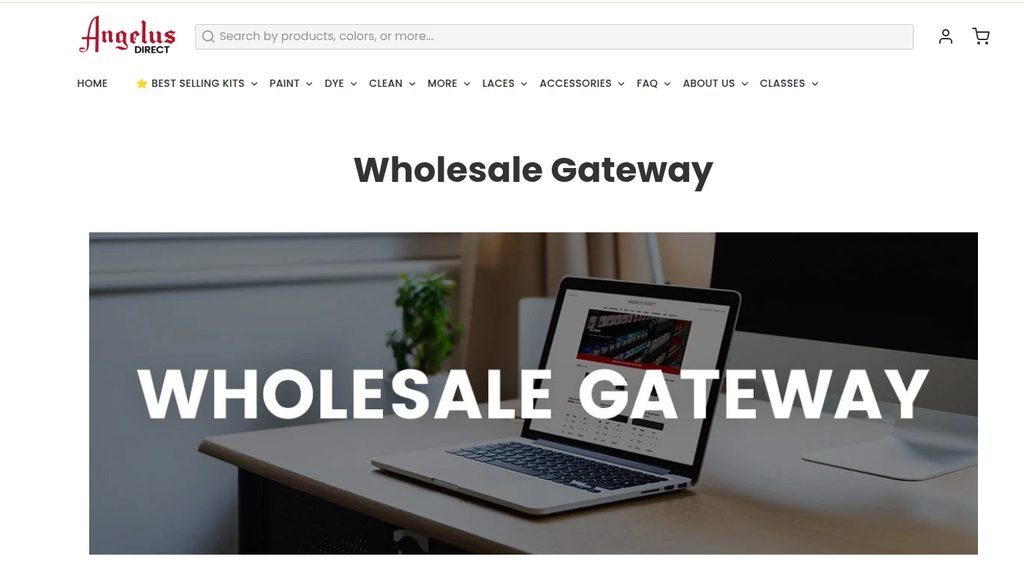
Angelus Direct makes leather paint and sneaker customization products. Before migrating to a Shopify B2B portal, their team processed wholesale orders through faxes, scratchpads, and email — with constant errors. Moving wholesale partners to a B2B portal eliminated the manual entry layer entirely.
Outcome: A 10x increase in global sales. “Now we channel wholesale partners to our B2B portal on Shopify, so there’s no discussion or intermediate area where someone might make a mistake,” says CEO Tyler Angelos.
Key lesson: Eliminating manual order entry error is one of the fastest and most measurable wins B2B merchants achieve. The ROI is immediate — fewer mistakes, fewer returns, less time spent correcting orders.

CeramicSpeed
CeramicSpeed is a premium Danish bicycle parts manufacturer with a global dealer network. Their B2B storefront delivers advanced search and filtering so buyers who know exactly which SKUs they need can find and order without browsing. They also use a Shopify mobile app enabling sales reps to place orders on behalf of dealers 5% faster while traveling.
Key lesson: For manufacturers selling through dealer and distributor networks, the speed at which a field sales rep can place an order on a customer’s behalf is an operational KPI. Self-serve and rep-assisted ordering must both work well.

Allied Medical
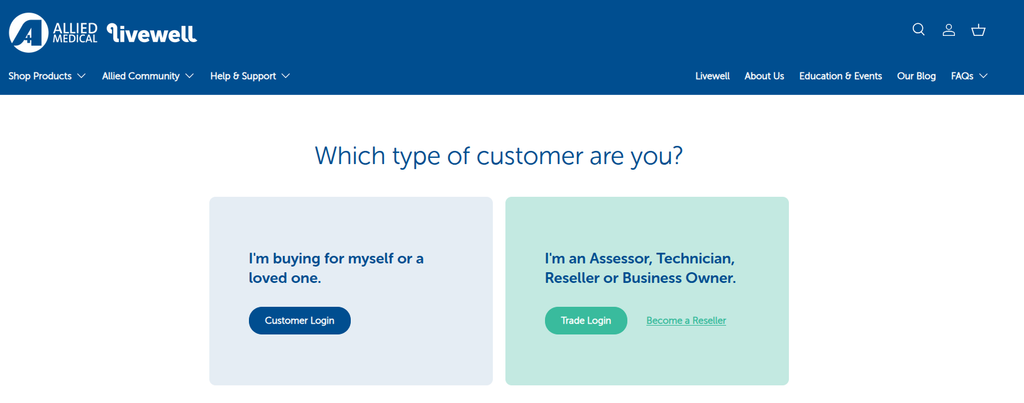
Allied Medical is a New Zealand healthcare brand with a custom B2B portal. They drive wholesale buyers to the portal through an SEO-focused content hub — articles targeting long-tail queries like “fixed frame vs. folding wheelchairs” that link directly to relevant products.
Key lesson: Content marketing works for B2B. Long-tail informational content that answers buyer questions and connects to product pages drives qualified traffic from buyers already in research mode — buyers who are closer to a purchase decision than a general brand awareness visitor.

Mokobara
Mokobara was a luggage DTC brand before expanding into B2B with a password-protected customer portal for wholesale buyers. The portal displays dynamic bulk pricing, self-serve reordering, and product customization options (engravings, corporate branding). Localized storefronts for India and the UAE automatically adjust currency, language, and payment methods.
Outcome: Doubled revenue, 30% growth, and 30% increase in customer retention year-over-year.
Key lesson: Multi-currency and localized B2B storefronts drive direct conversion in international wholesale markets. Buyers who see their own currency, language, and local payment options at checkout are significantly more likely to complete a purchase.

The Conran Shop
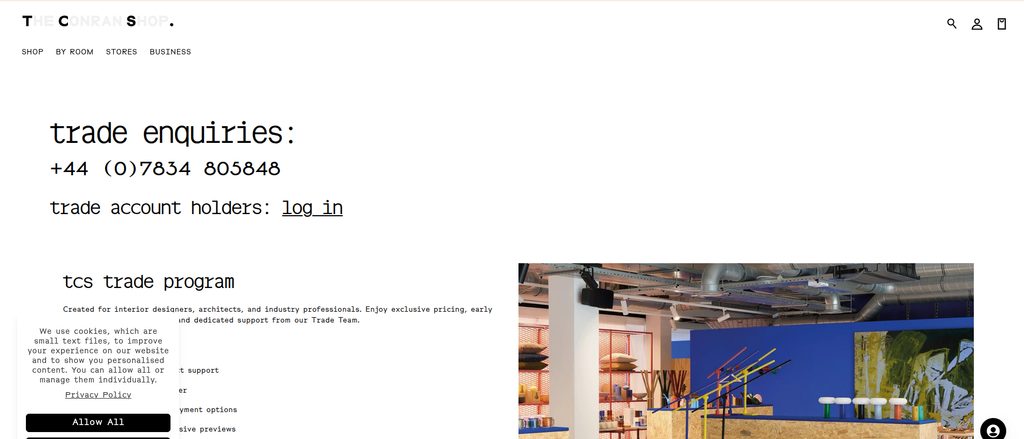
The Conran Shop is a premium furniture brand offering a specialized trade program for interior designers and architects. The program gives trade partners a dedicated account manager, competitive wholesale pricing, flexible payment and delivery, access to private events, and consultations at the London showroom.
Key lesson: Premium B2B segments — interior designers, architects, corporate buyers — respond to account-level service, not just online self-serve. Combining a digital portal with high-touch relationship management captures both the transactional and consultative dimensions of wholesale.

DECKED
DECKED sells truck bed storage and accessories through a dealer network. Instead of selling exclusively to other brands, DECKED uses a smart dealer locator that matches buyers to local partners by proximity, inventory availability, and display status — directing consumers to dealers who carry the most relevant product configurations.
Key lesson: For brands with complex purchase requirements or installation services, a dealer-routing tool can outperform pure self-serve. The locator turns your B2B portal into a traffic referral engine for your wholesale partners — which strengthens those relationships over time.

Boost Auto
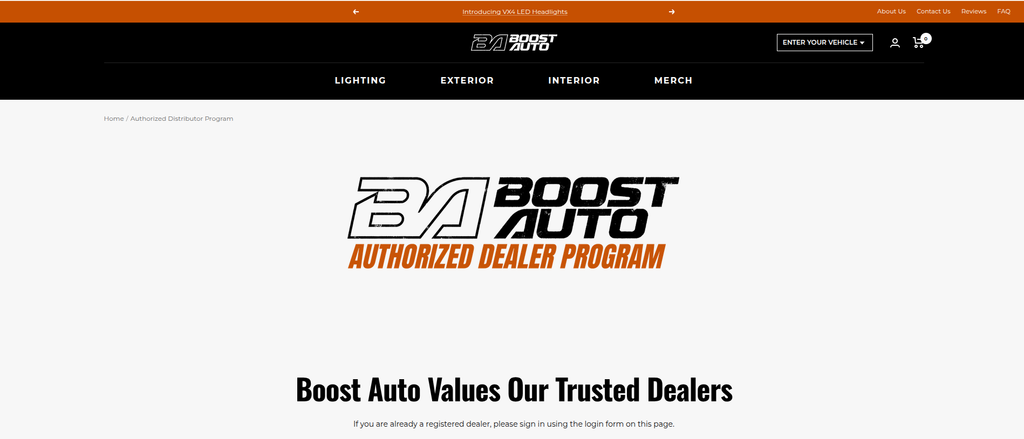
Boost Auto handles automotive parts wholesale with quick reorder functionality and detailed specification sheets for B2B buyers. Repeat customers can reorder from their order history without re-browsing the catalog.
Key lesson: In technical B2B categories, structured specification data matters as much as pricing. Bulk buyers make decisions based on specs, tolerance grades, and compatibility — not lifestyle imagery.

Mac Tools
Mac Tools distributes automotive tools to garages and dealers via a trade login portal featuring dedicated account access and category-level navigation tailored to distributor workflows.
Key lesson: High-value B2B accounts (dealers, garages, distributors) expect dedicated portal access and organized category navigation — not a retail store with a 10% trade discount applied at checkout.

Key B2B Features Behind These Stores
Every example above runs on a specific set of B2B capabilities. Understanding which feature powered which result helps you prioritize your own setup. Here’s the map:
| Feature | What It Does | Example Brands |
| Price Lists | Customer-specific B2B pricing per Customer Group | AMR Hair & Beauty (10 tiers), Mokobara, Tony’s Chocolonely |
| B2B Lock / Gated Access | Hides prices and add-to-cart until buyer logs in or registers | Dermalogica Pro, Hiut Denim, Maguire Shoes |
| Net Payment Terms (Net 15/30/60/90) | Deferred payment checkout flow for approved buyers | Kraft Heinz, distributor networks |
| B2B Registration Form | Customizable sign-up with approval workflow | Mooncup, Hiut Denim, SANJO |
| Quick Order Page | Single-page bulk ordering across the catalog | CeramicSpeed, Microfiber Wholesale |
| B2B Account Page | Self-serve portal for order history and reorders | Angelus Direct, Mokobara |
| Volume Discounts | Tiered pricing by quantity purchased | Tony’s Chocolonely, eFashion Paris |
| Override Price | Sets actual B2B price at variant level — no discount codes | All examples — keeps reporting accurate |
B2B Pricing: The Engine Behind Every Example
B2B pricing on Shopify works through Price Lists. A merchant defines B2B prices in one of four modes: PERCENT (a percentage discount off original price), FIXED (a set reduction), NEW (a completely new price), or CUSTOMIZE (a different price per product). These prices activate automatically when a logged-in buyer from the assigned Customer Group visits the store — they see their negotiated price on every product page, collection page, and in their cart.
Volume discount tiers layer on top. A distributor might see $50 per unit for orders under 50, $42 per unit for 50–99, and $38 per unit for 100 or more — all calculated and displayed automatically without manual intervention. AMR Hair & Beauty’s 10 pricing tiers across 6,000+ products is the most extreme version of this, but the same architecture powers a two-tier setup just as cleanly.

Gated Access: The Mechanism That Protects Wholesale Pricing
B2B Lock controls who can see your wholesale prices. Three lock types appear across the examples above:
- Login-required lock: Prices and add-to-cart buttons are hidden until the buyer logs in. Dermalogica Pro gates its entire ecommerce section this way. AMR Hair & Beauty and Maguire Shoes gate only the wholesale pricing tier.
- Password-protected collections: Specific product catalogs or sections require a password. Useful for exclusive distributor ranges or early-access launches.
- Page-level locks: Individual internal pages — dealer pricing sheets, partner resources, training materials — are restricted to specific Customer Groups.
Locked pages also serve as lead capture. A visitor who hits a locked page can see a “Register for a wholesale account” call to action — turning access denial into an application prompt.

Net Payment Terms: Why B2B Buyers Expect to Pay Later
Net Payment Terms — or net terms — let a wholesale buyer receive their order first and pay within an agreed window: Net 15, Net 30, Net 60, or Net 90. Standard B2B practice since before ecommerce existed. But most Shopify stores don’t support it natively, so buyers who need net terms default to placing orders by phone or email — the exact manual workflows that erode margin and create errors.
Net terms are configured per Customer Group. A key account with an established payment history gets Net 60; a newer account requires upfront payment or Net 15 until trust is established. Orders placed on net terms route to a dedicated checkout flow, create a Shopify draft order by default, and can be tagged for easy filtering in the admin.

B2B Registration: Turning Your Application Page into a Sales Page
Every buyer in the examples above started as an applicant. The registration form collects business credentials — company name, tax ID, resale certificate, website, order volume — and routes the application to the merchant for approval. On approval, the buyer is auto-tagged, assigned to a Customer Group, and immediately given access to the correct Price List.
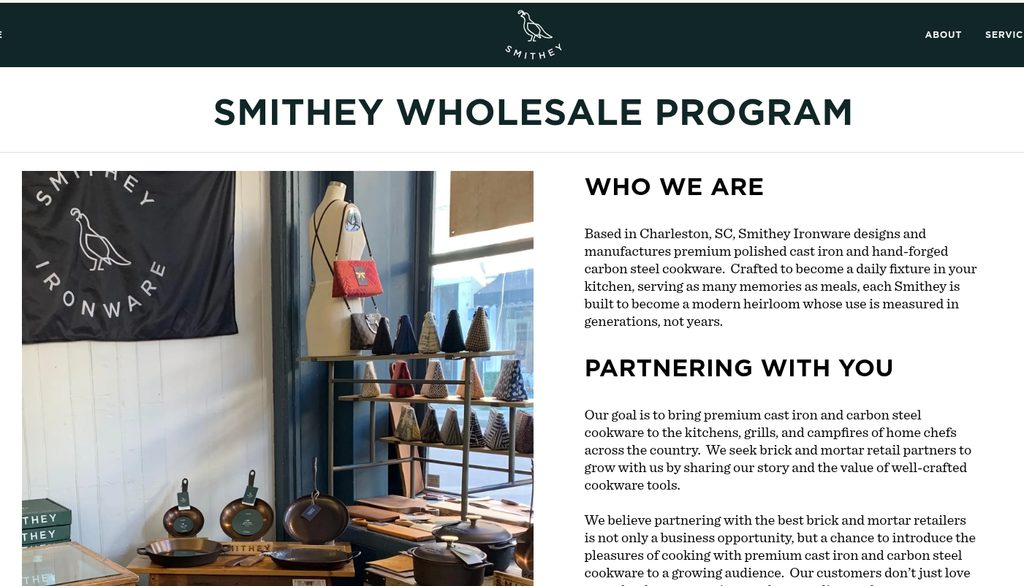
What Mooncup gets right: the registration page is surrounded by brand story, product education, testimonials, and FAQs. Smithey Ironware splits their landing page into two clear sections — existing customers log in above, new applicants apply at the bottom. Both approaches treat the registration page as a conversion surface, not a form dump. The brands that invest in the content around the form see more qualified applicants and fewer rejections.

How to Build a Shopify B2B Store Like These Examples
Reading the examples above raises a practical question: which of these patterns applies to your business, and where do you start? Here’s the framework.
Step 1 — Choose Your B2B Access Model
Three access models appear across the examples. Choose the one that matches your relationship between wholesale and retail:
- Full store lock — the entire store requires login (Dermalogica Pro). Best for brands with no DTC presence, or brands whose retail and wholesale product ranges are identical and confidentiality matters.
- Hybrid lock — B2B prices are gated behind login, but retail prices are visible to all visitors (AMR Hair & Beauty, Maguire Shoes, Mokobara). Best for brands running B2C and B2B from one Shopify store.
- Password-protected section — specific collections or catalogs are restricted (Angelus Direct wholesale portal). Best for brands with distinct product lines or pricing structures across their B2B and DTC channels.
The guiding question: “Do I want retail visitors to see retail prices alongside my wholesale section, or do I want my wholesale pricing invisible to everyone who isn’t a verified buyer?”
Step 2 — Set Up Your Price List and Customer Group Structure
Every store above runs on the same configuration sequence:
- Create a Price List — define the B2B prices for your product set using PERCENT, FIXED, NEW, or CUSTOMIZE pricing.
- Create a Customer Group — name your buyer segment (e.g., “Tier 1 Distributors”), and assign the Price List to it.
- Assign a customer tag — this tag identifies which buyers belong to which group. When a buyer is added manually or approved via registration, they’re auto-tagged.
- Install the theme code — so B2B prices actually display on your storefront product pages and collection pages.
For merchants with multiple buyer tiers — Gold/Silver/Bronze distributors, regional pricing, key account contracts — each tier becomes a separate Customer Group with its own Price List. The architecture scales without any workarounds.

Step 3 — Configure Buyer-Specific Payment and Order Rules
The best B2B stores match payment and ordering rules to buyer type. A key account with $500K in annual volume gets Net 60 and no MOQ. A newer account gets Net 15 and a $500 minimum order. Here’s what Customer Group settings control:
- Payment method: online payment only, net terms only, or both simultaneously
- Tax exemption: toggle tax collection on or off for the entire group — changes sync automatically to each customer’s Shopify admin profile
- Order limits: minimum and maximum order quantities, applied per product or across the entire order
- Product increments: force purchases in multiples — a food brand might require orders in multiples of 12 for case-pack integrity
Tony’s Chocolonely’s ChocoPortal shows this in action from the buyer’s side: tiered pricing is visible upfront, volume thresholds are clear, and the checkout reflects the correct price based on cart quantity. No negotiation. No confusion.

Step 4 — Launch with the Quick Order Page and B2B Account Portal
Two buyer-facing features determine whether wholesale buyers actually reorder — or reach for the phone instead.
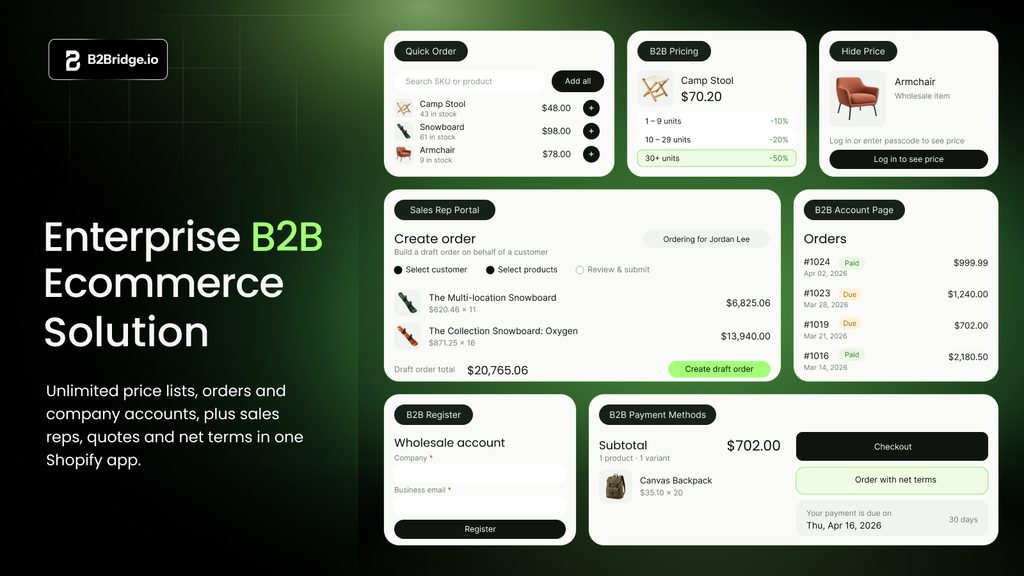
The Quick Order Page lets a buyer place a bulk order across dozens or hundreds of SKUs from a single page. No browsing required. They enter quantities next to SKU names, the cart updates, and they check out. For repeat buyers who know exactly what they need each cycle — like a café reordering coffee or a salon restocking products — this is the difference between a 3-minute reorder and a 20-minute process.
The B2B Account Page gives buyers a self-serve portal: order history, current order tracking, reorder from past purchases, and access to saved carts. Buyers who can manage their own account without contacting the merchant place orders more frequently and ask fewer support questions. CeramicSpeed’s field sales reps use this capability through the Shopify mobile app — placing orders on behalf of dealers while on the road, with full access to real-time inventory.

Build Your Own Shopify B2B Store with the Right Foundation
Every store in this article shares one structural truth: a reliable pricing and access control foundation is what makes everything else possible. Price Lists and Customer Groups determine who sees what price. B2B Lock keeps wholesale pricing confidential from retail visitors. Registration Forms control who qualifies. Net Terms remove payment friction for established buyers. And a Quick Order Page makes reordering fast enough that wholesale accounts never reach for the phone.
That foundation is the difference between a Shopify store that happens to have a few wholesale accounts and a Shopify B2B store that manufacturers, distributors, and large wholesalers actually prefer to use. The examples in this article built it. The results — 77% AOV growth, 10x sales, doubled revenue — followed from it.
If you’re a manufacturer, distributor, or wholesaler ready to build or upgrade your B2B operation on Shopify, B2Bridge gives you every feature in this article — Price Lists, Customer Groups, Net Terms, B2B Registration, Quick Order Page, B2B Account Portal, RFQ (Request for Quote), and a Public API for ERP integration — in a single app, without Shopify Plus, with hands-on setup support from day one.

FAQs about Shopify B2B Examples
Do I need Shopify Plus to build a B2B store like the examples above?
No. Most of the features powering the examples in this article — Price Lists, Customer Groups, Net Payment Terms, B2B Lock, Quick Order Pages, and B2B Registration Forms — are available without Shopify Plus through dedicated B2B apps. Shopify did expand some native B2B features to non-Plus plans in April 2026, including up to 3 B2B catalogs, company profiles, payment terms, and volume pricing. However, unlimited catalogs, direct catalog assignment to company locations, partial payments, and deposits remain Plus-exclusive. For merchants who need enterprise-grade B2B without the Shopify Plus price tag ($2,300/month), a dedicated B2B app covers the full feature set at a fraction of the cost.
Can I run B2B and DTC from the same Shopify store?
Yes — and it’s the most common setup in the examples above. AMR Hair & Beauty, Maguire Shoes, Tony’s Chocolonely, and Mokobara all run B2B and DTC from the same Shopify instance. B2B buyers log in and see their assigned pricing; retail visitors see standard prices. Both channels share inventory, admin, and reporting — no second store, no duplicate management overhead. The key requirement is a B2B pricing layer that activates on customer login status and Customer Group assignment. Once that’s in place, the same Shopify store serves both audiences cleanly.
How do the best Shopify B2B stores handle pricing for different buyer tiers?
Through Customer Groups. Each group has its own Price List — a different discount structure, pricing type, or product selection. AMR Hair & Beauty runs 10 B2B pricing tiers, each activated automatically at login. Tony’s Chocolonely uses volume discount tiers so larger cart quantities unlock deeper per-unit discounts without the buyer doing any math. Merchants with Gold/Silver/Bronze distributors, regional pricing differences, or key account contracts model each as a separate Customer Group linked to its own Price List. The buyer never sees the underlying structure — they just see their price.
What is the difference between a B2B store on Shopify Plus vs. a regular Shopify plan?
Shopify Plus includes native B2B features: company accounts with multi-user logins, unlimited catalogs, direct catalog assignment to companies and locations, partial payments, and deposits. As of April 2026, regular Shopify plans (Basic, Grow, Advanced) support up to 3 active B2B catalogs, company profiles, payment terms, volume pricing, and ACH payments in the US. For merchants who need more than 3 catalogs, direct company-level catalog assignment, or deposits and partial payments, either Shopify Plus or a dedicated B2B app fills the gap — with the app route offering the full feature set without the Plus subscription cost.
How long does it take to build a Shopify B2B store like the ones in this article?
With the right app and setup support, most merchants launch a functional B2B store in days. Filtrous — a lab equipment brand — migrated to Shopify and launched in 63 days, including ERP connectivity. The foundational setup (Price List, Customer Group, B2B Lock, and Registration Form) can be configured in a single working session. More complex setups involving ERP (Enterprise Resource Planning) integration, multi-currency pricing per Shopify Market, or 10+ pricing tiers take longer — but follow the same architecture. The timeline scales with complexity, not with the platform.
Which industries use Shopify B2B the most?
Fashion and apparel, food and beverage, beauty and personal care, industrial manufacturing, home and lifestyle, and automotive are all well-represented in the Shopify B2B ecosystem. The common thread across all industries: brands that sell to retailers, distributors, or trade buyers alongside their direct-to-consumer operations. The hybrid B2B + DTC model — one store serving both audiences — is the most common pattern. Shopify B2B is particularly strong for manufacturers and distributors who need account-specific pricing and payment terms at scale.