The Shopify B2B catalog limit gives Basic, Grow and Advanced stores 3 active catalog assignments across all B2B markets, and Plus removes the cap. Each assignment counts per market, so one catalog on two markets uses two of your three. Past that point, you consolidate tiers, rotate drafts, upgrade to Plus or add an app.
Three catalogs cover a tidy, tiered wholesale program. They stop working the day one buyer negotiates a price that none of your tiers match. This guide shows how Shopify counts the limit and what each way past it costs per month.
Key takeaways
- Non-Plus stores get 3 active catalog assignments in total, shared across every B2B market.
- Catalogs attach to markets below Plus, so one company can’t get a catalog of its own.
- Draft catalogs don’t count, which helps seasonal pricing but not everyday tiers.
- A fourth price level means Plus (from $2,300/mo) or a B2B app with unlimited price lists.
What Is the Shopify B2B Catalog Limit?
The Shopify B2B catalog limit is a cap of 3 active catalog assignments on the Basic, Grow and Advanced plans. Shopify Plus has no cap. The rule comes from Shopify’s B2B features by plan page, and it has applied since native B2B reached non-Plus plans on April 2, 2026 (Shopify News).
A catalog is a set of products plus the prices a group of B2B buyers pays for them. You can set a percentage off retail or a fixed price per variant.
| Plan | Active catalog assignments | Catalogs assigned to one company |
|---|---|---|
| Basic, Grow | 3 | No |
| Advanced | 3 | No |
| Plus | Unlimited | Yes |
Everything else in native B2B features works the same across these plans. The catalog count is where they split. That’s why the number decides more wholesale plans than any other line in the table.
How the Three-Catalog Limit Counts Your Catalogs
Shopify counts each catalog assignment to a market. Most guides shorten this to “3 catalogs”, and that shorthand hides how fast you can run out.
Assignments Count Per Market
One catalog assigned to two active B2B markets uses two of your three assignments. Shopify’s help center gives that exact example. A “US Retailer” catalog shared with a Canada market leaves you one slot, and regional selling burns the allowance faster than tiering does.
Draft Catalogs Don’t Count
A catalog set to Draft, or removed from its market, frees an assignment. That suits seasonal, launch or trade-show pricing. It doesn’t suit everyday tiers. A draft catalog prices nothing, so the buyers who need it lose their rate.
Catalogs Attach to Markets Below Plus
Below Plus, you assign catalogs to B2B markets, never to a single company. Every company location in a market shares that market’s catalogs. A contract customer can’t get private pricing natively, so the deal either fits a tier or uses one.
How Shopify Picks a Price When Catalogs Overlap
Overlapping catalogs follow a precedence rule. Among market catalogs, the more specific market wins, and only equally specific catalogs fall back to the lower price (Shopify help center). Plan overlaps on purpose, or a promo can undercut a contract rate.
Signs Your Wholesale Program Has Outgrown Three Catalogs
You’ve outgrown three catalogs when the prices you actually agree with buyers outnumber the catalogs Shopify lets you run. The rate card rarely tells you this. Your order history and your inbox do.
Watch for four signals:
- You quote more distinct price levels than you have catalog assignments, once you count every negotiated rate.
- A new account signed on a rate that none of your tiers match, and someone is applying it by hand.
- Agreed prices live in a spreadsheet or an email thread instead of the store.
- You sell to two or more B2B markets, and each one needs its own pricing.
The third sign is the easiest to miss. A spreadsheet of exceptions is a count of the prices your storefront can’t express. Every row is a manual step at order time and a chance to invoice the wrong amount.
Wholesale programs grow one negotiation at a time, and the rest of the native limits tend to show up in the same order. The catalog cap is usually first.
Which way out fits your program?
Five Ways to Work Around the Shopify B2B Catalog Limit
You can consolidate tiers, use price breaks, rotate draft catalogs, upgrade to Plus or add a B2B app. They’re listed here from cheapest to most capable.
Consolidate Your Tiers Into Three
Merge tiers that differ by a point or two. It costs nothing but a pricing conversation with buyers who move. It works best when your wholesale pricing tiers grew by accident over the years.
Replace Extra Tiers With Quantity Price Breaks
Shopify allows up to 10 price breaks per product inside a catalog. If two tiers differ only by order size, volume discount pricing replaces a catalog. Note that volume pricing fixes the price, so catalog percentage adjustments stop applying.
Rotate Catalogs With Draft Status
Switch seasonal or event catalogs to Draft when they’re not in use. You keep three live slots for daily pricing. It’s a scheduling fix, and buyers who need a rate every day still need a slot.
Upgrade to Shopify Plus
Plus removes the cap, adds direct company catalogs and unlocks deposits and partial payments. It starts at $2,300 a month. If you need deposits, an app won’t replace them. The Shopify B2B vs Shopify Plus comparison covers the rest.
Add a B2B App With Unlimited Price Lists
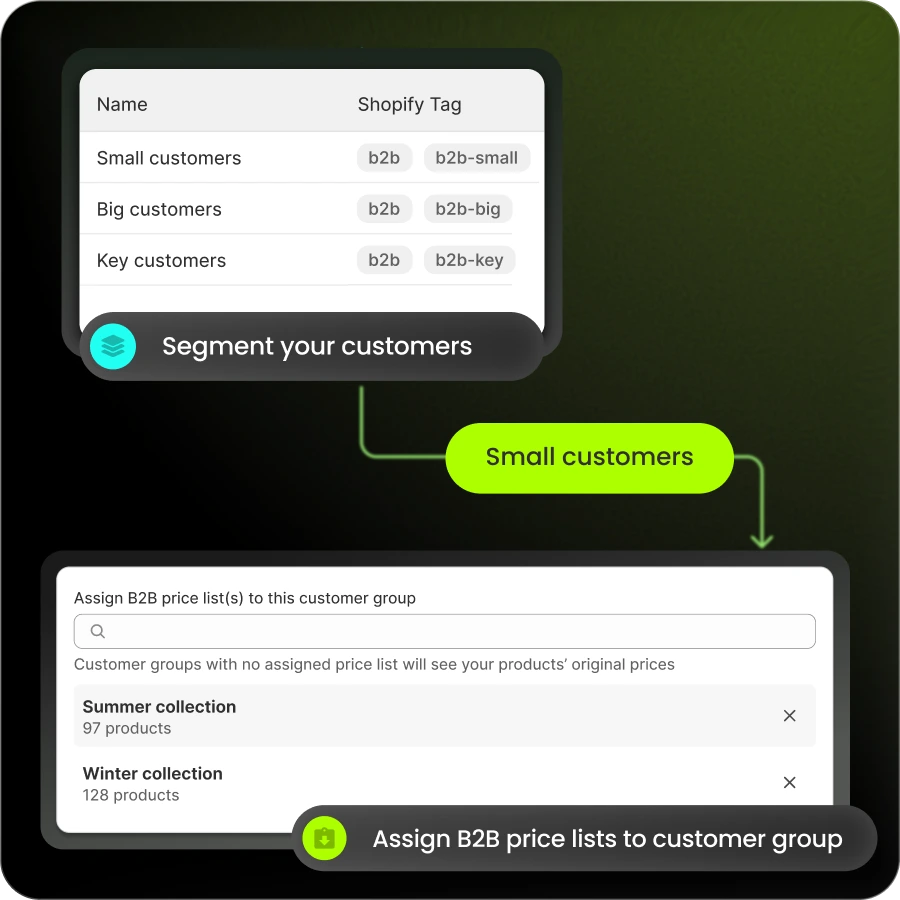
A B2B app keeps your plan and manages price lists outside Shopify’s catalog cap. B2Bridge gives you unlimited price lists and customer groups, and tag-based pricing apps exist too. Use one pricing source per buyer group so prices don’t stack.
Workarounds That Break as You Grow
Discount codes, a second store, custom code and manual draft orders all get you a fourth price. Each one costs a little more to run every month you keep it.
Discount Codes for Tier Four
Codes leak to retail shoppers. Orders also report as retail sales minus a promotion, which hides your true wholesale revenue. That gap grows with every order and makes ERP reconciliation slower.
A Separate Wholesale Store
A second store means a second plan fee and a second theme. Inventory drifts between them. The blended vs dedicated store trade-off only favors a split when wholesale needs its own brand.
Custom Shopify Functions
A developer can write pricing logic with the Discount Function API, which allows up to 25 active discount functions per store. You pay for the build, then for every change your pricing needs.
Manual Draft Orders for Contract Accounts
Your team builds each contract order by hand at the agreed price. It works for two or three accounts. Past that it becomes a job, and buyers lose self-serve reordering.
What Each Option Costs by Scenario
For most hybrid brands with 4–10 price levels, a B2B app on the Grow plan costs roughly a tenth of Shopify Plus. The table compares monthly list prices for four common setups.
| Scenario | Native B2B only | Shopify Plus | Grow + B2Bridge |
|---|---|---|---|
| 3 tiers, one B2B market | Grow $105/mo, fits | From $2,300/mo | Not needed |
| 5 tiers + 2 contract accounts, one market | Doesn’t fit | From $2,300/mo | $105 + Professional $99 = $204/mo |
| 5 tiers across US and EU, sales reps, credit limits | Doesn’t fit | From $2,300/mo, no native credit limits | $105 + Growth $199 = $304/mo |
| Needs deposits or partial payments | Doesn’t fit | From $2,300/mo | Doesn’t fit, Plus required |
Shopify prices are US monthly-billing rates from Shopify’s pricing page; B2Bridge prices from b2bridge.io/pricing. Both checked November 10, 2026.
Plus still wins in two places. Deposits and partial payments are Plus-only, and so is deeper checkout customization. If your terms depend on either, the app column isn’t an option. The Shopify B2B pricing breakdown covers annual billing.
How to Choose the Right Path for Your Catalog Count
How many prices do you actually quote? Start there, because the answer usually picks the path for you.
- Count distinct agreed prices. Include every negotiated rate as well as the tiers on your rate card.
- Stay native if the count is 3 or less. One market and stable tiers fit what you already pay for.
- Go to Plus for payment terms Shopify locks. Deposits, partial payments and custom checkout logic need it.
- Add an app for more price levels. That covers per-account pricing without the other Plus features.
- Re-count every quarter. New accounts move the number faster than you’d expect.
Most hybrid brands land on step 2 or step 4. A few large distributors land on step 3, and the Shopify Plus alternatives for B2B guide helps if you’re on the fence. Either way, you’ll know your monthly cost before the fourth account signs.
Move Past Three Catalogs With B2Bridge
Once your price count passes three, B2Bridge removes the ceiling without a platform change. You get unlimited price lists and customer groups against native B2B’s 3 catalog assignments. A contract buyer can sit in a customer group of their own, so their agreed price lives in the store where checkout can apply it.
The rest of your wholesale program runs in the same app:
- Approve wholesale applicants through a registration form before they see prices.
- Hide prices and lock products from logged-out visitors.
- Let buyers reorder fast with quick order and net payment terms.
- Give reps a Sales Rep Portal, plus credit limits and quotes, on Growth.
- Sync price lists with NetSuite, Zoho or Odoo through the Public API on Advanced.
Plans are Professional $99, Growth $199 and Advanced $299 a month, with Enterprise on request, after a 14-day free trial. See how it compares in B2Bridge vs Shopify B2B.
Book a Demo to see unlimited price lists on your own store.
FAQs About the Shopify B2B Catalog Limit
Does the catalog limit cap how many wholesale customers I can have?
No. The limit counts active catalog assignments only, so your number of companies, buyers and orders isn’t affected. One catalog can serve any number of wholesale accounts that pay the same price, so tiered programs scale without hitting it.
Does the Advanced plan raise the catalog limit?
No. Basic, Grow and Advanced all get 3 active catalog assignments. Advanced adds contextual storefront and checkout through Shopify Markets, which changes what B2B buyers see, but it doesn’t add catalog slots.
What happens to my catalogs if I upgrade to Shopify Plus?
They carry over unchanged. Companies, catalogs and payment terms are the same native features on every plan. Plus removes the assignment cap and lets you assign catalogs directly to company locations.
Can I use a B2B app and native catalogs at the same time?
Yes, in many setups, but give each buyer group one pricing source. If a native catalog and an app both price the same buyer, rates can stack. Test real orders as each buyer type before launch.
Is B2B available on the Shopify Starter or Retail plan?
No. Shopify B2B runs on the Basic, Grow, Advanced and Plus plans only. Starter and Retail plans don’t include companies or catalogs, so you’d need to upgrade before setting up wholesale pricing.

As a Product Marketing Executive at B2Bridge, I focus on the Enterprise B2B Ecommerce domain. I leverage my understanding of product and user psychology to deliver customer-centric content that addresses business challenges and fuels growth.