Wholesale profit margin is the percentage of your wholesale selling price that remains after you subtract the cost of the goods sold. Gross profit divided by revenue gives you the margin. A product costing $60 and selling for $100 carries a 40% gross margin and a 66.7% markup, two numbers that describe the same $40 of profit.
Most wholesale businesses know their revenue. Far fewer know their margin per product, per customer tier, per order. This guide gives you the formulas, a calculator, sourced industry benchmarks, and the pricing controls that hold a floor once your catalog is too large to check by hand.
Want to work from a target price instead? The wholesale price calculator runs the same math in reverse. For blended store-level numbers, use the Shopify profit margin calculator.
Wholesale Profit Margin Calculator
The calculator below returns four numbers. Gross margin, markup, net margin after operating costs, and the price a target margin requires. Enter your cost of goods and your wholesale price. Then read whichever tab matches the decision you’re making.
Free B2B Tool
Wholesale profit margin calculator
Work out gross margin, markup, net margin after carrying cost, and whether each of your wholesale pricing tiers still clears its margin floor.
Set one margin floor, then check every buyer tier against it.
Here’s what each tab produces from the same $60 cost of goods.
| Calculator tab | Inputs | Result |
|---|---|---|
| Basic | COGS $60, selling price $100 | 40% gross margin, 66.7% markup, $40 gross profit |
| Net Margin | COGS $60, price $100, warehouse $8, admin $5, fees $3 | 40% gross margin, 24% net margin |
| Tier Pricing | COGS $60, minimum margin 25% | Distributor $80, retailer $90, new account $100 |
| Product Pricing | COGS $60, target margin 40% | Required selling price $100 |
What Is Wholesale Profit Margin?
Wholesale profit margin measures the share of revenue you keep after paying for the product. It’s the number that separates a profitable wholesale operation from a merely large one.
Wholesale margin behaves differently than retail margin. You sell in bulk at lower per-unit prices. Your buyers expect account-specific pricing, volume discounts, and deferred payment. Each concession moves your margin. Don’t grant one before you know what the number can absorb.
Three measures matter in B2B.
- Gross margin is revenue minus cost of goods sold, as a percentage of revenue. It measures product-level profitability.
- Net margin is revenue minus every cost, as a percentage of revenue. It measures whether the business works.
- Wholesale margin is the spread between your landed cost and the price a specific customer group pays.
Wholesale Margin Formulas and Worked Examples
Four formulas cover almost every wholesale pricing decision, and mixing up the first two is the most expensive arithmetic error in wholesale. It’s also the most common.
| Metric | Formula | Calculated on | Best used for |
|---|---|---|---|
| Gross margin | (Revenue − COGS) ÷ Revenue × 100 | Revenue | Product-level pricing |
| Markup | (Price − Cost) ÷ Cost × 100 | Cost | Setting an initial price |
| Net margin | (Revenue − All costs) ÷ Revenue × 100 | Revenue | Overall business health |
| Required price | COGS ÷ (1 − Target margin) | Cost | Pricing to a margin floor |
Gross Margin Formula
Gross margin tells you how much of every sales dollar survives the cost of the product. A $100 sale on a $60 product returns $40 of gross profit. That’s a 40% gross margin.
Markup Formula
Markup sits on cost rather than revenue, which makes it the larger number. That same $60 product sold at $100 carries a 66.7% markup, and it’s still a 40% margin. Price to a 50% markup expecting a 50% margin and you’ll land at 33.3%.
Net Margin Formula
Net margin subtracts warehousing, admin, payment fees, software, and tax as well as COGS. Add $16 of operating cost to that $100 sale. The 40% gross margin becomes a 24% net margin. That’s the number that pays your rent.
Required Price Formula
Work backward when you’ve got a floor to hold. A $60 cost at a 40% target margin needs a $100 wholesale price, because $60 divided by 0.60 is $100.
How to Calculate Distributor Margin
Distributor margin is the gross margin a distributor earns between the price it pays a manufacturer and the price it charges a retailer. The formula is identical to wholesale gross margin. What changes is where you sit in the chain.
Each stage applies its own margin to the price it paid. That’s how a $40 production cost reaches the shelf at $130.
| Stage | Buy price | Sell price | Gross margin |
|---|---|---|---|
| Manufacturer | $40 to produce | $60 | 33.3% |
| Distributor | $60 | $80 | 25.0% |
| Retailer | $80 | $130 | 38.5% |
Distributors usually run thinner margins than the brands they carry, because they add logistics and credit rather than product. Lower percentage, faster turns. If you sell to distributors and retailers from one catalog, calculate each tier separately and set the floor per tier. A distributor pricing structure that averages the two hides the weaker one, and you won’t see it until the quarter closes.
Wholesale Profit Margin Benchmarks by Industry
Margin targets vary widely by sector. A number that’s healthy in apparel would be unsurvivable in food distribution. The table below reports gross and net margins by sector for US-listed companies, as of January 2026, from Aswath Damodaran’s margin dataset at NYU Stern.
| Sector | Gross margin | Net margin |
|---|---|---|
| Apparel | 56.9% | 3.9% |
| Healthcare products | 54.0% | 9.6% |
| Household products | 51.0% | 11.7% |
| Machinery | 37.5% | 10.6% |
| Retail distributors | 30.6% | 6.1% |
| Electronics (general) | 26.8% | 6.5% |
| Food processing | 23.2% | 2.8% |
| Food wholesalers | 15.4% | 1.2% |
| Total US market | 37.8% | 9.7% |
Read the two columns together. Apparel holds a 56.9% gross margin and keeps 3.9% at the bottom line. Household products convert a lower 51.0% gross margin into 11.7% net. Gross margin alone predicts very little.
These are company-level averages for public firms rather than per-order channel margins. Treat them as orientation. Your own floor comes from your operating cost structure.
What Erodes Wholesale Margins
Margin erosion in wholesale rarely arrives as one dramatic event. It accumulates through pricing gaps that compound quietly across thousands of orders. You won’t notice any single one.
Volume Discounts Without a Minimum Order Quantity
A discount tier with no quantity gate lets buyers claim bulk pricing on single-unit orders. Minimum order quantities make sure the order is big enough to justify the price you granted. Without that gate, you’re funding somebody’s sample order at pallet pricing.
Wholesale Priced as a Retail Discount Code
When B2B pricing runs as a discount code on retail prices, orders report as retail price minus a promotion. You can’t separate true wholesale revenue from marketing activity, and margin analysis by customer group stops working.
One Price List for Every Buyer
A flat percentage off retail undercharges your distributors and overcharges your new accounts. Both errors cost money. The second one costs relationships too, because your best buyers work out soon enough that they aren’t getting a real deal.
Payment Terms Priced as Free
Net payment terms carry a real cost. Waiting 60 days for payment means financing your buyer’s inventory at your own cost of capital, which thins the margin on that order. If you don’t price that in, you’re lending at 0%.
Prices That Never Move After Costs Do
Landed cost shifts with supplier increases, freight rates, duties, and currency. Merchants who set a price once absorb every one of those increases silently. By the time it reaches the quarterly numbers, you’ve already shipped the orders.
How to Protect Wholesale Margins at Scale
Knowing your margin changes nothing on its own. Defending it takes pricing architecture that applies the same rules to every buyer without anyone checking each order.
- Build tiered price lists by customer group. Give each segment its own price list and its own margin floor. Requests below the floor go through approval.
- Enforce MOQs and order increments. Set a minimum quantity per product, and require case or pallet multiples where you sell that way. Fulfillment cost then stays proportional to order value.
- Set true B2B prices rather than discount codes. Price at the variant level for logged-in buyers. Your reporting then shows real wholesale revenue, which matters for ERP reconciliation and tax.
- Gate wholesale prices behind a login. A price list visible to retail visitors becomes a bargaining chip for every buyer who screenshots it.
- Review margins quarterly. Recalculate your top SKUs by revenue against current landed cost. Reprice or renegotiate before the next cycle.
Which of those five is hardest to hold? Enforcement, usually, because each rule has to fire on orders nobody reviews.
Enforcing Margin Rules with B2Bridge on Shopify
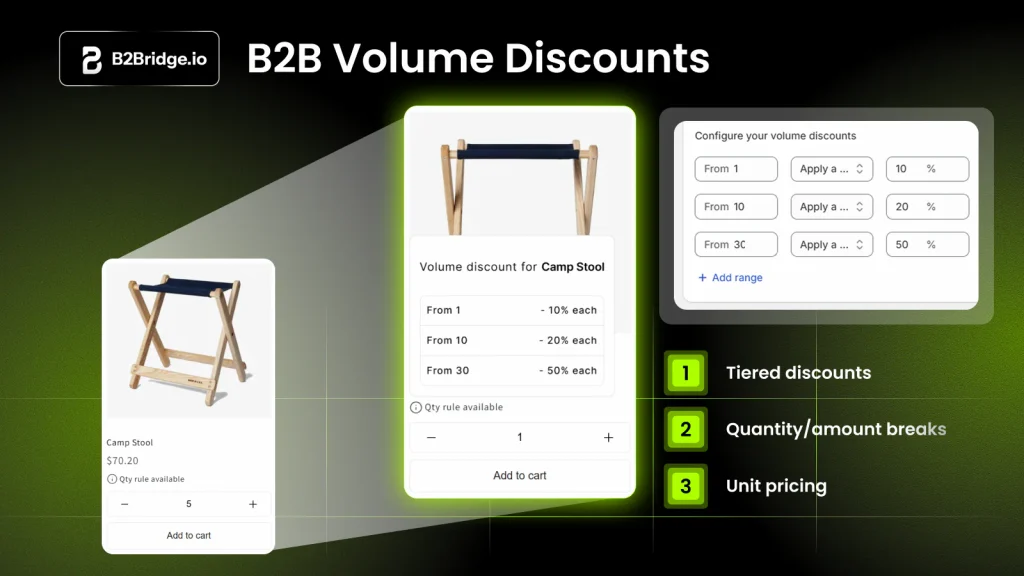
B2Bridge applies your margin rules automatically on every B2B order in Shopify. You get unlimited price lists, customer groups, and volume discount tiers, so the rules keep working as your catalog and your buyer list grow. There’s no per-catalog cap to design around.
Pricing, customer segmentation, MOQ enforcement, net terms, and quote requests run in one app and one Shopify admin. That removes the reconciliation work of stitching several tools together. The Sales Rep Portal lets reps order on behalf of accounts, and ERP sync pushes true wholesale prices into NetSuite, Zoho, or Odoo.
Margin floors then hold without manual checking, and revenue data stays clean enough to calculate margin per customer group rather than per catalog. More than 500 Shopify merchants run their B2B operation on B2Bridge today.
FAQs about Wholesale Profit Margin
What is a good wholesale profit margin?
A good wholesale margin covers your operating costs with profit left over, so it’s specific to your business. Sector gross margins run from roughly 15% in food distribution to 57% in apparel.
What is the difference between margin and markup?
Margin divides profit by the selling price, and markup divides the same profit by cost. A 50% markup on a $60 item produces a $90 price and a 33.3% margin.
How do volume discounts affect wholesale profit margin?
Volume discounts lower your per-unit price, so gross margin compresses at every tier. Calculate the margin at each quantity break, and pair the break with a minimum order quantity that justifies it.
Should I use one price list for all wholesale buyers?
No. Distributors, retailers, and new accounts differ in volume and in fulfillment cost. Separate price lists per customer group give you margin control at the segment level rather than the catalog level.
How do net terms affect my wholesale margin?
Granting Net 30 or Net 60 means carrying the cost of goods until payment lands. That financing cost thins the margin on the order, so price it in or gate terms behind a minimum.
How often should I recalculate wholesale margins?
Recalculate quarterly, and immediately after any supplier increase, freight change, or currency swing. A quarterly review of your top-revenue SKUs keeps selling prices tracking current landed cost rather than last year’s.
Protect Your Wholesale Margins with B2Bridge
The formulas above tell you where your margin stands. Holding it takes a pricing system that enforces the same floor on every order, from your largest distributor to a first-time account.
B2Bridge gives Shopify merchants that system.
- Unlimited price lists, customer groups, and volume discount tiers
- MOQ and quantity increment rules enforced at the product level
- True B2B variant pricing instead of discount codes
- Gated wholesale pricing for verified, logged-in buyers
- Net terms, quote requests, and a self-service buyer portal
- Sales Rep Portal and ERP sync for NetSuite, Zoho, and Odoo
Whether you manage 50 SKUs or 50,000, the pricing logic runs on every logged-in buyer without anyone checking the order.
Book a Demo to see how B2Bridge enforces your margin floors across every wholesale account.

Hi, I’m Ha My Phan – an ever-curious digital marketer crafting growth strategies for Shopify apps since 2018. I blend language, logic, and user insight to make things convert. Strategy is my second nature. Learning is my habit. And building things that actually work for people? That’s my favorite kind of win.