Choosing between Shopify and NetSuite Commerce often comes down to one question: do you want your ecommerce platform to drive your operations, or do you want your operations to drive your ecommerce platform? The answer shapes everything from implementation timeline to total cost of ownership.
This guide breaks down how each platform handles B2B pricing, ERP integration, storefront flexibility, and wholesale workflows—so you can decide which architecture fits your business.
Shopify vs NetSuite Commerce at a Glance
Shopify is a user-friendly, fast-to-deploy ecommerce platform built for rapid B2C growth and ease of use. NetSuite Commerce (also called SuiteCommerce) is an ERP-native solution designed for complex B2B, high-SKU, or omnichannel businesses that require real-time inventory and financial integration. That single distinction shapes nearly every decision when comparing the two platforms.
| Criteria | Shopify / Shopify Plus | NetSuite Commerce (SuiteCommerce) |
|---|---|---|
| Platform type | Hosted ecommerce SaaS | ERP module with ecommerce layer |
| Primary use case | DTC and hybrid B2B/B2C | ERP-driven B2B and omnichannel |
| B2B capabilities | Native on Plus; apps extend any plan | Native customer pricing, hierarchies, RFQ |
| ERP integration | Requires connectors or apps | Built into NetSuite ERP |
| Pricing model | Monthly subscription + transaction fees | Quote-based licensing bundled with ERP |
| Time to launch | Days to weeks | Months (ERP configuration required) |
| Best for | Brands prioritizing storefront UX and speed | Operations-heavy businesses on NetSuite |
If you’re already running NetSuite for financials and inventory, SuiteCommerce keeps everything under one roof. On the other hand, if you want a modern storefront with flexibility to add B2B capabilities through apps, Shopify offers that path without a massive upfront commitment.
>> See more: Does Shopify Integrate With NetSuite? Step-By-Step Guide 2026
What Is Shopify
Shopify is a hosted ecommerce platform that handles your storefront, checkout, and order management. It’s not an ERP, meaning it doesn’t manage accounting, warehouse-level inventory, or manufacturing workflows. What Shopify does exceptionally well is get you selling online quickly with minimal technical overhead.
Shopify Plus is the enterprise tier, adding features like customer-specific pricing, company accounts, and payment terms—contributing to Shopify’s 96% B2B GMV growth in 2025.
However, merchants on standard Shopify plans can achieve similar B2B functionality through apps like B2Bridge.
Core Shopify capabilities for B2B and B2C sellers
- Hosted storefront: Managed infrastructure with thousands of themes and templates
- Checkout and payments: Native payment processing plus third-party gateway support
- App ecosystem: Over 8,000 apps to extend B2B pricing, wholesale workflows, and ERP sync
- Shopify B2B features: Customer-specific pricing, company accounts, net terms, and RFQ workflow (requires Plus or apps on standard plans)
What Is NetSuite Commerce
NetSuite Commerce is the native ecommerce module built directly into Oracle NetSuite ERP. It’s designed for businesses that already run NetSuite for financials, inventory, and operations and want their online store to pull from that same data source.
The platform comes in tiers: SuiteCommerce Standard for simpler storefronts and SuiteCommerce Advanced for complex, highly customized implementations.
Core SuiteCommerce capabilities for ERP-driven sellers
- Native ERP connection: Real-time sync with NetSuite financials, inventory, and CRM
- Unified data model: Single source of truth for orders, customers, and pricing
- B2B and B2C storefronts: Supports both selling models within the NetSuite ecosystem
- Advanced customization: SuiteScript and SuiteCommerce Advanced for complex workflows
Key Differences Between Shopify and NetSuite Commerce
The fundamental architectural difference comes down to starting point. Shopify is ecommerce-first, so you build your storefront and then connect back-office systems as needed. NetSuite Commerce is ERP-first, meaning your ecommerce layer sits on top of an existing operational backbone.
- Starting point: Shopify begins with the storefront; NetSuite begins with back-office operations
- Integration approach: Shopify requires connectors for ERP; SuiteCommerce is natively embedded
- Flexibility vs. control: Shopify offers app ecosystem flexibility; NetSuite offers centralized control
- Audience: Shopify suits DTC brands scaling into B2B; NetSuite suits operations-heavy businesses with complex workflows
Neither approach is inherently better. The right choice depends on where your business complexity lives, whether in the buying experience or in the operational backend.
Pricing and Total Cost of Ownership
Sticker price tells only part of the story. Both platforms have variable costs based on features, transaction volume, and implementation scope.
Shopify and Shopify Plus pricing
Shopify’s tiered plans (Basic, Grow, Advanced, Plus) offer B2B features across all tiers, with more advanced capabilities exclusive to Plus. Core B2B features like companies, net terms, quantity rules, and group-level pricing are available on Basic, Grow, and Advanced. Customer-specific pricing (direct catalog assignment per company/location) and advanced payment features like deposits and partial payments are exclusive to Plus. Apps like B2Bridge can add additional wholesale capabilities on top of any Shopify plan.

NetSuite Commerce licensing and implementation costs
NetSuite uses quote-based licensing that bundles ERP modules with SuiteCommerce. Expect a higher upfront investment, as implementations typically require a NetSuite partner and take longer than Shopify deployments. Annual licensing often starts in the tens of thousands.
Hidden costs to plan for
- Customization and development: SuiteScript development vs. Shopify app subscriptions
- Ongoing maintenance: NetSuite requires dedicated admin resources; Shopify is largely self-serve
- Integration middleware: Connecting Shopify to NetSuite may require iPaaS tools like Celigo
B2B and Wholesale Features Compared
This is where the comparison gets interesting for wholesale operators. Which platform handles complex B2B operations better out of the box, and which requires add-ons?
Customer group and contract pricing
NetSuite handles tiered pricing natively through customer records and price levels. Shopify Plus offers native B2B pricing, while standard Shopify merchants can use apps like B2Bridge to achieve customer-specific price lists, volume discounts, and contract pricing.
Net terms, RFQ, and quote-to-order workflows
Net terms (Net 30, Net 60) let buyers pay on invoice rather than at checkout, increasingly important as 73% of B2B buyers spend $50,000+ through digital channels. RFQ, or Request for Quote, workflows allow buyers to request custom pricing on large orders.
NetSuite supports net terms and RFQ natively through its sales order workflow. Shopify requires Plus features or B2B apps to enable invoice-based payments and quote requests.
Minimum order quantities, case packs, and volume rules
MOQs (minimum order quantities) and quantity increments prevent orders that don’t meet your packaging or profitability thresholds. NetSuite handles MOQs through item records and pricing rules. Shopify requires apps or Plus to enforce order minimums and case-pack logic.
Wholesale gating and B2B registration
Hiding wholesale prices from retail visitors protects your margins and creates an incentive to register. NetSuite uses customer roles and access controls for gating. Shopify uses apps or Plus features for login-gated pricing and B2B registration forms.
Ecommerce and Storefront Capabilities
Shopify excels at conversion-optimized storefronts with modern themes. SuiteCommerce storefronts are functional but less design-flexible.
- Theme ecosystem: Shopify offers thousands of themes; SuiteCommerce has limited templates
- Checkout experience: Shopify’s checkout is highly optimized; SuiteCommerce checkout is integrated but less customizable
- Mobile commerce: Shopify themes are mobile-first; SuiteCommerce requires more configuration
Outcome: Shopify typically wins for DTC-style buyer experiences. SuiteCommerce wins when back-office integration matters more than storefront polish.
NetSuite ERP Integration and Data Sync
How do you keep orders, inventory, customers, and pricing in sync between your ecommerce platform and NetSuite? This question drives many platform decisions.
Native SuiteCommerce to NetSuite connection
SuiteCommerce is part of NetSuite, so data flows automatically without middleware. This native connection is the main advantage for businesses already committed to NetSuite.
Connecting Shopify to NetSuite via API or middleware
Shopify merchants can integrate with NetSuite using iPaaS connectors (Celigo, Boomi) or custom API development. B2Bridge offers native NetSuite integration to sync pricing, customers, and orders without complex middleware. This approach lets you keep Shopify’s storefront advantages while gaining ERP connectivity.
Performance and Scalability for Enterprise Volume
Shopify is a managed SaaS with built-in scaling, so you don’t worry about server capacity during traffic spikes. SuiteCommerce performance depends on your NetSuite instance configuration.
Both platforms can handle enterprise volume. Shopify abstracts infrastructure concerns away from the merchant, while NetSuite gives you more control and more responsibility over performance tuning.
Implementation Time and Launch Complexity
Shopify stores can launch in days to weeks. SuiteCommerce implementations often take months due to ERP configuration requirements.
- Shopify: Faster launch, lower technical barrier, iterative improvements
- SuiteCommerce: Longer planning phase, requires NetSuite expertise, better for businesses already on NetSuite
How to Extend Shopify for Enterprise B2B Without Migrating to NetSuite Commerce
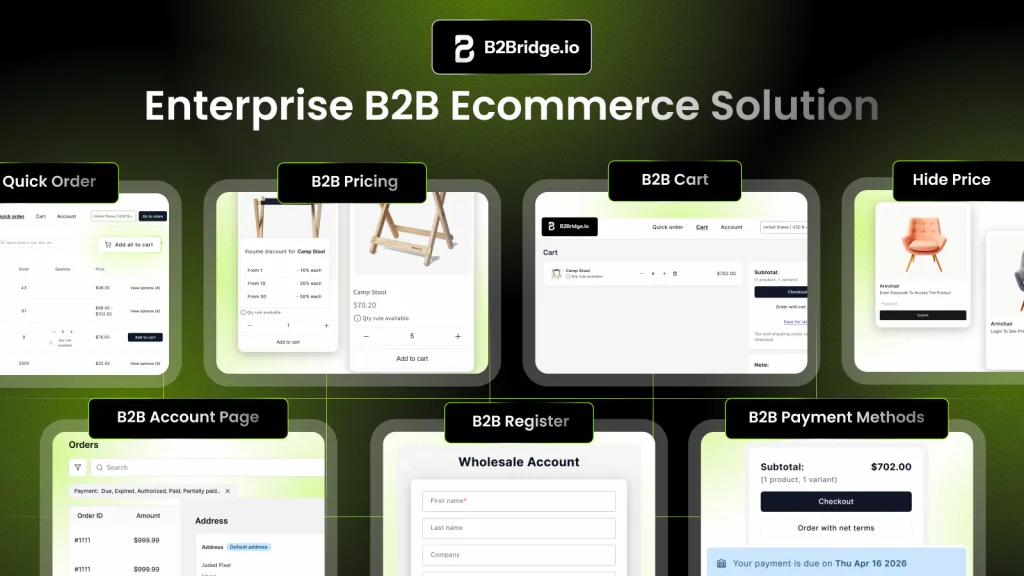
You don’t have to choose between Shopify’s storefront strengths and enterprise B2B capabilities. Merchants can add wholesale features using solutions like B2Bridge, including customer-specific pricing, net terms, RFQ, wholesale gating, and NetSuite sync.
- B2B pricing engine: Role-based pricing, volume tiers, and contract price lists
- Payment flexibility: Net terms and RFQ workflows without Shopify Plus
- ERP sync: Native integration with NetSuite, Zoho, Odoo, and custom ERPs
- Wholesale access control: Gated pricing, B2B registration, and customer group management
This approach lets you keep Shopify’s UX advantages while closing the B2B feature gap.
Who Should Choose Shopify vs NetSuite Commerce
When NetSuite Commerce is the right fit
Businesses already running NetSuite ERP and prioritizing back-office integration over storefront flexibility tend to benefit most from SuiteCommerce. If your operations team lives in NetSuite daily, having ecommerce data flow natively into the same system reduces manual work and data discrepancies.
When Shopify is the right fit
Brands prioritizing fast launch, DTC-quality storefronts, and app ecosystem flexibility often find Shopify more practical. With 67% of B2B buyers preferring rep-free experiences, this is especially true for businesses running hybrid B2B and B2C models where storefront experience matters as much as backend operations.
When a Shopify plus NetSuite integration stack wins
Some businesses want Shopify’s storefront and UX advantages but rely on NetSuite for financials and operations. This hybrid approach uses API connectors or apps like B2Bridge to sync data between platforms, giving you the best of both worlds without forcing a full platform migration.
Picking the Right B2B Commerce Platform for Your Business
Evaluate based on your current ERP investment, B2B complexity, storefront priorities, and time-to-launch requirements. If you’re running or moving B2B operations to Shopify and want enterprise wholesale capabilities with NetSuite integration, Book a Demo to see how B2Bridge can help.
Frequently Asked Questions About Shopify vs NetSuite Commerce
Can NetSuite Commerce replace Shopify for ecommerce?
Yes, SuiteCommerce can serve as your primary ecommerce storefront if you are already using NetSuite ERP and prioritize native integration over storefront design flexibility.
Does Shopify integrate with NetSuite without custom development?
Yes, Shopify can integrate with NetSuite using pre-built iPaaS connectors like Celigo or B2B apps like B2Bridge that offer native NetSuite sync for pricing, customers, and orders.
Is Shopify Plus required to run B2B wholesale on Shopify?
No, Shopify merchants on any plan can add B2B capabilities like customer-specific pricing, net terms, and wholesale gating using apps like B2Bridge without upgrading to Shopify Plus.
Can you run B2B and B2C on the same Shopify store?
Yes, Shopify supports hybrid B2B and B2C storefronts where logged-in wholesale buyers see different pricing and checkout options than retail visitors.
How long does a typical SuiteCommerce implementation take compared to Shopify?
Shopify stores can launch in days to weeks, while SuiteCommerce implementations typically require several months due to ERP configuration and customization requirements.

As a Product Marketing Executive at B2Bridge, I focus on the Enterprise B2B Ecommerce domain. I leverage my understanding of product and user psychology to deliver customer-centric content that addresses business challenges and fuels growth.