Getting B2B pricing wrong costs you twice—once when you lose deals to competitors with better terms, and again when you win deals at margins that don’t sustain your business. The complexity multiplies when you’re managing different price lists for distributors, retailers, and contract accounts across an ecommerce storefront.
This guide covers the core pricing models and methods B2B ecommerce teams use, how to operationalize them in your store, and the mistakes that erode margins even when strategy looks solid on paper.
What Is a B2B Ecommerce Pricing Strategy
A B2B ecommerce pricing strategy balances scalable consistency online with individualized contract terms. Rather than showing one price to everyone, you use customer-specific portals that dynamically display negotiated agreements, volume breaks, and unique price lists depending on which buyer logs in.
Think of it as a system of rules—not a single price tag. Your pricing strategy governs how you assign prices to different customer segments, order sizes, and contract terms across digital channels.
- Customer segmentation: Different prices for distributors vs. retailers vs. one-time buyers
- Volume and order rules: Discounts triggered by quantity thresholds or case packs
- Contract terms: Negotiated pricing locked to specific accounts
Outcome: A clear pricing strategy reduces manual quoting, speeds up orders, and protects margins across your wholesale operation.
How B2B Pricing Differs From B2C Pricing
B2B pricing involves negotiated rates, longer sales cycles, relationship-based discounts, and net payment terms. B2C uses fixed public prices with immediate payment. The differences go deeper than just who’s buying.
| Factor | B2B Pricing | B2C Pricing |
|---|---|---|
| Price visibility | Hidden or login-gated | Public |
| Pricing flexibility | Customer-specific, negotiated | Fixed for all |
| Payment terms | Net 30/60, credit limits | Immediate |
| Order size | Bulk, case packs, MOQs | Single units |
| Buyer decision | Committee, multi-step approval | Individual impulse |
When you apply retail pricing logic to wholesale, you erode margins and frustrate procurement managers who expect personalized terms. B2B buyers aren’t browsing—they’re comparing suppliers against specific requirements.
Core B2B Pricing Models
Four foundational pricing models form the basis of most B2B strategies. The right choice depends on your product type, market position, and how much data you have about your buyers.
Value-Based Pricing
Value-based pricing ties your price to the outcome or ROI your product delivers to the buyer, not your costs. This approach works well for differentiated products where you solve a specific operational pain—like reducing downtime or improving efficiency.
The challenge? Value-based pricing requires deep understanding of your buyer’s business. You’re pricing based on what they gain, which means you need data and conversations to justify your numbers.
Cost-Plus Pricing
Cost-plus pricing calculates your total cost (production, shipping, overhead) and adds a fixed margin. It’s simple and predictable, which makes it common for commoditized goods where differentiation is limited.
The downside is that cost-plus ignores market conditions and what buyers are actually willing to pay. You might leave money on the table or price yourself out of deals without realizing it.
Competition-Based Pricing
Competition-based pricing sets your prices relative to competitors—matching, undercutting, or positioning premium. This requires ongoing market monitoring and works well when benchmarks are clear.
The risk is triggering price wars or margin erosion if you compete on price alone without differentiation. You’re essentially letting competitors dictate your strategy.
Dynamic Pricing
Dynamic pricing adjusts prices in real time based on demand, inventory, or market signals. It’s more common in high-volume, fast-moving categories where conditions change quickly.
This approach requires pricing software and data infrastructure. For most B2B operations, dynamic pricing applies to specific product categories rather than the entire catalog.
B2B Pricing Methods and Structures
Pricing models describe your overall approach. Pricing methods are the mechanics—how you actually structure charges by tier, volume, or contract.
Tiered Pricing
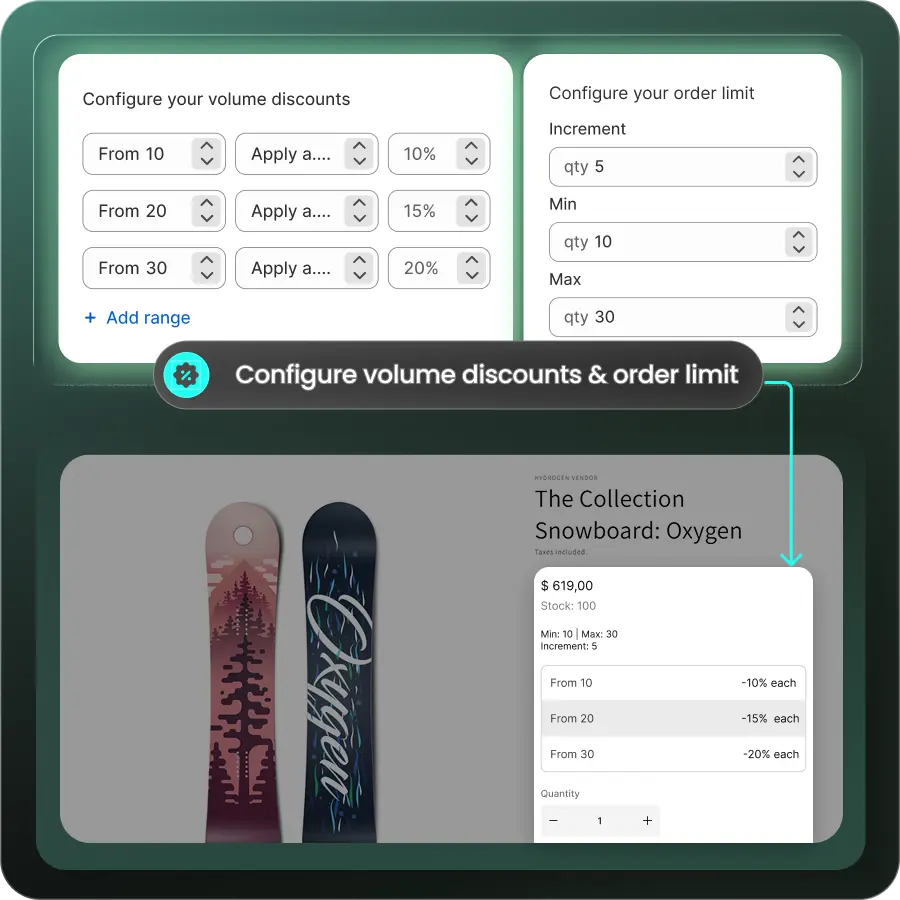
Tiered pricing unlocks different price levels as buyers hit quantity thresholds. For example, Tier 1 might cover 1–99 units at $12 each, while Tier 2 covers 100–499 units at $10.50 each.
This structure incentivizes larger orders while giving you granular control over discount levels.

Volume Pricing
Volume pricing applies a single discount based on total order quantity—the more you buy, the lower the unit price. It’s simpler than tiered pricing but less granular.
Many B2B operations use volume pricing for straightforward product lines where managing multiple tiers adds unnecessary complexity.
Contract-Based Pricing
Contract-based pricing locks custom pricing into a formal agreement for a specific customer or account. Terms are often negotiated annually and require price list management in your ERP or ecommerce platform.
This method dominates enterprise B2B relationships where buyers expect stability and predictability.
Flat-Rate Pricing
Flat-rate pricing offers one fixed price per product regardless of buyer or volume. It’s the simplest to manage but rarely suits complex B2B operations where customer segmentation matters.
Usage-Based Pricing
Usage-based pricing charges based on consumption—per API call, per transaction, or per unit consumed. While common in SaaS, it also applies to B2B services or consumables where usage varies significantly.
Per-User Pricing
Per-user pricing charges per seat or user account. This method is typical for software or subscription-based B2B products and less common for physical goods.
When to Use Contract and Negotiated Pricing
Fixed pricing structures don’t always fit. Large accounts, long-term relationships, and non-standard terms often require custom, negotiated pricing.
- Large accounts: Enterprise buyers expect volume-based discounts locked into contracts
- Custom products: Pricing reflects configuration or customization costs
- Long-term relationships: Multi-year agreements with pricing stability
- Non-standard terms: Extended payment terms, exclusivity, or bundled services
Contract pricing requires RFQ (request for quote) workflows and quote-to-order conversion capabilities in your ecommerce platform. Without RFQ functionality, your sales team ends up managing negotiations outside the system entirely.
How to Determine the Optimal B2B Price
Setting B2B prices involves more than picking a number. A structured process connects your pricing to actual customer behavior and market conditions.
Step 1: Segment Your B2B Customers and Buying Behavior
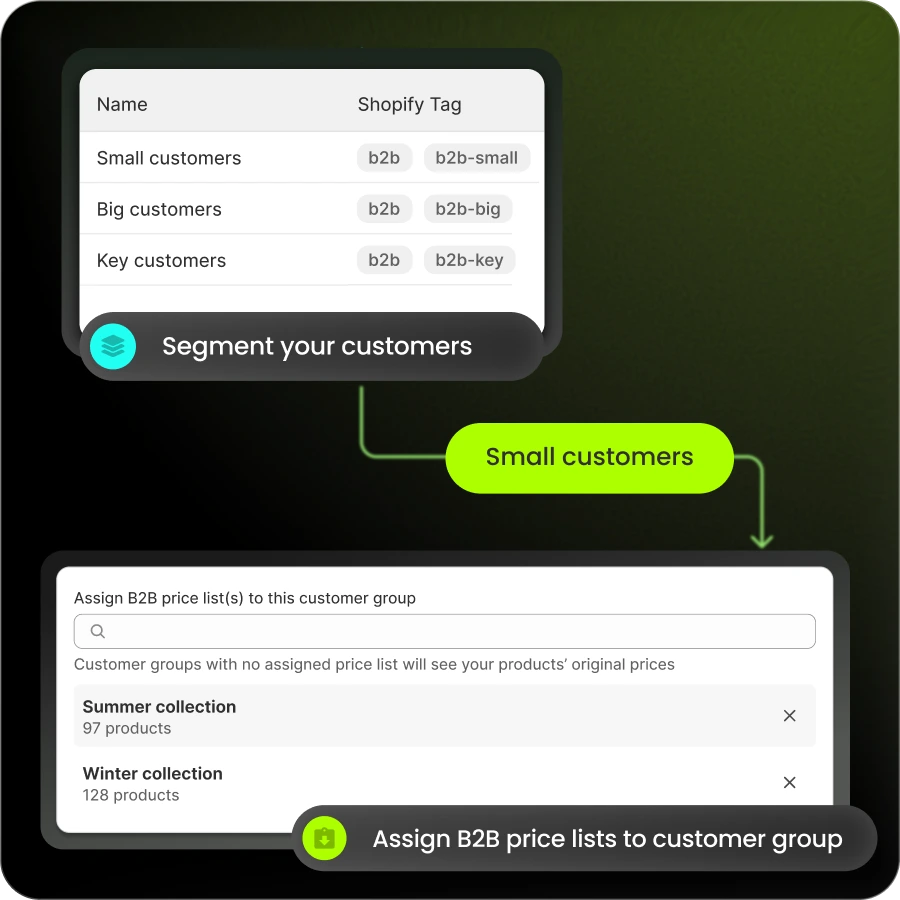
Group customers by type (distributor, retailer, contractor), order frequency, and average order value. Different segments warrant different pricing tiers, and treating them identically leaves value on the table.
Step 2: Map Costs, Margins, and Discount Floors
Calculate your true cost per product including fulfillment, returns, and payment processing. Set minimum acceptable margins—your “floor”—below which you won’t discount regardless of deal size.
Step 3: Benchmark Competitor and Market Pricing
Research what competitors charge similar customer segments. Identify where you can price at parity, premium, or discount based on your value proposition.
Step 4: Build Tiered and Contract Price Lists
Create structured price lists for each customer group. Store price lists in your ERP or pricing engine so they sync to your ecommerce storefront automatically—manual updates create errors and inconsistencies.
Step 5: Test, Measure, and Refine With ERP Data
Monitor win/loss rates, order values, and margin performance. Adjust pricing rules based on actual sales data from your ERP and CRM rather than assumptions.
Outcome: A data-driven pricing process replaces guesswork with repeatable decisions tied to real customer behavior.
How to Operationalize B2B Pricing in Your Ecommerce Store
Strategy means nothing without execution. Here’s how pricing rules actually work inside an ecommerce platform.
Customer-Specific and Role-Based Price Lists
Assign unique price lists to individual accounts or customer groups (Gold vs. Silver tier, for example). Prices display only after login, which is core to B2B ecommerce.
Hidden B2B Pricing on a Unified Storefront
Keep wholesale prices invisible to retail shoppers. A unified B2B + B2C store reduces operational overhead compared to running separate sites while protecting your pricing structure.
Multi-Currency and Tax-Exempt Pricing for Global Wholesale
Support international buyers with localized currency and tax-exempt checkout for verified resellers. This typically requires integration with Shopify Markets or similar tools.
Quote-to-Order and RFQ Workflows
Enable buyers to request quotes, then convert approved quotes to orders. RFQ workflows are essential for large or complex purchases where pricing isn’t fixed upfront.
ERP and CRM Synced Price Lists
Keep pricing consistent between your ERP (source of truth) and ecommerce storefront. Automated sync avoids manual updates that cause discrepancies and order errors.
Outcome: Operationalizing pricing means your ecommerce store enforces pricing rules automatically—fewer errors, faster orders, consistent margins.
Best Practices for Your B2B Ecommerce Pricing Strategy
Maintaining an effective pricing strategy requires ongoing discipline and alignment across teams.
- Anchor prices to customer value: Frame pricing around what buyers gain—cost savings, efficiency, reliability—not just your costs
- Keep pricing rules simple and auditable: Complex discount stacking creates confusion and margin leakage
- Centralize price lists in your ERP: Manage pricing in one system and sync to all channels
- Use net terms as pricing levers: Offering Net 30/60 terms can justify maintaining price points rather than discounting
- Make decisions with sales data: Review order data and win rates regularly, adjusting based on evidence
Common B2B Pricing Mistakes to Avoid
Even solid strategies fail when execution breaks down. Watch for common pitfalls that erode margins or create operational problems.
- Showing wholesale prices to retail shoppers: Exposing B2B pricing to B2C visitors undercuts your retail pricing and creates channel conflict
- Overcomplicating discount rules: Stacking too many discounts makes pricing unpredictable and hard to audit
- Undercutting your sales reps online: If online prices are lower than what reps quote, you devalue the sales relationship
- Ignoring total cost of fulfillment: Pricing that doesn’t account for shipping, handling, and returns eats into margins
- Misaligning pricing with revenue goals: Aggressive discounting to win volume can sacrifice margin targets
Scaling Your B2B Pricing Strategy With B2Bridge
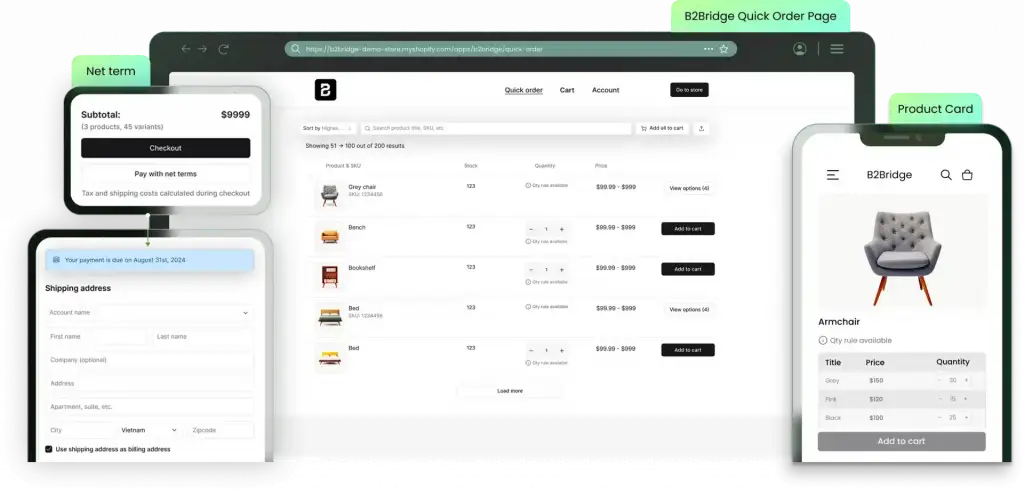
Running complex B2B pricing on Shopify doesn’t require Shopify Plus or a separate wholesale site. B2Bridge’s Advanced B2B Pricing Engine supports the models and methods covered in this guide—role-based pricing, contract price lists, volume rules, hidden B2B pricing, multi-currency, and ERP sync.
The platform embeds enterprise-grade pricing directly into your Shopify store, keeping pricing consistent between your ERP and storefront. Your wholesale team can manage price lists, customer groups, and quote-to-order workflows without splitting work across multiple platforms.
Book A Demo to see how B2Bridge operationalizes complex B2B pricing directly in your Shopify store.
Frequently Asked Questions About B2B Ecommerce Pricing Strategy
How long does it typically take to implement a B2B pricing strategy on Shopify?
Implementation depends on complexity, but with a solution like B2Bridge, most merchants launch within days to a few weeks after scoping price lists and customer segments.
Do you need Shopify Plus to run customer-specific B2B pricing?
No—apps like B2Bridge enable customer-specific pricing, role-based price lists, and hidden B2B pricing on standard Shopify plans without requiring Shopify Plus.
How do you migrate existing price lists from spreadsheets or an ERP?
Most B2B ecommerce apps support CSV import/export or direct ERP integration (NetSuite, Zoho, Odoo) to sync price lists without manual re-entry.
How often should B2B pricing be reviewed and updated?
Review pricing at least quarterly or whenever costs, competitor pricing, or customer segments change significantly—automated ERP sync makes updates faster and more reliable.
Can you run B2B and B2C pricing on the same Shopify store?
Yes—a unified storefront with login-gated B2B pricing keeps wholesale prices hidden from retail shoppers while reducing the operational cost of maintaining two separate stores.

As a Product Marketing Executive at B2Bridge, I focus on the Enterprise B2B Ecommerce domain. I leverage my understanding of product and user psychology to deliver customer-centric content that addresses business challenges and fuels growth.