Shopify brands selling wholesale need nine documents: a price list, a line sheet, an order form, a wholesale application form, a wholesale agreement, a net terms agreement, an invoice, a catalog, and a quote email. Each one is free to download below. Start with the price list, the order form, and the application form, which together cover the first order from a new retailer.
Most brands collect these one at a time, usually after something goes wrong. A retail shopper finds the wholesale price. An order arrives as a scanned PDF nobody can read. This guide covers all nine, what belongs on each, and which ones your Shopify store can run without a file at all.
What Wholesale Templates Do Shopify Brands Need
A wholesale template is a reusable document that carries one step of a bulk sale: pricing, presenting, qualifying, ordering, agreeing, or billing. Nine of them cover the full cycle. Most brands need three to take a first order, and the rest arrive as the account grows.
The table below maps each document to where it sits in the order. Read it as a checklist. If you can’t name the file you’d send at a given stage, that’s the gap worth closing first.
| Stage | Document | What it does | Who fills it in |
|---|---|---|---|
| Discovery | Line sheet | Shows SKUs, wholesale price, MSRP | You |
| Discovery | Catalog | Presents the full range with imagery | You |
| Qualification | Wholesale application form | Vets the retailer before pricing is shared | Buyer |
| Pricing | Price list | Sets tiered and group pricing | You |
| Pricing | Quote email | Answers a pricing request | You |
| Order | Order form | Captures the bulk order | Buyer |
| Order | Wholesale agreement | Sets MOQ, lead time, returns | Both |
| Payment | Net terms agreement | Sets credit limit and payment window | Both |
| Payment | Invoice | Bills against agreed terms | You |
The qualification step is the one brands skip. Without an application form, you’re quoting wholesale pricing to anyone who asks, including consumers hunting a discount.
Free Wholesale Templates to Download
Each template below is free. The Shopify equivalent line names the store workflow that replaces the file once manual upkeep costs more than it saves.
Wholesale Price List Template for Tiered B2B Pricing
A wholesale price list sets what each buyer group pays per unit, with tier breaks for volume. It’s the document you’ll update most often, so build it with formulas rather than typed values.
- Best for: any brand with more than one pricing tier
- Includes: item code, product name, unit, wholesale price, MSRP, MOQ, tier breaks, validity dates
- Format: Google Sheets and Excel
- Shopify equivalent: customer group price lists
Grab it from the wholesale price list template collection.
Wholesale Order Form Template for Trade Shows and Email Orders
A wholesale order form captures a bulk order with SKUs, quantities, and totals in one signed document. Two versions exist. An empty SKU table suits large or fast-changing catalogs, and a prefilled table suits per-product minimums.
- Best for: trade shows, phone orders, and email ordering
- Includes: company info, order ID, buyer details, SKU table, payment method, terms, signature
- Format: Excel and PDF
- Shopify equivalent: quick order page
Download the wholesale order form template.
Wholesale Line Sheet Template for Buyer Meetings
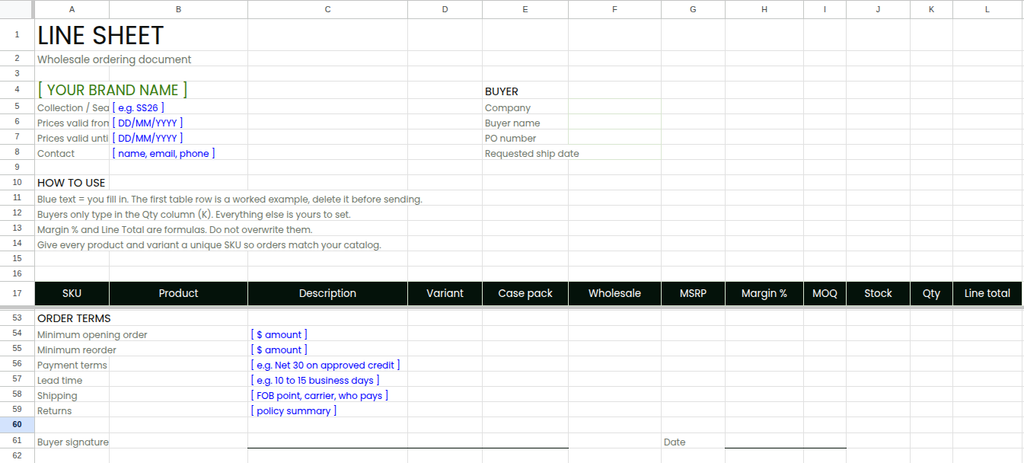
A line sheet is the one-page document a buyer writes an order from. It puts the wholesale price and the MSRP side by side so the buyer reads their own margin without doing arithmetic.
- Best for: trade shows and buyer meetings
- Includes: product photo, SKU, short description, wholesale price, MSRP, variants, order terms
- Format: Excel and print-ready PDF
- Shopify equivalent: a gated collection page priced per customer group
Download the wholesale line sheet template
Wholesale Application Form Template for Vetting Retailers
A wholesale application form qualifies a retailer before you show them pricing. This is the cheapest protection you have against quoting trade rates to a consumer.
- Best for: every brand that publishes or emails wholesale prices
- Includes: legal business name, EIN or tax ID, resale certificate, business type, years trading, expected monthly volume, trade references
- Format: PDF and DOCX
- Shopify equivalent: B2B registration with auto-approval rules
Download wholesale application form template

Wholesale Agreement Template for Order Terms
A wholesale agreement fixes the rules both sides operate under, separate from any single order. Sign it once per account and reference it on every order form afterwards.
- Best for: accounts you expect to reorder
- Includes: MOQ, lead time, returns policy, price-change notice, territory, termination
- Format: DOCX
- Shopify equivalent: none, this one stays a document
Download wholesale agreement template

Net Terms Agreement Template for Credit Approvals
A net terms agreement records the credit you’ve extended and the window the buyer has to pay. Net 30 is the common default, and Net 60 or Net 90 show up with larger retailers.
- Best for: any account paying after delivery
- Includes: terms length, credit limit, late fee, trade references, personal guarantee clause
- Format: DOCX
- Shopify equivalent: net terms with credit limits per customer group
The windows differ more than the names suggest. Compare Net 30 and Net 60 payment terms before you commit.
Download net terms agreement template

Wholesale Invoice Template for Net Terms Billing
A wholesale invoice bills against terms you already agreed. The due date runs from either the invoice date or the ship date. Pick one, state it, and most payment disputes disappear.
- Best for: brands invoicing outside Shopify checkout
- Includes: invoice number, PO reference, line items, terms, due date, remittance details
- Format: Excel
- Shopify equivalent: order invoices with terms applied at checkout
Settle invoice date versus due date before you send the first one.
Download wholesale invoice template

Wholesale Catalog Template for Full Range Presentation
A wholesale catalog presents your full range with photography and story, where the line sheet strips everything back to ordering data. Buyers browse the catalog and order from the line sheet.
- Best for: seasonal drops and new account pitches
- Includes: cover, brand story, category pages, product imagery, SKU index, contact page
- Format: Excel/CSV
- Shopify equivalent: a gated catalog visible only after login
Start from the wholesale catalog template.
Wholesale Pricing Email Template for Quote Replies
A pricing email answers an inbound wholesale enquiry without rewriting your terms each time. Keep one version for qualified buyers and one that asks for the application first.
- Best for: inbound enquiries and quote follow-ups
- Includes: greeting, qualification ask, tier summary, MOQ, lead time, next step
- Format: plain text
- Shopify equivalent: RFQ handled in the store
Start from the wholesale pricing email template.
What Each Wholesale Template Must Include
Three of these documents carry most of the risk when a field is missing. Here’s what belongs on each.
Fields Every Wholesale Price List Needs
Item code, product name, unit of sale, wholesale price, MSRP, MOQ, tier breaks, stock status, and validity dates. The validity date matters most. Without it, a buyer can hold you to a price list you replaced months ago.
Tier breaks follow your volume discount structure, and the unit column prevents the per-piece versus per-case confusion that generates returns. Set your minimum order quantity per product where it differs.
Fields Every Wholesale Order Form Needs
Eight sections: company information, order ID, buyer information with resale number, the SKU table, payment method, terms of sale, notes, and signature. Give every product and variation a unique SKU so buyers order by code.
Use a coded order ID rather than a sequential one. Something like 170316-MGC-1 tells you the date and the trade show at a glance.
Fields Every Wholesale Application Form Needs
Legal business name, EIN or tax ID, resale certificate upload, business type, years trading, storefront or online, expected monthly volume, trade references, and both addresses. Ask for the resale certificate as a file, not a number.
Expected volume is the field most brands leave off, and it’s the one that tells you which pricing tier to open.
How to Move Wholesale Templates Into Shopify
Which of these documents can your store handle on its own? Four of them, once wholesale volume justifies the setup. Shopify opened native B2B to Basic, Grow, and Advanced plans on 2 April 2026. Those plans run up to three active catalogs, per Shopify’s changelog.
Turn Your Price List Into Customer Group Pricing
Import the spreadsheet as a price list, assign it to a customer group, and approved buyers see their own prices at login. Nobody re-sends a file after a price change. Shopify’s native version caps non-Plus stores at three active catalogs.
Replace the Order Form With a Quick Order Page
A quick order page lets buyers enter SKUs and quantities directly, then checkout. Orders arrive structured, so nobody rekeys a PDF into your admin. Reorders take under a minute for accounts buying the same lines each month.
Replace the Application Form With Gated B2B Registration
Custom registration fields collect the tax ID and resale certificate at signup, and approval rules route applications automatically. Your catalog and pricing stay hidden until a buyer is approved. This is how a B2B self-service portal keeps trade rates off the public store.
Replace Net Terms Paperwork With Credit Limits
Apply Net 15, 30, 60, or 90 per customer group, and enforce a credit limit at checkout so an account can’t exceed its balance. Setting up net terms on Shopify removes the spreadsheet nobody reconciles.
| Wholesale workflow | Manual template | Shopify B2B native | B2Bridge |
|---|---|---|---|
| Tiered price lists | Spreadsheet, updated by hand | 3 active catalogs on non-Plus | Unlimited price lists |
| Customer groups | A tab per buyer | Company-level catalogs | Unlimited customer groups |
| Bulk ordering | Emailed order form | Standard cart | Quick order and saved cart |
| Buyer vetting | Application form by email | Manual company creation | B2B registration with auto-approval |
| Net terms | Signed agreement in a sheet | Payment terms on orders | Net terms with credit limits |
| Quotes | Email thread | Not available | RFQ |
| Rep ordering | Rep fills the buyer’s form | Not available | Sales Rep Portal |
This article is written and published by the B2Bridge team. B2Bridge competes directly with Shopify’s native B2B features and with the other tools named here, so weigh the commercial context when reading the comparison above.
When a Wholesale Template Stops Working
When does a template start costing more than it saves? Four signals, and any one of them is enough.
You’re maintaining more than three pricing groups. A buyer orders from a price list you replaced last week. Orders arrive as scanned PDFs somebody rekeys by hand. Net terms live in a spreadsheet nobody has reconciled this quarter.
The file itself is still free. What changed is the upkeep. Every price change means editing a sheet, exporting a PDF, and emailing it to each account. Then you field the orders that used the old numbers anyway. Brands running dynamic pricing across several buyer tiers hit this wall fastest, because each tier multiplies the maintenance.
That’s the point where the document stops being the solution.
Best Practices for Managing Wholesale Documents
- Give every product and variation a unique SKU. A coded system like SHPL-GR-L reads at a glance and survives being copied between your line sheet, order form, and invoice.
- Keep one source of truth for pricing. Every other document references it. Two live price lists means one of them is wrong.
- Put a validity window on every price list. Start date and end date, on the document itself.
- Build one price list per buyer group. Sending everyone the same file and trusting them to read the right column invites errors.
- Review on cost changes, not on a calendar. When your landed cost moves, the price list moves. Check your margins with the wholesale price calculator before you republish.
Running Wholesale Without Spreadsheets Using B2Bridge
You’ve now got the nine documents. Six of them describe work your Shopify store can do on its own once wholesale stops being occasional.
B2Bridge runs those workflows without a cap on what you’re allowed to scale. Price lists, customer groups, and orders are unlimited on every paid plan. Growing wholesale won’t push you into a higher tier or a platform migration.
- Unlimited price lists, customer groups, and orders
- B2B registration with auto-approval and gated catalogs
- Quick order, saved cart, and reorder
- Net terms with credit limits, RFQ, and company accounts on Growth
- Sales Rep Portal and ERP sync for teams ordering on a buyer’s behalf
New stores start on a 14-day free trial, then Professional at $99 a month, Growth at $199, or Advanced at $299. Trailer Valet came to B2Bridge for exactly this, moving price lists and flexible net terms onto their existing Shopify store.

Book a Demo and we’ll map your nine documents onto your store.
FAQs About Wholesale Templates
What is the difference between a line sheet and a wholesale catalog?
A line sheet is a compact ordering document with SKUs, wholesale price, and MSRP in tight rows. A catalog is the richer brand piece with photography and story. Buyers browse the catalog and order from the line sheet.
Do I need a wholesale application form if I already gate my prices?
Yes. Gating hides prices from the public, and the application decides who gets past the gate. Without it you’re approving accounts on instinct, with no tax ID or resale certificate on file.
What format should I send wholesale templates in?
Send Excel or Google Sheets for anything a buyer edits, like order forms and price lists. Send PDF for anything they only read, like line sheets and catalogs. Agreements go out as DOCX for signing.
How often should I update my wholesale price list?
Update when your landed cost changes, not on a fixed schedule. Put a validity window on every version you send so buyers can’t hold you to superseded pricing. Most brands revise two to four times a year.
Can Shopify handle wholesale pricing without an app?
Yes, within limits. Native B2B covers company profiles, volume pricing, and payment terms on all plans, capped at three active catalogs outside Plus. Brands needing more pricing groups than that use an app.
Do I need a developer to set up wholesale on Shopify?
No. Price lists, customer groups, and registration forms are configured in the admin. A developer helps with ERP sync or custom checkout logic, and implementation support covers most setups without one.

As a Product Marketing Executive at B2Bridge, I focus on the Enterprise B2B Ecommerce domain. I leverage my understanding of product and user psychology to deliver customer-centric content that addresses business challenges and fuels growth.