Enterprise B2B ecommerce involves large-scale digital sales between businesses—manufacturers selling to distributors, wholesalers supplying retailers, or any company selling products to other companies online with complex pricing, ERP integration, and multi-buyer account structures. Unlike standard ecommerce, it handles contract pricing, purchase orders, approval workflows, and net payment terms that B2C platforms were never designed to support.
This guide covers what separates enterprise B2B platforms from basic wholesale tools, breaks down the features that actually matter for manufacturers and distributors, and compares the top platforms available in 2026.
What is enterprise B2B ecommerce
Enterprise B2B ecommerce refers to large-scale digital sales between businesses—manufacturers selling to distributors, wholesalers supplying retailers, or any company selling products to other companies online. The “enterprise” part signals complexity: custom contract pricing, account hierarchies with multiple buyers, approval workflows, and real-time integration with ERP systems like NetSuite or SAP.
Unlike B2C where one consumer buys one item with a credit card, enterprise B2B involves purchase orders, net payment terms, and buying committees that take weeks to make decisions. You’re not just adding a wholesale discount to your store. You’re managing hundreds of price lists, syncing inventory across systems, and giving different users within the same company different permissions.
- Enterprise-grade: Built for tiered pricing, net terms, and approval chains
- B2B-specific: Designed for business buyers placing large, recurring orders
- Platform vs. app: A complete commerce layer versus bolt-on functionality
Why manufacturers, distributors, and wholesalers need an enterprise B2B ecommerce platform
Most wholesale teams searching for enterprise solutions are dealing with the same frustrations. Orders live in one system, inventory in another, and pricing in spreadsheets that someone updates manually. When contract prices don’t apply correctly at checkout, your team spends hours fixing errors and fielding calls from buyers who expected different numbers.
Meanwhile, wholesale customers who want to place orders themselves end up emailing or calling because your current setup doesn’t support how they actually buy. Running a separate B2B store doubles your operational work—two catalogs to maintain, two sets of inventory to track, two platforms to troubleshoot.
- Disconnected systems: Orders, inventory, and pricing scattered across tools
- Manual pricing errors: Contract rates not applied at checkout
- Low self-service adoption: Buyers default to phone and email
- Duplicate work: Maintaining separate B2B and B2C stores
Outcome: An enterprise platform consolidates pricing, orders, and customer data so your team spends less time on manual fixes and more time growing wholesale revenue.
What to look for in an enterprise B2B ecommerce platform
Not every B2B platform handles enterprise complexity. Some work fine for simple wholesale discounts but break down when you introduce contract pricing, ERP sync, or multi-buyer accounts.
Advanced B2B pricing engine
A B2B pricing engine supports role-based pricing, contract price lists, per-customer rates, volume discounts, minimum order quantities, and case pack rules. Standard ecommerce platforms offer one price per product. Enterprise B2B often requires hundreds of prices per product depending on who’s buying.
Deep ERP and CRM integration
ERP (enterprise resource planning) systems like NetSuite hold your inventory, pricing, and order data. CRM (customer relationship management) systems track customer relationships and sales history. When your ecommerce platform syncs with both, you eliminate the manual reconciliation that eats up hours every week.
Quote to order and RFQ workflows
Large buyers often negotiate before ordering. RFQ stands for “request for quote“—a formal process where buyers ask for pricing on specific quantities or configurations. Your platform handles quote creation, internal approval, and conversion to order without forcing buyers into a separate system.
Net payment terms and credit controls
B2B buyers expect to pay on invoice, not at checkout. Net 30 or Net 60 terms are standard in wholesale. Your platform assigns payment terms by customer, tracks credit limits, and manages outstanding balances.
Quick order and bulk ordering UX
Wholesale buyers order hundreds of SKUs at once. They want CSV upload, quick order forms, and reorder functionality—not a consumer cart designed for someone buying a single item.
Company accounts, roles, and approvals
B2B buyers aren’t individuals. They’re companies with multiple users who have different permissions: one person views pricing, another places orders, and a third approves purchases over a certain threshold.
Unified B2B and B2C storefront
Running both channels from one store means a single catalog, single inventory source, and login-based pricing visibility. This approach reduces the overhead of maintaining two separate sites.
Multi-currency and tax-exempt logic
Global wholesale requires currency conversion and tax exemption handling per customer or region. Without built-in support, you’re stuck with manual adjustments on every international order.
Top enterprise B2B ecommerce platforms for manufacturers, distributors, and wholesalers
| Platform | Best For | Shopify Compatible | Native ERP Integration | Pricing Model |
|---|---|---|---|---|
| B2Bridge | Shopify merchants with complex B2B | Yes | NetSuite, Zoho, Odoo, custom | Subscription |
| OroCommerce | Mid-market wanting full control | No | Multiple | Open source + enterprise |
| SAP Commerce Cloud | Global enterprises with SAP ERP | No | SAP native | Enterprise license |
| BigCommerce B2B | Standalone B2B storefronts | No | Via integrations | SaaS subscription |
| Adobe Commerce | Large enterprises with dev teams | No | Via extensions | License + hosting |
| Shopify Plus B2B | Simpler B2B on Shopify Plus | Yes (Plus only) | Via apps | Plus subscription |
B2Bridge
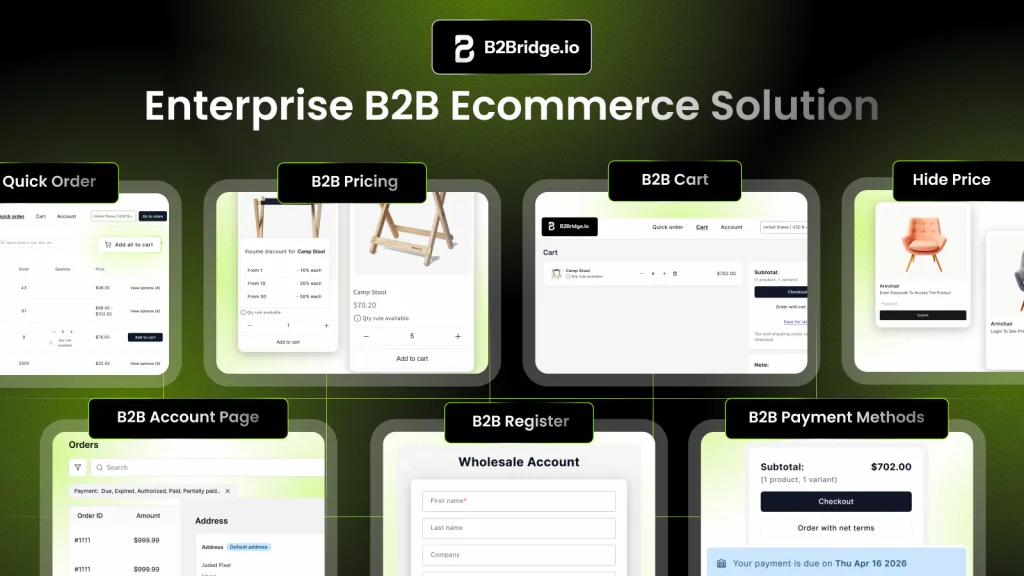
B2Bridge is an enterprise B2B layer for Shopify that embeds wholesale operations without requiring Shopify Plus or a separate site. It’s built for manufacturers and distributors already on Shopify who want ERP integration, advanced pricing engines, and quote-to-order workflows in one unified storefront.
OroCommerce
OroCommerce is an open-source, purpose-built B2B platform with native CRM capabilities. It works well for mid-market to enterprise companies wanting full control and customization outside the Shopify ecosystem, though implementation typically requires significant development resources.
SAP Commerce Cloud
SAP Commerce Cloud serves global manufacturers with existing SAP ERP investments. The platform handles massive scale but comes with high complexity, high cost, and implementation timelines measured in months.
BigCommerce B2B Edition
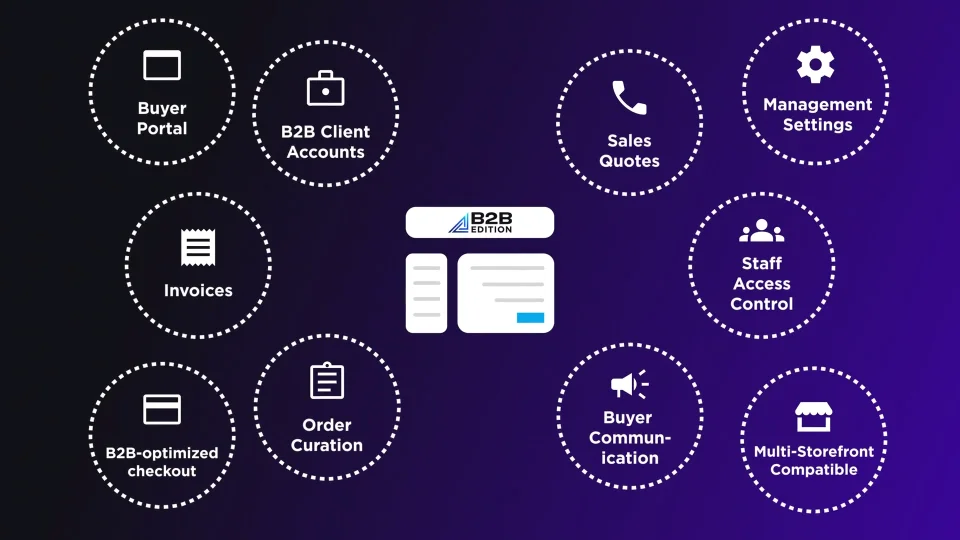
BigCommerce offers a SaaS platform with B2B features built in. It’s a solid choice for companies wanting a standalone B2B storefront with moderate customization, though it lacks Shopify ecosystem integration.
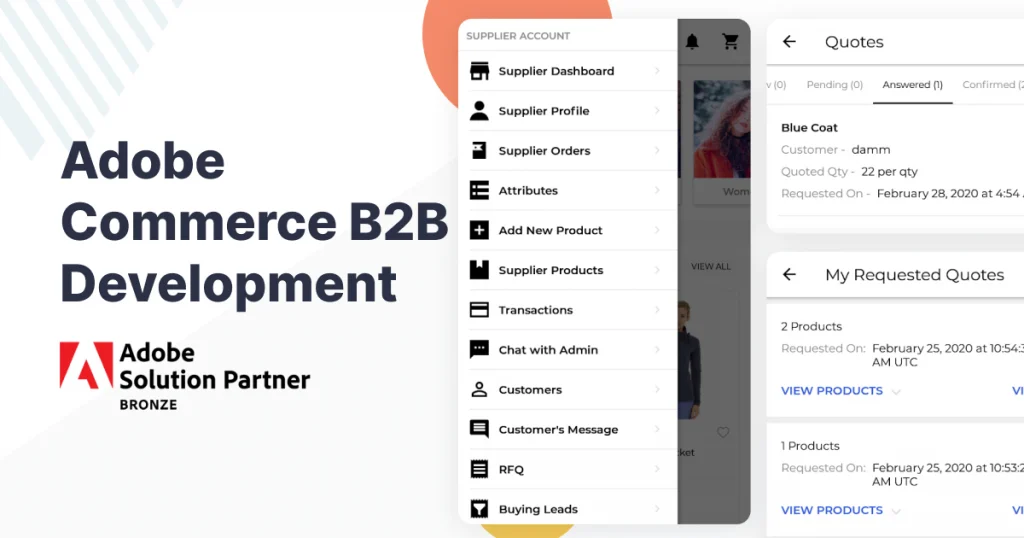
Adobe Commerce
Formerly Magento, Adobe Commerce is highly customizable but requires significant development resources. It fits large enterprises with in-house development teams who want complete control over their platform.
Shopify Plus B2B
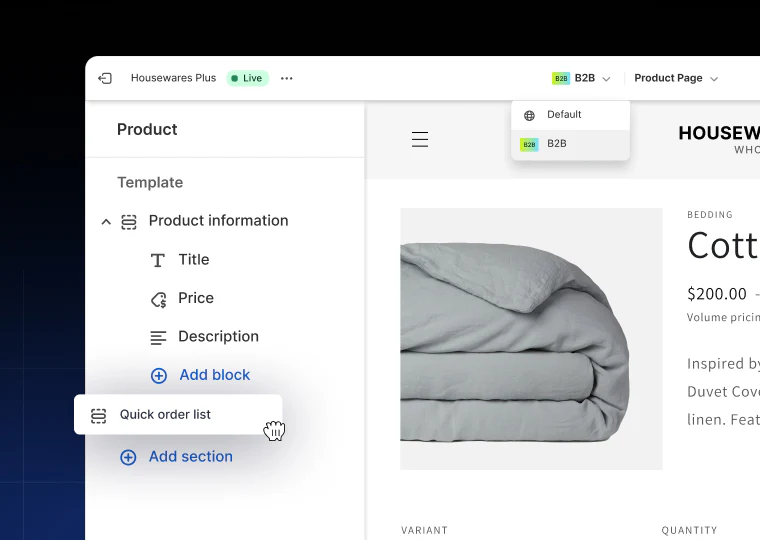
Shopify’s native B2B channel works for Plus merchants with simpler wholesale operations. However, it’s more limited on advanced pricing rules and workflows compared to dedicated B2B solutions.
How to choose the right enterprise B2B ecommerce platform for your business
Step 1: Map your B2B pricing and workflow requirements
Start by listing every pricing rule you use: customer-specific pricing, volume discounts, contract rates, minimum order quantities. Document your order workflows too—do buyers request quotes? Do orders require approval chains? This list becomes your requirements checklist.
Step 2: Audit your ERP, CRM, and existing tech stack
Identify what systems require integration and what data flows between them. Customers, pricing, inventory, orders—where does each live today, and where does it go next?
Step 3: Shortlist platforms against enterprise B2B criteria
Use the criteria from the previous section to filter platforms. Eliminate options that can’t meet your requirements before investing time in demos.
Step 4: Validate with a live demo and proof of concept
Book demos with shortlisted vendors and test real scenarios from your operation. Can the platform handle your most complex pricing rules? Does the ERP sync work the way you expect?
Step 5: Plan implementation, onboarding, and ongoing support
Understand the vendor’s implementation process and timeline. Ask what support looks like post-launch and how the platform scales as your catalog and customer base grow.
Running enterprise B2B ecommerce on Shopify without Shopify Plus
A common assumption: advanced B2B requires Shopify Plus. Solutions like B2Bridge embed enterprise-grade B2B operations on standard Shopify plans, which means you can run sophisticated wholesale without upgrading or migrating to a separate platform.
- Customer-specific and contract pricing applied automatically at checkout
- ERP integration with NetSuite, Zoho, Odoo, and custom systems
- Net payment terms with credit limits per customer
- Quick order, RFQ, and quote-to-order workflows built into the buying experience
- Company accounts with roles and approval chains
Outcome: You don’t have to upgrade to Shopify Plus or migrate to a separate platform to run sophisticated B2B operations.
Scaling wholesale revenue with B2Bridge
B2Bridge brings enterprise B2B commerce to Shopify by embedding wholesale operations directly into your existing store. The platform adapts to your pricing models, ERP workflows, and customer requirements rather than forcing you into a rigid template.
Every B2B operation is different. B2Bridge works as a technical partner from day one—understanding your operation, launching the right setup, and supporting it after go-live. That includes onboarding, implementation support, and ongoing assistance as your catalog, customers, and processes grow.
Book A Demo to see how B2Bridge supports enterprise B2B ecommerce on Shopify.
FAQs about enterprise B2B ecommerce
What is an enterprise B2B company?
An enterprise B2B company sells products or services to other businesses at scale, typically involving complex operations like contract pricing, bulk ordering, and integration with ERP and CRM systems.
What are the four types of ecommerce?
The four main types are B2C (business to consumer), B2B (business to business), C2C (consumer to consumer), and C2B (consumer to business). Enterprise B2B ecommerce focuses specifically on large-scale wholesale transactions between businesses.
Do you need Shopify Plus to run enterprise B2B ecommerce on Shopify?
No. Solutions like B2Bridge embed advanced B2B functionality—pricing engines, ERP integration, net terms, and RFQ workflows—directly into standard Shopify plans without requiring Shopify Plus.
How long does it take to launch an enterprise B2B ecommerce platform?
Timelines vary based on complexity. Shopify-based B2B solutions with hands-on onboarding support can launch in days to weeks, while standalone enterprise platforms often require several months.
What is the difference between a B2B ecommerce app and an enterprise B2B platform?
A B2B ecommerce app adds specific features like wholesale pricing to an existing store. An enterprise B2B platform provides a comprehensive commerce layer with deep ERP integration, advanced workflows, and customization for complex wholesale operations.
Can one Shopify store handle both B2B and B2C customers?
Yes. With the right B2B solution, one unified storefront can show logged-in wholesale buyers contract pricing and B2B features while retail customers see standard B2C pricing—all from the same Shopify store.

As a Product Marketing Executive at B2Bridge, I focus on the Enterprise B2B Ecommerce domain. I leverage my understanding of product and user psychology to deliver customer-centric content that addresses business challenges and fuels growth.