B2B BNPL and net terms both let a business buyer take the goods now and pay later, but they split the risk very differently. With net terms, you invoice an approved buyer and wait 15 to 90 days — the seller keeps full margin, but carries the credit risk. With B2B BNPL, a third-party provider pays the merchant upfront and collects from the buyer for a fee. Net terms cost less and keep the relationship yours; BNPL offloads risk and speeds up approvals.
So which one should you offer your wholesale buyers? It depends on who you sell to and how much risk you want to hold. This guide breaks down the difference and how to run either on Shopify.
B2B BNPL vs Net Terms at a Glance
So what actually separates the two? The core trade-off is cost and control versus risk and speed. Net terms keep your margin and your buyer relationship, but you handle credit checks, invoicing, and collections. B2B BNPL hands that work — and the default risk — to a provider who pays you upfront, in exchange for a fee. Here’s how they line up.
| Factor | Net Terms | B2B BNPL |
|---|---|---|
| Who pays you, and when | Buyer pays the seller directly, in 15–90 days | Provider pays upfront, in about 24–48 hours |
| Who carries default risk | The merchant | The BNPL provider |
| Cost to merchant | No financing fee; full margin kept | A per-transaction or merchant fee |
| Credit checks and collections | Merchant handles both | Provider handles both |
| Buyer approval speed | Manual, slower | Real-time at checkout |
| Best for | Established, vetted, repeat buyers | New, unvetted, or high-value one-off buyers |
| On Shopify | Using Shopify net terms or a B2B app like B2Bridge | Via a BNPL provider integration |
What Are Net Terms in B2B
Net terms are an agreement that lets an approved buyer receive goods now and pay the full invoice within a set window. The most common windows are Net 30, Net 60, and Net 90 — the number is the days a buyer has to pay after the invoice date. Shorter windows like Net 15 suit smaller or well-established accounts.
The flow is straightforward. You ship the order, send an invoice, and the clock starts. The buyer pays before the due date, and the amount is recorded against their account. If they don’t, you follow up.
That last part is the catch. With net terms, the credit risk sits with the seller. Roughly 55% of B2B invoices in the US are paid late, and bad debt affects about 9% of credit-based sales, according to Atradius as of 2023. Terms build loyalty and larger orders, but they tie up cash and time.
What Is B2B BNPL
B2B BNPL — buy now, pay later for businesses — is a payment option where a third-party provider pays the merchant upfront and then collects from the buyer over an agreed schedule. Once the buyer is approved at checkout, the provider absorbs the cost, pays within about 24 to 48 hours, and takes on the default and fraud risk.
Think of it as net terms delivered as a service. The provider runs a real-time credit check, extends the terms, and handles collections, so you don’t wait on payment or chase invoices.
It isn’t the same as consumer BNPL. B2C BNPL splits a small personal purchase into a few equal payments. B2B BNPL is built for higher order values, repeat buying, and the longer cycles businesses run on. Deferred payment has powered trade for centuries — the World Trade Organization estimates up to 90% of world trade relies on some form of trade finance. So when is paying that fee actually worth it?
Key Differences Between BNPL and Net Terms
Both options let buyers defer payment, so the real question is simple: who does the work, and who holds the risk? Five differences decide it.
Payment Timing and Cash Flow
Net terms make you wait; BNPL pays now. With net terms, cash arrives 15 to 90 days after the invoice, so your working capital is tied up the whole window. With BNPL, the provider fronts the money and you’re paid within roughly 48 hours.
Credit Risk and Who Carries It
This is the biggest split. Under net terms, you own the default risk — if a buyer never pays, you eat the loss. Under BNPL, the provider assumes that risk once the order is approved, so a bad debt becomes their problem, not yours.
Fees and Cost to the Merchant
Net terms have no financing fee, so you keep full margin on every order. BNPL charges for the service, usually a percentage of the transaction or a flat merchant fee. You trade a slice of margin for upfront cash and offloaded risk.
Administrative Work and Collections
Net terms mean you run credit approvals, send invoices, track due dates, and chase late payers. BNPL bundles all of that into the provider’s platform. The heavier your account volume, the more that admin adds up.
Buyer Approval and Experience
Net terms usually involve manual vetting, so onboarding a new buyer can take days. BNPL runs an instant credit decision at checkout, which closes new buyers faster. For an unknown buyer, that speed can be the difference between a sale and an abandoned cart.
Outcome: net terms cost less and keep control in-house; BNPL costs a fee but removes risk and waiting.
When Net Terms Are the Better Choice
Net terms win when you already know and trust your buyers. If you sell to repeat wholesale accounts with a payment history, carrying terms in-house is cheaper than paying a provider — and it keeps the relationship and the data yours. No fee, no middleman. In most B2B categories, terms are also what buyers expect, so offering them signals that you take the relationship seriously.
Net terms are the stronger fit when you:
- Sell to established, repeat buyers you’ve already vetted.
- Operate where deferred payment is standard, like wholesale, manufacturing, or distribution.
- Want to protect your full margin and avoid per-order fees.
- Value owning the buyer relationship end to end.
Can terms run in-house without endless admin? Yes — with the right tooling, which we’ll get to below.
When B2B BNPL Makes Sense
What if the buyer is a stranger? B2B BNPL makes sense when the risk or the wait would hurt. For a buyer you can’t vet quickly, or a large one-off order, handing the risk to a provider protects your cash flow and closes the deal on the spot.
Reach for BNPL when you:
- Sell to new or unvetted buyers you can’t credit-check fast.
- Take large or high-value orders where a default would sting.
- Serve seasonal or fast-growing buyers with uneven cash flow.
- Can’t afford to wait 30 to 90 days for payment.
BNPL providers also report that flexible terms lift average order value, since buyers commit to bigger purchases when they can spread the cost. For the right buyer, that’s real upside.
How to Offer Net Terms on Shopify
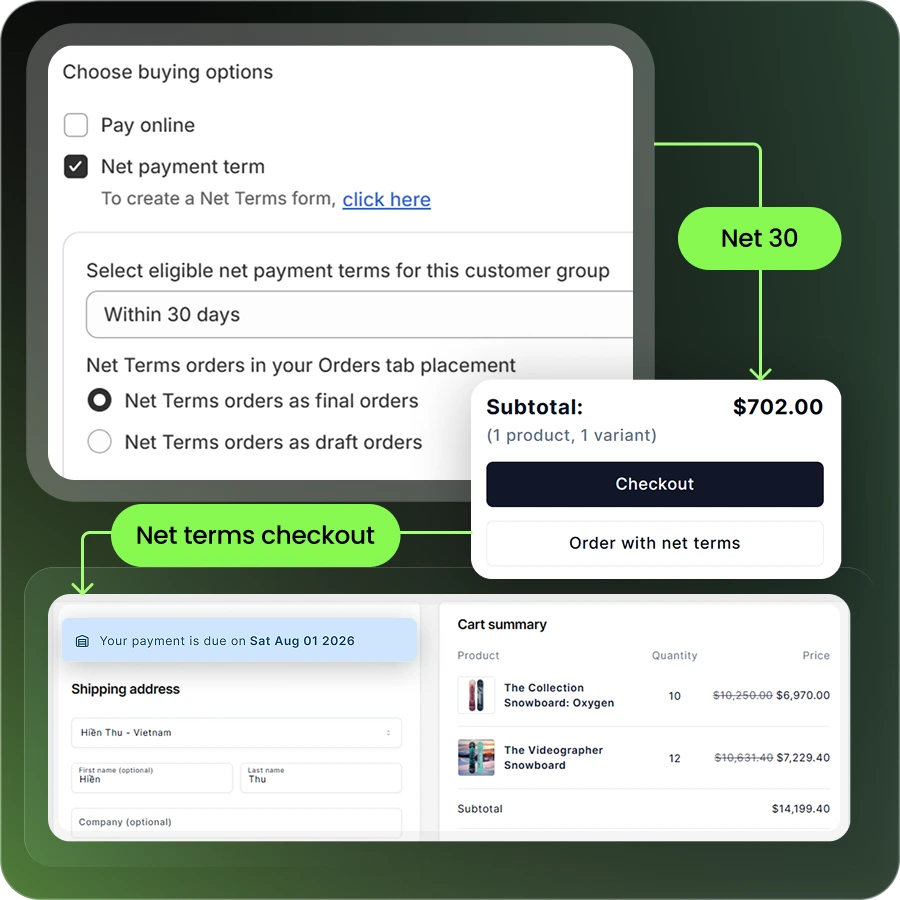
Can you run net terms on Shopify without a financier? Yes — a B2B app makes them native. With B2Bridge, you assign Net 15, 30, 60, or 90 terms to specific customer groups, so your vetted wholesale buyers see invoice payment at checkout while retail shoppers never do.
Risk control is built in. A per-customer credit limit (on the Growth plan and above) caps how much any account can owe at once. Net-terms orders save as a Shopify draft order by default, leaving a beat to adjust shipping, tax, or the term period before finalizing.
Because B2Bridge keeps orders unlimited at a flat monthly price, there’s no per-order financing fee and no order-count cap as the wholesale channel grows. Terms, pricing, and customers also sync to NetSuite, Zoho, Odoo, or a custom ERP, so invoices aren’t entered twice by hand.
Outcome: your approved buyers get professional net payment terms, you keep full margin, and you control your exposure — all inside Shopify.
How to Choose Between BNPL and Net Terms
Which fits the store? Start with who the buyers are and how much risk the business can hold. Map the situation to the option that removes the biggest constraint.
| Your situation | Lean toward |
|---|---|
| Established, repeat accounts you already trust | Net terms |
| You want full margin and to own the relationship | Net terms |
| New or unvetted buyers you can’t check quickly | B2B BNPL |
| Large one-off orders where a default would hurt | B2B BNPL |
| You can’t wait 30–90 days and need cash now | B2B BNPL |
| You’re scaling and don’t want per-order fees or caps | Native net terms |
It doesn’t have to be one or the other. Many merchants run native net terms for trusted repeat buyers and layer a BNPL provider for new or high-value accounts — terms where it’s cheap, BNPL where the risk is real.
Running B2B Net Terms with B2Bridge
If most wholesale comes from buyers you already know, native net terms are usually the smarter play — and B2Bridge makes them simple to run on Shopify. It automates the invoicing and control work that makes in-house terms painful, without a per-order fee eating your margin.
With B2Bridge you can:
- Assign Net 15/30/60/90 terms by customer group, hidden from retail shoppers.
- Set per-customer credit limits to cap exposure on every account.
- Review net-terms orders as draft orders before finalizing.
- Enable request for quote for negotiated deals.
- Let sales reps place orders on behalf of assigned customers.
- Sync terms, invoices, and customers to an ERP.
Because everything stays unlimited at a flat price, terms scale with the wholesale channel instead of getting capped during growth. Ready to offer net terms the right way on Shopify? Book a Demo.
FAQs about B2B BNPL and Net Terms
Is B2B BNPL the same as net terms?
Not quite. Both let buyers pay later, but with net terms you extend the credit, while with BNPL a provider fronts the payment and takes the risk for a fee.
Does B2Bridge offer BNPL or net terms?
B2Bridge offers native net terms, not BNPL. It sets Net 15/30/60/90 terms and credit limits by customer group inside Shopify. The seller keeps full margin and control, and carries the credit risk directly.
Can I offer both net terms and BNPL on Shopify?
Yes. Many merchants run native net terms for trusted repeat buyers and add a BNPL provider for new or high-value accounts. B2Bridge handles the net-terms side; a BNPL integration handles the financed side.
Who takes the loss if a buyer never pays?
With net terms, the loss is the seller’s — which is why vetting buyers and setting credit limits matters. With B2B BNPL, the provider absorbs the default once the order is approved.
Do I need Shopify Plus to offer net terms?
No. Any Shopify plan can offer net terms using a B2B app. B2Bridge brings net terms and B2B pricing to Shopify without requiring Shopify Plus or a separate storefront.

As a Product Marketing Executive at B2Bridge, I focus on the Enterprise B2B Ecommerce domain. I leverage my understanding of product and user psychology to deliver customer-centric content that addresses business challenges and fuels growth.