Net 90 payment terms give buyers 90 calendar days from the invoice date to pay in full—essentially a three-month interest-free loan from seller to buyer. It’s one of the longest standard payment windows in B2B transactions, and it comes with real trade-offs for both sides.
This guide covers how net 90 works and when to offer or accept these terms. It explains how to manage cash flow and credit risk with extended payment windows.
What Are Net 90 Payment Terms
Net 90 payment terms allow buyers to pay for goods or services in full within 90 calendar days of the invoice date. This arrangement acts as a form of trade credit—essentially an interest-free loan from the seller to the buyer.
You’ll see net 90 most often in B2B transactions for large bulk purchases. Buyers want cash flow flexibility and sellers want bigger orders.
The term itself breaks down simply:
- Net: The full invoice amount owed, with no deductions
- 90: The number of calendar days until payment is due
The 90-day clock starts on the invoice date, not delivery. If goods arrive a week later, the payment window is closer to 83 days from receipt.

How Net 90 Payment Terms Work
The mechanics are straightforward. A seller delivers goods or services, issues an invoice, and then waits up to three months to collect payment. During that window, the buyer can sell the inventory, generate revenue, or simply hold onto their cash longer.
From an accounting perspective, the seller records an accounts receivable entry while the buyer records an accounts payable obligation. Both sides track the balance until the invoice is settled.
Think of it like this: the seller is financing the buyer’s purchase for 90 days without charging interest. That’s a meaningful benefit for the buyer—and a real cost for the seller in terms of delayed cash flow.
Net 30 vs Net 60 vs Net 90 Payment Terms
Net 30 is the standard in most B2B industries. Net 60 and net 90 are reserved for larger orders, established relationships, or industries where extended terms are the norm.
| Term | Payment Window | Typical Use Case |
|---|---|---|
| Net 30 | 30 days | Standard B2B transactions |
| Net 60 | 60 days | Mid-size wholesale orders |
| Net 90 | 90 days | Large bulk purchases, enterprise buyers |
Net 30 Payment Terms
Net 30 gives buyers 30 days to pay and works well for both parties. Sellers get paid relatively quickly, and buyers have enough time to process invoices through their accounts payable systems.
Net 60 Payment Terms
Net 60 sits in the middle. Buyers who want more flexibility than net 30 but can’t justify net 90 often land here. It’s common when order values climb into the mid-five-figure range.
Net 90 Payment Terms
Net 90 is typically reserved for creditworthy buyers with a track record. Sellers offering net 90 are essentially providing a three-month interest-free loan, which is why approval usually involves a credit check.
Real Examples of Net 90 Payment Terms in B2B
Concrete scenarios help clarify how net 90 plays out in practice.
Manufacturer Selling to a Distributor
A bicycle parts manufacturer ships $50,000 worth of components to a regional distributor on January 15. The invoice is dated January 15 with net 90 terms, so payment is due by April 15. The distributor can sell those parts to retailers over the next three months and use that revenue to pay the manufacturer.
Wholesaler Selling to a National Retailer
A lighting wholesaler lands a contract with a national home improvement chain. The retailer’s purchasing department requests net 90 because of their internal payment cycles and the volume they’re committing to. The wholesaler agrees because the order size and repeat business potential justify the extended terms.
Supplier Offering 2/10 Net 90 With an Early Payment Discount
A food ingredients supplier offers “2/10 net 90” to a bakery chain. The bakery can take a 2% discount if they pay within 10 days, or pay the full amount within 90 days. On a $10,000 invoice, paying early saves $200.
Why Businesses Offer Net 90 Payment Terms
Extending net 90 often comes down to competitive pressure and customer expectations.
- Enterprise accounts: Large buyers, especially national retailers and government contractors, often expect extended terms as a condition of doing business
- Industry norms: Manufacturing, wholesale distribution, and construction commonly operate on net 60 or net 90 terms
- Relationship building: Offering favorable terms to established customers strengthens long-term partnerships
Not every seller can afford to wait 90 days for payment. The decision depends on cash reserves, profit margins, and buyer creditworthiness.
Advantages of Net 90 for Sellers and Buyers
The benefits differ depending on which side of the transaction you’re on.
Advantages for Sellers
Sellers who offer net 90 often see larger order sizes since buyers aren’t constrained by immediate cash outlay. Extended terms also attract enterprise customers.
Advantages for Buyers
Buyers gain improved cash flow since they can use goods to generate revenue before payment is due. There’s also less pressure on working capital—no need to tie up cash in inventory immediately.
Disadvantages and Risks of Net 90 Payment Terms
Extended payment terms come with real downsides.
Risks for Sellers
Waiting 90 days for payment can strain working capital, especially for smaller businesses. The longer the payment window, the more time for a buyer’s financial situation to change. And tracking receivables across dozens of accounts takes time and resources.
Risks for Buyers
Taking on too many net 90 obligations can create cash flow problems down the line. Missing the 90-day deadline can result in late fees, interest charges, or loss of credit privileges with that supplier.
How to Qualify Customers for Net 90 Trade Credit
Offering net 90 to every buyer who asks is a recipe for cash flow problems. A structured approval process protects your business.
Step 1. Collect a Business Credit Application
Request key information upfront: legal business name, tax ID, years in business, bank references, and trade references from other suppliers.
Step 2. Run a Business Credit Check
Review the applicant’s business credit score through services like Dun & Bradstreet or Experian Business. Look for payment history patterns with other vendors.
Step 3. Set a Credit Limit per Customer
Even approved buyers shouldn’t have unlimited credit. Set a maximum outstanding balance based on their creditworthiness. A new account might start with a $10,000 limit that increases over time.

Step 4. Document Terms on the Purchase Order and Invoice
Clearly state payment terms on every document. Include the due date, any early payment discounts, and late payment penalties. Ambiguity leads to disputes.
Alternatives to Offering Net 90 Payment Terms
If net 90 feels too risky, several alternatives can still give buyers flexibility.
Shorter Net Terms Like Net 30 or Net 60
Shorter terms reduce cash flow exposure while still providing buyers with payment flexibility. Many buyers who request net 90 will accept net 60 if that’s your policy.

Early Payment Discounts
Discounts like “2/10 net 90” incentivize faster payment. Buyers with available cash often take the discount, which improves your cash flow.
Invoice Factoring
Invoice factoring involves selling unpaid invoices to a third-party company at a discount. You receive immediate cash, and the factoring company collects from your buyer.
Third-Party Trade Credit Providers
Services like Resolve or Credit Key handle credit checks, extend terms to your buyers, and pay you upfront. The buyer pays the third party according to the agreed terms.
How Early Payment Discounts Work With Net 90
Early payment discounts encourage faster payment while still offering extended terms. “2/10 net 90” gives a 2% discount if paid within 10 days, or full payment in 90 days.
- 2/10 net 90: 2% discount if paid within 10 days, full payment due in 90 days
- Why sellers offer discounts: Improves cash flow and reduces late payment risk
- Why buyers take discounts: The annualized return on paying early is substantial
Not every buyer will take the discount, but those with healthy cash positions often do.
How to Offer Net 90 Payment Terms in B2B Ecommerce
Running net 90 in an online wholesale store requires more than adding a payment option at checkout.
Step 1. Approve Wholesale Buyers and Assign Credit Limits
Before a buyer can select net 90 at checkout, they need to be verified and approved. This typically involves a registration form, credit application review, and manual approval.
Step 2. Enable Net Terms at B2B Checkout
Display net 90 as a payment option for approved buyers only. Hide it from retail customers and unapproved accounts.
Step 3. Sync Orders and Invoices to Your ERP
When a buyer places an order on net terms, that order creates an accounts receivable entry. Syncing orders and invoices to your ERP or accounting system keeps financial records accurate without manual data entry.
Step 4. Track Receivables and Automate Payment Reminders
Set up automated reminders before invoices come due and follow-up sequences for overdue accounts. Consistent communication reduces late payments.
Run Net 90 Wholesale Orders on Shopify With B2Bridge
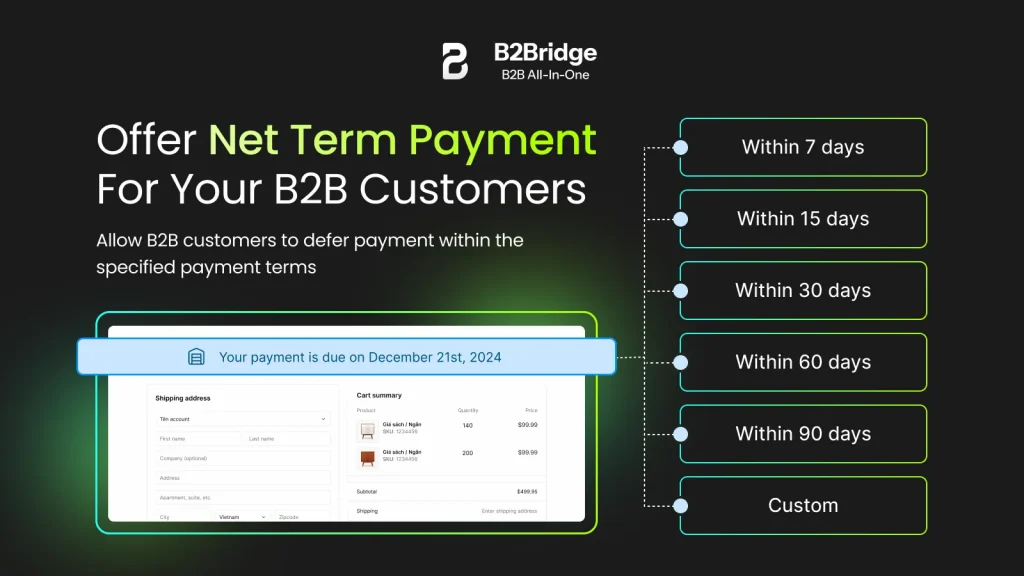
B2Bridge lets Shopify merchants offer net 15, net 30, net 60, or net 90 payment terms to approved B2B buyers—without requiring Shopify Plus. The platform handles credit limits, customer-specific terms, and order syncing directly from your Shopify admin.
- Flexible payment terms: Configure net 15, 30, 60, or 90 per customer group or individual account
- Credit limits: Set maximum outstanding balances to control risk exposure
- ERP integration: Sync orders, invoices, and customer data with NetSuite, Zoho, Odoo, or custom systems
- Gated B2B access: Keep net terms visible only to approved wholesale buyers
Contact us to get guidance on setting up net payment terms for your Shopify wholesale store.
Frequently Asked Questions About Net 90 Payment Terms
Does net 90 include weekends and holidays?
Yes. Net 90 is calculated using calendar days, so weekends and holidays count toward the 90-day window.
How common are net 90 payment terms?
Net 90 is less common than net 30 but appears frequently in manufacturing, wholesale distribution, construction, and marketing services. Large enterprise buyers and government contracts often expect extended terms.
What happens when a customer pays late on net 90?
Consequences vary by seller policy. Common responses include late fees, interest charges, suspension of credit privileges, or requiring prepayment on future orders.
Can a small business offer net 90 payment terms?
Small businesses can offer net 90, but the cash flow implications are significant. Waiting three months for payment on a large order can strain working capital. Invoice factoring or third-party credit providers can help offset the risk.
Is net 90 the same as due in 90 days?
Yes. “Net 90” and “due in 90 days” mean the same thing—the full invoice amount is due within 90 calendar days of the invoice date.

Hi, I’m Ha My Phan – an ever-curious digital marketer crafting growth strategies for Shopify apps since 2018. I blend language, logic, and user insight to make things convert. Strategy is my second nature. Learning is my habit. And building things that actually work for people? That’s my favorite kind of win.