Enterprise B2B ecommerce platforms are commerce systems built for large wholesale operations: account-specific pricing, multi-user company accounts, quotes, approvals, and ERP sync at scale. The main options in 2026 are B2Bridge for Shopify brands, Shopify Plus, Adobe Commerce, SAP Commerce Cloud, and Salesforce B2B Commerce, with commercetools, OroCommerce, and BigCommerce B2B Edition close behind.
The stakes are large. US manufacturers and distributors sold $15.12 trillion in 2025, and Digital Commerce 360 reports that digital channels are growing at a double-digit pace inside that flat total. This guide groups the eight platforms by architecture, because that choice decides your cost and timeline more than any single feature.
Disclosure: This article is written and published by the B2Bridge team. B2Bridge is a B2B app for Shopify and competes with some of the products reviewed here. We aim to present accurate, fair information, but you should weigh our conclusions with that commercial context in mind.
What Makes a B2B Ecommerce Platform Enterprise-Grade
An enterprise-grade B2B platform handles complexity without spreadsheets on the side. The real test is how many buyer-specific rules it can run at once.
Five capabilities separate enterprise platforms from basic wholesale tools:
- Hundreds of price lists, contract rates, and volume tiers tied to specific accounts
- Company accounts with multiple buyers, each with their own role and approval limits
- Quote to order, where an approved quote becomes an order without re-entry
- Net terms, invoices, and credit limits by customer
- ERP integration that keeps orders, inventory, and pricing in sync with NetSuite, SAP, or Microsoft Dynamics
The platforms below cover all five. What actually separates them? Architecture. Some are full suites you implement over months. Some are composable APIs your developers assemble. Others add B2B depth on top of a SaaS store you already run.
Enterprise B2B Ecommerce Platforms at a Glance
Here’s how the eight compare. “Architecture” matters most, because it sets your implementation path.
| Platform | Architecture | Best for | Public pricing |
|---|---|---|---|
| B2Bridge | B2B layer on Shopify | Shopify brands outgrowing native B2B | From $99/month |
| Shopify Plus | SaaS platform with native B2B | DTC-first brands adding wholesale | From $2,300/month |
| Adobe Commerce | Customizable suite | Large catalogs with in-house developers | Quote only |
| SAP Commerce Cloud | ERP-native suite | Companies running SAP ERP | Quote only |
| Salesforce B2B Commerce | CRM-native suite | Sales Cloud customers | % of GMV, quote |
| commercetools | Composable, API-first | Teams building custom front ends | Quote only |
| OroCommerce | B2B-native suite with CRM | Manufacturers with complex sales cycles | Free community edition; enterprise by quote |
| BigCommerce B2B Edition | SaaS platform with B2B add-on | Standalone B2B storefronts | Quote only |
Five of these vendors (SAP, Salesforce, Adobe, commercetools, and Shopify) were named Leaders in the 2025 Gartner Magic Quadrant for Digital Commerce, according to each vendor’s announcement. The links sit in the sections below.
The 8 Best Enterprise B2B Ecommerce Platforms
B2Bridge for Enterprise Wholesale on Shopify
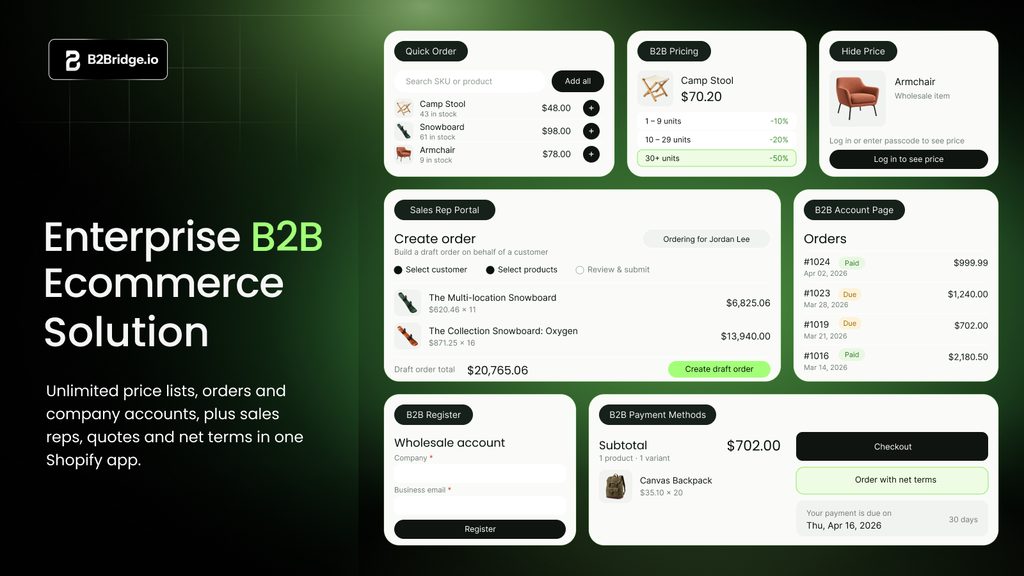
B2Bridge is an all-in-one B2B app that adds enterprise wholesale features to the Shopify store you already run. It’s built for brands whose B2B program has outgrown Shopify’s native limits.
Best for: manufacturers, distributors, and hybrid brands already selling on Shopify
Standout features:
- Unlimited price lists, customer groups, and orders
- A Sales Rep Portal for ordering on behalf of accounts
- RFQ, credit limits, and company accounts
- ERP sync with NetSuite, Zoho, and Odoo, plus a Public API for custom systems
Considerations: it runs on Shopify only, so it won’t replace an SAP- or Oracle-led commerce stack.
Pricing: Professional $99/month, Growth $199, Advanced $299, Enterprise custom, each with a 14-day free trial. Sales Rep Portal and RFQ start on Growth.
Shopify Plus for DTC-First Brands Adding Wholesale
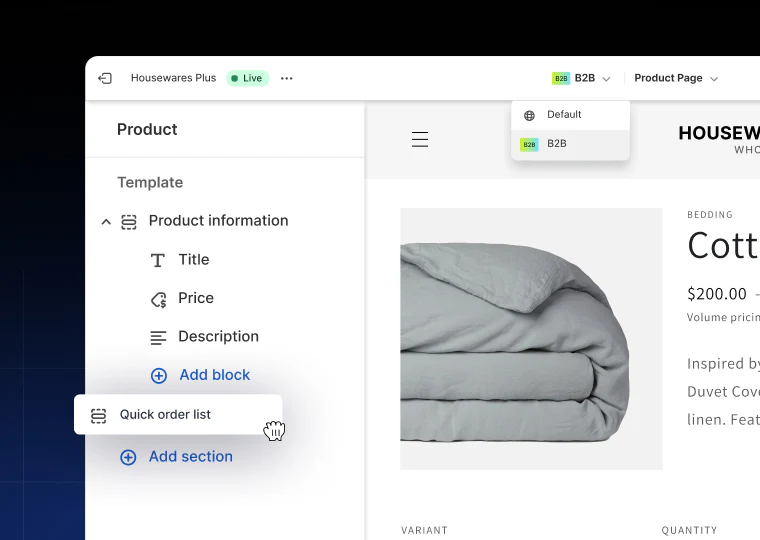
Shopify Plus is Shopify’s enterprise plan, and it unlocks the full native B2B feature set. Shopify was named a Leader in Gartner’s 2025 Digital Commerce Magic Quadrant for the third consecutive year.
Best for: high-volume brands that need DTC and B2B on one SaaS platform
Standout features:
- Unlimited B2B catalogs, compared with 3 active catalogs on Basic, Grow, and Advanced
- Direct catalog assignment to companies and locations
- Checkout customization through Shopify Functions
- Expansion stores for dedicated wholesale storefronts
Considerations: quote requests and rep commission tracking still need an app.
Pricing: from $2,300/month on a 3-year term, or $2,500/month on a 1-year term. See Shopify B2B vs Shopify Plus for the full split.
Adobe Commerce for Highly Customized Catalogs
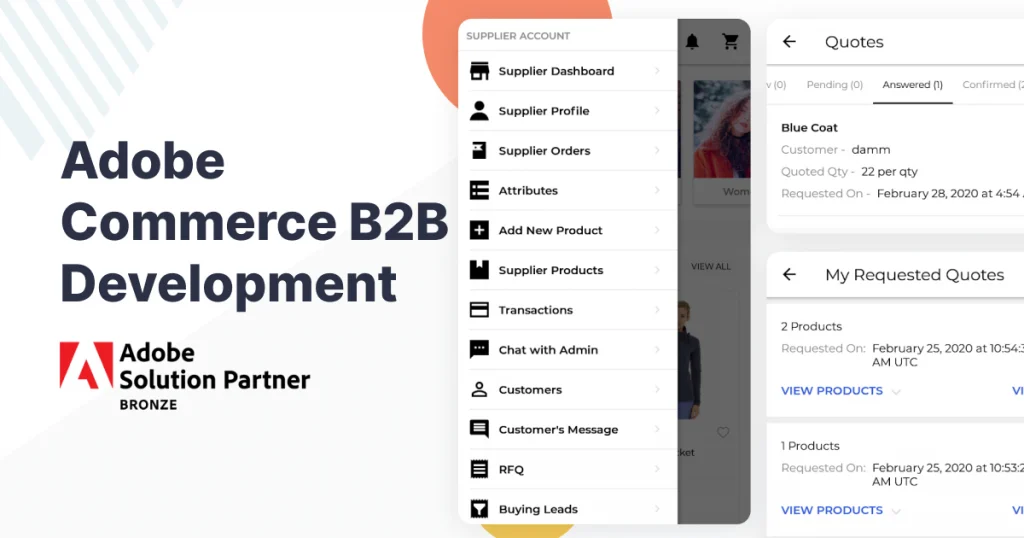
Adobe Commerce, formerly Magento, gives developers code-level control over data models and B2B logic. Adobe has been a Gartner Leader for nine consecutive years, according to its 2025 announcement.
Best for: enterprises with large catalogs and an in-house or agency development team
Standout features:
- Native B2B module with company accounts and shared catalogs
- Negotiable quotes between buyer and seller
- Requisition lists for repeat orders
- Purchase order approval workflows
Considerations: upgrades and custom modules won’t maintain themselves; you’ll need ongoing developer time.
Pricing: not published; licensing goes through Adobe sales. Compare it in Shopify vs Adobe Commerce.
SAP Commerce Cloud for SAP-Centric Enterprises
SAP Commerce Cloud fits companies whose orders, pricing, and inventory already live in SAP ERP or S/4HANA. SAP reports it has been a Gartner Leader for 11 consecutive years.
Best for: global manufacturers standardized on SAP
Standout features:
- Native alignment with SAP ERP data and processes
- Multi-site, multi-currency, multi-language deployments
- Built for large B2B catalogs and account-based buying
Considerations: implementation usually needs a specialized SAP partner and a multi-month timeline.
Pricing: not published; quoted by SAP. See Shopify vs SAP Commerce Cloud.
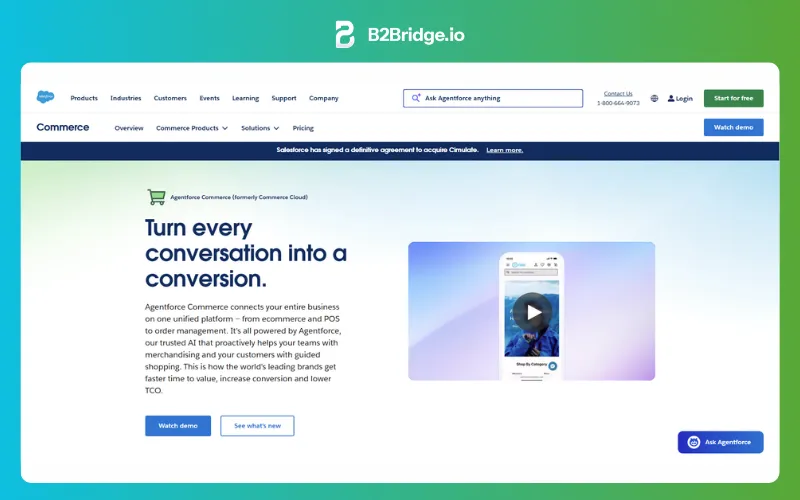
Salesforce B2B Commerce for CRM-Led Sales Teams
Salesforce B2B Commerce connects storefront orders with Sales Cloud and Service Cloud data, so reps and buyers work from one account record. Salesforce has been a Gartner Leader for 10 consecutive years.
Best for: companies whose sales process already runs in Salesforce
Standout features:
- Shared account and contact data with Sales Cloud
- AI-driven product recommendations and search
- Self-service reordering for business buyers
- Multi-brand and multi-region storefronts
Considerations: costs rise with order volume, and if you’re not already on Salesforce, much of the value doesn’t apply.
Pricing: Salesforce charges a percentage of GMV; current editions are “contact for pricing.” More in Shopify Plus vs Salesforce Commerce Cloud.
commercetools for Composable Commerce Teams
commercetools is an API-first, headless platform you assemble into your own stack. It has been a Gartner Leader for six consecutive years, according to the company.
Best for: enterprises with strong engineering teams building custom buyer experiences
Standout features:
- Business Units that model company hierarchies and buyer roles
- A Quotes API for request, negotiation, and acceptance
- Multi-tier approval rules inherited down the hierarchy
Considerations: there’s no ready-made storefront; every buyer-facing screen has to be built.
Pricing: not published; quoted by commercetools. See Shopify Plus vs commercetools.

OroCommerce for B2B-Native Sales Cycles
OroCommerce was built for B2B from the start and ships commerce, CRM, and quoting in one product. It comes as a free open-source Community Edition or a paid Enterprise Edition.
Best for: manufacturers and distributors with multi-step, quote-heavy sales
Standout features:
- Built-in CRM alongside the storefront
- Account hierarchies with delegated purchasing
- Configure-price-quote and RFQ workflows
- One license covering multiple sites
Considerations: customization and hosting need developer resources, and the partner ecosystem is smaller than Adobe’s.
Pricing: Enterprise licenses are aligned to GMV bands and quoted. Compare it in Shopify vs OroCommerce.

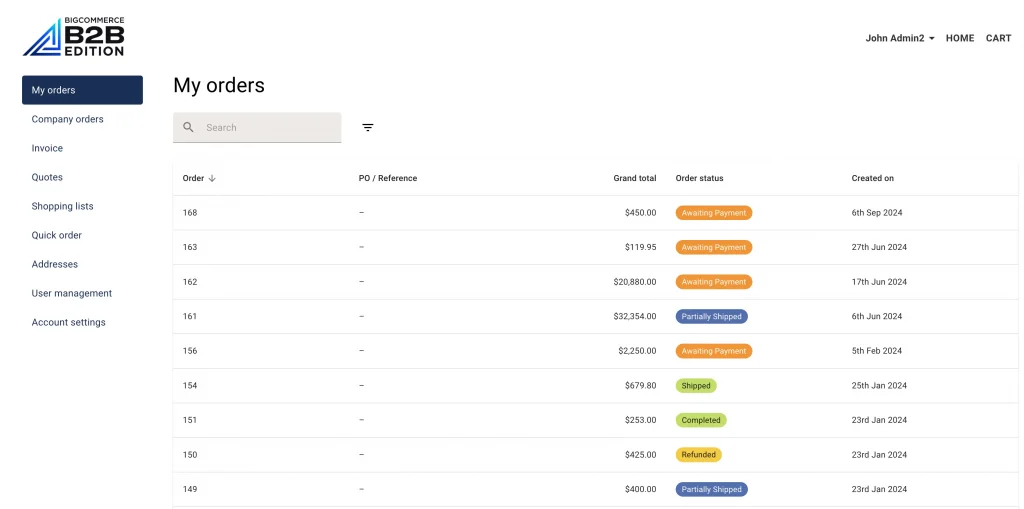
BigCommerce B2B Edition for Standalone B2B Storefronts
BigCommerce B2B Edition adds a buyer portal and company accounts to BigCommerce’s SaaS platform. It suits teams that want B2B features built in, with less custom development than a full suite.
Best for: mid-market and enterprise sellers running a dedicated B2B site
Standout features:
- Buyer Portal for orders, quotes, and reorders
- Company accounts with multiple buyer roles
- Quote management from request to order
- Price lists and customer groups
Considerations: brands that also sell DTC often run separate B2B and B2C storefronts.
Pricing: request a quote from BigCommerce. See Shopify B2B vs BigCommerce B2B.
How to Choose an Enterprise B2B Ecommerce Platform
Where does your order data live today? Start there, because the platform that matches your system of record usually wins on total cost.
| If your situation is… | Shortlist |
|---|---|
| Already on Shopify, B2B outgrowing native limits | B2Bridge, then Shopify Plus |
| SAP ERP runs the business | SAP Commerce Cloud |
| Sales team lives in Salesforce | Salesforce B2B Commerce |
| Large catalog, in-house developers | Adobe Commerce, commercetools |
| Quote-heavy, multi-step sales | OroCommerce |
| Dedicated B2B site on SaaS | BigCommerce B2B Edition |
Then run four checks before you sign anything:
- Map your pricing rules. Count price lists, contract rates, and volume tiers. Shopify’s native cap of 3 catalogs on non-Plus plans is often the first limit growing brands hit.
- Confirm the ERP connector. Ask for a live demo of your exact ERP, with your data. Don’t accept slides.
- Price the full build. Suites and composable platforms carry implementation and agency costs on top of the license.
- Pilot one channel first. Launch with one buyer segment before migrating every account.
Teams already on Shopify can skip the replatforming question entirely. That’s the case the next section covers.
Scale Enterprise Wholesale on Shopify With B2Bridge
If your store already runs on Shopify, you don’t need a new commerce suite to reach enterprise B2B depth. B2Bridge adds it inside the admin your team already uses.
What you get:
- Unlimited price lists, customer groups, and orders on every plan, so growth never hits a catalog cap
- Pricing, gated access, registration, quick order, RFQ, and net terms in one app instead of several
- A Sales Rep Portal plus ERP sync with NetSuite, Zoho, Odoo, or custom systems through the Public API
Brooklyn Bicycle Co. runs its wholesale this way, with variant-level pricing and NetSuite sync on the same Shopify store as its retail site. See plans and pricing, or compare the wider field in our B2B ecommerce platform guide.
Book a Demo to see how B2Bridge handles enterprise wholesale on your Shopify store.
FAQs About Enterprise B2B Ecommerce Platforms
What is the best enterprise B2B ecommerce platform?
The best fit matches your system of record. SAP Commerce Cloud suits SAP shops, Salesforce B2B Commerce suits Salesforce teams, and B2Bridge or Shopify Plus suits brands already selling on Shopify.
How much does an enterprise B2B ecommerce platform cost?
Shopify Plus starts at $2,300 a month on a 3-year term. Adobe, SAP, commercetools, and Oro quote by deal, and Salesforce charges a share of GMV. Implementation costs come on top.
Is Shopify Plus an enterprise B2B platform?
Yes. Shopify Plus includes unlimited B2B catalogs, checkout customization, and expansion stores, and Shopify is a Gartner Leader. Advanced needs like RFQ or rep commissions still require an app.
What is the difference between composable and suite commerce?
A suite like Adobe or SAP ships storefront, catalog, and B2B features together. Composable platforms like commercetools provide APIs your developers assemble, so you’ll gain flexibility and take on more build work.
How long does an enterprise B2B platform take to implement?
App-based setups on an existing Shopify store can launch within weeks, since there’s no migration. Full suites and composable builds typically run several months, depending on ERP integration and catalog size.

As a Product Marketing Executive at B2Bridge, I focus on the Enterprise B2B Ecommerce domain. I leverage my understanding of product and user psychology to deliver customer-centric content that addresses business challenges and fuels growth.