Shopify native B2B is the wholesale toolkit included in the Basic, Grow, Advanced and Plus plans at no extra cost. It covers company accounts, net terms, volume pricing and up to three active catalog assignments below Plus. A B2B app earns its fee when you need more price levels, a sales rep portal, quotes or ERP-managed pricing.
For a brand selling retail and wholesale from one store, the question changed in April 2026. Showing trade buyers their own prices now comes with your plan. An app is worth paying for when you hit a specific limit, and this guide maps where those limits sit and what each setup costs at four common sizes.
Key takeaways
- Native B2B fits stores with three or fewer price levels, no sales team and standard net terms.
- The hard ceiling below Plus is three active catalog assignments, counted per B2B market.
- Apps pay off for extra price levels, rep ordering, quotes and pricing that lives in an ERP.
- Most B2B apps install on the store you already run, so you can keep the native features that work.
Shopify Native B2B vs a B2B App at a Glance
Native B2B wins on cost and simplicity. A B2B app wins once your pricing or sales process outgrows the native limits. The table compares both on the points that usually settle it, based on Shopify’s B2B features by plan page.
| Capability | Shopify native B2B (Basic, Grow, Advanced) | Typical B2B app |
|---|---|---|
| Added cost | Included in your plan | About $10 to $299 a month, more on enterprise tiers |
| Price levels | 3 active catalog assignments | Unlimited on many apps |
| Per-company pricing | Plus only | Common in pricing apps |
| Net terms | Net 7 to 90, every plan | Included in most all-in-one apps |
| Wholesale sign-up | Request form with manual or Flow approval | Forms that tag buyers into pricing groups |
| Sales rep ordering | Draft orders in the admin | Storefront rep portals in some apps |
| Quotes | No quote request workflow | RFQ in some apps or as an add-on |
| ERP-managed pricing | Shopify Admin API | App APIs, usually on top tiers |
Read the price level row first. It’s the limit most growing stores hit before any other.
What Shopify Native B2B Includes on Every Paid Plan
Since April 2, 2026, native B2B runs on Basic, Grow and Advanced as well as Plus. Shopify’s plan table lists the core wholesale tools as available on every one of those plans:
- Companies, company locations and buyer permissions
- Quantity rules and quantity price breaks inside each catalog
- Net terms, payment reminders, vaulted cards and US ACH
- Draft order to invoice, checkout to draft and PO numbers
- Sales staff permissions and a quick order list on the Trade theme
- Company account requests, a Shopify Forms application that creates a company for you to approve
Two requirements catch merchants out. B2B needs the newer customer accounts, and Shopify’s B2B considerations page says accelerated checkouts like Shop Pay don’t work on B2B orders. Orders also cap at 500 line items. Our Shopify B2B features guide walks through each tool in detail.
Where does that toolkit run out?
Where Native Shopify B2B Stops
Four limits decide most native-versus-app choices. Each one is documented by Shopify, and each one shows up as a specific operational problem once your wholesale channel grows.
Three Catalog Assignments Below Plus
Basic, Grow and Advanced allow three active catalog assignments across active B2B markets. Shopify counts each market separately, so one catalog used in two markets takes two of the three slots. Bronze, Silver and Gold use the whole allowance.
Per-Company Pricing Stays on Plus
Assigning a catalog directly to one company or location is a Plus feature. Below Plus, you price by market or segment. A distributor with negotiated rates for each account can’t model that natively without upgrading.
Sales Reps Work Inside the Admin
Native reps take orders as draft orders in your Shopify admin. Each rep needs a staff account, and Shopify’s pricing page caps those at 5 on Grow and 15 on Advanced. Basic includes no additional staff accounts.
No Quote Request Workflow
Shopify’s plan table has no quote request feature on any plan. Negotiated deals move to email, then someone rebuilds them as draft orders. For manufacturers who quote most orders, that manual step repeats on every deal.
What Native B2B Does Better Than an App
Native B2B is the right answer more often than app vendors admit. It adds nothing to your monthly bill. Shopify maintains it as part of the platform.
Your wholesale data also stays in Shopify’s own company, catalog and payment terms records. That makes reporting and Flow automations simpler, and it means you aren’t migrating price lists out of an app later. Shopify’s considerations page warns that some third-party apps don’t work with B2B at all. Fewer apps means fewer conflicts to debug.
The payment side is strong too. Vaulted cards, ACH and payment reminders work on every plan, and a Shopify Flow action can charge a vaulted card when terms come due. If your wholesale program is a handful of retailers on two price levels, native covers it.
That counts for a lot.
Types of Shopify B2B Apps and What They Add
B2B apps fall into four groups. Point tools fix one gap each, while all-in-one apps bundle several. Prices below come from each app’s Shopify App Store listing on November 4, 2026.
| App type | What it adds | Examples and starting price |
|---|---|---|
| Pricing apps | Price rules by customer, tag or quantity | Wholesale Pricing Discount B2B from $24.99, BSS B2B Wholesale Pricing free then $29, Wholesale Gorilla from $34.95 |
| Access control apps | Locks pages, products or prices behind login | Wholesale Lock Manager from $9.99 |
| Order form apps | Single-page bulk ordering and reorder | WSH Order Form & ReOrder from $15.99 |
| All-in-one B2B apps | Pricing, terms, registration, reps and quotes together | SparkLayer free then $49, B2Bridge from $99 |
Stacking point tools works for one or two gaps. Past that, compare the combined bill against one all-in-one plan. Running two pricing apps on the same buyers risks conflicting rules at checkout. Our roundup of the best Shopify B2B apps compares ten of them on caps and price.
What Each Setup Costs by Scenario
Monthly cost depends on three numbers: price levels, B2B orders and sales reps. The table shows app cost on top of your Shopify plan, using list prices checked on November 4, 2026. Shopify Plus replaces your plan from $2,300 a month.
| Your wholesale setup | Native B2B | SparkLayer | B2Bridge |
|---|---|---|---|
| 3 price levels, 40 orders a month, no reps | $0 | Starter, $49 | Professional, $99 |
| 6 price levels, 120 orders a month, no reps | Needs Plus, from $2,300 | Pro, $299 | Professional, $99 |
| 6 price levels, 120 orders a month, 3 reps | Needs Plus, from $2,300 | Pro, $299 | Growth, $199 |
| 10 price levels, 300 orders a month, 8 reps | Needs Plus, from $2,300 | Enterprise, from $499 | Growth, $199 |
Native wins the first row outright. SparkLayer is also cheaper than B2Bridge there, and its pricing page says the app keeps working if you pass your order cap.
The gap opens with scale. SparkLayer plans cap B2B orders at 50, 100 and 150 a month and reps at 1, 2 and 5. B2Bridge has unlimited orders on every plan and unlimited sales agents from Growth. Our B2Bridge vs SparkLayer comparison covers the rest.
Can You Use a B2B App With Native Shopify B2B?
Yes. Most B2B apps install on top of your existing store, and many merchants keep native features that already work. Net terms on vaulted cards are a common example to leave native.
The rule is one pricing engine per buyer. If an app sets a buyer’s wholesale price, don’t also assign that buyer a native catalog with different prices. Pick which system owns pricing, then let the other handle the jobs it does well.
Test before you switch anyone over. Shopify notes that some third-party apps don’t work with B2B checkout, so place a real order on a development store first. Check the price, the quantity rules and the payment terms on the final order. A clean test order tells you more than any feature chart.
How to Choose Between Native B2B and a B2B App
Which limit will you hit first? Match your situation below, starting with price levels, since that limit binds earliest.
| If your wholesale channel has | Start with |
|---|---|
| 3 or fewer price levels, no reps, standard terms | Shopify native B2B |
| 4 or more price levels or regional price books | A B2B app with unlimited price lists |
| Negotiated pricing for individual accounts | A pricing or all-in-one app, or Plus |
| Sales reps ordering for buyers | An app with a rep portal |
| Quotes before most orders | An app with RFQ |
| Pricing that your ERP owns | An app with an API, or Plus |
| Deposits or partial payments | Shopify Plus |
Plan for the channel you expect to run in twelve months. Moving 200 accounts from native catalogs to an app mid-season is harder than starting on the right setup.
If two or more app rows match, an all-in-one app usually costs less than stacking point tools.
Scaling Past Native B2B with B2Bridge
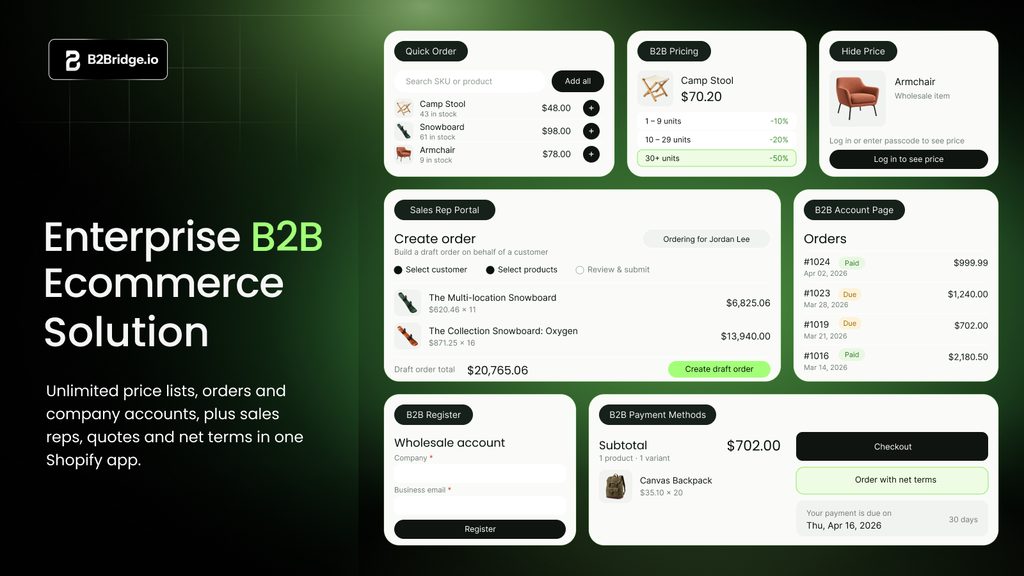
If your wholesale channel is passing the three-catalog limit or adding a sales team, B2Bridge is built for that stage. It runs on Basic, Grow, Advanced or Plus, and it’s priced by features, so your bill doesn’t rise with order volume.
- Unlimited B2B catalogs and price lists where native stops at three, plus unlimited orders on every plan
- Price lists, customer groups, net terms, registration and quick order in one app from Professional at $99 a month
- A Sales Rep Portal with unlimited sales agents, plus RFQ and credit limits, from Growth at $199
- A Public API that syncs price lists and customer groups with your ERP on Advanced at $299
Every plan starts with a 14-day free trial. Book A Demo and we’ll map your price levels, reps and ERP to the right plan.
FAQs about Shopify Native B2B and B2B Apps
Is Shopify native B2B free?
Yes. Shopify includes B2B at no extra cost on Basic, Grow, Advanced and Plus. Shopify notes that B2B and retail orders can carry different variable platform fees, so ask Shopify Support for your rates.
How many B2B catalogs can I have without Shopify Plus?
You get three active catalog assignments across active B2B markets on Basic, Grow and Advanced. Assigning one catalog to two markets uses two slots. Plus removes the limit and adds direct company catalogs.
Can Shopify native B2B hide wholesale prices from retail shoppers?
Partly. Shopify’s help docs say you can hide prices from logged-out visitors with Liquid code, or with the theme editor’s B2B context on Advanced and Plus. Access control apps do this without theme edits.
Does Shopify B2B have a wholesale registration form?
Yes. Company account requests use the Shopify Forms app to create a company you approve manually or through Flow. The form can’t add buyers to an existing company and doesn’t work on a gated B2B-only store.
Do I need Shopify Plus for customer-specific pricing?
Natively, yes. Only Plus assigns catalogs directly to a company or location. Below Plus, a B2B app is the usual way to give individual accounts their own negotiated prices without upgrading your plan.
Can sales reps place orders on Shopify without an app?
Yes, through draft orders in the admin. Reps need staff accounts with company permissions, capped at 5 on Grow and 15 on Advanced. A rep portal app lets them order from the storefront instead.

As a Product Marketing Executive at B2Bridge, I focus on the Enterprise B2B Ecommerce domain. I leverage my understanding of product and user psychology to deliver customer-centric content that addresses business challenges and fuels growth.