Wholesale pricing in fashion typically involves setting a price 2.0x to 2.5x the total Cost of Goods Sold, which covers materials, labor, and overhead while leaving room for retailers to apply their own markup and hit a 50–60% margin. Get the formula wrong—in a year when McKinsey projects low single-digit growth—and you either squeeze your own profits or price yourself out of retailer relationships entirely.
This guide walks through the core formulas, pricing strategies, and operational considerations that help fashion brands protect margins and scale wholesale revenue—whether you’re selling to boutiques or department stores.
What is a wholesale pricing strategy in fashion
A wholesale pricing strategy in fashion is the method brands use to set prices for bulk sales to retailers. Most fashion brands calculate wholesale prices as 2.0x to 2.5x their total Cost of Goods Sold (COGS), which includes materials, labor, and shipping. This multiplier covers production costs and profit while leaving room for retailers to apply their own markup—typically doubling the wholesale price to hit a 50–60% retail margin.
You can think of wholesale pricing as the layer between what it costs to produce a garment and what the end consumer pays. Boutiques, department stores, and online retailers buy at this lower rate so they can mark up and resell profitably.

Why wholesale pricing strategy matters for fashion brands
Get wholesale pricing wrong, and you either squeeze your own margins or price yourself out of retailer relationships. A clear strategy protects profitability while keeping products attractive to buyers.
- Profit margins: Covers all costs while leaving room for sustainable growth
- Retailer adoption: Competitive wholesale prices encourage retailers to carry and reorder products
- Channel consistency: Prevents pricing conflicts between wholesale partners and direct-to-consumer sales
Wholesale price vs retail price vs MSRP
These three terms represent different price points in the supply chain, and they often get mixed up.
| Term | Definition | Who Sets It | Who Pays It |
|---|---|---|---|
| Wholesale Price | Price retailers pay the brand for bulk orders | Brand or manufacturer | Retailer |
| Retail Price | Price consumers pay in-store or online | Retailer | End consumer |
| MSRP | Manufacturer’s Suggested Retail Price | Brand or manufacturer | Guideline only |
MSRP acts as a guardrail. It signals to retailers what the brand considers a fair consumer price, which helps maintain brand positioning across different sales channels.
Markup vs margin in fashion pricing
Markup and margin measure profitability differently, and confusing them leads to pricing errors that compound across an entire catalog.
Markup is the percentage added on top of cost. Margin is the percentage of the final selling price that represents profit.
| Term | Formula | Example ($20 cost, $30 price) |
|---|---|---|
| Markup | (Price − Cost) ÷ Cost | 50% markup |
| Margin | (Price − Cost) ÷ Price | 33% margin |
A 50% markup does not equal a 50% margin. When negotiating with retailers or setting internal targets, knowing which metric is on the table prevents costly miscommunication.
How to calculate COGS and true unit cost for apparel
COGS—Cost of Goods Sold—represents the direct costs required to produce one unit. True unit cost goes further, capturing expenses that often get overlooked until they’ve already eroded margins.
- Materials: Fabric, trims, buttons, zippers, labels, hangtags, packaging
- Labor: Cutting, sewing, finishing, quality control
- Overhead: Factory costs, shipping to warehouse, import duties—averaging 35.1% on U.S. apparel
- Hidden costs: Chargebacks from retailers, returns allowances, freight to the buyer
Underestimating any of these—especially chargebacks and returns—means the wholesale price looks profitable on paper but falls short in practice.
Wholesale pricing formula for fashion brands
The core formula is straightforward: Wholesale Price = True Unit Cost × Markup Multiplier.
Most fashion brands apply a multiplier between 2.0x and 2.5x, depending on positioning and cost structure. If true unit cost is $25 and the multiplier is 2.2x, the wholesale price lands at $55.
This formula assumes all costs have been captured accurately. If the unit cost calculation misses overhead or hidden expenses, the multiplier won’t save the margin.
Main wholesale pricing strategies for fashion brands
Different approaches suit different brand positions and market conditions. Most fashion brands blend elements from several rather than committing to just one.
Cost plus pricing
Add a fixed percentage markup to total production cost. This approach is transparent and easy to calculate, making it common for basics and commodity-style products where margins are tight and predictable.
Value based pricing
Price based on perceived brand value rather than pure cost. Designer labels and premium brands often use this approach because brand equity justifies prices that exceed what cost-plus would suggest.
Competitor based pricing
Set prices relative to what similar brands charge. This works well in crowded market segments where buyers compare options side by side, though it risks a race to the bottom if everyone undercuts each other.
Keystone pricing
Double the cost to set the retail price, then halve it for wholesale. Keystone pricing is a traditional rule of thumb in fashion—simple to calculate and widely understood by retailers.
Tiered and volume based pricing
Offer lower per-unit prices for larger order quantities. This incentivizes bulk purchases and rewards high-volume buyers, which is standard practice for brands selling to both small boutiques and large retailers.
>> You may also like:
- Volume Discount: A Complete Guide for B2B Businesses
- Value-Based Pricing: Key Concepts, Strategies, and Examples
How to set a wholesale price for clothing step by step
1. Calculate your true unit cost
List every direct cost to produce one unit—materials, labor, packaging, inbound shipping. Track actual costs rather than estimates, because even small oversights compound across large orders.
2. Research competitor and market pricing
Benchmark against similar brands in the same category. If prices land significantly higher, revisiting costs or accepting a lower margin may be necessary. If they’re lower, there may be money left on the table.
3. Choose a pricing strategy
Align the strategy with brand positioning. A premium brand using cost-plus pricing may underprice itself, while a basics brand using value-based pricing may struggle to justify higher rates.
4. Apply your wholesale markup
Multiply true unit cost by the chosen multiplier. For most fashion brands, this falls between 2.0x and 2.5x, though luxury and premium segments may go higher.
5. Validate against retail markup and MSRP
Check that the wholesale price leaves enough margin for retailers. If a retailer doubles the wholesale price and the result exceeds what consumers will pay, the deal falls apart.

Industry standard wholesale markup and profit margins in apparel
Typical wholesale markups in fashion range from 2.0x to 2.5x COGS. Several factors influence where a brand falls within that range.
- Product category: Basics and essentials typically run tighter margins than fashion-forward or seasonal items
- Brand positioning: Mass market brands compete on price; premium and luxury brands command higher margins
- Sales channel: Traditional wholesale differs from off-price, consignment, or marketplace sales
Retailers generally expect to achieve a 50–60% gross margin after applying their own markup, so the wholesale price has to leave room for that.
How to price wholesale so retailers still hit their margin
Retailers won’t carry products they can’t profit from. Working backward from the target retail price helps ensure the wholesale price makes sense for both parties.
If the target retail price is $100 and the retailer expects a 50% margin, they can pay up to $50 wholesale. If costs require a $60 wholesale price, either the retail price has to increase or cost efficiencies have to be found.
MSRP serves as a useful tool here. By setting a suggested retail price, brands signal to retailers what markup the market will bear, which helps align expectations before the first order ships.
Wholesale pricing across DTC, retail, and premium channels
Selling through multiple channels introduces complexity. Pricing has to account for each channel’s economics without creating conflicts.
- DTC (direct-to-consumer): Brands sell at or near retail price, but undercutting wholesale partners damages those relationships
- Traditional retail: Standard wholesale pricing applies, with retailers marking up to their target margin
- Premium or exclusive channels: May command different pricing, terms, or exclusivity arrangements
Channel conflict—where DTC prices undercut retailers—is one of the fastest ways to lose wholesale accounts.
Common wholesale pricing mistakes fashion brands make
Ignoring hidden costs and chargebacks
Retailer chargebacks for compliance issues, packaging errors, or late shipments can erode up to 15% of gross sales. Failing to account for these in pricing means actual margin falls short of target.
Confusing markup with margin
Using these terms interchangeably leads to pricing errors. A 50% markup yields a 33% margin—not the same thing. Clarifying which metric is being used in every pricing conversation prevents problems.
Undercutting retailers with DTC prices
When consumers can buy directly from a brand for less than retailers charge, those retailers stop ordering. Maintaining price parity or offering retailers exclusive products protects the relationship.
Using a single price for every customer
One-size-fits-all pricing ignores volume buyers, regional differences, and contract accounts. Tiered pricing and customer-specific price lists reward loyalty and volume without leaving money on the table.
How to manage wholesale pricing in Shopify and your ERP
A pricing strategy only works if systems can enforce it. Manual spreadsheets and disconnected tools lead to errors, version control issues, and frustrated buyers.
Customer group and tier based price lists
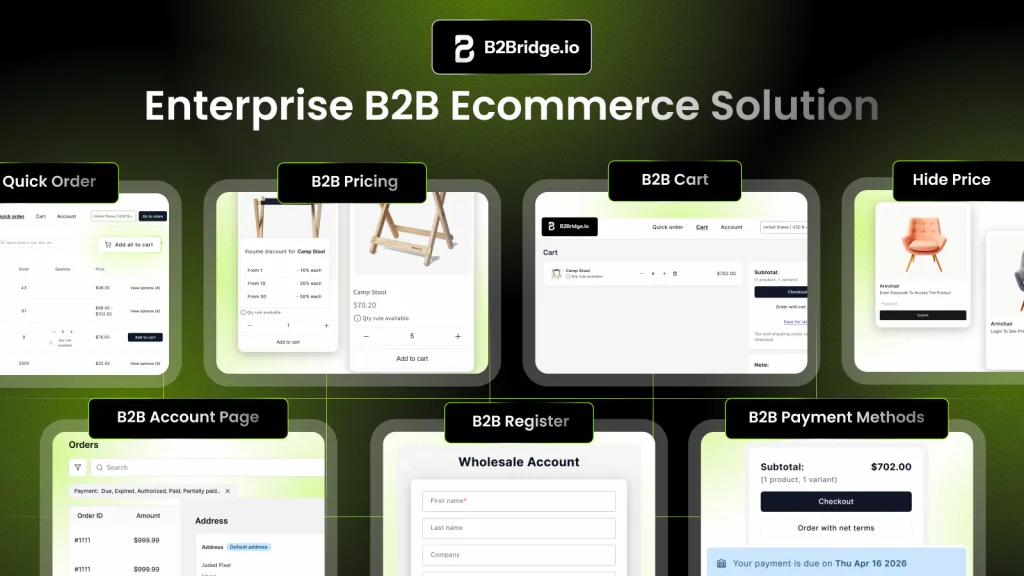
Assigning different price lists to different buyer segments—gold accounts, silver accounts, new retailers—allows for flexible pricing without manual intervention. B2Bridge supports unlimited customer groups and contract price lists directly in Shopify, without requiring Shopify Plus.
Volume discounts and minimum order quantities
Enforcing minimum order quantities, case packs, and quantity breaks in the ordering system protects margins on small orders while rewarding bulk purchases automatically.
ERP and CRM synced price lists
Keeping pricing aligned across Shopify, ERP (NetSuite, Zoho, Odoo), and CRM prevents errors and saves time. API-based synchronization eliminates manual updates and prevents mismatched quotes from reaching buyers.
Wholesale pricing trends shaping fashion brands
Personalized pricing is becoming more common, with brands offering contract-specific or negotiated pricing tailored to individual accounts. Pricing engines are replacing manual spreadsheets, reducing errors and speeding up quote turnaround. And tighter coordination between DTC and wholesale pricing prevents channel conflict and protects brand positioning.
Build a scalable wholesale pricing engine for your fashion brand
Sustainable wholesale growth requires a pricing engine that adapts to customer tiers, channels, and order volumes—without creating operational chaos.
B2Bridge brings enterprise-grade B2B pricing to Shopify, handling customer-group pricing, volume tiers, MOQs, and quantity increments from the Shopify admin. It integrates with ERPs like NetSuite, Zoho, and Odoo, keeping pricing aligned across systems. And it scales as catalog, customer base, and operational complexity grow.
Contact us to get expert guidance and practical solutions for your wholesale fashion business.
Frequently asked questions about wholesale pricing for fashion
How do you calculate a wholesale price for clothing?
Calculate true unit cost—including materials, labor, overhead, and hidden costs—then multiply by the target markup (typically 2.0x to 2.5x) to arrive at the wholesale price.
What is the difference between markup and margin in fashion pricing?
Markup is the percentage added on top of cost, while margin is the percentage of profit relative to the final selling price. A 50% markup yields only a 33% margin.
How often should fashion brands review and update wholesale prices?
Most brands review pricing at least seasonally or whenever input costs, supplier terms, or competitive conditions change significantly.
Can fashion brands manage wholesale pricing on Shopify without Shopify Plus?
Yes. Apps like B2Bridge add enterprise-grade B2B pricing features—including customer groups, tiered pricing, and volume discounts—to standard Shopify plans.
How do net payment terms affect wholesale pricing decisions?
Offering net 30 or net 60 terms ties up cash flow, so some brands build financing costs into their wholesale price or offer early-payment discounts to offset the delay.
How should fashion brands price wholesale orders for international retailers?
Factor in currency conversion, duties, and regional market conditions. Maintaining separate price lists for different markets—supported by multi-currency pricing tools—simplifies international B2B transactions.

Hi, I’m Ha My Phan – an ever-curious digital marketer crafting growth strategies for Shopify apps since 2018. I blend language, logic, and user insight to make things convert. Strategy is my second nature. Learning is my habit. And building things that actually work for people? That’s my favorite kind of win.