B2B ecommerce is the online sale of products or services between businesses, while B2C ecommerce is the sale of products directly to individual consumers. The distinction sounds simple, but the operational differences between the two models affect everything from how you price products to how you get paid.
This guide breaks down the eight differences that matter most—and shows how to run both models from a single Shopify store when your business serves wholesale buyers and retail customers.
What Is B2B Ecommerce
B2B (business-to-business) ecommerce is the online sale of products or services between companies. Instead of selling to individual shoppers, B2B sellers work with procurement managers, buying committees, and corporate accounts who purchase for their organization’s operations.
Think of a restaurant chain ordering kitchen equipment from a supplier, or a boutique restocking inventory from a distributor. The buyer isn’t spending personal money on something they’ll use at home—they’re making a business decision with company funds.
Key Characteristics of B2B Ecommerce
- Bulk ordering: Orders are large, often recurring, and measured in cases or pallets rather than single units
- Relationship-driven sales: Buyers and sellers build long-term partnerships, not one-off transactions
- Complex purchasing: Multiple people weigh in before an order gets approved
- Negotiated terms: Prices and payment schedules are often customized per account
Common Industries in B2B Ecommerce
Manufacturing, wholesale distribution, industrial supplies, office equipment, and commercial lighting are classic B2B categories. A lighting manufacturer selling to electrical contractors or a food distributor supplying restaurants—both are B2B relationships.
What Is B2C Ecommerce
B2C (business-to-consumer) ecommerce is what most people picture when they think of online shopping. A company sells directly to an individual who’s buying for personal use.
The decision-maker is typically one person, and the purchase often happens in a single browsing session. Emotional factors like brand appeal, convenience, and aesthetics play a bigger role here than ROI calculations.
Key Characteristics of B2C Ecommerce
- Individual buyers: One person decides and pays
- Smaller order values: Single items or small quantities per transaction
- Fast transactions: Impulse-driven, promotion-responsive purchases
- Standardized pricing: Everyone sees the same price on the product page
Common Industries in B2C Ecommerce
Fashion, consumer electronics, beauty products, home goods, and food delivery dominate B2C. When you buy sneakers from a brand’s website or order groceries through an app, that’s B2C.
B2B vs B2C Ecommerce at a Glance
Here’s a quick reference comparing the two models across the eight differences covered below:
| Feature | B2B Ecommerce | B2C Ecommerce |
|---|---|---|
| Buyer | Procurement teams, buying committees | Individual consumers |
| Order Volume | Bulk, high-value, recurring | Single items, lower value |
| Sales Cycle | Long, complex, relationship-driven | Short, fast, impulse-driven |
| Pricing | Negotiated, tiered, contract-based | Fixed, standardized |
| Payment | Net terms (net 30/60), purchase orders | Credit cards, digital wallets |
| Marketing | LinkedIn, direct outreach, trade publications | Social media, paid ads, influencers |
| Relationships | Long-term retention, account management | Acquisition-focused, brand loyalty |
| Platform Needs | Custom catalogs, reorder hubs, approval workflows | Guest checkout, mobile optimization |
8 Critical Differences Between B2B and B2C Ecommerce
1. Target Audience and Buyer Profile
B2B sells to businesses. The buyer might be a procurement manager placing orders for a retail chain, or a buying committee evaluating vendors for a manufacturing plant. They’re spending company money and answering to stakeholders.
B2C sells to individuals spending their own money for personal use. One person browses, decides, and checks out—often in the same session.
2. Sales Cycle and Decision Process
B2B sales cycles stretch over weeks or months. Multiple stakeholders weigh in, approvals move through management layers, and negotiations happen before anyone clicks “place order.” The focus is on ROI and how the purchase fits into broader operations.
B2C cycles are short. A flash sale or limited-time offer can close the deal in minutes. Decisions are driven by convenience, aesthetics, and emotional appeal rather than spreadsheets.
3. Pricing Models and Price Lists
B2B pricing is rarely one-size-fits-all. A distributor might see different rates than a small retailer, and a long-term partner might have a custom price list entirely. Volume discounts, contract pricing, and tiered rates are standard.
B2C pricing is standardized. Every shopper sees the same price, with occasional promotions applied universally.

4. Order Volume, MOQs, and Case Packs
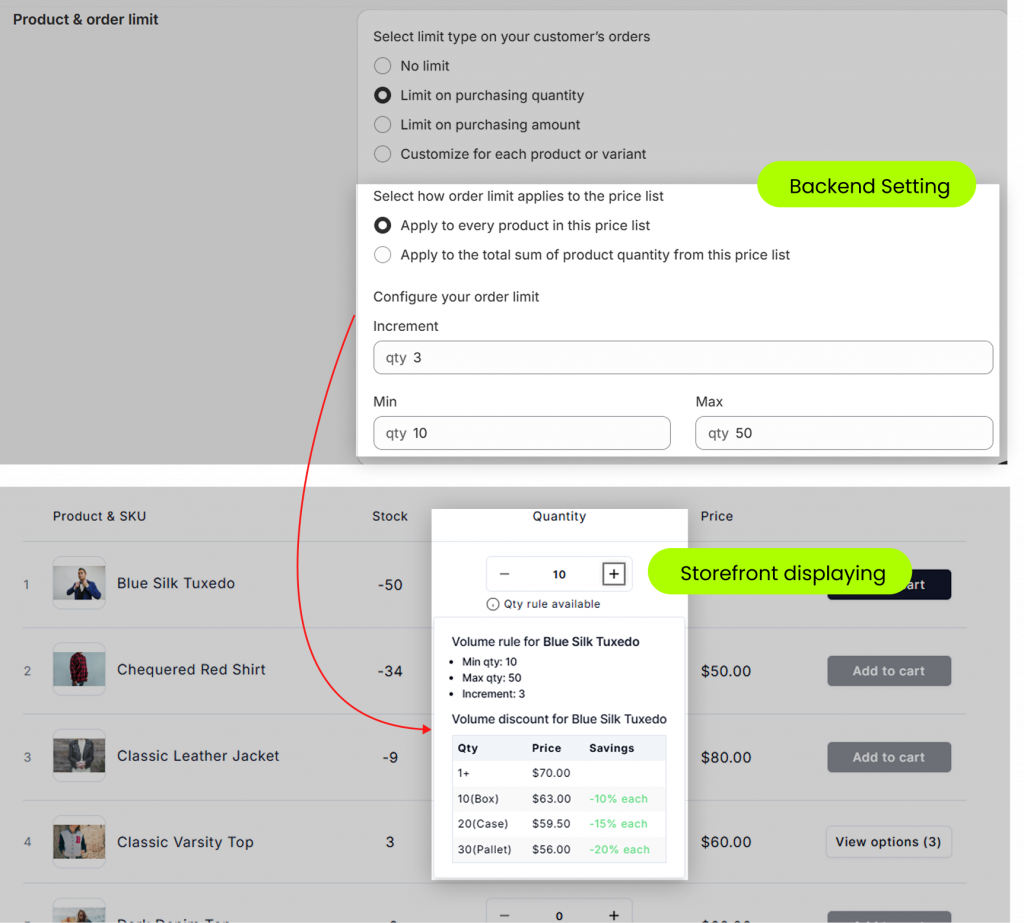
B2B orders are bulk orders. Wholesalers often enforce MOQs (minimum order quantities)—the smallest amount a buyer can purchase. Case packs, where products ship in fixed quantities like cases of 12, are common because they simplify logistics and protect margins.
B2C orders are typically single items with no minimums. A consumer buying one t-shirt is the norm.
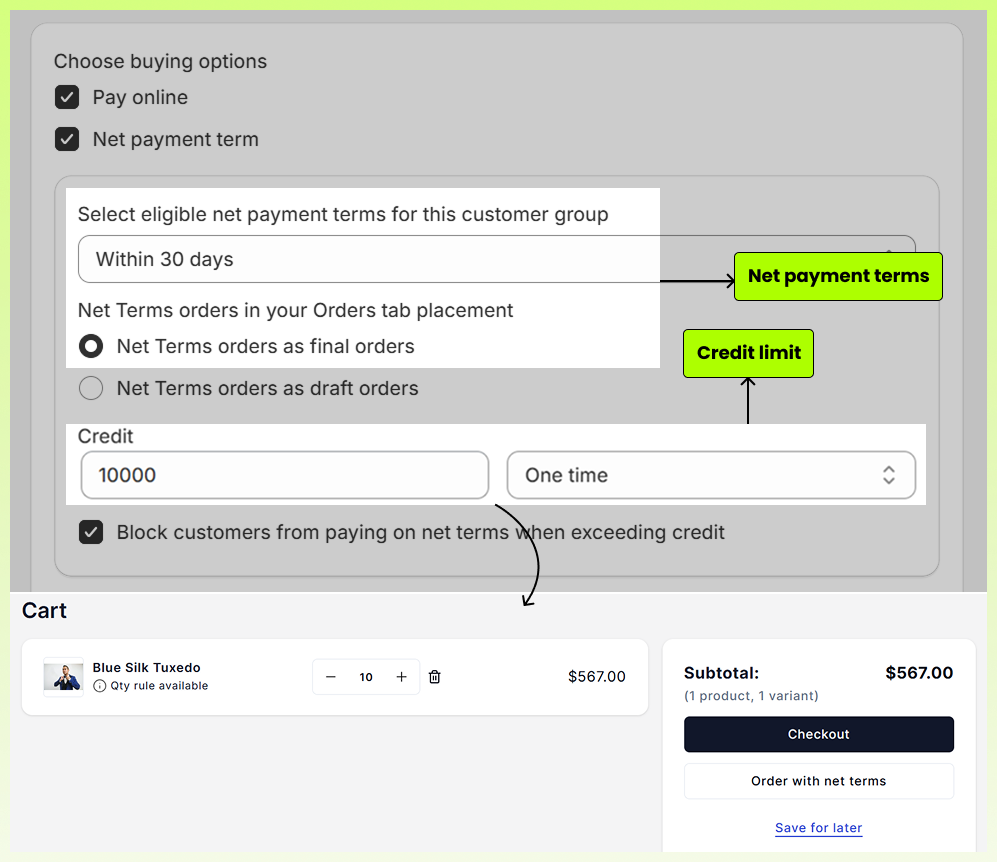
5. Payment Methods and Net Payment Terms
B2B buyers often pay on terms rather than at checkout. Net 30 means the buyer has 30 days to pay after receiving the invoice. Net 60 and net 90 extend that window further. Purchase orders and wire transfers are standard.
B2C buyers pay immediately with credit cards, PayPal, Apple Pay, or Buy Now Pay Later options. The transaction closes at checkout.
6. Marketing Strategy and Channels
B2B marketing happens on LinkedIn, through email outreach, at trade shows, and in industry publications. The messaging focuses on efficiency, cost savings, and solving business problems.
B2C marketing lives on Instagram, TikTok, paid ads, and influencer partnerships. The messaging emphasizes lifestyle, emotional benefits, and urgency.
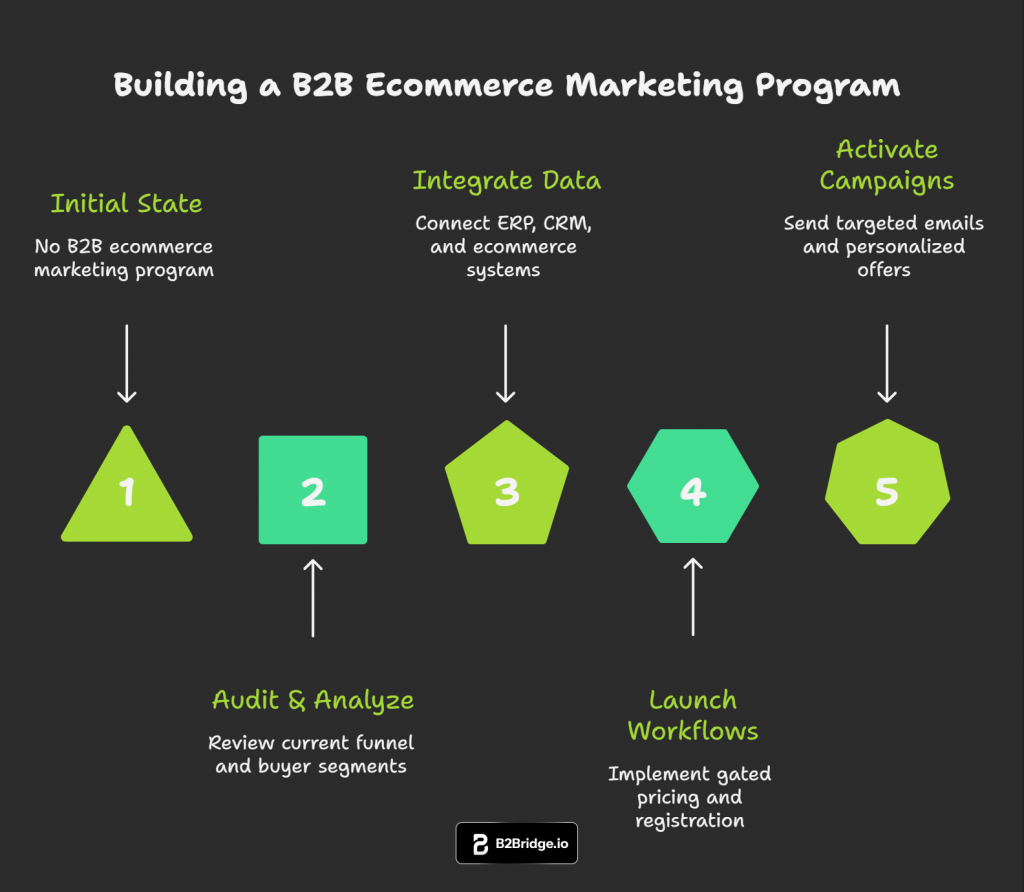
7. Customer Relationships and Account Management
B2B prioritizes retention. Dedicated account managers, regular check-ins, and contract renewals are part of the relationship. Losing a single B2B customer can mean losing significant recurring revenue.
B2C focuses on acquisition and brand loyalty. The goal is attracting new customers through marketing while building repeat purchases through loyalty programs.
8. Technology and Platform Requirements
B2B platforms require features that B2C stores rarely use: personalized catalogs, reorder functionality, corporate account management, and approval workflows. Buyers expect to see their negotiated prices and reorder past purchases quickly.
B2C platforms prioritize sleek design, guest checkout, and mobile optimization. The experience is built for speed and simplicity.
Why B2B Ecommerce Is More Complex Than B2C
The operational complexity of B2B goes beyond larger orders. You’re managing multiple price lists, approval workflows, ERP and CRM integrations, tax-exempt handling, and custom fulfillment rules—often simultaneously.
Many B2B merchants struggle with disconnected systems. Pricing lives in one place, customer data in another, and orders in a third. Manual processes fill the gaps, and errors multiply.
- Custom pricing per customer: Managing contract prices and volume discounts across dozens of accounts
- Approval workflows: Multiple stakeholders signing off before orders process
- System integrations: ERP and CRM data staying aligned with the storefront
- Fulfillment complexity: MOQs, case packs, and shipping terms that vary by account
How to Choose Between B2B, B2C, and Hybrid Ecommerce
The right model depends on your target customer, product type, and operational capacity.
When B2B Ecommerce Is the Right Fit
B2B works when you’re selling to retailers, distributors, or corporate accounts. Products that require bulk quantities, margins that depend on volume, and buyers who expect custom pricing and payment terms all point toward B2B.
When B2C Ecommerce Is the Right Fit
B2C works when you’re selling directly to individual consumers. Products ready for immediate personal use, one-time or low-frequency transactions, and standard pricing that works for all customers fit the B2C model.
When a Hybrid B2B and B2C Model Wins
Many brands serve both audiences from one store. A skincare brand might sell individual products to consumers while also supplying spas at wholesale rates.
The benefits include unified inventory, a single admin dashboard, and broader revenue streams. Shopify supports hybrid models without requiring separate storefronts—though you’ll want tools that manage customer-specific pricing and gated access.
How to Run B2B and B2C on the Same Shopify Store
Running both models from one store is possible without Shopify Plus when you use the right setup.
Step 1: Map Your B2B Catalog and Customer Groups
Start by identifying which products are wholesale-only versus shared with retail customers. Define your customer groups—retailers, distributors, VIP accounts—and plan which products and prices each group sees.
Step 2: Configure Price Lists and Net Payment Terms
Set up tiered or customer-specific pricing for each group. Establish payment terms like net 15, 30, or 60 for qualified buyers. Keep B2B prices hidden from B2C shoppers to avoid channel conflict.
Step 3: Connect Your ERP and CRM for Data Sync
Pricing, inventory, and customer data stay aligned across systems through integrations with platforms like NetSuite, Zoho, or Odoo via API-based synchronization.
Step 4: Gate B2B Access and Launch the Wholesale Channel
Set up B2B registration forms with business verification (tax ID, resale certificate). Lock wholesale products, pages, or prices behind login. Test the buyer experience before going live.
B2B Ecommerce Features That Close the Gap With B2C
B2B buyers now expect B2C-level convenience. They want fast, intuitive experiences—not clunky portals that feel outdated.
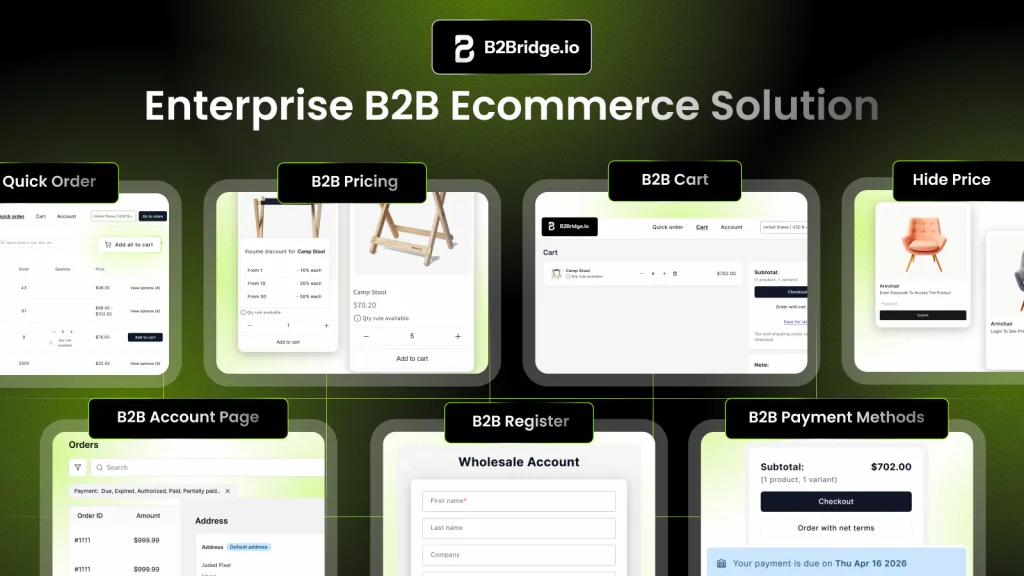
Customer Specific Pricing and Volume Discounts
B2B platforms display personalized prices per customer or group. Tiered discounts that increase with quantity encourage larger orders while matching the negotiated pricing B2B buyers expect.
Quick Order Pages and Reorder Workflows
Quick order pages let buyers enter SKUs or upload CSVs to build orders fast. Reorder functionality pulls from past purchases, reducing friction for repeat buyers who know exactly what they want.
Quote to Order and RFQ Support
RFQ (request for quote) workflows handle large or custom orders. The buyer requests a quote, the seller responds with pricing, and the buyer converts it to an order.
Gated Access and Verified Wholesale Registration
B2B stores gate products and prices behind login to keep wholesale pricing hidden from retail shoppers. Registration forms with business verification ensure only approved buyers access wholesale rates.
The Future of B2B and B2C Ecommerce
The lines between B2B and B2C experiences are blurring. B2B buyers increasingly expect the same convenience they get as consumers—fast checkouts, mobile-friendly interfaces, and self-service options.
Self-serve B2B portals are replacing phone calls and email chains for quotes and reorders. Real-time ERP sync is becoming standard rather than a differentiator.
Bring Enterprise B2B Ecommerce to Your Shopify Store
B2Bridge brings enterprise-grade B2B operations to Shopify without requiring Shopify Plus or a separate storefront.
- Advanced B2B pricing engine: Customer-specific pricing, volume discounts, tiered pricing, MOQs, and quantity increments
- Net payment terms and credit limits: Net 15/30/60 and RFQ workflows built in
- ERP and CRM integration: Sync with NetSuite, Zoho, Odoo, or custom systems via API
- Unified B2B + B2C store: Run both models from one Shopify admin

Contact us to get expert guidance for your wholesale store.
Frequently Asked Questions About B2B vs B2C Ecommerce
Is Shopify a B2B or B2C platform?
Shopify supports both B2B and B2C ecommerce. With apps like B2Bridge, merchants can run wholesale and retail operations from a single Shopify store without Shopify Plus.
Is Apple a B2B or B2C company?
Apple operates primarily as a B2C company, selling devices directly to individual consumers. Apple also has B2B programs for enterprise customers and educational institutions.
Is Walmart B2B or B2C?
Walmart is primarily a B2C retailer serving individual consumers. Walmart also operates Walmart Business, a B2B division that sells to businesses, schools, and nonprofits.
Is B2B ecommerce more profitable than B2C ecommerce?
B2B ecommerce typically generates higher order values and stronger customer lifetime value due to bulk purchasing and recurring orders. Profitability depends on margins, operational costs, and the specific industry.
Can one business sell both B2B and B2C online?
Yes. Many businesses operate hybrid models that serve both wholesale buyers and individual consumers from a single ecommerce store. This approach requires tools that support customer-specific pricing, gated access, and flexible payment terms.

Hi, I’m Hanh – a product marketing professional passionate about driving growth, simplifying complex solutions, and creating impactful strategies for Shopify that connect products with customers.