Choosing between Zoey and Shopify often comes down to a single question: is your business B2B-first, or do you need to serve both wholesale and retail from one platform? The answer shapes everything from your pricing setup to your ERP integration approach.
This guide breaks down 10 key differences between the platforms, covering pricing engines, quote workflows, net terms, and the scenarios where each platform—or a third option—makes the most sense for your wholesale operation.
Zoey vs Shopify quick verdict for B2B brands
Shopify dominates direct-to-consumer retail with its massive app ecosystem and design flexibility. Zoey, on the other hand, is a specialized platform engineered specifically for B2B wholesale, distribution, and manufacturing. The right choice depends entirely on your primary business model—and sometimes, you don’t have to choose at all.
Many merchants run Shopify for their public storefront while layering in dedicated B2B functionality for wholesale operations. Here’s the quick breakdown:
- Choose Zoey if: your operation is B2B-only or B2B-primary and you want a platform purpose-built for wholesale complexity out of the box.
- Choose Shopify if: you want a unified platform for both DTC and B2B—with native B2B features now available on every plan, including company profiles, custom catalogs, volume pricing, quantity rules, and payment terms. No third-party apps or workarounds required for foundational wholesale needs.
- Choose Shopify Plus if: you need enterprise-grade B2B capabilities—unlimited catalogs, direct per-company/location catalog assignment, partial payments, deposits, advanced checkout customization, and deeper ERP integrations.
- Add a B2B app layer (any plan) if: you need advanced workflows not covered natively, such as RFQ/quoting, complex order approval flows, or deep ERP sync.
What Zoey is and who it serves
Zoey is a dedicated B2B ecommerce platform built from the ground up for manufacturers, distributors, and wholesalers. Unlike platforms that bolt B2B features onto a consumer foundation, Zoey’s entire architecture assumes you’re selling to businesses first.
Typical Zoey customers are mid-market wholesalers who want built-in quote workflows, customer-specific pricing, and sales rep tools without heavy customization. If your operation runs B2B-only or B2B-primary, Zoey offers a streamlined path to launch with fewer moving parts.

What Shopify offers for B2B ecommerce
Shopify started as a DTC platform, though it now supports B2B through both native features and third-party apps. The distinction between standard Shopify and Shopify Plus matters significantly when you’re evaluating wholesale capabilities.
Standard plans (Basic, Grow, Advanced)
As of April 2026, all Shopify plans include native B2B features at no extra cost—no apps or workarounds needed for core wholesale operations.
Available natively:
- Company profiles & locations with permission levels
- Up to 3 B2B catalogs with tailored pricing (assigned via B2B Markets — group-level)
- Quantity rules (min, max, increment) & volume price breaks
- Net payment terms & payment reminders
- Vaulted credit cards & ACH payments (US only)
- Draft orders, invoices, PO numbers & easy reorders
- Quick order lists & Trade theme
- Shopify Flow for B2B automation
- Contextual storefront & checkout (Advanced plan only)
Limitations vs Plus:
- Max 3 catalogs — assigned via Markets only, not per individual company/location
- No deposits or partial payments
- No per-company negotiated pricing (group-level only)
Shopify Plus
Includes everything above, plus:
- Unlimited B2B catalogs
- Direct catalog assignment per company & location (true per-account negotiated pricing)
- Deposit requirements & partial payments
- Payment requests per fulfillment (preorders, custom products, multiple shipments)
- Advanced checkout customization (Checkout Blocks, Extensions, Branding API)
- Contextual storefront & checkout via Markets
- Audiences, expansion stores & dedicated support
Still requires apps or custom development (on any plan including Plus):
- RFQ / quoting workflows
- Deep ERP integration (NetSuite, Dynamics 365 — requires connector apps or iPaaS)
- Complex order approval flows
10 key differences between Zoey and Shopify for B2B
Each difference below addresses a specific B2B workflow. The question isn’t which platform is “better”—it’s which handles your particular requirements out of the box versus with customization.
| Feature | Zoey | Shopify (Basic/Grow/Advanced) | Shopify Plus |
| Customer-specific pricing | Native | Group-level native | Per-company native |
| Quote-to-order / RFQ | Native | Requires app | Requires app |
| Net payment terms | Native | Native | Native |
| Company accounts | Native | Native | Native |
| Quick order lists | Native | Native | Native |
| ERP integrations | Built-in connectors | Requires app | Requires app |
| B2B + B2C unified store | Separate | Unified (native) | Unified (native) |
| Tax exemptions per company | Native | Native | Native |
| Multi-currency B2B | Limited | Native (via Markets + Shopify Payments) | Native (via Markets + Shopify Payments) |
1. B2B pricing engine and custom price lists
Zoey includes customer-specific pricing, tiered pricing, and contract price lists natively. On Shopify, all plans now include native B2B catalogs with volume pricing and quantity rules—but the approach differs by plan. Basic, Grow, and Advanced support up to 3 catalogs assigned at the market (group) level. Shopify Plus adds unlimited catalogs with direct assignment per company and location, enabling true per-account negotiated pricing.
Outcome: Zoey and Shopify Plus are comparable for per-account pricing complexity. Shopify (non-Plus) works well for up to 3 pricing tiers. Shopify wins overall on ecosystem flexibility.


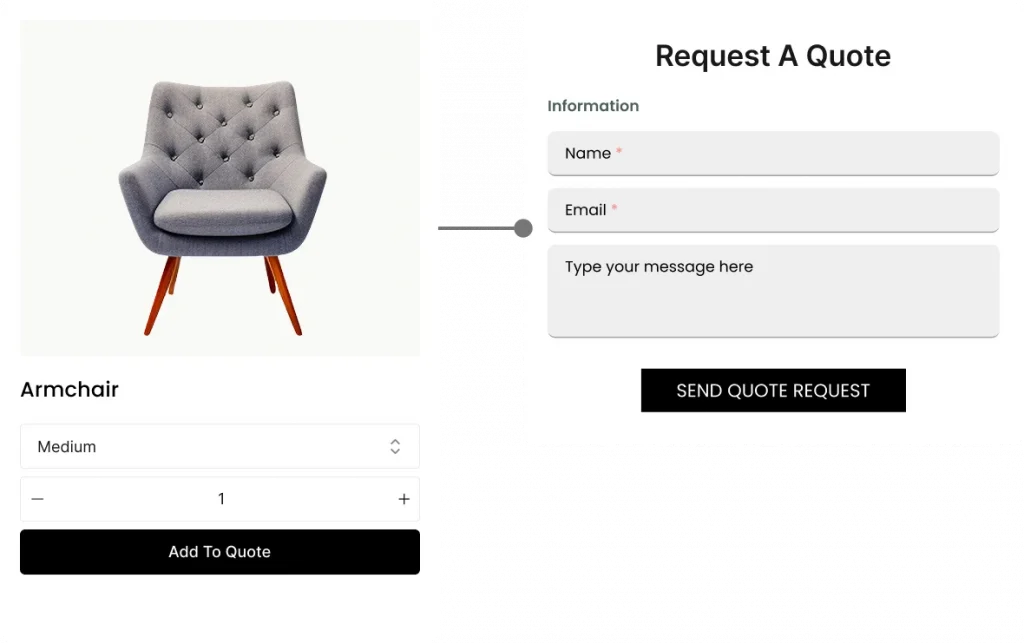
2. Quote-to-order and RFQ workflows
RFQ (Request for Quote) is a workflow where buyers submit quote requests that your team converts to orders—standard practice for large B2B purchases where pricing depends on volume, customization, or negotiation.
Zoey has native quote management built in. Shopify requires apps for RFQ and quote-to-order conversion on any plan, including Plus.

3. Net payment terms and credit limits
Net 30, Net 60, and structured payment terms are standard B2B expectations—wholesale buyers typically pay invoices after delivery rather than at checkout.
Both Zoey and Shopify handle this natively. Net terms, payment reminders, and vaulted credit cards are available on all Shopify plans (Basic and above). ACH payments are also supported natively, though limited to US stores. Shopify Plus adds deposit requirements and partial payments on top of this.
4. Company accounts and buyer roles
Company accounts allow multiple buyers under one business account with shared order history and role-based permissions—a purchasing manager places orders while a finance lead handles payments, all under the same company profile.
This is native in both Zoey and Shopify. As of April 2026, company profiles with location-level permissions are available on all Shopify plans, not just Plus.


5. ERP and CRM integrations
Zoey has built-in connectors for common ERPs. Shopify relies on apps or custom development for deep integration with systems like NetSuite, Dynamics 365, or Odoo—on any plan.
If you’re syncing customers, pricing, orders, and inventory between your ecommerce platform and back-office systems, Zoey reduces integration setup effort out of the box. Shopify’s larger app ecosystem offers more connector options, but requires more evaluation and configuration.
6. Unified B2B and B2C storefront
Shopify is built for hybrid selling—running wholesale and retail from the same store, same product catalog, same inventory system. This is native on all plans. Zoey is typically B2B-focused and requires separate setup for consumer-facing sales.
If you sell to both audiences, Shopify’s unified approach reduces operational overhead significantly.
7. Quick order and bulk purchasing UX
Quick order lists are native on all Shopify plans—no app required. The Quick order list section is available in Shopify’s free themes (v11.0.0+) and can be added directly to product pages for B2B customers ordering multiple variants in bulk. Both platforms support this workflow; the difference is Shopify now includes it out of the box.
8. Multi-currency and tax-exempt wholesale
Shopify Markets handles multi-currency B2B well—customers see pricing in their market’s currency at checkout. Note that multi-currency checkout requires Shopify Payments as the payment gateway.
Tax exemptions for B2B are native on all Shopify plans: you can apply tax-exempt status per customer or per company location, including VAT number support for EU/UK. Both platforms can handle international B2B tax requirements; implementation details vary by region and setup.
9. Customization and theme flexibility
Shopify has a significantly larger theme ecosystem, Liquid-based customization, and a deep developer community. Zoey offers customization within a smaller ecosystem.
For design flexibility, brand control, and available developer resources, Shopify has a clear advantage.
10. App ecosystem and extensibility
Shopify’s app marketplace is significantly larger than Zoey’s. Zoey compensates by building more B2B features natively, reducing app dependency for core wholesale workflows.
The trade-off: Zoey requires fewer apps to run B2B out of the box. Shopify offers more choice for extending functionality—and with native B2B now available on all plans, the gap in app dependency has narrowed considerably.
Pricing and cost of ownership compared
Zoey starts around $600/month with B2B features included. Shopify’s standard plans range from $39 to $399/month, though adding B2B functionality through apps changes the total cost picture.
- Platform subscription: Zoey is higher upfront; Shopify varies by tier
- Transaction fees: Shopify charges fees unless you use Shopify Payments
- App costs: Shopify may require multiple paid apps for full B2B functionality
- Implementation: Zoey often includes onboarding; Shopify varies by approach
For some merchants, adding B2B apps to standard Shopify proves more cost-effective than either Zoey or Shopify Plus.
Implementation timeline and onboarding compared
Zoey typically provides guided onboarding with dedicated support. Shopify implementation depends on complexity and whether you’re using Plus or working with a partner.
- Zoey: guided implementation, dedicated support
- Shopify DIY: faster launch, less hand-holding
- Shopify with B2B partner: implementation support available through solutions like B2Bridge
When to choose Zoey over Shopify for wholesale
Zoey makes sense when your operation is B2B-primary and you want extensive wholesale features without managing multiple apps.
- Your model is B2B-only or B2B-primary
- You want built-in sales rep tools and mobile ordering
- You prefer predictable B2B-focused platform costs
When to choose Shopify over Zoey for wholesale
Shopify makes sense when you want DTC strength alongside wholesale, or you’re already running on the platform.
- You want a strong DTC presence alongside wholesale
- You prefer a larger theme and app ecosystem
- You already use Shopify for retail and want to add B2B
Shopify B2B alternatives beyond Zoey and Shopify Plus
Third-party B2B layers on standard Shopify
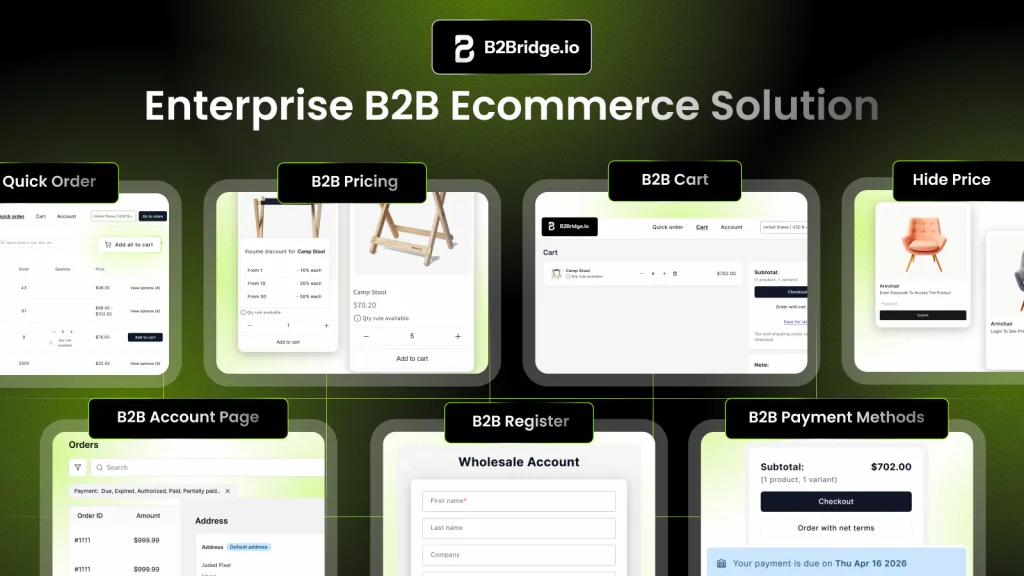
Apps like B2Bridge add enterprise B2B capabilities to standard Shopify without upgrading to Plus. You get custom pricing, quote workflows, ERP integration, sales Agent portal and company accounts while staying on your current plan.
Headless B2B builds
Headless commerce separates your frontend from your backend, offering maximum flexibility for large enterprises with custom requirements. This approach involves higher complexity and cost—typically suited for businesses with dedicated development resources.
Run enterprise B2B on Shopify without replatforming
If you’re already on Shopify and want Zoey-level B2B functionality without migrating, B2Bridge embeds enterprise B2B operations directly into your store. The platform includes an advanced pricing engine, ERP/CRM integration, and quote-to-order workflows—without requiring Shopify Plus or a separate wholesale site.
Outcome: You get Shopify’s flexibility with purpose-built B2B capabilities, plus ongoing technical partnership as your wholesale operation scales.
FAQs about Zoey vs Shopify
Is Zoey better than Shopify for B2B ecommerce?
It depends on your requirements. Zoey offers more native B2B features out of the box—particularly for RFQ/quoting and ERP integrations. Shopify, however, now includes native B2B features on every plan, and with its larger app ecosystem and built-in B2B/B2C unified storefront, it can match or exceed Zoey’s capabilities for most wholesale use cases. If you sell to both businesses and consumers, Shopify’s unified approach has a clear operational advantage.
Can you run B2B on Shopify without Shopify Plus?
Yes. Third-party B2B apps add customer-specific pricing, quote workflows, net terms, and company accounts to standard Shopify plans.
Why does Shopify appear cheaper than Zoey upfront?
Shopify’s base plans are priced for general commerce. For straightforward B2B needs, native features are now included at no extra cost on all plans. For more complex requirements—more than 3 price lists, per-account negotiated pricing, deposits, or partial payments—upgrading to Shopify Plus changes the cost equation. Factor in your specific B2B requirements, app costs if needed, and total cost of ownership when comparing platforms.
Can you migrate from Zoey to Shopify?
Yes. Merchants can migrate products, customers, and order history from Zoey to Shopify. B2B functionality requires Shopify Plus or a B2B app layer to maintain feature parity.
Does Shopify support net 30 payment terms natively?
Yes – on all plans. Net terms (Net 30, Net 60, etc.), payment reminders, and vaulted credit cards are native B2B features available on Basic, Grow, Advanced, and Plus. Shopify Plus additionally supports deposit requirements and partial payments for more complex payment workflows.

As a Product Marketing Executive at B2Bridge, I focus on the Enterprise B2B Ecommerce domain. I leverage my understanding of product and user psychology to deliver customer-centric content that addresses business challenges and fuels growth.