Finding the right wholesale app for Shopify can feel like comparing apples to enterprise resource planning systems. Some apps handle basic tiered discounts; others connect your entire B2B operation to NetSuite and manage quote-to-order workflows.
This guide breaks down the top wholesale apps for Shopify in 2026, covering what each does best, where they fall short, and how to match app capabilities to your actual B2B requirements—whether you’re running a simple wholesale channel or a full enterprise operation with ERP integration and net payment terms.
What to look for in a Shopify wholesale app
The best wholesale app for Shopify depends on your business size and how complex your B2B operations are. For merchants on standard Shopify plans, apps like Wholesale Gorilla and B2B Wholesale Hub work well for straightforward wholesale pricing. If you’re running enterprise-level operations with ERP integration requirements, solutions like B2Bridge and SparkLayer offer the depth that larger wholesalers typically require.
Before diving into individual apps, it helps to understand what separates a basic pricing tool from a full B2B commerce platform.
Advanced B2B pricing engine
A price list is a set of custom prices assigned to a specific customer or customer group—separate from your public retail pricing. The more complex your wholesale operation, the more pricing flexibility you’ll want.
- Role-based pricing: Different rates for distributors, retailers, and VIP accounts based on customer tags
- Contract pricing: Negotiated rates for specific accounts that override standard wholesale tiers
- Volume and tiered discounts: Price breaks that activate at quantity thresholds
- Min/max order quantities: Controls that enforce case packs or prevent over-ordering
ERP and CRM integration
If you’re managing pricing, customers, and orders across NetSuite, Zoho, Odoo, or another system, your wholesale app becomes the bridge between Shopify and your back office. Native connectors or a robust API can sync pricing rules, customer data, and order history automatically.
Outcome: Fewer manual errors and less time reconciling orders across systems.
B2B buying experience and conversion
Wholesale buyers don’t shop like consumers. They often know exactly what they want and order dozens of SKUs at once. A quick order form lets buyers enter SKUs or product names directly and add multiple items without clicking through product pages one by one.
Features that drive wholesale conversion include bulk ordering interfaces, CSV upload for large orders, saved carts for repeat purchasing, and a dedicated B2B cart that displays net terms and volume pricing.
Net payment terms and credit control
Net terms—like Net 30 or Net 60—allow approved wholesale customers to pay invoices within a set number of days after order placement rather than at checkout. This is standard practice in B2B transactions.
Credit limits cap how much a customer can owe before requiring payment, which protects your cash flow while offering the flexibility wholesale buyers expect.
Scalability across standard Shopify plans
Many wholesale apps work as Shopify Plus B2B alternatives, which matters if you’re not ready for the $2,000+/month commitment. Running a unified B2B and B2C storefront on a single Shopify site—rather than maintaining separate stores—reduces operational overhead significantly.
Native Shopify B2B vs wholesale apps vs Shopify Plus
Understanding your options helps you avoid paying for features you don’t use—or discovering gaps after you’ve already launched.
| Factor | Native Shopify | Wholesale apps | Shopify Plus B2B |
|---|---|---|---|
| Pricing flexibility | Limited | Extensive | Extensive |
| ERP integration | Manual/basic | Varies by app | Native + apps |
| Plan requirement | Any plan | Any plan | Plus only |
| Best for | Simple discounts | Growing wholesale | Enterprise scale |
Native Shopify B2B features
Standard Shopify plans offer basic customer tagging and discount codes, but no dedicated B2B pricing engine or wholesale portal. Manual workarounds exist, though they rarely scale well.
Wholesale apps on standard Shopify
Apps extend standard plans with customer-specific pricing, quick order forms, net terms, and gated access—without requiring Plus. Most apps in this guide work on regular Shopify plans.
Shopify Plus B2B capabilities
Plus includes company profiles, custom catalogs, vaulted credit cards for repeat purchasing, and a dedicated B2B checkout flow. The trade-off is cost: Plus starts at $2,000/month.

Quick comparison of the best wholesale apps for Shopify
| App | Best for | Key strength | Starting price | Plus required? |
|---|---|---|---|---|
| B2Bridge | Enterprise wholesale | Custom ERP integration + pricing engine | Custom | No |
| SparkLayer | Mid-market B2B portals | B2B widget overlay | $49/mo | No |
| Wholesale Gorilla | B2B customer experience | Easy setup on standard plans | $29.95/mo | No |
| Wholesale Club | Tiered discounts | Customer tagging simplicity | $29/mo | No |
| Wholesale Pricing Discount | Budget SMB | Modular pricing + POS support | $24.99/mo | No |
| Bold Commerce | Advanced pricing rules | Granular quantity breaks | Varies | No |
| Massy B2B | Free entry-level | Zero cost for core features | Free | No |
| HulkApps | Custom development | Bespoke B2B workflows | Custom | No |
| Shopify B2B | Plus merchants | Native integration | Included with Plus | Yes |
B2Bridge for enterprise B2B wholesale on Shopify
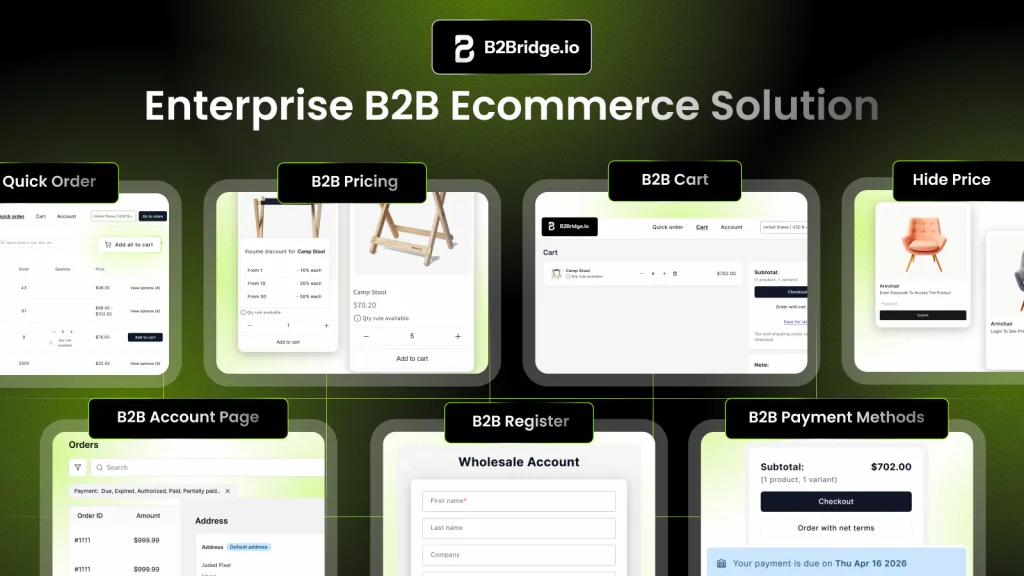
B2Bridge is built for manufacturers, distributors, and large wholesalers who want more than a pricing app—they want a technical partner. The platform embeds enterprise-grade B2B operations directly into Shopify without requiring Plus or a separate wholesale site.
Key features
- Advanced B2B pricing engine: Role-based pricing, contract price lists, per-customer pricing, volume rules, case packs, multi-currency, and tax-exempt logic
- Deep ERP/CRM integration: Native connectors for NetSuite, Zoho, Odoo, plus an enterprise API for custom systems
- B2B UX for conversion: Quick order pages, dedicated B2B cart with net terms, RFQ workflows, and quote-to-order conversion
- Unified B2B+B2C: Single Shopify storefront serving both channels
Why B2Bridge matters for wholesale sellers
Unlike template-based apps, B2Bridge works with your team from day one to design a B2B setup tailored to your pricing models, ERP workflows, and growth stage. The platform replaces fragmented app stacks with a single solution that scales alongside your operation.
SparkLayer for mid-market B2B sales channels
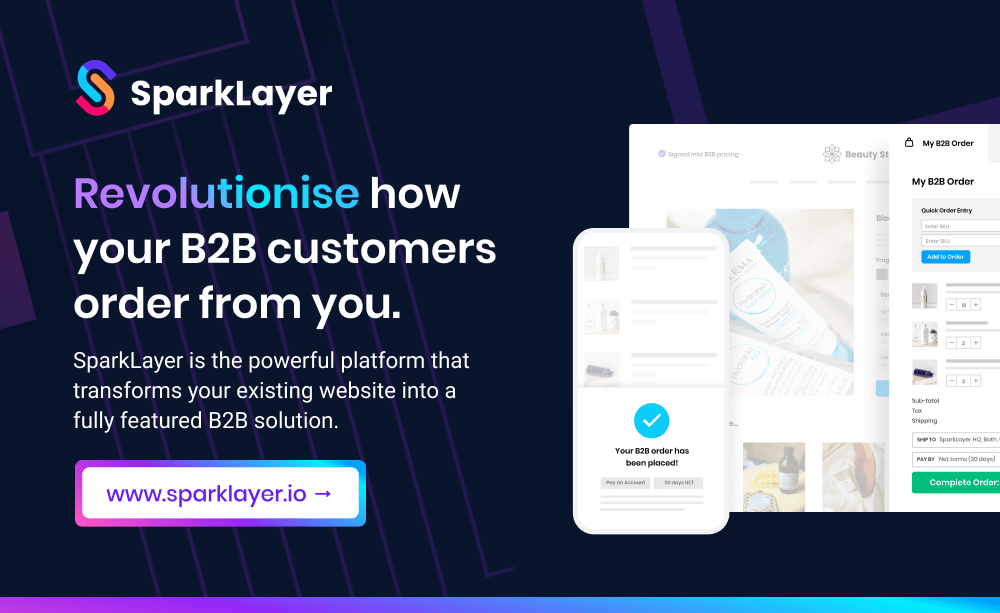
SparkLayer takes a widget-based approach, overlaying B2B functionality onto your existing Shopify product pages and checkout. Merchants on Reddit frequently recommend it for dedicated B2B ordering without rebuilding the storefront.
Key features
- Advanced price lists: Multiple pricing tiers with customer-specific assignments
- Sales rep assignments: Link customers to sales reps for commission tracking
- B2B checkout flows: Modified checkout experience for wholesale buyers
- Starting price: $49/month
Why SparkLayer matters for wholesale sellers
If you want to modify how existing product pages behave for wholesale clients—rather than building a separate portal—SparkLayer offers a middle ground between basic pricing apps and full enterprise solutions.
Wholesale Gorilla for B2B customer experience
Wholesale Gorilla consistently ranks as a top all-rounder for merchants on standard Shopify plans. The app integrates wholesale operations without the complexity or cost of Plus.
Key features
- Custom B2B portals: Dedicated wholesale storefront experience
- Volume pricing: Quantity-based discounts with flexible rules
- MOQ controls: Minimum order quantities enforced at checkout
- Starting price: $29.95/month
Why Wholesale Gorilla matters for wholesale sellers
For merchants new to B2B or with straightforward wholesale requirements, Wholesale Gorilla covers core functionality with minimal setup friction.

Wholesale Club for tiered discounts and custom pricing
Wholesale Club (also known as B2B Wholesale HubWholesale Club (also known as B2B Wholesale Hub) simplifies B2B pricing through customer tagging. It’s one of the most-installed wholesale apps on Shopify.
- Customer tagging: Assign wholesale pricing by tag with automatic discount application
- Tiered discounts: Volume-based pricing that scales with order quantity
- Product locking: Hide wholesale-only products from retail visitors
- Starting price: $29/month

Wholesale Pricing Discount B2B for a modular stack
Wholesale Pricing Discount B2B by Wholesale Helper serves merchants who want flexible pricing rules at a lower price point. The $24.99/month entry plan covers customer price lists, tiered pricing, and net terms.
- Flexible pricing rules: Percentage, fixed, and variant-level discounts
- Shopify POS support: In-person wholesale pricing for trade shows or showrooms
Consideration: Hiding prices from retail visitors requires a separate Wholesale Lock Manager subscription.

Massy B2B Wholesale Pricing for free entry-level B2B
Massy launched in January 2025 and remains completely free. It covers customer group pricing, volume discounts, MOQ controls, and a B2B registration form with approval workflow.
Best for: Merchants testing wholesale without budget commitment.
Limitations: No RFQ, no ERP sync, no API. Designed for simple SMB setups rather than mid-market complexity.

Shopify B2B for Shopify Plus merchants
If you’re already on Shopify Plus, native B2B features eliminate the need for third-party apps for core functionality.
- Built-in price lists: Custom pricing by company
- Company profiles: Manage multiple buyers under one account
- Vaulted credit cards: Stored payment methods for repeat orders
- Net 15-60 terms: Configurable payment terms
Native integration means no metafield conflicts with other apps. The trade-off is the Plus subscription cost.
How wholesale apps integrate with ERP and CRM systems
Integration depth varies significantly across apps. Some offer native connectors for popular systems like NetSuite or Zoho; others rely on API access for custom development.NetSuite or Zoho; others rely on API access for custom development.
Common data that syncs between your wholesale app and ERP/CRM:
- Pricing: Price lists and customer-specific rates
- Customers: Account information, tags, and credit terms
- Orders: Order history, status updates, and fulfillment data
- Inventory: Stock levels and availability
Many third-party apps rely on hidden metafields, which can occasionally conflict with other apps. Testing integration thoroughly before launch prevents surprises.
How to choose the right wholesale app for your Shopify store
Step 1: Map your B2B pricing and customer rules
Start by listing your pricing models—tiered, contract, per-customer, or some combination. Identify your customer groups and how they differ. This determines which pricing engine complexity you actually require.
Step 2: Audit your ERP and CRM data flows
Which systems currently hold your pricing, customer, and order data? Check whether apps offer native connectors or API access for your specific ERP before committing.API access for your specific ERP before committing.
Step 3: Define your B2B buying experience requirements
Do you want quick order forms? RFQ workflows? Net terms with credit limits? Company accounts with multiple buyers and approval workflows? Not every app covers every feature.
Step 4: Compare app plans against your growth stage
Match app tiers to your current order volume and projected growth. Paying for enterprise features you won’t use for two years rarely makes sense.
Step 5: Validate implementation and support models
For complex B2B operations, implementation support matters as much as features. Check onboarding assistance, documentation quality, and ongoing support availability.
Frequently asked questions about Shopify wholesale apps
Can you run B2B and B2C on the same Shopify store with a wholesale app?
Yes. Most wholesale apps let you run a unified storefrontYes. Most wholesale apps let you run a unified storefront by showing different pricing to tagged wholesale customers while keeping standard pricing for retail shoppers.
Do Shopify wholesale apps work without Shopify Plus?
Most apps in this guide work on standard Shopify plans. Only Shopify’s native B2B features require Plus.
Which Shopify wholesale apps support net 30 and net 60 payment terms?
B2Bridge, SparkLayer, Wholesale Club, and Shopify Plus native B2B all support configurable net payment terms with credit limits.
How do Shopify wholesale apps handle multi-currency pricing for international B2B buyers?
Most enterprise-tier apps support multi-currency pricing that syncs with Shopify Markets, letting you set region-specific wholesale prices.
How long does it typically take to launch a wholesale channel using a Shopify app?
Simple setups can launch in days. Complex implementations with ERP integration and custom pricing rules may take several weeks depending on your requirements and chosen app’s support model.
Scaling wholesale revenue on Shopify with B2Bridge
Running sophisticated wholesale operations on Shopify doesn’t require Plus or a separate platform. B2Bridge embeds enterprise B2B capabilities—advanced pricing, ERP integration, quote-to-order workflows—directly into your existing Shopify store.
The platform replaces fragmented app stacks with a unified solution designed around how manufacturers, distributors, and wholesalers actually operate. Unlike template-based tools, B2Bridge includes implementation support and ongoing technical partnership to ensure your B2B setup scales with your business.
Book A Demo to see how B2Bridge can power your wholesale channel on Shopify.

Hi, I’m Ha My Phan – an ever-curious digital marketer crafting growth strategies for Shopify apps since 2018. I blend language, logic, and user insight to make things convert. Strategy is my second nature. Learning is my habit. And building things that actually work for people? That’s my favorite kind of win.