Bundle pricing is a strategy where businesses group multiple products together and sell them at a single price—typically lower than the sum of buying each item separately. It’s one of the most effective ways to increase average order value while giving customers the perception of a better deal.
This guide covers the main types of bundle pricing, how to calculate bundle prices, common mistakes to avoid, and how B2B sellers can implement bundles across different customer groups.
What is bundle pricing
Bundle pricing is a strategy where companies group multiple products or services together and sell them at a single, discounted price—lower than the total cost of buying each item separately. The approach increases sales volume, enhances how customers perceive value, and raises average order value.
You’ve probably seen bundle pricing without thinking about it. A camera sold with a bag, tripod, and memory card for one price. A fast food meal with burger, fries, and drink. A software suite that includes email, storage, and analytics at one monthly rate. Each of these packages items together at a combined price that feels like a better deal than buying everything individually.
For sellers, bundles move more inventory per transaction. For buyers, bundles simplify decisions and deliver savings. That’s the core trade-off that makes bundle pricing work.

How bundle pricing works
The mechanics are straightforward. First, select products that naturally go together. Then, combine them into a single offer. Finally, set a price below the sum of individual prices.
The discount creates perceived value, which motivates buyers to purchase the bundle instead of individual items—or nothing at all. The key is choosing products that make sense together. Random combinations don’t work because customers won’t see the value.
Bundles tend to perform best in a few specific situations:
- Complementary products: Items that naturally pair together, like shampoo and conditioner or a phone case and screen protector
- New product launches: Bundling new items with popular products increases exposure without requiring separate marketing spend
- Excess inventory: Pairing slow-moving stock with high-demand items clears shelves without steep standalone discounts
Types of bundle pricing strategies
Not all bundles are structured the same way. The approach you choose depends on your products, customers, and operational goals.
Pure bundling
Pure bundling means products are only available as a bundle—customers cannot purchase items separately. Cable TV packages are a classic example: you buy the package or nothing at all.
This approach works when the bundled items have limited standalone appeal or when you want to simplify your catalog. The tradeoff is that some customers will walk away if they only want one item in the bundle.
Mixed bundling
Mixed bundling offers products both as a discounted bundle and individually at full price. Software suites often use this model—you can buy the full suite at a discount or purchase individual apps separately.
Mixed bundling gives customers flexibility. Someone who only wants one product can still buy it, while someone who wants everything gets a deal. According to a Harvard Business School study, this flexibility typically increases overall revenue compared to pure bundling.
Joint bundling
Joint bundling combines two or more products at a single combined price, with no option to buy separately. Fast food value meals are the textbook example: burger, fries, and drink for one price.
The key difference from pure bundling is that joint bundles are often promotional or limited-time offers rather than permanent catalog structures.
Leader bundling
Leader bundling pairs a popular “leader” product with less popular items to drive sales of the latter. A best-selling printer bundled with ink cartridges is a common example.
The leader product draws attention and creates the initial interest. The bundled items ride along and move inventory that might otherwise sit on shelves.
Bundle pricing examples
Seeing bundles in action makes the strategy concrete.
Discount bundles
A straightforward percentage or dollar discount when purchasing grouped items together. “Buy 3 items, save 15%” is a simple discount bundle that encourages larger orders without requiring specific product combinations.
Accessory bundles
Bundling a primary product with complementary accessories. A camera sold with a bag, tripod, and memory card for one price is a classic accessory bundle—common in electronics and outdoor gear.
Product family bundles
Bundling related products from the same category. A skincare set with cleanser, toner, and moisturizer lets customers try a full routine at a lower entry price than buying each product individually.
Custom B2B bundles
B2B sellers often create tailored bundles for wholesale customers based on their specific needs or order history. A lighting distributor might bundle fixtures with bulbs and mounting hardware, with different bundle prices for different customer groups based on their price list or contract terms.
Who uses bundle pricing
Bundle pricing works across industries and business models, though the execution varies depending on who’s buying and what’s being sold.
Manufacturers and distributors
Manufacturers bundle complementary products or kits for resellers. Industrial suppliers, consumer goods companies, and electronics manufacturers commonly use bundles to simplify ordering and increase average order value.
Wholesalers
Wholesalers use bundles to encourage larger orders, often with wholesale pricing structures tailored by customer group or case pack requirements.
Retail and ecommerce brands
D2C and retail brands use bundles for promotions, holiday sets, and cross-selling. Gift sets, starter kits, and “complete the look” bundles are standard tactics during peak seasons.
Subscription and SaaS companies
Software companies bundle features or services into tiers. A cloud provider offering email, storage, and analytics at one monthly rate is using bundle pricing—even if they don’t call it that.

Benefits of bundle pricing
Bundles offer advantages beyond simple discounting:
- Increased sales volume: Customers purchase more items per transaction—in one case, 4× the average cart size—even if individual margins are slightly lower
- Higher perceived value: Buyers feel they’re getting a deal, which can boost conversions by 15–25%
- Efficient inventory management: Move slow-moving stock alongside popular items without steep standalone markdowns
- Improved average order value: Larger transactions without proportionally higher customer acquisition costs
- Simplified buying experience: One decision instead of multiple purchases reduces friction
Disadvantages of bundle pricing
Bundles aren’t without tradeoffs:
- Margin erosion: Discounting can reduce profit per unit if not calculated carefully
- Unwanted items: Customers may not want every product in the bundle, which can create friction or returns
- Pricing complexity: Managing bundle prices across customer segments adds operational work, especially in B2B
- Cannibalization risk: Bundles may reduce sales of individual items that would have sold at full price
How to determine bundle pricing
Setting the right bundle price requires balancing customer value with margin protection.
1. Identify the products to bundle
Select items that complement each other or are frequently purchased together. Avoid bundling unrelated products—customers won’t see value if the items don’t logically connect.
2. Calculate combined cost and margin
Add up the cost of goods for each item in the bundle. Then determine your target profit margin for the bundle as a whole, not for each individual item.
3. Set the bundle discount
Choose a discount that provides clear value to the customer while protecting margin. A 10–20% discount off the combined individual prices is common, though this varies by industry and competitive positioning.
4. Test and adjust the bundle price
Launch the bundle and monitor performance—conversion rate, margin, inventory movement. Refine pricing based on results. Bundles that don’t move may need a deeper discount or different product combinations.
Common bundle pricing mistakes to avoid
Even well-intentioned bundles can backfire. Here are the pitfalls to watch for:
- Bundling unrelated products: Customers won’t see value if items don’t go together logically
- Discounting too heavily: Erodes margin and trains customers to wait for deals
- Ignoring customer segmentation: Different customer groups often respond to different bundles or prices—a one-size-fits-all approach frequently underperforms
- Overcomplicating the offer: Too many bundle options create decision fatigue and reduce conversion
- Not tracking bundle performance: Without measurement, you can’t optimize or catch margin leakage
How to implement bundle pricing in B2B ecommerce
B2B bundle pricing adds complexity because different customers often see different prices. Here’s how to approach it.
1. Define customer groups and price lists
Set up customer groups—by region, volume tier, or contract—and assign specific bundle pricing to each group. A distributor might see a 25% bundle discount while a smaller retailer sees 15%.
2. Configure volume rules and case packs
Apply minimum order quantities, case pack increments, or volume discounts to bundles. Wholesale operations commonly require bundles to be ordered in specific quantity increments to maintain fulfillment efficiency.
3. Sync bundles with your ERP
Ensure bundle pricing, inventory, and customer data stay aligned through Shopify B2B integration with your ERP or CRM. Manual updates across disconnected systems lead to pricing errors and fulfillment issues.
4. Launch and monitor bundle performance
Go live, track metrics like conversion, AOV, and margin, and adjust bundles based on data. B2B bundles often need refinement as you learn which combinations resonate with different customer segments.

Try a wholesale pricing app for smarter bundle pricing
If you’re running B2B operations on Shopify, managing bundle pricing across customer groups, volume tiers, and ERP systems can get complicated fast.
B2Bridge brings enterprise-grade B2B pricing to Shopify:
- Customer-group pricing: Assign different bundle prices to different buyer segments
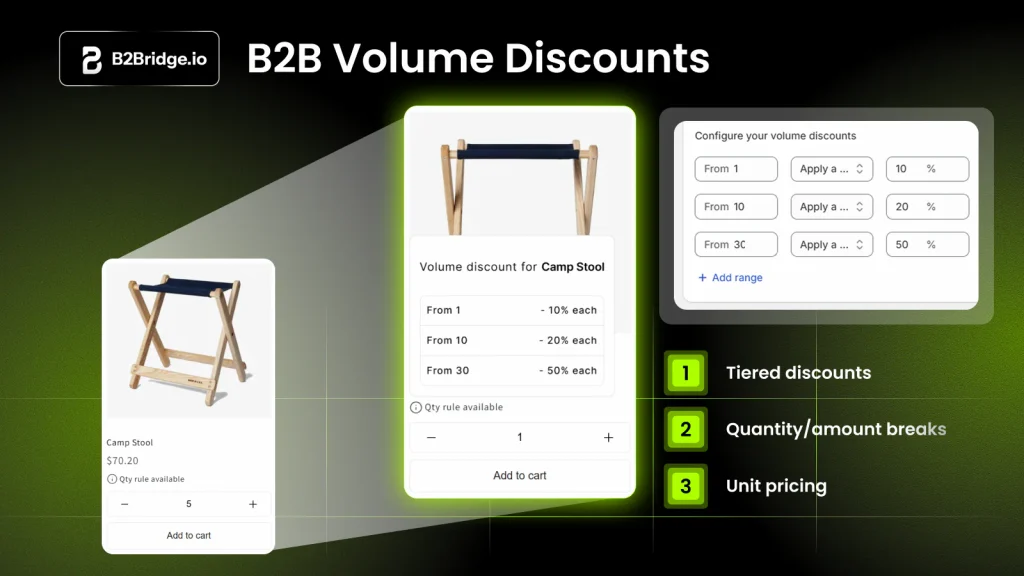
- Volume discounts and MOQs: Configure quantity-based pricing and minimum order requirements
- ERP integration: Sync pricing, customers, and orders with NetSuite, Zoho, Odoo, or custom systems
- Hidden pricing: Keep wholesale bundle prices invisible to retail shoppers
The result is fewer pricing errors, faster order processing, and a wholesale experience your buyers actually prefer.
Contact us to get expert guidance and practical solutions for your wholesale store.
FAQs about bundle pricing
Is bundle pricing illegal?
No, bundle pricing is legal. However, “tying”—forcing customers to buy an unwanted product to get a desired one—can violate antitrust laws in some jurisdictions if it restricts competition.
What is the difference between bundle pricing and volume discounts?
Bundle pricing groups different products together at a combined price. Volume discounts reduce the price per unit when buying larger quantities of the same product.
Can B2B sellers offer different bundle prices to different customer groups?
Yes. B2B sellers commonly assign different bundle prices to different customer groups based on contracts, volume tiers, or relationship status using price lists.
Does Shopify support bundle pricing without an app?
Shopify’s native features offer limited bundle support. For advanced bundle pricing with customer-specific pricing, volume rules, and ERP sync, merchants typically use a wholesale app for Shopify.

Hi, I’m Ha My Phan – an ever-curious digital marketer crafting growth strategies for Shopify apps since 2018. I blend language, logic, and user insight to make things convert. Strategy is my second nature. Learning is my habit. And building things that actually work for people? That’s my favorite kind of win.